Grades are presented as true measures of ability but are actually engineered lies to rank students; the essay urges adults to reclaim their learning by believing in themselves rather than the system’s labels.
#2166 published 01:15:17 audio duration2,851 wordsgradesschoolteachersstudentslearningself-empowermentreflection
I began by extending JavaScript with a MapSet that combined Maps (key–value pairs) and Sets (unique values) to implement a lightweight EventEmitter—each event name maps to a set of listener functions that can be added or removed, while a Signal object holds a single value and notifies subscribers whenever it changes. I then built a TripleStore that stores facts like “Socrates isA Man” and, with an event‑driven RuleEngine (adding transitive rules such as if x isA y and y isA z then x isA z, plus “Man isA Mortal”), automatically updates Signals so that querying “Is Sokrates mortal?” now emits a value. With this reactive foundation I created progressive tests: a signup form, an AI‑powered prompt, and finally a text‑adventure game modeled after Zork—using a node server, the TripleStore to generate world data, and Stable Diffusion to produce room images in styles like Painterly or Botero. I then explored VR with Meta’s IWSDK, letting the AI build a textured skybox, 8K upscaling, movable objects, and a simple platform while I interacted via gestures. On Monday morning I reflected that the game logic is essentially the same 2D text adventure code, but I can now generate 3‑D models quickly with Stable Diffusion and render them in Painted, Neon or Cartoon worlds; the remaining work is to
#2165 published 10:37 audio duration916 words1 linkjavascriptmapseteventssignaltriplesrdfruleenginetransitiveclosurereactiveprogrammingtextadventuregamestablediffusionvriwsdk
Walking, listening to thoughtful audiobooks, and asking if your life matches your own desires are the simple steps that unlock true self‑discovery, not productivity hacks.
#2164 published 23:44 audio duration1,668 wordsself-helpaudiobookwalkingreadingthoreauphilosophymindfulnesspersonal-developmentbooks
In this reflective essay the narrator chronicles a young traveler’s bus‑bound journey to Alaska, using it as a lens through which he examines the failures of modern life—bus rides, “forty‑year” California dreams, schools that only fill bubbles, and a culture that sells itself in commercials and songs. He paints the protagonist as a child who leaves behind the manufactured suits of success, armed with nothing but a bag
#2163 published 13:59 audio duration1,303 wordspoetrybusjourneytravelyouthnaturestory
Sophia reaches Chief Mountain to finish the Triple Crown of American hiking, weeps at its triumph, and discovers her integrated self through the authentic, wisdom‑bearing journey she has walked for seven thousand miles.
#2162 published 54:56 audio duration5,227 words2 linkshikingtrailtriplecrownnaturephilosophypersonalgrowthstory
The post reflects on the passage of time through the changing seasons, noting how spring is just weeks away while winter has shifted its feel. It muses on the Groundhog’s prediction as a playful reminder that even simple rituals can hint at future weather, and it celebrates the anticipation of early birdsong and the return of warm air. The writer encourages repeated adventures—hiking the Appalachian Trail or any favorite trail each year—and stresses that regular visits keep one youthful and fit. In sum, the piece is a poetic ode to seasonal rhythm, travel, and the joy of revisiting familiar paths.
#2160 published 02:31 audio duration262 wordspoetryseasonshikingtravelnaturegroundhog
The post celebrates how modern AI—especially fast‑running models like GLM—has become an accessible “thinking machine” that can teach anyone to program for the web, generate complete applications, test flows, and self‑correct until they’re perfect. By asking the AI to build a language based on ffmpeg filtergraphs or to produce a node.js test harness, you let it create its own architecture and refine it automatically. The writer frames this as a way out of poverty: with AI’s help anyone can write VR schools, pixel art games, or choose‑your‑own‑adventure books without needing a master’s degree in code. It also recalls how past generations were “played” by politicians, but that legacy is no longer needed—just learn web programming and let the AI guide you to create your own infinite programs.
#2159 published 04:59 audio duration446 words1 linkaiwebdevprogrammingvrgamespixelart
The author introduces **lulz**, a tiny visual‑programming language built on an ffmpeg filter‑graph that uses plain English‑named, single‑purpose functions so that AI can easily parse and generate code. By converting the complex state‑manager *flarp* into just 15 lines of lulz, they show that an AI can understand the program’s structure without higher‑order constructs like map or reduce. The post argues that this lower‑level, black‑box approach lets machines reason about real applications, and invites others to experiment with lulz for AI‑assisted programming.
She recounts a personal ascent through mountains and trials that teaches her that greatness comes from persistent effort, pain as information, shedding distractions, and turning longing into action—culminating at the summit where she vows to rise and inspire others on their own path.
#2157 published 37:16 audio duration2,931 wordspoetryshort storytrailmountainnaturenarrative
The post describes a developer’s experiment with artificial intelligence to build an XML‑based state management system for Web Components. Using multiple AI “agents” that iterate through several rewrites, the author was able to create a fully functional State Toolkit in only a few hours—something that would normally take years of manual coding. The AI quickly learns from its mistakes and can generate clean, efficient code that passes most tests; it even handles garbage collection and persistence across multiple users. The author concludes that while AI is not human‑like but can outperform humans in rapid, creative programming, the system he built (“flarp”) demonstrates real innovation in dynamic web pages, proving that large language models can be harnessed to accelerate software development.
#2156 published 09:43 audio duration833 words3 linksaiprogrammingxmlwebcomponentsstate-managementagent-based-developmentautomationcode-generationiterative-rewritesperformance-testingmemory-leaksgarbage-collectionrole-playingdynamic-web-pages
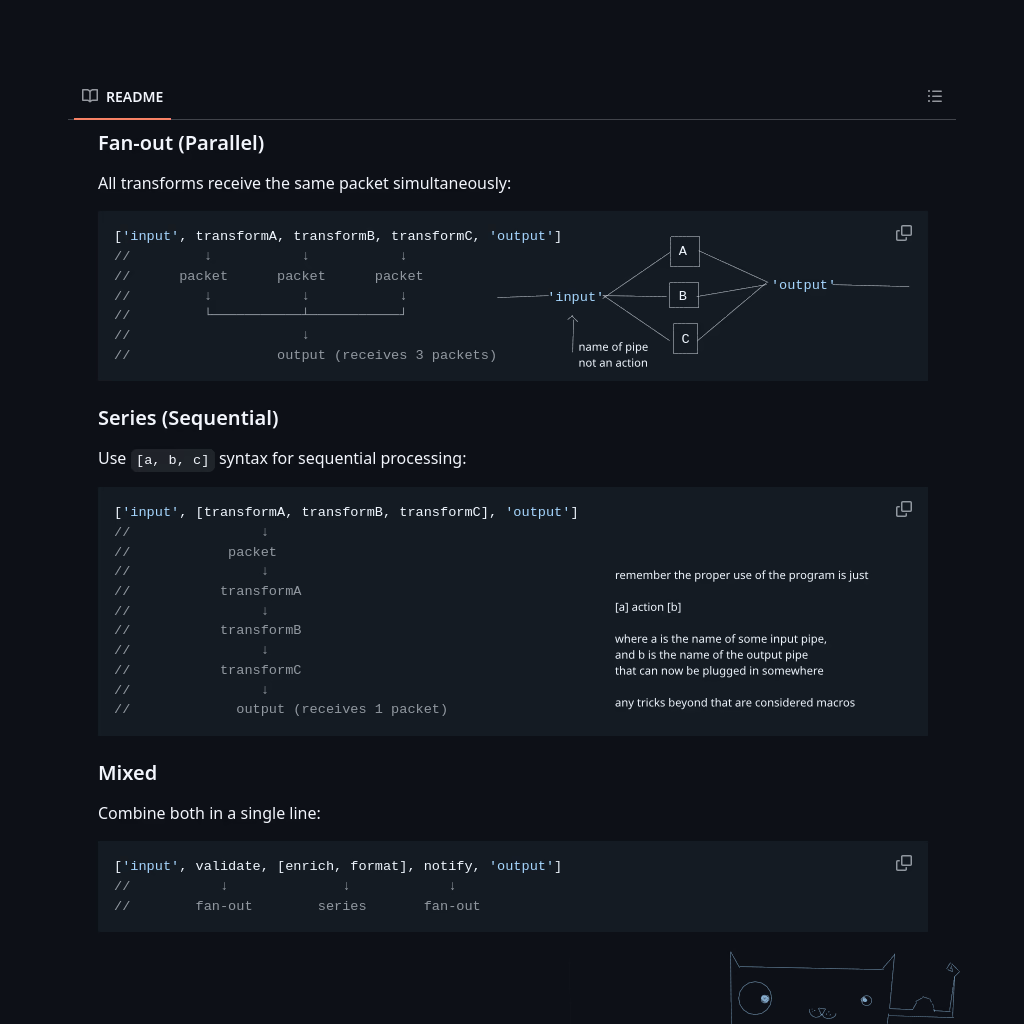
The author introduces “lulz,” a lightweight programming language inspired by ffmpeg’s filtergraph yet expressed through JavaScript‑style array syntax, where data flows are explicitly marked with the strings “in” and “out.” After refining the design with AI assistance, they added parallel/series helpers, worker integration, and extensive documentation to simplify execution flow. The post also frames lulz as a textual form of visual programming: functions are wrapped in two identifiers (e.g., ‘user‑signup’, saveUserToDatabase, ‘user‑added’) that act as named input/output pipes, making parallel logic readable and AI‑friendly while still retaining the simplicity of script‑based code.
#2155 published 09:03 audio duration509 words5 linkslulzjavascriptnodejsffmpegparallel-processingworkersvisual-programmingarray-notationgithub
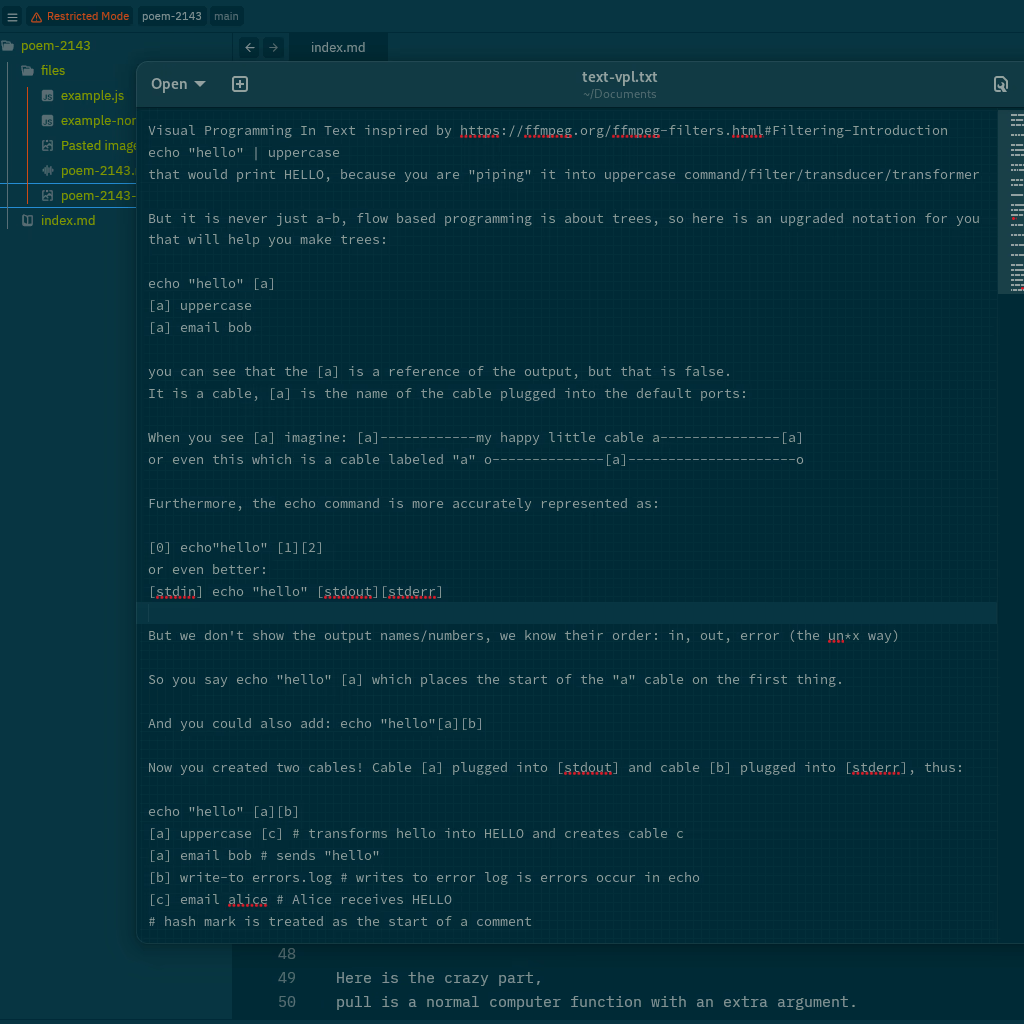
In this post the author argues that programming remains the key to escaping poverty, especially in an era where AI amplifies the power and reach of software—no longer needing warehouses or large teams, but instead enabling local AI to perform tasks such as converting images into 3‑D models for VR worlds. He reflects on his own journey from a novice programmer with no milestones to now presenting a flow‑based system called “lulz,” a text‑based visual language that uses ffmpeg‑style filtergraphs in JavaScript array notation and borrows ideas from Node‑RED. The post highlights how AI can finish programs quickly, yet also shows the challenges of visual programming—grouping nodes, nesting, and managing cables—which are hard mentally but fit well with AI’s grunt work. By describing a text‑visual approach where cable connections are explicit in code, he envisions an AI that listens to these flows, samples data at each link, and thus creates modular programs automatically—an early glimpse of the revolution he expects for AI coding.
#2154 published 12:11 audio duration830 words1 linkprogrammingaivisual programmingflow based programmingffmpegnode-redjavascriptgithublulz
The poem argues that our schooling system trains us to obey rather than to think, so from childhood we learn to follow instructions without understanding them, become “servants” who serve those in power, and later work as assistants, soldiers or corporate workers who carry out orders while never questioning why. In this cycle of rote learning, the writer claims that “poverty” is not only a lack of money but a lack of agency created by an education that teaches us to wait for rescue instead of solving problems ourselves. The poet calls for a new kind of learning—one that involves curiosity, questioning, and unlearning obedience—to break this cycle, so that individuals can rise as awake citizens who no longer produce servants, feed wars or mistake misery for maturity, but become agents capable of making real changes in their own lives and in society.
#2153 published 14:15 audio duration908 wordspoetryeducationschoollearningworkforcemilitaryuniformlifereflectionpersonal-growth
The post is a lyrical tour through twelve philosophers, each section capturing their core insight in brief, evocative prose. Locke frames knowledge as self‑assembled from sensory experience; Hume introduces the habit of association and humility before certainty; Rousseau reveals society’s shaping of self, yet its underlying freedom; Kant shows the mind actively structuring reality and moral law; Hegel presents history as a dialectical unfolding where contradictions resolve into higher unity; Kierkegaard stresses personal choice amid existential loneliness; Nietzsche declares God dead but urges life‑affirming self‑creation; Schopenhauer finds stillness in art, music, and compassion; Wittgenstein treats language as a game of rules that shape our world; Russell champions logic and clear thought for truth; Heidegger asks what it means to be, calling for authentic existence; Sartre asserts freedom is the only essence we craft. Together they form a poetic snapshot of modern philosophy’s journey from perception to being.
#2152 published 09:58 audio duration828 wordspoemphilosophylockehumerousseaukanthegelkierkegaardnietzscheschopenhauerwittgensteinrussellheideggersartre
A lyrical tribute to the anonymous soldiers whose names were lost in war, woven with the author’s own journey from humble beginnings through philosophical study and disciplined craft, illustrating how true greatness is forged by personal resolve rather than conflict.
#2151 published 22:04 audio duration1,911 wordspoetryessaynarrativewarsoldierpersonalphilosophystory
This essay exhorts the reader to master self‑command—temper, lust, tongue, and fear—and to live with deliberate intention, as if each moment were witnessed by history. It insists that dignity is restraint, not pride, and that true honor is quiet, earned through consistent action rather than proclamation. The author stresses the importance of tradition, language, law, and art as inherited gifts whose neglect leads to rot, while discipline sharpens character and pursuit of greatness ennobles life. Finally, he reminds us that civilizations collapse when their people grow weak; therefore one must govern oneself, honor responsibility, and stand for knowledge and future before self‑glorification.
#2150 published 08:02 audio duration552 wordsessaymotivationalselfimprovementphilosophyculturehistory
A poetically self‑affirming narrator declares himself a knight of ambition, marching through time and work as if they were battlements and ink, and he claims that his labor is not ordinary but heroic; he proclaims his own crown of silver sun, vows to conquer horizons, sees the world as his stage, lifts himself above the dust of routine, and believes each individual can climb their own mountain, thereby bringing back light into the sky and making the world a home for all.
#2149 published 05:30 audio duration559 wordspoetryversesknightmedievalself-empowerment
The post argues that short, heavy “choking” sets and isolated muscle work are ineffective for building real strength; instead, it recommends longer, steady‑state sessions that involve the whole body, using moderate weights lifted continuously over an hour, and gradually increasing load as adaptation occurs. It encourages incorporating movement like dancing or walking with light dumbbells (or biking and hiking) to build endurance and muscle mass before moving on to heavier lifts, emphasizing rhythm and music to keep the workout fluid and sustained rather than brief, isolated bursts.
#2148 published 07:50 audio duration830 wordsfitnessworkoutbodybuildingweightliftingcardiofull-bodysets-and-repstempo-musicdance-exercisewalkingjoggingcyclinghiking
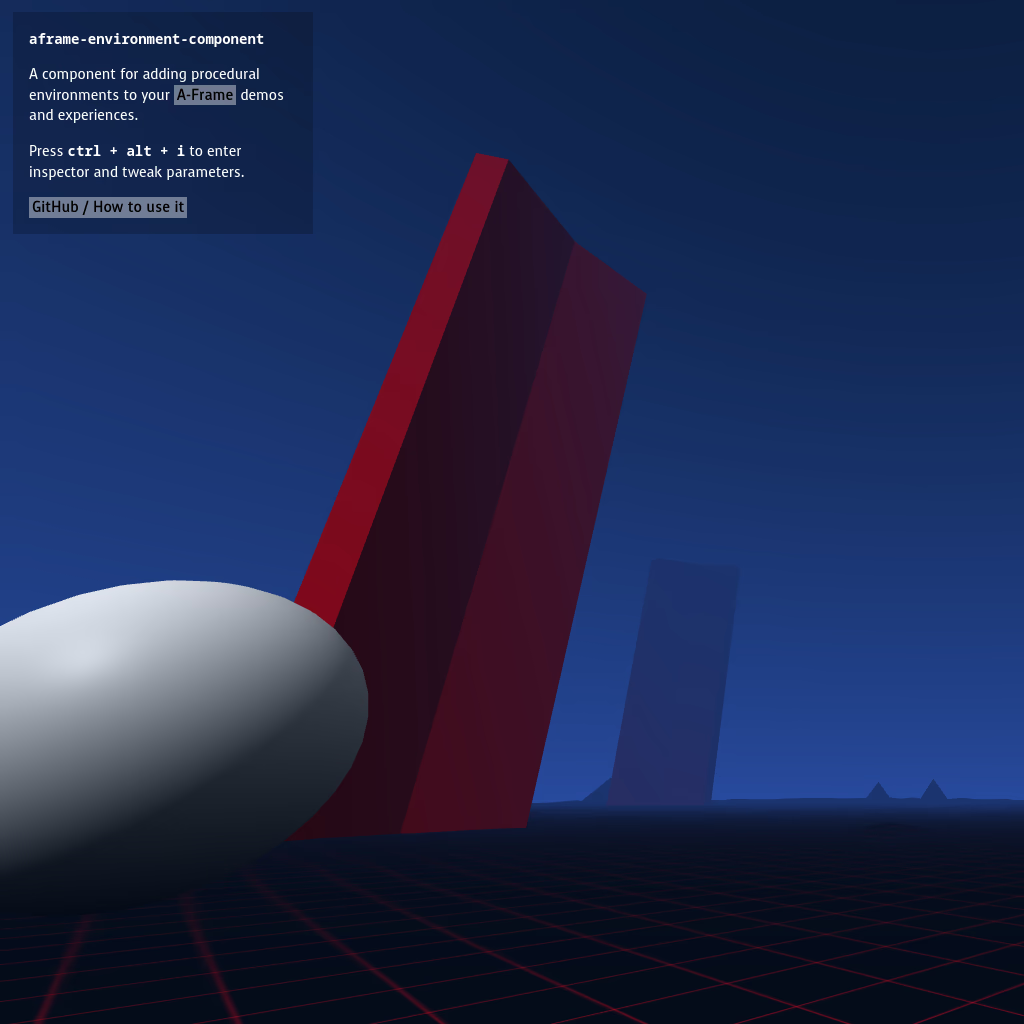
The post shows that anyone can build simple VR worlds with just HTML, CSS, and JavaScript (via A‑Frame), offering example code, step‑by‑step instructions, and resources to get started.
#2147 published 23:45 audio duration3,465 words12 linkshtmlcssjavascriptaframethree.jswebvrwebxrtutorial
The author outlines a dumbbell routine that begins with slow, back‑and‑forth repetitions using light but challenging weights—“heavy” is defined as what you can lift for an extended period—and stresses the importance of gradual progression: start above three pounds if your experience demands it, then add wrist weights and jog for an hour to warm up. The workout cycles through exercises for 45–60 minutes with brief rests between sets, before moving to “level two” by increasing the dumbbells in small increments (about 2½ lb) once you can handle the current weight; if the gym lacks certain sizes, wrist weights can serve as a substitute. The author also shares a personal anecdote of a bodybuilder woman approaching him at the gym, illustrating real‑world practice and confidence.
#2146 published 06:09 audio duration606 wordsdumbbellsexerciseworkoutgymbodybuildingendurancewrist-weightsinterval-timerscycling
The post notes that many gym‑goers copy the look of movie bodybuilders but never see real results because they lift too heavy, isolate muscles, and “cut circulation” with short bursts rather than continuous work. The writer argues that bodybuilding is simply a light aerobic routine—think dancing or jogging—with small weights that steadily increase as the body adapts; this keeps joints loose, avoids aches, and builds muscle without over‑exertion. In other words, a light, rhythmic dumbbell “dance” works all the major groups, extends youth, and gives you that effortless look of a wrestler or superhero.
#2145 published 06:21 audio duration587 wordsbodybuildinggymexerciseworkout strategydumbbells
Learning programming can be a joyful journey fueled by artificial intelligence, and the post outlines a practical setup with Node.js, Zed Code Editor, and a local AI assistant powered by llama.cpp or Ollama to generate JavaScript code on demand. It encourages experimenting across a spectrum of projects—from simple CLI “hello world” scripts that teach argument parsing and state machines, to web servers using pastebin/WikiWiki style pages for data exchange; MUDs with friendly AI characters; coding agents that dispatch JavaScript objects as tools; Electron‑based editors; CodeMirror components; procedurally generated 3D worlds; pixel‑art screensavers or games driven by flocking state machines; to even crafting 3D models from AI‑generated art for printing or metal casting—each project illustrating how AI can scaffold code, data flow, and user interfaces while letting developers focus on creative ideas.
In this post the author explains how to build an efficient AI‑service using a simple push/pull pipeline that can be coded in roughly fifteen lines. The idea is that clients “push” requests into a log‑file queue; the system then “pulls” them one by one, waiting for each AI call to finish before sending the next request. By treating the send function as a lightweight dispatcher and the pull loop as an asynchronous consumer, the architecture naturally scales across multiple CPU cores and keeps latency low while keeping the code simple and maintainable.
#2143 published 08:57 audio duration514 words1 linkjavascriptasync-awaitqueuepipelinepush-pullflow-based-programming