


The & (binary bitwise AND) operator is not quite appropriate here. The and (boolean AND) operator would be more appropriate. Even though the results appear identical, the execution isn't —differs: the logical and allows short-circuit evaluation.
200_success
- 145.7k
- 22
- 191
- 481
deleted 4 characters in body; added 1 character in body; added 169 characters in body
200_success
- 145.7k
- 22
- 191
- 481
Concept
Obligatory XKCD comic, before I begin:
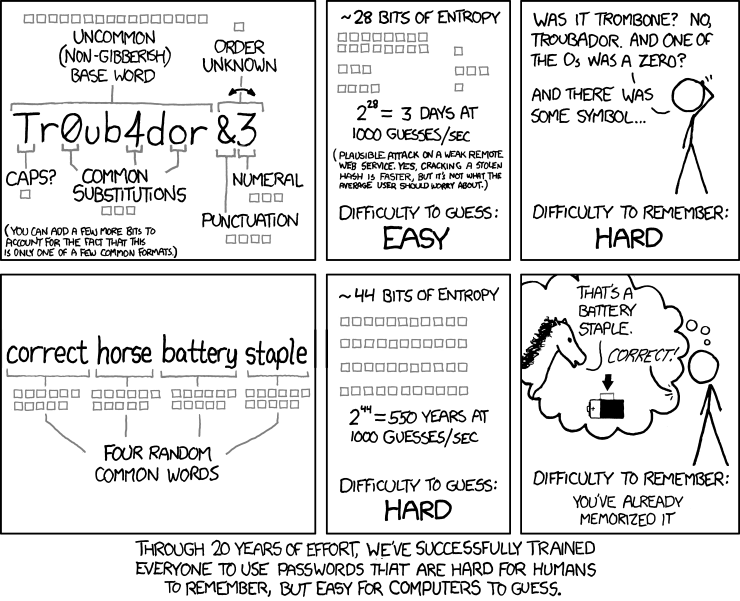
Enforcing password strength by requiring human-unfriendly characters is no longer considered good practice. Nevertheless, I'll review the code as you have written it.
"Obvious" simplifications
Any code with the pattern
if bool_expr: return True; else: return Falseshould be written simply asreturn bool_expr.Strings are directly iterable; there is no need to convert them into a list first, using
.split(). In other words, the code would work the same if you just wrote:upper_list = "ABCDEFGHIJKLMNOPQRSTUVWXYZ"Better yet, you could just use
string.ascii_uppercase.The
uppers += 1counting loop could be written more expressively using thesum()built-in function. Actually, in this case, since you only care whetheruppers > 0, you could just use theany()function.
With those changes, your check_upper() function becomes a one-liner:
def contains_upper(s): return any(c in ascii_uppercase for c in s) I've renamed check_upper() to contains_upper() to make it clear that the function returns True or False. Also, avoid using variable names, like input, that coincide with names of built-in functions: it could cause trouble if you ever want to use input().
Code duplication
Most of your check_something() functions are identical. You should generalize, instead of duplicating the code.
from string import ascii_uppercase, ascii_lowercase, digits def contains(required_chars, s): return any(c in required_chars for c in s) def contains_upper(s): return contains(ascii_uppercase, s) def contains_lower(s): return contains(ascii_lowercase, s) def contains_digit(s): return contains(digits, s) def contains_special(s): return contains(r"""!@$%^&*()_-+={}[]|\,.></?~`"':;""", s) def long_enough(s): return len(s) >= 8 Note that I've used a raw long string to help deal with the need for backslashes in the punctuation string.
validate_password()
The check_dict isn't doing anything for you. You'd be no worse off with five boolean variables.
The & (binary bitwise AND) operator is not quite appropriate here. The and (boolean AND) operator would be more appropriate.
Personally, I'd write it this way, gathering up a list of all of the failure messages:
def validate_password(password): VALIDATIONS = ( (contains_upper, 'Password needs at least one upper-case character.'), (contains_lower, 'Password needs at least one lower-case character.'), (contains_digit, 'Password needs at least one number.'), (contains_special, 'Password needs at least one special character.'), (long_enough, 'Password needs to be at least 8 characters in length.'), ) failures = [ msg for validator, msg in VALIDATIONS if not validator(password) ] if not failures: return True else: print("Invalid password! Review below and change your password accordingly!\n") for msg in failures: print(msg) print('') return False If the function returns True in one place, then it would be good practice to return False instead of None in the other branch, for consistency.
Free-floating code
It is customary to put if __name__ == '__main__': around the any statements in the module that are not inside a function. That way, you could incorporate the functions into another program by doing import psk_validate without actually running the program.
Calling sys.exit(0) is rarely desirable or necessary, if you structure the code properly. Here, all you needed was a break.
if __name__ == '__main__': while True: password = raw_input("Enter desired password: ") print() if validate_password(password): print("Password meets all requirements and may be used.\n") print("Exiting program...\n") break