


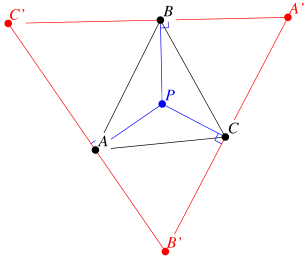
The antipedal triangle  of a reference triangle
  with respect to a given point
  is the triangle of which
  is the pedal triangle with respect to
  . If the point
  has trilinear coordinates
  and the angles of
  are
are  ,
,  , and
, and  , then the antipedal triangle has trilinear vertex matrix
![[-(beta+alphacosC)(gamma+alphacosB) (gamma+alphacosB)(alpha+betacosC) (beta+alphacosC)(alpha+gammacosB); (gamma+betacosA)(beta+alphacosC) -(gamma+betacosA)(alpha+betacosC) (alpha+betacosC)(beta+gammacosA); (beta+gammacosA)(gamma+alphacosB) (alpha+gammacosB)(gamma+betacosA) -(alpha+gammacosB)(beta+gammacosA)]](http://mathworld.wolfram.com/images/equations/AntipedalTriangle/NumberedEquation1.svg) | (1) |
(Kimberling 1998, p. 187).
The antipedal triangle is a central triangle of type 2 (Kimberling 1998, p. 55).
The following table summarizes some named antipedal triangles with respect to special antipedal points. The antipedal triangle of the first Fermat point is an (apparently unnamed) equilateral triangle (Shenghui Yang, pers. comm. to E. Pegg, Jr., Jan. 3, 2025), which has side lengths
![a^'=b^'=c^'=2^(3/2)3^(-1/4)(12Delta(a^2+b^2+c^2)+4sqrt(3)(a^2b^2+b^2c^2+c^2a^2)-sqrt(3)(a^4+b^4+c^4))/([12Delta+sqrt(3)(a^2+b^2+c^2)]^(3/2)),](http://mathworld.wolfram.com/images/equations/AntipedalTriangle/NumberedEquation2.svg) | (2) |
where  are the side lengths of the reference triangle and
  its area (E. Weisstein, Jan. 6, 2025).
| antipedal point | Kimberling center | antipedal triangle |
incenter  |  | excentral triangle |
circumcenter  |  | tangential triangle |
orthocenter  |  | anticomplementary triangle |
first Fermat point  |  | (unnamed?) equilateral triangle |
The antipedal triangle with respect to  and
and  has side lengths
 |  |  | (3) |
 |  |  | (4) |
 |  |  | (5) |
where  is the circumradius of
  , and area
 | (6) |
The isogonal conjugate of the antipedal triangle of a given triangle  with respect to a point
  is the antipedal triangle of
  with respect to the isogonal conjugate of
  . It is also homothetic with the pedal triangle of
  with respect to
  . Furthermore, the product of the areas of the two homothetic triangles equals the square of the area of the original triangle (Gallatly 1913, pp. 56-58).
