


A complete set of mutually conjugate group elements. Each element in a group belongs to exactly one class, and the identity element ( ) is always in its own class. The conjugacy class orders of all classes must be integral factors of the group order of the group. From the last two statements, a group of prime order has one class for each element. More generally, in an Abelian group, each element is in a conjugacy class by itself.
Two operations belong to the same class when one may be replaced by the other in a new coordinate system which is accessible by a symmetry operation (Cotton 1990, p. 52). These sets correspond directly to the sets of equivalent operations.
To see how to compute conjugacy classes, consider the dihedral group D3, which has the following multiplication table.
 | 1 |  |  |  |  |  |
| 1 | 1 |  |  |  |  |  |
 |  | 1 |  |  |  |  |
 |  |  | 1 |  |  |  |
 |  |  |  | 1 |  |  |
 |  |  |  |  |  | 1 |
 |  |  |  |  | 1 |  |
 is always in a conjugacy class of its own. To find another conjugacy class take some element, say
  , and find the results of all similarity transformations
  on
on  . For example, for
  , the product of
  by
by  can be read of as the element at the intersection of the row containing
  (the first multiplicand) with the column containing
  (the second multiplicand), giving
  . Now, we want to find
  where
where  , so pre-multiply both sides by
  to obtain
  , so
, so  is the element whose column intersects row
  in 1, i.e.,
  . Thus,
  . Similarly,
  , and continuing the process for all elements gives
 |  |  | (1) |
 |  |  | (2) |
 |  |  | (3) |
 |  |  | (4) |
 |  |  | (5) |
The possible outcomes are  ,
,  , or
, or  , so
, so  forms a conjugacy class. To find the next conjugacy class, take one of the elements not belonging to an existing class, say
  . Applying a similarity transformation gives
 |  |  | (6) |
 |  |  | (7) |
 |  |  | (8) |
 |  |  | (9) |
 |  |  | (10) |
so  form a conjugacy class.
Let  be a finite group of group order
  , and let
  be the number of conjugacy classes of
  . If
. If  is odd, then
 | (11) |
(Burnside 1955, p. 295). Furthermore, if every prime  dividing
  satisfies
 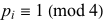 , then
 | (12) |
(Burnside 1955, p. 320). Poonen (1995) showed that if every prime  dividing
  satisfies
 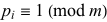 for
for  , then
 | (13) |
