


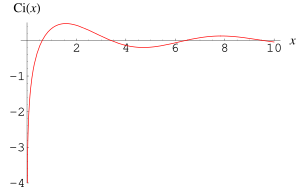
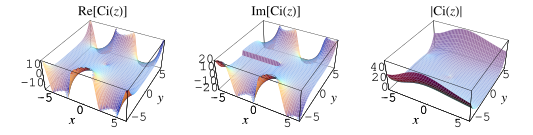
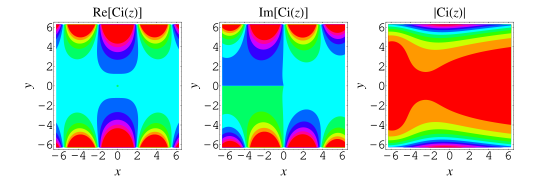
The most common form of cosine integral is
 |  |  | (1) |
 |  | 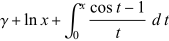 | (2) |
 |  | ![1/2[Ei(ix)+Ei(-ix)]](http://mathworld.wolfram.com/images/equations/CosineIntegral/Inline9.svg) | (3) |
 |  | ![-1/2[E_1(ix)+E_1(-ix)],](http://mathworld.wolfram.com/images/equations/CosineIntegral/Inline12.svg) | (4) |
where  is the exponential integral,
  is the En-function, and
  is the Euler-Mascheroni constant.
 is returned by the Wolfram Language command CosIntegral[x], and is also commonly denoted
  .
.
 has the series expansion
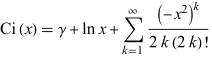 | (5) |
(Havil 2003, p. 106; after inserting a minus sign in the definition).
The derivative is
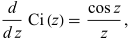 | (6) |
and the integral is
 | (7) |
 has zeros at 0.616505, 3.38418, 6.42705, .... Extrema occur when
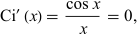 | (8) |
or  , or
, or  ,
,  ,
,  , ..., which are alternately maxima and minima. At these points,
  equals 0.472001,
  , 0.123772, .... Inflection points occur when
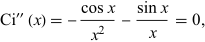 | (9) |
which simplifies to
 | (10) |
which has solutions 2.79839, 6.12125, 9.31787, ....
The related function
 |  | 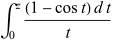 | (11) |
 |  |  | (12) |
is sometimes also defined.
To find a closed form for an integral power of a cosine function, use integration by parts to obtain
 |  |  | (13) |
 |  |  | (14) |
Now, if  is even so
  , then
 |  |  | (15) |
 |  | ![((2n-1)!!)/((2n)!!)[sinxsum_(k=0)^(n-1)((2k)!!)/((2k+1)!!)cos^(2k+1)x+x].](http://mathworld.wolfram.com/images/equations/CosineIntegral/Inline45.svg) | (16) |
On the other hand, if  is odd so
  , then
 | (17) |
Now let  ,
,
 | (18) |
The general result is then
![intcos^mxdx={((2n-1)!!)/((2n)!!)[sinxsum_(k=0)^(n-1)((2k)!!)/((2k+1)!!)cos^(2k+1)x+x] for m=2n; ((2n)!!)/((2n+1)!!)sinxsum_(k=0)^n((2k-1)!!)/((2k)!!)cos^(2k)x for m=2n+1.](http://mathworld.wolfram.com/images/equations/CosineIntegral/NumberedEquation9.svg) | (19) |
The infinite integral of a cosine times a Gaussian can also be done in closed form,
 | (20) |
