


The Heaviside step function is a mathematical function denoted  , or sometimes
  or
or  (Abramowitz and Stegun 1972, p. 1020), and also known as the "unit step function." The term "Heaviside step function" and its symbol can represent either a piecewise constant function or a generalized function.
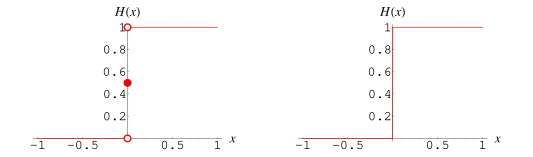
When defined as a piecewise constant function, the Heaviside step function is given by
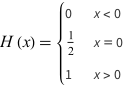 | (1) |
(Abramowitz and Stegun 1972, p. 1020; Bracewell 2000, p. 61). The plot above shows this function (left figure), and how it would appear if displayed on an oscilloscope (right figure).
When defined as a generalized function, it can be defined as a function  such that
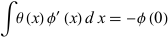 | (2) |
for  the derivative of a sufficiently smooth function
  that decays sufficiently quickly (Kanwal 1998).
The Wolfram Language represents the Heaviside generalized function as HeavisideTheta, while using UnitStep to represent the piecewise function Piecewise[
 1, x >= 0
 ] (which, it should be noted, adopts the convention
  instead of the conventional definition
  ).
).
The shorthand notation
 | (3) |
is sometimes also used.
The Heaviside step function is related to the boxcar function by
 | (4) |
and can be defined in terms of the sign function by
![H(x)=1/2[1+sgn(x)].](http://mathworld.wolfram.com/images/equations/HeavisideStepFunction/NumberedEquation5.svg) | (5) |
The derivative of the step function is given by
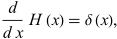 | (6) |
where  is the delta function (Bracewell 2000, p. 97).
The Heaviside step function is related to the ramp function  by
by
 | (7) |
and to the derivative of  by
by
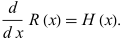 | (8) |
The two are also connected through
 | (9) |
where  denotes convolution.
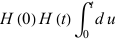
Bracewell (2000) gives many identities, some of which include the following. Letting  denote the convolution,
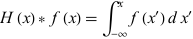 | (10) |
 |  | 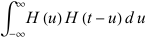 | (11) |
 |  | 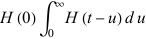 | (12) |
 |  |  | (13) |
 |  |  | (14) |
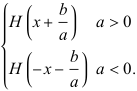
In addition,
 |  |  | (15) |
 |  |  | (16) |
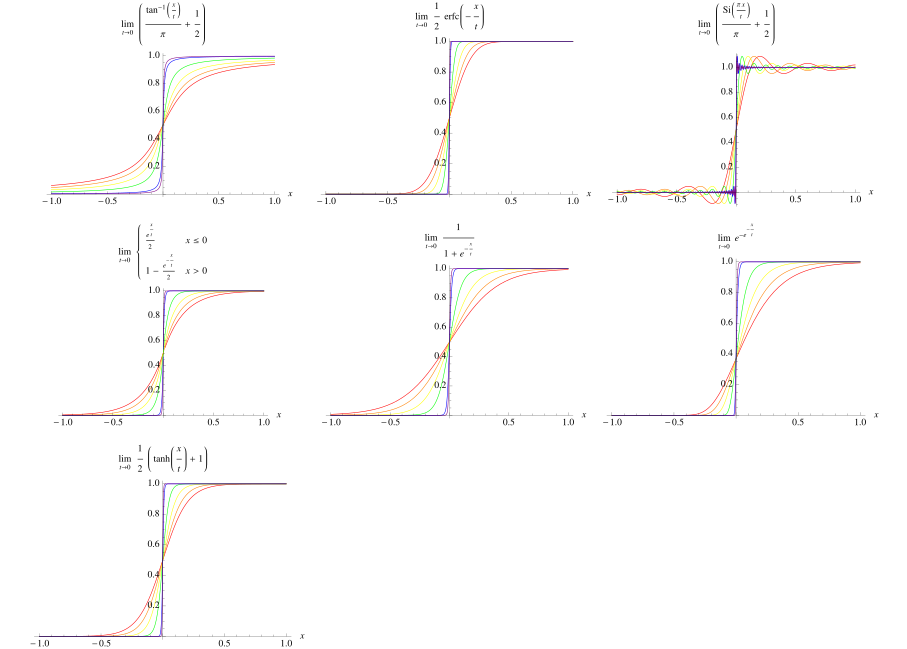
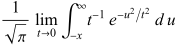
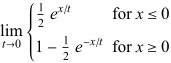
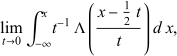
The Heaviside step function can be defined by the following limits,
 |  | ![lim_(t->0)[1/2+1/pitan^(-1)(x/t)]](http://mathworld.wolfram.com/images/equations/HeavisideStepFunction/Inline38.svg) | (17) |
 |  |  | (18) |
 |  | 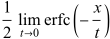 | (19) |
 |  | 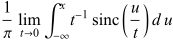 | (20) |
 |  | 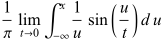 | (21) |
 |  | 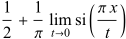 | (22) |
 |  |  | (23) |
 |  |  | (24) |
 |  |  | (25) |
 |  | ![1/2lim_(t->0)[1+tanh(x/t)]](http://mathworld.wolfram.com/images/equations/HeavisideStepFunction/Inline65.svg) | (26) |
 |  |  | (27) |
where  is the erfc function,
  is the sine integral,
  is the sinc function, and
  is the one-argument triangle function. The first four of these are illustrated above for
  , 0.1, and 0.01.
Of course, any monotonic function with constant unequal horizontal asymptotes is a Heaviside step function under appropriate scaling and possible reflection. The Fourier transform of the Heaviside step function is given by
![F[H(x)]](http://mathworld.wolfram.com/images/equations/HeavisideStepFunction/Inline74.svg) |  | 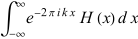 | (28) |
 |  | ![1/2[delta(k)-i/(pik)],](http://mathworld.wolfram.com/images/equations/HeavisideStepFunction/Inline79.svg) | (29) |
where  is the delta function.

 ."
."  and Related Functions." Ch. 8 in