


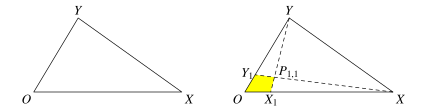
The perspective image of an infinite checkerboard. It can be constructed starting from any triangle  , where
  and
and  form the near corner of the floor, and
  is the horizon (left figure). If
  is the corner tile, the lines
  and
and  must be parallel to
  and
and  respectively. This means that in the drawing they will meet
  and
and  at the horizon, i.e., at point
  and point
  respectively (right figure). This property, of course, extends to the two bunches of perpendicular lines forming the grid.
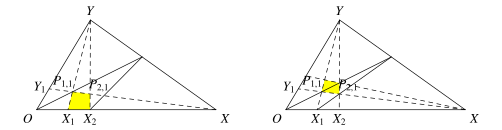
The adjacent tile 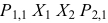 (left figure) can then be determined by the following conditions:
1. The new vertices  and
and  lie on lines
  and
and  respectively.
2. The diagonal  meets the parallel line
  at the horizon
  .
.
3. The line  passes through
  .
.
Similarly, the corner-neighbor  of
of  (right figure) can be easily constructed requiring that:
1. Point  lie on
  .
.
2. Point  lie on the common diagonal
  of the two tiles.
3. Line  pass through
  .
.
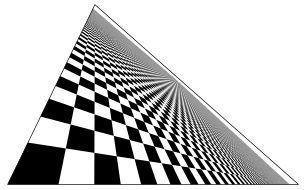
Iterating the above procedures will yield the complete picture. This construction shows how naturally projective geometry arises from perspective design, since  and
and  can be interpreted as two coordinate axes in the real projective plane with
  and
and  their points at infinity, joined by the line at infinity
  .
.
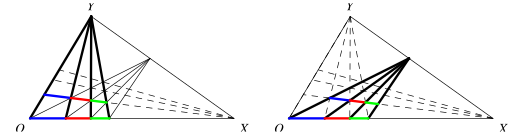
The Möbius net is the result of a projective transformation of the two-dimensional lattice. Unlike in affine geometry, the length proportions along the two perpendicular directions are not preserved, whereas the cross ratio, which is invariant by central projection, is. The "horizontal" sides of the projected tiles have different lengths, but are related by the central projections from  (left figure) and
  (right figure), so that
 |  |  | (1) |
 |  |  | (2) |
