


A general prism is a polyhedron possessing two congruent polygonal faces and with all remaining faces parallelograms (Kern and Bland 1948, p. 28; left figure).
A right prism is a prism in which the top and bottom polygons lie on top of each other so that the vertical polygons connecting their sides are not only parallelograms, but rectangles (right figure). A prism that is not a right prism is known as an oblique prism. If, in addition, the upper and lower bases are rectangles, then the prism is known as a cuboid.
The volume of a prism of height  and base area
  is simply
 | (1) |

The above figure shows the first few regular right prisms, whose faces are regular  -gons. The 4-prism with unit edge lengths is simply the cube. The dual polyhedron of a regular right prism is a dipyramid.
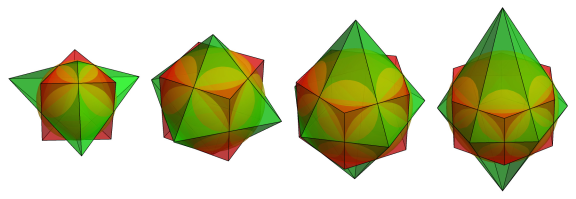
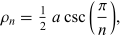
The regular right equilateral prisms are canonical polyhedra whose duals are canonical dipyramids. Canonical prisms have midradius equal to the circumradius of their  -gonal faces, i.e.,
 | (2) |
where  is the edge length.
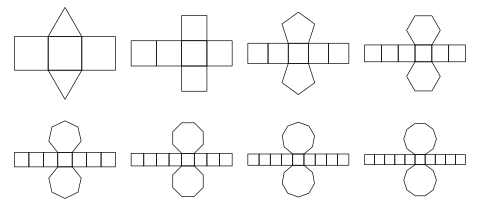
The regular right prisms have particularly simple nets, given by two oppositely-oriented  -gonal bases connected by a ribbon of
  squares. The graph corresponding to the skeleton of a prism is known, not surprisingly, as a prism graph.
A regular right unit  -prism has surface area
 |  |  | (3) |
 |  | ![n[1+1/2cot(pi/n)],](http://mathworld.wolfram.com/images/equations/Prism/Inline14.svg) | (4) |
where  is the area of the corresponding regular polygon. The first few surface areas are
 |  |  | (5) |
 |  |  | (6) |
 |  | 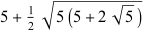 | (7) |
 |  |  | (8) |
 |  |  | (9) |
 |  |  | (10) |
 |  |  | (11) |
 |  | 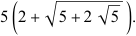 | (12) |
The algebraic degrees of these areas for  , 4, ... are 2, 1, 4, 2, 6, 2, 6, 4, 10, 2, 12, 6, 8, 4, 16, 6, 18, 4, ... (OEIS A089929).
A regular right unit  -prism has volume
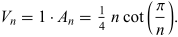 | (13) |
The first few volumes are
 |  |  | (14) |
 |  |  | (15) |
 |  | 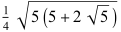 | (16) |
 |  |  | (17) |
 |  |  | (18) |
 |  |  | (19) |
 |  |  | (20) |
 |  | 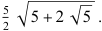 | (21) |
The algebraic degrees of the volumes are the same as for the surface areas.
The right regular triangular prism, square prism (cube), and hexagonal prism are all space-filling polyhedra.
