The signed Stirling numbers of the first kind are variously denoted (Riordan 1980, Roman 1984), (Fort 1948, Abramowitz and Stegun 1972), (Jordan 1950). Abramowitz and Stegun (1972, p. 822) summarize the various notational conventions, which can be a bit confusing (especially since an unsigned version is also in common use). The signed Stirling number of the first kind is are returned by StirlingS1[n, m] in the Wolfram Language, where they are denoted .
The signed Stirling numbers of the first kind are defined such that the number of permutations of elements which contain exactly permutation cycles is the nonnegative number
(1)
This means that for and . A related set of numbers is known as the associated Stirling numbers of the first kind. Both these and the usual Stirling numbers of the first kind are special cases of a general function which is related to the number of cycles in a permutation.
The triangle of signed Stirling numbers of the first kind is
The Stirling numbers of the first kind are connected with the Stirling numbers of the second kind. For example, the matrices and are inverses of each other, where denotes the matrix with th entry for , ..., (G. Helms, pers. comm., Apr. 28, 2006).
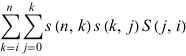
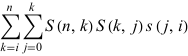
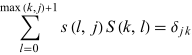
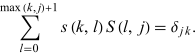
Other formulas include
(18)
(19)
(Roman 1984, p. 67), as well as
(20)
(21)
(22)
(23)
A nonnegative (unsigned) version of the Stirling numbers gives the number of permutations of objects having permutation cycles (with cycles in opposite directions counted as distinct) and is obtained by taking the absolute value of the signed version. The nonnegative Stirling numbers of the first kind are variously denoted
(24)
(Graham et al. 1994). Diagrams illustrating , , , and (Dickau) are shown above.
The unsigned Stirling numbers of the first kind satisfy
(25)
and can be generalized to noninteger arguments (a sort of "Stirling polynomial") using the identity


 (Riordan 1980, Roman 1984),
  (Fort 1948, Abramowitz and Stegun 1972),
  (Jordan 1950). Abramowitz and Stegun (1972, p. 822) summarize the various notational conventions, which can be a bit confusing (especially since an unsigned version
  is also in common use). The signed Stirling number of the first kind
  is are returned by StirlingS1[n, m] in the Wolfram Language, where they are denoted
  .
.  are defined such that the number of permutations of
  elements which contain exactly
  permutation cycles is the nonnegative number
 for
for  and
and  . A related set of numbers is known as the associated Stirling numbers of the first kind. Both these and the usual Stirling numbers of the first kind are special cases of a general function
  which is related to the number of cycles in a permutation.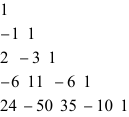








![1/2(-1)^(n-1)(n-1)![H_(n-1)^2-H_(n-1)^((2))]](http://mathworld.wolfram.com/images/equations/StirlingNumberoftheFirstKind/Inline25.svg)


 is the Kronecker delta,
  is a harmonic number,
  is a harmonic number of order
  , and
, and  is a binomial coefficient.


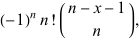
 is a falling factorial and
  is the rising factorial,
 ![sum_(k=m)^infty(s(k,m))/(k!)x^k=([ln(x+1)]^m)/(m!)](http://mathworld.wolfram.com/images/equations/StirlingNumberoftheFirstKind/NumberedEquation3.svg)
 (Abramowitz and Stegun 1972, p. 824) and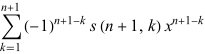



 and the sum identities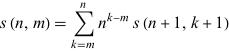
 and
and 
 , where
  is a binomial coefficient.
  are connected with the Stirling numbers of the second kind
  . For example, the matrices
  and
and  are inverses of each other, where
  denotes the matrix with
  th entry
  for
for  , ...,
  (G. Helms, pers. comm., Apr. 28, 2006).





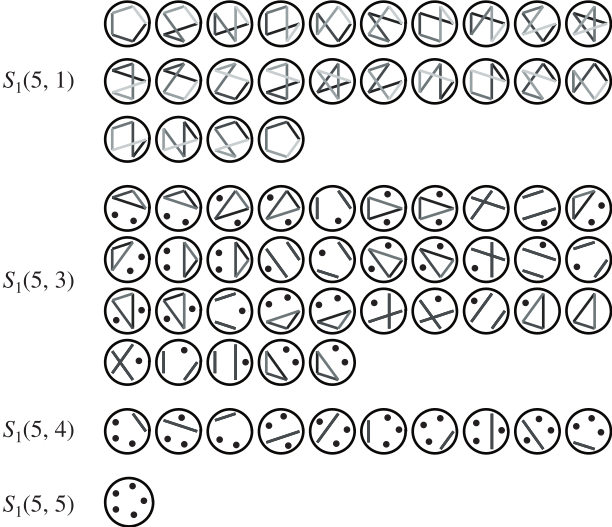
 objects having
  permutation cycles (with cycles in opposite directions counted as distinct) and is obtained by taking the absolute value of the signed version. The nonnegative Stirling numbers of the first kind are variously denoted
 ![S_1(n,m)=[n; m]=|s(n,m)|](http://mathworld.wolfram.com/images/equations/StirlingNumberoftheFirstKind/NumberedEquation11.svg)
 ,
,  ,
,  , and
, and  (Dickau) are shown above.


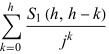



 (Gosper 1996).
 ." Grunert Archiv 65, 171-175, 1880.Butzer, P. L. and Hauss, M. "Stirling Functions of the First and Second Kinds; Some New Applications." Israel Mathematical Conference Proceedings: Approximation, Interpolation, and Summability, in Honor of Amnon Jakimovski on his Sixty-Fifth Birthday (Ed. S. Baron and D. Leviatan). Ramat Gan, Israel: IMCP, pp. 89-108, 1991.Carlitz, L. "On Some Polynomials of Tricomi." Boll. Un. M. Ital. 13, 58-64, 1958.Carlitz, L. "Note on Nörlund's [sic] Polynomial
  ." Proc. Amer. Math. Soc. 11, 452-455, 1960.Comtet, L.