

A generalization of the p-adic norm first proposed by Kürschák in 1913. A valuation  on a field
  is a function from
  to the real numbers
  such that the following properties hold for all
  :
:
1.  ,
,
2.  iff
iff  ,
,
3.  ,
,
4.  implies
  for some constant
  (independent of
  ).
).
If (4) is satisfied for  , then
  satisfies the triangle inequality,
4a.  for all
  .
.
If (4) is satisfied for  then
then  satisfies the stronger ultrametric inequality
4b.  .
.
The simplest valuation is the absolute value for real numbers. A valuation satisfying (4b) is called non-Archimedean valuation; otherwise, it is called Archimedean.
If  is a valuation on
  and
and  , then we can define a new valuation
  by
by
 | (1) |
This does indeed give a valuation, but possibly with a different constant  in axiom 4. If two valuations are related in this way, they are said to be equivalent, and this gives an equivalence relation on the collection of all valuations on
  . Any valuation is equivalent to one which satisfies the triangle inequality (4a). In view of this, we need only to study valuations satisfying (4a), and we often view axioms (4) and (4a) as interchangeable (although this is not strictly true).
If two valuations are equivalent, then they are both non-Archimedean or both Archimedean.  ,
,  , and
, and  with the usual Euclidean norms are Archimedean valuated fields. For any prime
  , the p-adic numbers
  with the
  -adic valuation
  is a non-Archimedean field.
If  is any field, we can define the trivial valuation on
  by
by  for all
  and
and  , which is a non-Archimedean valuation. If
  is a finite field, then the only possible valuation over
  is the trivial one. It can be shown that any valuation on
  is equivalent to one of the following: the trivial valuation, Euclidean absolute norm
  , or
, or  -adic valuation
  .
.
The equivalence of any nontrivial valuation of  to either the usual absolute value or to a p-adic norm was proved by Ostrowski (1935). Equivalent valuations give rise to the same topology. Conversely, if two valuations have the same topology, then they are equivalent. A stronger result is the following: Let
  ,
,  , ...,
  be valuations over
  which are pairwise inequivalent and let
  ,
,  , ...,
  be elements of
  . Then there exists an infinite sequence (
 ,
,  , ...) of elements of
  such that
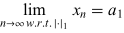 | (2) |
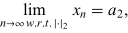 | (3) |
etc. This says that inequivalent valuations are, in some sense, completely independent of each other. For example, consider the rationals  with the 3-adic and 5-adic valuations
  and
and  , and consider the sequence of numbers given by
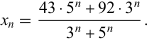 | (4) |
Then  as
as  with respect to
  , but
, but  as
as  with respect to
  , illustrating that a sequence of numbers can tend to two different limits under two different valuations.
A discrete valuation is a valuation for which the valuation group is a discrete subset of the real numbers  . Equivalently, a valuation (on a field
  ) is discrete if there exists a real number
  such that
 | (5) |
The  -adic valuation on
  is discrete, but the ordinary absolute valuation is not.
If  is a valuation on
  , then it induces a metric
 | (6) |
on  , which in turn induces a topology on
  . If
. If  satisfies (4b), then the metric is an ultrametric. We say that
  is a complete valuated field if the metric space is complete.
