


Given an  -dimensional vector
![x=[x_1; x_2; |; x_n],](http://mathworld.wolfram.com/images/equations/VectorNorm/NumberedEquation1.svg) | (1) |
a general vector norm  , sometimes written with a double bar as
  , is a nonnegative norm defined such that
1.  when
when  and
and  iff
iff  .
.
2.  for any scalar
  .
.
3.  .
.
In this work, a single bar is used to denote a vector norm, absolute value, or complex modulus, while a double bar is reserved for denoting a matrix norm.
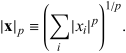
The vector norm  for
for  , 2, ... is defined as
 | (2) |
The  -norm of vector
  is implemented as Norm[v, p], with the 2-norm being returned by Norm[v].
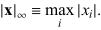
The special case  is defined as
 | (3) |
The most commonly encountered vector norm (often simply called "the norm" of a vector, or sometimes the magnitude of a vector) is the L2-norm, given by
 | (4) |
This and other types of vector norms are summarized in the following table, together with the value of the norm for the example vector  .
.
| name | symbol | value | approx. |
 -norm -norm |  | 6 | 6.000 |
 -norm -norm |  |  | 3.742 |
 -norm -norm |  |  | 3.302 |
 -norm -norm |  |  | 3.146 |
 -norm -norm |  | 3 | 3.000 |
