


Buy new: -46% $56.43$56.43 FREE delivery Sunday, March 29 Ships from: Amazon.com Sold by: Amazon.com
Save with Used - Good $42.49$42.49 FREE delivery Sunday, March 29 Ships from: Amazon Sold by: nikis-misc
Download the free Kindle app and start reading Kindle books instantly on your smartphone, tablet, or computer - no Kindle device required.
Read instantly on your browser with Kindle for Web.
Using your mobile phone camera - scan the code below and download the Kindle app.
Follow the author
OK
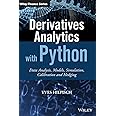
Derivatives Analytics with Python: Data Analysis, Models, Simulation, Calibration and Hedging (The Wiley Finance Series) 1st Edition
Purchase options and add-ons
Derivatives Analytics with Python shows you how to implement market-consistent valuation and hedging approaches using advanced financial models, efficient numerical techniques, and the powerful capabilities of the Python programming language. This unique guide offers detailed explanations of all theory, methods, and processes, giving you the background and tools necessary to value stock index options from a sound foundation. You'll find and use self-contained Python scripts and modules and learn how to apply Python to advanced data and derivatives analytics as you benefit from the 5,000+ lines of code that are provided to help you reproduce the results and graphics presented. Coverage includes market data analysis, risk-neutral valuation, Monte Carlo simulation, model calibration, valuation, and dynamic hedging, with models that exhibit stochastic volatility, jump components, stochastic short rates, and more. The companion website features all code and IPython Notebooks for immediate execution and automation.
Python is gaining ground in the derivatives analytics space, allowing institutions to quickly and efficiently deliver portfolio, trading, and risk management results. This book is the finance professional's guide to exploiting Python's capabilities for efficient and performing derivatives analytics.
- Reproduce major stylized facts of equity and options markets yourself
- Apply Fourier transform techniques and advanced Monte Carlo pricing
- Calibrate advanced option pricing models to market data
- Integrate advanced models and numeric methods to dynamically hedge options
Recent developments in the Python ecosystem enable analysts to implement analytics tasks as performing as with C or C++, but using only about one-tenth of the code or even less. Derivatives Analytics with Python ― Data Analysis, Models, Simulation, Calibration and Hedging shows you what you need to know to supercharge your derivatives and risk analytics efforts.
- ISBN-101119037999
- ISBN-13978-1119037996
- Edition1st
- PublisherWiley
- Publication dateAugust 3, 2015
- LanguageEnglish
- Dimensions6.9 x 1.1 x 9.7 inches
- Print length384 pages
Discover the latest buzz-worthy books, from mysteries and romance to humor and nonfiction. Explore more
Frequently bought together

Similar items that may deliver to you quickly
Quantitative Finance with Python: A Practical Guide to Investment Management, Trading, and Financial Engineering (Chapman and Hall/CRC Financial Mathematics Series)HardcoverFREE Shipping by AmazonGet it as soon as Sunday, Mar 29Only 2 left in stock (more on the way).
Financial Data Analytics with Machine Learning, Optimization and Statistics (Wiley Finance)Sam ChenHardcoverFREE Shipping by AmazonGet it as soon as Sunday, Mar 29Only 7 left in stock (more on the way).
Python for Finance: Mastering Data-Driven FinancePaperbackFREE Shipping by AmazonGet it as soon as Sunday, Mar 29
Machine Learning for Algorithmic Trading: Predictive models to extract signals from market and alternative data for systematic trading strategies with PythonPaperbackFREE Shipping by AmazonGet it as soon as Sunday, Mar 29
Financial Theory with Python: A Gentle IntroductionPaperbackFREE Shipping on orders over $35 shipped by AmazonGet it as soon as Sunday, Mar 29Only 10 left in stock (more on the way).
Python for Algorithmic Trading Cookbook: Recipes for designing, building, and deploying algorithmic trading strategies with PythonPaperbackFREE Shipping by AmazonGet it as soon as Sunday, Mar 29
Customers also bought or read
- Artificial Intelligence in Finance: A Python-Based Guide
Paperback$49.49$49.49FREE delivery Sun, Mar 29 - Machine Learning for Algorithmic Trading: Predictive models to extract signals from market and alternative data for systematic trading strategies with Python
Paperback$39.75$39.75FREE delivery Sun, Mar 29 - Python for Algorithmic Trading Cookbook: Recipes for designing, building, and deploying algorithmic trading strategies with Python
Paperback$47.99$47.99FREE delivery Sun, Mar 29 - The Elements of Quantitative Investing (Wiley Finance)
Hardcover$50.20$50.20FREE delivery Sun, Mar 29 - Algorithmic Trading: Winning Strategies and Their Rationale (Wiley Trading)
Hardcover$46.00$46.00FREE delivery Sun, Mar 29 - Option Volatility and Pricing: Advanced Trading Strategies and Techniques, 2nd Edition
Hardcover$74.55$74.55FREE delivery Sun, Mar 29 - Quantitative Portfolio Management: The Art and Science of Statistical Arbitrage
Hardcover$43.09$43.09FREE delivery Sun, Mar 29 - Quantitative Risk Management: Concepts, Techniques and Tools - Revised Edition (Princeton Series in Finance)
Hardcover$66.41$66.41FREE delivery Apr 4 - 9 - The Concepts and Practice of Mathematical Finance (Mathematics, Finance and Risk, Series Number 8)
Hardcover$56.73$56.73FREE delivery Sun, Mar 29 - Python for Data Analysis: Data Wrangling with pandas, NumPy, and Jupyter
Paperback$43.99$43.99FREE delivery Sun, Mar 29 - AI Engineering: Building Applications with Foundation Models#1 Best SellerNatural Language Processing
Paperback$57.74$57.74FREE delivery Sun, Mar 29 - Machine Learning for Financial Risk Management with Python: Algorithms for Modeling Risk
Paperback$49.99$49.99FREE delivery Sun, Mar 29 - Options, Futures, and Other Derivatives, Global Edition
Paperback$69.58$69.58FREE delivery Apr 4 - 10 - Fluent Python: Clear, Concise, and Effective Programming
Paperback$43.99$43.99FREE delivery Sun, Mar 29 - Python for Algorithmic Trading: From Idea to Cloud Deployment
Paperback$44.49$44.49FREE delivery Sun, Mar 29 - Hands-On Machine Learning with Scikit-Learn, Keras, and TensorFlow: Concepts, Tools, and Techniques to Build Intelligent Systems
Paperback$49.50$49.50FREE delivery Sun, Mar 29 - Quantitative Equity Portfolio Management, Second Edition: An Active Approach to Portfolio Construction and Management
Hardcover$59.94$59.94FREE delivery Sun, Mar 29 - Systematic Trading: A unique new method for designing trading and investing systems
Hardcover$55.13$55.13FREE delivery Sun, Mar 29 - Quantitative Finance with Python: A Practical Guide to Investment Management, Trading, and Financial Engineering (Chapman and Hall/CRC Financial Mathematics Series)
Hardcover$98.00$98.00FREE delivery Sun, Mar 29 - 150 Most Frequently Asked Questions on Quant Interviews, Third Edition (Pocket Book Guides for Quant Interviews)
Paperback$38.50$38.50FREE delivery Sun, Mar 29 - Modern Quant: Quantitative Finance with Python: A Sophiticaticated Guide For The Finance Professional In 2024
Paperback$34.99$34.99Delivery Sun, Mar 29
Editorial Reviews
From the Inside Flap
Market-based valuation of stock index options is an essential task for every buy-side and sell-side decision maker in the derivatives analytics domain. In Derivatives Analytics with Python, you'll discover why Python has established itself in the financial industry and how to leverage this powerful programming language so you can implement market-consistent valuation and hedging approaches.
Written for Quant developers, traders, risk managers, compliance officers, and model validators, this reliable resource skillfully covers the four areas necessary to effectively value options: market-based valuation as a process; sound market model; numerical techniques; and technology. Presented in three parts, Part One looks at the risks affecting the value of equity index options and empirical facts regarding stocks and interest rates. Part Two covers arbitrage pricing theory, risk-neutral valuation in discrete time, continuous time, and introduces the two popular methods of Carr-Madan and Lewis for Fourier-based option pricing. Finally, Part Three considers the whole process of a market-based valuation effort and the Monte Carlo simulation as the method of choice for the valuation of exotic and complex index options and derivatives.
Practical and informative, with self-contained Python scripts and modules and 5,000+ lines of code provided to help you reproduce the results and graphics presented. In addition, the companion website (http: //wiley. quant-platform.com) features all code and IPython Notebooks for immediate execution and automation.
Author Yves Hilpisch explores market-based valuation as a process, as well as empirical findings about market realities. By reading this book, you'll be equipped to develop much-needed tools during a market-based valuation with balanced coverage of:
- Market-based valuation
- Risk-neutral valuation
- Discrete market models
- Black-Scholes-Merton Model
- Fourier-based option pricing
- Valuation of American options
- Stochastic volatility and jump-diffusion models
- Model calibration
- Simulation and valuation
Python is gaining ground in the derivatives analytics space, allowing institutions to quickly and efficiently deliver pricing, trading, and risk management results. Learn to implement market-consistent valuation and hedging approaches for European and American options with the solid guidance found in Derivatives Analytics with Python.
From the Back Cover
Market-based valuation of stock index options is an essential task for every buy-side and sell-side decision maker in the derivatives analytics domain. In Derivatives Analytics with Python, you'll discover why Python has established itself in the financial industry and how to leverage this powerful programming language so you can implement market-consistent valuation and hedging approaches.
Written for Quant developers, traders, risk managers, compliance officers, and model validators, this reliable resource skillfully covers the four areas necessary to effectively value options: market-based valuation as a process; sound market model; numerical techniques; and technology. Presented in three parts, Part One looks at the risks affecting the value of equity index options and empirical facts regarding stocks and interest rates. Part Two covers arbitrage pricing theory, risk-neutral valuation in discrete time, continuous time, and introduces the two popular methods of Carr-Madan and Lewis for Fourier-based option pricing. Finally, Part Three considers the whole process of a market-based valuation effort and the Monte Carlo simulation as the method of choice for the valuation of exotic and complex index options and derivatives.
Practical and informative, with self-contained Python scripts and modules and 5,000+ lines of code provided to help you reproduce the results and graphics presented. In addition, the companion website (http://wiley.quant-platform.com) features all code and IPython Notebooks for immediate execution and automation.
Author Yves Hilpisch explores market-based valuation as a process, as well as empirical findings about market realities. By reading this book, you'll be equipped to develop much-needed tools during a market-based valuation with balanced coverage of:
- Market-based valuation
- Risk-neutral valuation
- Discrete market models
- Black-Scholes-Merton Model
- Fourier-based option pricing
- Valuation of American options
- Stochastic volatility and jump-diffusion models
- Model calibration
- Simulation and valuation
Python is gaining ground in the derivatives analytics space, allowing institutions to quickly and efficiently deliver pricing, trading, and risk management results. Learn to implement market-consistent valuation and hedging approaches for European and American options with the solid guidance found in Derivatives Analytics with Python.
About the Author
YVES HILPISCH is founder and Managing Partner of The Python Quants, a group that focuses on Python & Open Source Software for Quantitative Finance. Yves is also a Computational Finance Lecturer on the CQF Program. He works with clients in the financial industry around the globe and has ten years of experience with Python. Yves is the organizer of Python and Open Source for Quant Finance conferences and meetup groups in Frankfurt, London and New York City.
Product details
- Publisher : Wiley
- Publication date : August 3, 2015
- Edition : 1st
- Language : English
- Print length : 384 pages
- ISBN-10 : 1119037999
- ISBN-13 : 978-1119037996
- Item Weight : 1 pounds
- Dimensions : 6.9 x 1.1 x 9.7 inches
- Best Sellers Rank: #402,464 in Books (See Top 100 in Books)
- #42 in Financial Engineering (Books)
- #69 in Derivatives Investments
- #299 in Python Programming
- Customer Reviews:
About the author

Dr. Yves J. Hilpisch is founder and CEO of The Python Quants (http://tpq.io), a group focusing on the use of open source technologies for financial data science, artificial intelligence, algorithmic trading, and computational finance. He is also the founder and CEO of The AI Machine (http://aimachine.io), a company focused on AI-powered algorithmic trading based on a proprietary strategy execution platform.
Yves has a Diploma in Business Administration, a Ph.D. in Mathematical Finance and is Adjunct Professor for Computational Finance.
Yves is the author of five books (https://home.tpq.io/books):
* Artificial Intelligence in Finance (O’Reilly, forthcoming)
* Python for Algorithmic Trading (O’Reilly, forthcoming)
* Python for Finance (2018, 2nd ed., O’Reilly)
* Listed Volatility and Variance Derivatives (2017, Wiley Finance)
* Derivatives Analytics with Python (2015, Wiley Finance)
Yves is the director of the first online training program leading to University Certificates in Python for Algorithmic Trading (https://home.tpq.io/certificates/pyalgo) and Computational Finance (https://home.tpq.io/certificates/compfin). He also lectures on computational finance, machine learning, and algorithmic trading at the CQF Program (http://cqf.com).
Yves is the originator of the financial analytics library DX Analytics (http://dx-analytics.com) and organizes Meetup group events, conferences, and bootcamps about Python, artificial intelligence and algorithmic trading in London (http://pqf.tpq.io), New York (http://aifat.tpq.io), Frankfurt, Berlin, and Paris. He has given keynote speeches at technology conferences in the United States, Europe, and Asia.
Customer reviews
Customer Reviews, including Product Star Ratings help customers to learn more about the product and decide whether it is the right product for them.
To calculate the overall star rating and percentage breakdown by star, we don’t use a simple average. Instead, our system considers things like how recent a review is and if the reviewer bought the item on Amazon. It also analyzed reviews to verify trustworthiness.
Learn more how customers reviews work on AmazonTop reviews from the United States
There was a problem filtering reviews. Please reload the page.
- Reviewed in the United States on April 22, 2018Format: HardcoverVerified PurchaseElegant and stylized book, although you should know a lot, because it isn't easy digest.

- Reviewed in the United States on February 4, 2024Format: HardcoverVerified PurchaseStrong background in engineering level math and python is highly recommended. Code provided by author contains many uncorrected bugs (at least for visualizing 2D and 3D plots) which is unacceptable considering the book has been in print now for nearly 10 years. Code for 3D plots (mpl_toolkits.mplot3d.axes3d) ?!?!? is extremely obscure and provides no tangible benefit to the end user compared to the standard matplotlib.pyplot package. I have a decent (but not great) background in Python and have been coding simpler BSM models (with 2D plots) in Python which made spotting and correcting errors easier. Pricing & market models with jump diffusion & stochastic vol are quite interesting and really the only compelling reason (for me) to read the book. In reality the entire buggy code is available by the author online for free and the actual text of the book does little to complement the code. All in all a disappointment compared to Hilpisch's book 'Python for Finance' which is a great resource that I would not hesitate to recommend.
- Reviewed in the United States on January 2, 2020Format: HardcoverThis book has absolutely nothing new other than re-statement of known equation from many classical textbooks (e.g. Hull) in subject matter. The Python code (sole value proposition to buy) in this book relies on data files (e.g. option chain for VSTOXX ) obfuscated intentionally by the author to prevent the reader to use the code for his own purpose. When reaching out to the author, instead of guiding the reader, he repeatedly attempted to sell me to enroll in his "on-line course" instead of helping! Very unprofessional in the academic world. Essentially a bait and switch approach to make a buck. Do NOT waste your time or money on any of this author's (Yves Hilpisch) books
- Reviewed in the United States on October 10, 2022Format: HardcoverThere was a lot of math in the book. Also a lot of theory. I was irked because the most import Python code did not work. I do understand this book was published back in 2015. There were some ideas that I could take and run with, writing my own Python code. So not a total waste. Seemed overpriced on the print edition.
Top reviews from other countries
Ho Yan ChanReviewed in the United Kingdom on May 2, 20185.0 out of 5 stars A great book!
Format: HardcoverVerified PurchaseA great book!
Alex T.Reviewed in Canada on February 28, 20185.0 out of 5 stars Five Stars
Format: HardcoverVerified PurchaseExcellent
Amazon CustomerReviewed in the United Kingdom on December 25, 20165.0 out of 5 stars Five Stars
Format: HardcoverVerified Purchasev good