
Holiday Hosting Essentials for the Kitchen
Enjoy fast, free delivery, exclusive deals, and award-winning movies & TV shows.
Kindle app logo image

Download the free Kindle app and start reading Kindle books instantly on your smartphone, tablet, or computer - no Kindle device required.

Read instantly on your browser with Kindle for Web.

Using your mobile phone camera - scan the code below and download the Kindle app.

QR code to download the Kindle App

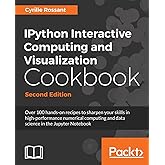
  • IPython Interactive Computing and Visualization Cookbook

Follow the author

Get new release updates & improved recommendations
Something went wrong. Please try your request again later.

IPython Interactive Computing and Visualization Cookbook


{"desktop_buybox_group_1":[{"displayPrice":"$54.99","priceAmount":54.99,"currencySymbol":"$","integerValue":"54","decimalSeparator":".","fractionalValue":"99","symbolPosition":"left","hasSpace":false,"showFractionalPartIfEmpty":true,"offerListingId":"snqxsWdYh2PMNzAzfJh5zBxZAoXA6o%2FQoqsJ%2BJnk6K%2BgOBvo1nRdCksfB%2F4AJXbY9FO2duj3bXc6EUOc5Wiv0jOzeIsTAtr74zypY%2BOeeydFmdvgmo0LNsHt6tqaSl5LDfu0RGYNT8EtXnATcIsgSg%3D%3D","locale":"en-US","buyingOptionType":"NEW","aapiBuyingOptionIndex":0}]}

Purchase options and add-ons

Harness IPython for powerful scientific computing and Python data visualization with this collection of more than 100 practical data science recipes


Key Features


  • Leverage the new features of the IPython notebook for interactive web-based big data analysis and visualization
  • Become an expert in high-performance computing and visualization for data analysis and scientific modeling
  • A comprehensive coverage of scientific computing through many hands-on, example-driven recipes with detailed, step-by-step explanations


Book Description

IPython is at the heart of the Python scientific stack. With its widely acclaimed web-based notebook, IPython is today an ideal gateway to data analysis and numerical computing in Python.


IPython Interactive Computing and Visualization Cookbook contains many ready-to-use focused recipes for high-performance scientific computing and data analysis. The first part covers programming techniques, including code quality and reproducibility; code optimization; high-performance computing through dynamic compilation, parallel computing, and graphics card programming. The second part tackles data science, statistics, machine learning, signal and image processing, dynamical systems, and pure and applied mathematics.


What you will learn

  • Code better by writing high-quality, readable, and well-tested programs; profiling and optimizing your code, and conducting reproducible interactive computing experiments
  • Master all of the new features of the IPython notebook, including the interactive HTML/JavaScript widgets
  • Analyze data with Bayesian and frequentist statistics (Pandas, PyMC, and R), and learn from data with machine learning (scikit-learn)
  • Gain valuable insights into signals, images, and sounds with SciPy, scikit-image, and OpenCV
  • Learn how to write blazingly fast Python programs with NumPy, PyTables, ctypes, Numba, Cython, OpenMP, GPU programming (CUDA and OpenCL), parallel IPython, MPI, and many more


Who this book is for

This book is for web developers who want to build the next generation of state-of-the-art mobile and desktop web applications with Angular. This book does not require you to have prior exposure to either Angular 1.x, 2 or 4, although comprehensive knowledge of JavaScript is assumed.

There is a newer edition of this item:


From the brand

Editorial Reviews

About the Author

Dr. Cyrille Rossant is a French researcher in computational neuroscience. A graduate of the Ecole Normale Supérieure, Paris, where he studied Mathematics and Computer Science, he has also worked at Princeton University and University College London. He is interested in all kinds of relationships between brains and computers, including models of neural processing, high-performance simulations of neural networks, and analysis of neurophysiologic data.

He has also worked on parallel computing and high-performance visualization technologies for Python, and he is a core developer of Vispy, a visualization package. He is the author of Learning IPython for Interactive Computing and Data Visualization, Packt Publishing, the prequel of this cookbook.

Product details

About the author

Follow authors to get new release updates, plus improved recommendations.
Cyrille Rossant
Brief content visible, double tap to read full content.
Full content visible, double tap to read brief content.

Neuroscience researcher and software engineer

Customer reviews

3.9 out of 5 stars
15 global ratings

Top reviews from the United States

  • Reviewed in the United States on May 28, 2017
    Format: PaperbackVerified Purchase
    probably my preferred book in Python. Great case studies. Rashka, Rossant= fantastic books

  • Reviewed in the United States on September 17, 2017
    Format: KindleVerified Purchase
    Excellent book. Well written examples; easy to follow and very detailed. My only gripe with this book is the Kindle format. It's not as easy to navigate as a few others that I've bought.
  • Reviewed in the United States on February 23, 2015
    Format: Kindle
    I read a review copy, all 509 pages as this was a great read.
    The book has a very broad coverage of interactive computing through the use of IPython.

    Each chapter and sub-section finishes with a “There’s more …” section providing a large number of useful links for further study on that sections content, allowing the reader to investigate further.

    The book steps us through all example source code, but the example source and example data are all provided in github repositories so all experiments can be reproduced by the reader. Sufficient information is provided to reproduce the experiments on Windows, Linux or OS X.

    The earlier chapters introduce us to IPython, in it’s current 2.x form but also present what’s coming in the 3.0 release. It was impressive to see how IPython is evolving into a more interactive platform through the integration of Javascript capabilities - it is shown how IPython can be extended in various ways, and how widgets can be used to interact with the visualization - e.g. having a slider widget to modify an analysis and the associated plot. One example involves the implementation of a piano keyboard within IPython.
    Impressive stuff showing how useful IPython is becoming for data analysis and visualization.

    Nevertheless for an introduction to IPython the authors’ earlier book on PacktPub “Learning IPython for Interactive Computing and Data Visualization” is a recommended read.

    The first part of the book covers high performance interactive computing, starting with IPython, its’ notebooks, profiling and optimization of code through various libraries including Numpy, Numba, Cython and even OpenCL or pyCUDA to harness GPUs. The final chapter of this section covers plotting libraries such as prettyplotlib, seaborn, Bokeh, NetworkX, D3.js, Vispy which go beyond the capabilities of the standard matplotlib.

    The second part of the book enumerates how these capabilities can be applied in many domains of data science whether it be statistical data analysis, machine learning, optimization, signal processing, image and audio, deterministic and stochastic dynamic systems, graphs and geographical systems and finally symbolic mathematics.

    There is a very impressive range of techniques covered in the book and the examples cover a wide range of ideas from pure statistics, to frequency domain (FFT), audio, image and graph and map plotting.

    Whilst such a book can not go into great depth for so many subjects, tools and methods the book provides many realistic reproducible examples, in souce code, along with many references to be able to investigate further.

    The last chapter deals with symbolic mathematics using sympy. I was quite amazed at what I was able to do by just installing one extra python module - sympy. Sympy is able to display mathematical formulas, via the Latex-capable MathJax library, to solve equations and the like.

    Overall this book is a very interesting read and is packed with information, examples and very useful references. I recommend it to anyone wanting an overview of Python/IPython capabilities for data visualization.

    An inspiring book?
    Well yes, I'm inspired to delve deeper into IPython and its use in various data analytic domains, I'm also inspired to use the examples for teaching workshops.
    3 people found this helpful
    Report
  • Reviewed in the United States on March 28, 2015
    Format: Paperback
    When I pick up a cookbook for technology X, I expect the recipes to be grounded in technology X. While recipes can be about how to set up the technology or use the technology to accomplish a task, the book has to be about the technology. In this case (as with "Learning IPython for Interactive Computing and Data Visualization"), recipes focus on libraries such as NumPy, Pandas, Matplotlib, and SymPy, etc. and not specific to IPython.

    Even if the book were shorter, I would have been happier if it focused on the abilities and features of IPython and left recipes specific to other technologies to cookbooks dedicated to those technologies. To elaborate, if a recipe involving NumPy can be applied independent of IPython, then the recipe is specific to NumPy. On the other hand, if a recipe involving NumPy relies on a feature of IPython and cannot be employed outside of IPython (e.g., python shell), then the recipe specific to IPython. Moreover, I suspect such a recipe would be applicable to other technologies that can be used with IPython. If so, the book should illustrate such general uses of a recipe.

    In short, while I may return to this book, I will only do so for very few chapters that are specific to IPython.
    7 people found this helpful
    Report
  • Reviewed in the United States on March 29, 2015
    Format: Paperback
    This book was well worth purchasing, in my opinion. I follow the ipython-dev list and I've seen the author's name appear many times, with very useful contributions, so I felt he certainly had the credibility to write this book. Any book about a software project runs the risk of becoming out of date as the project evolves, but in this case, at least so far, it holds up very well.

    The book has considerable breadth, as can be seen from the online Table of Contents (although the last page of the ToC seems to be missing). Breadth isn't necessarily a positive feature for every book/reader, but I personally like it. If one wants more depth, it's probably better to use online resources anyway.

    I appreciate the author being so pro open source and that he provides a github repo for code related to the book. And I personally agree with his decision to recommend using Anaconda's Python distribution; it makes life much easier when installing packages from the larger Python ecosystem. He might have gone one step further and encourage readers to join the Anaconda mailing list, but hopefully they'll figure that out on their own.

    I'd say the target audience is probably college students - any student in need of doing some interactive computational or data science. However, I *wish* more high school students would pick up a book like this and use it. MATLAB is fine, but Python + matplotlib, etc is better in many ways.

    I appreciate being made aware of the author's own visualization package, vispy, and hope to play with it more in the future. However, I was a little surprised and disappointed he didn't also mention VTK (although VTK doesn't currently install using conda/Anaconda Python 3.4).

    I thought it was especially brave (and admirable) of the author to contribute Chapter 5 on HPC, especially for multiple operating systems, GPU libs (CUDA and OpenCL), and MPI. Fairly advanced stuff, but worth the read.

    I sincerely appreciate the author undertaking this book project and commend him on the selection of topics and the overall layout. A good read with good visuals. Thanks!
    5 people found this helpful
    Report

Top reviews from other countries

  • Milan Skocic
    5.0 out of 5 stars Great cookbook
    Reviewed in France on February 6, 2015
    Format: PaperbackVerified Purchase
    The book is easy read and it contains clear and simple examples to be quickly tested. Personally, I have rediscovered Ipython.