


Holiday Hosting Essentials for the Kitchen
Enjoy fast, free delivery, exclusive deals, and award-winning movies & TV shows.
Kindle app logo image

Download the free Kindle app and start reading Kindle books instantly on your smartphone, tablet, or computer - no Kindle device required.

Read instantly on your browser with Kindle for Web.

Using your mobile phone camera - scan the code below and download the Kindle app.

QR code to download the Kindle App

  • Prolog Programming for Artificial Intelligence

Follow the author

Get new release updates & improved recommendations
Something went wrong. Please try your request again later.

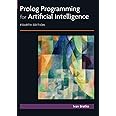
Prolog Programming for Artificial Intelligence 4th Edition


{"desktop_buybox_group_1":[{"displayPrice":"$95.99","priceAmount":95.99,"currencySymbol":"$","integerValue":"95","decimalSeparator":".","fractionalValue":"99","symbolPosition":"left","hasSpace":false,"showFractionalPartIfEmpty":true,"offerListingId":"U6p5r%2BTzSVkiMIcBOhjXJTAbWirswTqclikZa%2F0J0jQb5cuVkC4fXVvpDHEhiJVTbRgj4MmrST9j4RNQsUr5ixCtj6dOwS0OJSssU6mDQJCOCoWpPaRxjn7mlMtd0RkcIGFyc0pvSGk%3D","locale":"en-US","buyingOptionType":"NEW","aapiBuyingOptionIndex":0}]}

Purchase options and add-ons

This best-selling guide to Prolog and Artificial Intelligence, which has been updated to include key developments in the field, concentrates on the art of using the basic mechanisms of Prolog to solve interesting AI problems.


  • Combined approach to Prolog and AI allows flexibility for learning and teaching.
  • Provides a thorough representation of AI, emphasizing practical techniques and Prolog implementations.
  • Prolog programs for use in projects and research are available for download from the companion website http://www.pearsoned.co.uk/bratko

Frequently bought together

This item: Prolog Programming for Artificial Intelligence
$95.99
Get it as soon as Sunday, Mar 29
In Stock
Ships from and sold by Amazon.com.
+
$14.00
Get it as soon as Sunday, Mar 29
In Stock
Ships from and sold by Amazon.com.
+
$22.21
Get it as soon as Friday, Apr 3
Available to ship in 1-2 days
Ships from and sold by Amazon.com.
Total price: $00
To see our price, add these items to your cart.
Details
Added to Cart
Some of these items ship sooner than the others.
Choose items to buy together.

Customers also bought or read

Loading...

Editorial Reviews

From the Back Cover

The fourth edition of this best-selling guide to Prolog and Artificial Intelligence has been updated to include key developments in the field while retaining its lucid approach to these topics. Divided into two parts, the first part of the book introduces the programming language Prolog, while the second part teaches Artificial Intelligence using Prolog as a tool for the implementation of AI techniques.

Prolog has its roots in logic; however the main aim of this book is to teach Prolog as a practical programming tool. This text therefore concentrates on the art of using the basic mechanisms of Prolog to solve interesting problems. The fourth edition has been fully revised and extended to provide an even greater range of applications, which further enhance its value as a self-contained guide to Prolog, AI or AI Programming for students and professional programmers alike.

Features:
· Combined approach to Prolog and AI allows flexibility for learning and teaching
· Provides a thorough representation of AI, emphasizing practical techniques and Prolog implementations
· Prolog programs in the book are available for download from the book's companion website at
www.pearsoned.co.uk/bratko . Lecturers visiting the website have access to PowerPoint slides.

New for this edition:

· Coverage of constraint logic programming (CLP) is extended and now introduced earlier in the book, in the Prolog part

· Most of the existing chapters on AI techniques have been systematically improved and updated

· Coverage of planning methods is deepened in a new chapter that includes implementations of partial order planning and the GRAPHPLAN approach

· The treatment of search methods now includes an RTA* program (real-time A* search)

· The chapter on meta-programming (now chapter 25) is extended by the addition of sections on abductivereasoning, query-the-user interpreter, and a sketch of CLP interpreter, all implemented as Prolog meta-interpreters

· Programming examples are refreshed throughout the book, making them more interesting and practical. One such example introduces semantic reasoning with the well-known lexical database WordNet®


Author:
Professor Ivan Bratko leads the AI Lab in the Faculty of Computer and Information Science at the University of Ljubljana. He has taught Prolog worldwide, as well as applied Prolog in medical expert systems, robot programming, qualitative modelling and computer chess research.

About the Author

Professor Ivan Bratko leads the AI Lab in the Faculty of Computer and Information Science at Ljubljana University. He has taught Prolog world-wide as well as applying Prolog in medical expert systems, robot programming, qualitative modelling and computer chess research.

Product details

About the author

Follow authors to get new release updates, plus improved recommendations.
Ivan Bratko
Brief content visible, double tap to read full content.
Full content visible, double tap to read brief content.

Discover more of the author’s books, see similar authors, read book recommendations and more.

Customer reviews

4.6 out of 5 stars
75 global ratings

Top reviews from the United States

  • Reviewed in the United States on January 17, 2001
    Having just read a book on automated reasoning which covered topics in logic, such as unification and resolution, I was very pleased with the prolog programming language, in that it takes concepts from logic, and uses them in ways that can be applied to a number of interesting areas of AI, such as NLP, planning, and expert systems. I thought Bratko succeeded in making this connection with logic, without burdening the reader with notation and concepts that are really not needed for writing or understanding prolog programs.
    The book also worked for me on the level of providing a good introduction to the syntax and sematics of the language. The first 200 pages succeed to this end.
    Finally, the last 13 chapters can be summarized as representing an introduction to AI from a prolog perspective. On the positive side, he shows how to apply prolog to all of the modern, main streams of AI study. However, on the negative, the slant towards prolog in these chapters tends to oversimplify these disciplines.
    My impression of the language is that it seems good as a prototying language, since it is declarative in nature, but from my experimentation (using SWI Prolog) I think I could write better implementations using c or java.
    In closing, Bratko's book represents a very good place to start learning prolog and the world of AI.

    21 people found this helpful
    Report
  • Reviewed in the United States on April 22, 2014
    Though I have just started this book, I can tell that it is going to be amazing. I have been trying to find a good introduction to Prolog for some time now, and this is exactly what I had been looking for. Clear presentation, beautiful and complete editing work, easy to understand, and comprehensive.

    If you do want to use this book for A.I. though, and you either already understand Prolog or would rather work in lisp/python/etc. this book may be a bit much for you, either in terms of redundancy or over-saturation. However, if you can manage to slug through it (it is rather huge at 678 pgs), I think that anyone interested in A.I. or Prolog could find something helpful in this book.

    Overall, I am excited to work through this book, and I will probably update my review once I have done so.
    7 people found this helpful
    Report
  • Reviewed in the United States on January 28, 2018
    Format: PaperbackVerified Purchase
    In searching Prolog courses on-line, this book is referenced as #1 over and over again. So far I have read about 1/2 the book. It does not disappoint. I find Prolog a hard language to get proficency. The "declarative style" of programming is very different from the other 3 paradigms of programming. (The other three are procedural, object oriented, and functional. As a prerequisite to this book I would suggest "The Structure and Interpretation of Computer Programs." ) This book gives lots of examples and exposition to get both a logical and intuitive feel of problem solving in Prolog. I am afraid it make take more than one reading to understand Prolog.
    9 people found this helpful
    Report
  • Reviewed in the United States on March 19, 2012
    Format: PaperbackVerified Purchase
    First page provides link to web resource page where Prolog code should be available. Unfortunately, if you go there, there is message that "companion web page not available yet" and the only available one is for 3rd edition.

    Otherwise, great Prolog application book, however here and there pretty shallow, such as chapter on CLP
    3 people found this helpful
    Report
  • Reviewed in the United States on October 3, 2010
    A new edition will be out soon, in 2010. This is an excellent book on Prolog *and* on AI.

    For example, chapter 19 is an introduction to inductive learning in first-order logic, an advanced topic rarely found in introductory books. The example program HYPER is a very powerful learner as compared to other "propositional" machine learning methods such as decision trees, neural networks, or support vector machines. I have ported HYPER to Lisp and am still exploring it.

    Prolog is not a very popular language nowadays, but basic knowledge of it is still essential to learning logic-based AI.
    7 people found this helpful
    Report
  • Reviewed in the United States on March 6, 2002
    Professor Bratko has done a tremendous job of putting all the fundamental concepts of Prolog and its applications in various areas of AI. Although this book is focused on Prolog, the concepts that he has discussed are so fundamental that they can be implemented in other languages like Java as well.
    I recommend this book to everyone who wants to learn Prolog. I would also recommend the readers to use a Prolog system to work out the examples and exercises as s/he goes through every chapter. A DEC10 Prolog system (like SICStus Prolog) would probably be the best companion for this book.
    10 people found this helpful
    Report
  • Reviewed in the United States on July 12, 2015
    Format: PaperbackVerified Purchase
    I teach programming in Prolog and Artificial Intelligence in a Mexican University.
    This is an essential book for Prolog programming, excellent!
    A loving fourth edition 2012 from Ivan Bratko.
    3 people found this helpful
    Report
  • Reviewed in the United States on October 18, 2016
    Format: PaperbackVerified Purchase
    very good!

Top reviews from other countries

  • Amazon Customer
    5.0 out of 5 stars I got the third edition at a great price and in perfect condition
    Reviewed in the United Kingdom on November 20, 2016
    I got the third edition at a great price and in perfect condition. I'm learning Prolog for my own interest, not a university course, so managed to get a virtually brand new edition for just over ZAR200 including mail to South Africa. A new edition, which university lecturers tend to insist students bankrupt themselves with, would have been over ZAR1000. (I'm guessing the high price of books is a reason we have student riots in South Africa).

    My main interest is using Prolog for game playing, so am starting at the second last chapter (22) and then referring back as needed. I've only just received the book (incredibly quickly for the notoriously slow South African post office), so can't offer a full review yet.
  • Shubham Chatterjee
    4.0 out of 5 stars nice examples
    Reviewed in India on September 25, 2016
    Very comprehensive and covers all aspects of prolog.....nice examples
  • E. Murat Esin
    5.0 out of 5 stars Etkin
    Reviewed in Turkey on March 17, 2020
    Format: PaperbackVerified Purchase
    Etkin bir sıra ile iyi anlatılmış. Başucu kitabı niteliğinde.
  • AAA
    5.0 out of 5 stars 手続き型プログラマへの示唆に富んだ書
    Reviewed in Japan on March 17, 2023
    Format: PaperbackVerified Purchase
    世の大多数を占める手続き型言語とは異なる思想によって作られた、宣言型言語であるPrologの入門書です。
    全く手続きを使用しないわけではないのですが、基本的には対象の間の関係を定義することで、処理系に解を探索させるという動作形式のプログラミング言語です。
    手続き型言語に慣れた人が読んでいくと、「これでいいのか?」という疑問が湧いてくることが頻繁に起こります。
    そういう時は手続き型言語の細々とした工夫は忘れて、ごくシンプルなデータの並び順への依存と再帰呼び出しと復帰による単純なアプローチであることを思い出してください。
    つじつまが合うか否かという部分すら、処理系が検証・探索してくれるため、プログラマは事実と関係の記述にほぼ専念できます。
    既存の概念はひとまず置いておいて、関係性を充足させるだけでプログラミングが完結するという不思議な世界をぜひ一度は味わってみてください。
    この本のよいところは、常に関係こそがPrologの利点であることを忘れないところです。
    ウェブのProlog入門などでは、他のプログラミング言語と同等の機能の実現に力を注ぎ過ぎて、なぜPrologでやるのかということがおろそかになったりしますが、この本はそのようなことはありません。
  • Phlois
    5.0 out of 5 stars Best book on Prolog with AI
    Reviewed in France on March 18, 2022
    Format: PaperbackVerified Purchase
    If you are interested in the Prolog language and artificial intelligence, this is the book for you.