
Shop Viral Beauty Essentials Now
Kindle app logo image

Download the free Kindle app and start reading Kindle books instantly on your smartphone, tablet, or computer - no Kindle device required.

Read instantly on your browser with Kindle for Web.

Using your mobile phone camera - scan the code below and download the Kindle app.

QR code to download the Kindle App

  • An Introduction to Complex Function Theory (Undergraduate Texts in Mathematics)

Follow the author

Get new release updates & improved recommendations
Something went wrong. Please try your request again later.

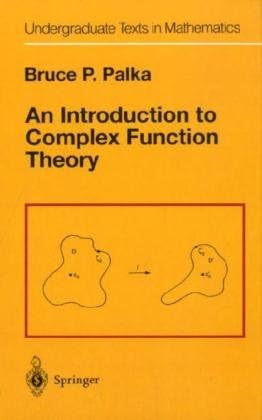
An Introduction to Complex Function Theory (Undergraduate Texts in Mathematics) 1st ed. 1991. Corr. 2nd printing 1995 Edition


This book provides a rigorous yet elementary introduction to the theory of analytic functions of a single complex variable. While presupposing in its readership a degree of mathematical maturity, it insists on no formal prerequisites beyond a sound knowledge of calculus. Starting from basic definitions, the text slowly and carefully develops the ideas of complex analysis to the point where such landmarks of the subject as Cauchy's theorem, the Riemann mapping theorem, and the theorem of Mittag-Leffler can be treated without sidestepping any issues of rigor. The emphasis throughout is a geometric one, most pronounced in the extensive chapter dealing with conformal mapping, which amounts essentially to a "short course" in that important area of complex function theory. Each chapter concludes with a wide selection of exercises, ranging from straightforward computations to problems of a more conceptual and thought-provoking nature.

Product details

  • Publisher ‏ : ‎ Springer
  • Publication date ‏ : ‎ January 1, 1990
  • Edition ‏ : ‎ 1st ed. 1991. Corr. 2nd printing 1995
  • Language ‏ : ‎ English
  • Print length ‏ : ‎ 560 pages
  • ISBN-10 ‏ : ‎ 038797427X
  • ISBN-13 ‏ : ‎ 978-0387974279
  • Item Weight ‏ : ‎ 2.15 pounds
  • Dimensions ‏ : ‎ 6.5 x 1.25 x 9.75 inches
  • Best Sellers Rank: #2,749,443 in Books (See Top 100 in Books)
  • Customer Reviews:

About the author

Follow authors to get new release updates, plus improved recommendations.
Bruce P. Palka
Brief content visible, double tap to read full content.
Full content visible, double tap to read brief content.

Discover more of the author’s books, see similar authors, read book recommendations and more.

Customer reviews

4.8 out of 5 stars
9 global ratings

Top reviews from the United States

  • Reviewed in the United States on July 7, 2011
    Format: HardcoverVerified Purchase
    I have gone through chapters 1, 3, 4, and part of 5 in this book and I love it. I have done many of the problems too. Palka explains everything in great detail. The book is wordy, but I like it that way. Wordiness is a virtue when it comes to learning. I learned the concept of a branch of a funcion due to the careful detail of this text. This book helped me understand many other concepts that I could not understand in Ahlfors. The book did stump me a few times, but the fault was mostly my own. I feel that Palka could have developed Chapter 4, Section 4, a little more, but this is a minor gripe. Palka's discussion of the winding number was good, but it would have been even better if he would have elobarted more on how the uniform continuity of a smooth, closed path guarantees unique single loop subdivisions of the closed interval [a,b]. Again, the gripe is minor and I eventually figured out what is happening. The problem sets are challenging but enlightening. I resorted to other sources for help on some of hardest problems, but I solved most of them independently. I will keep everyone posted when I read the upcoming chapters.

    I would also like to add that Palka is rigorous. He also covers many topics in detail. The book is easier to use than other books due to the detail, not the omission of topics. Palka does not shy away from proving important theorems.

    PS: I am studying independently in hopes of one day getting my Ph.D in mathematics. I already have my M.S. in mathematics.

    6 people found this helpful
    Report
  • Reviewed in the United States on February 15, 2013
    Format: HardcoverVerified Purchase
    The book is very thorough and friendly. Palka writes very clearly, covers topics in a sensible order, and provides plenty of examples. This has been one of the better math texts I've used in the past several years.
    One person found this helpful
    Report
  • Reviewed in the United States on March 23, 2014
    Format: HardcoverVerified Purchase
    I'm most of the way though an upper-level complex analysis course where we've used this book. The book is not bad. The sections follow a nice order, and the book is much more readable compared to Ahlfors, which I have as well. I find that Ahlfors can be very unfocused, where Palka follows a more structured pattern of presenting material. Each section contains a surprisingly large number of exercises which vary from routine computation to non-trivial proofs. Many sections have plenty of figures as well, which help show the geometry behind the complex plane. Overall, I've had a nice experience using this book, and would recommend it to other students in the future.

    That is not to say that Palka is without faults. Our professor rearranged the order of the book, slightly, moving Mobius transformations close to the beginning of the course. This added insight actually made a fair number of the exercises in the middle chapters (mostly concerning Cauchy's thereoms and such) easier. Palka is also prone to being overly chatty, to the point where the the content gets watered down by his verbiage.

    Most aggravating, for me, is Palka's use of notation. He strays from the general path regarding most standard notation, and prefers to adopt his own. For instance, he uses "phi" for "emptyset", "~" for set difference, and several others. While these don't necessarily make any real fault in the book, it is annoying to have to translate Palka's notation. Also, the chapters are numbered with roman numerals, then individual sections and subsections start over from "1" every time. Exercise sections are numbered with the last section of the chapter--it's somewhat of a mess. A more straightforward Ch.sec.subsec would be less confusing.

    Most of these remarks are merely esoteric, though, and as said, the book is overall quite sound. It's worth having for an undergraduate course as a complement to, or in lieu of, more popular books, such as Ahlfors.
    4 people found this helpful
    Report
  • Reviewed in the United States on September 18, 2012
    Format: HardcoverVerified Purchase
    this book is new and good. it costs about 5 business days to deliver to me. and also it is cheaper than other guys
    One person found this helpful
    Report
  • Reviewed in the United States on October 8, 2007
    Format: Hardcover
    I agree that the exposition and proof's are both wordy, but for self study I found this invaluable. I took this course as a reading course, which means no lecture accompanies the course. I find most weeks, I can solve nearly all of the problems assigned by 1-3 readings of the chapter. This is in my opinion the best book I found to date for self study. However, the addition of solutions to selected exercises would be even better. I recommend the book for those wishing for a introduction to complex analysis, or those with some background and wishing to extend their background to include the material covered on most complex qualifying exams.
    8 people found this helpful
    Report
  • Reviewed in the United States on October 21, 2007
    Format: Hardcover
    This textbook was delivered promptly to me in promised condition. It was a real life-saver as well, as this text was required for my Complex Analysis class, and the university bookstores were not carrying it.
  • Reviewed in the United States on June 1, 2001
    Format: Hardcover
    I used this book for a first course in complex analysis. This book comprehensively covers the standard topics in a first course. There are also enrichment sections for those who are interested (such as proving certain definitions are equivalent to the usual definitions). The style of writing is very readable, but this is at the expense of using a lot of words and hence the author sometimes takes a long time to explain a simple idea. This book is not written concisely for this reason. Also, the book does not set out definitions as separate paragraphs nor are they numbered (this seems to be increasingly common for math texts); they are buried within the text, and are very difficult to find later on. Proofs are given out in full and explained in detail with lots of words (at the expense of length and terseness), so that readers can understand very easily. There are plenty of examples, and they demonstrate good techniques for evaluating integrals. There are many exercises and solutions are not provided. Historical facts and footnotes are seldomly found. I believe this book is also suitable for less-prepared students.
    7 people found this helpful
    Report