



Download the free Kindle app and start reading Kindle books instantly on your smartphone, tablet, or computer - no Kindle device required.
Read instantly on your browser with Kindle for Web.
Using your mobile phone camera - scan the code below and download the Kindle app.

Follow the author
OK
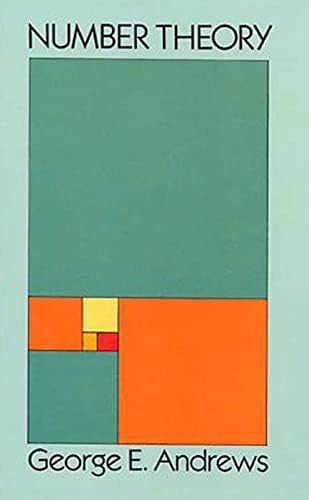
Number Theory (Dover Books on Mathematics) 1st Edition
Purchase options and add-ons
Written by a distinguished mathematician and teacher, this undergraduate text uses a combinatorial approach to accommodate both math majors and liberal arts students. In addition to covering the basics of number theory, it offers an outstanding introduction to partitions, plus chapters on multiplicativity-divisibility, quadratic congruences, additivity, and more.
Although mathematics majors are usually conversant with number theory by the time they have completed a course in abstract algebra, other undergraduates, especially those in education and the liberal arts, often need a more basic introduction to the topic. In this book, the author solves the problem of maintaining the interest of students at both levels by offering a combinatorial approach to elementary number theory. Among the topics covered in this accessible, carefully designed introduction are:
- Multiplicativity-divisibility, including the fundamental theorem of arithmetic
- Combinatorial and computational number theory
- Congruences, arithmetic functions, primitive roots and prime numbers
- Later chapters offer lucid treatments of quadratic congruences, additivity (including partition theory), and geometric number theory
Of particular importance in this text is the author's emphasis on the value of numerical examples in number theory and the role of computers in obtaining such examples. Exercises provide opportunities for constructing numerical tables with or without a computer. Students can then derive conjectures from such numerical tables, after which relevant theorems will seem natural and well-motivated.
Dover is widely recognized for a magnificent mathematics list featuring such world-class theorists as Paul J. Cohen (Set Theory and the Continuum Hypothesis), Alfred Tarski (Undecidable Theories), Gary Chartrand (Introductory Graph Theory), Hermann Weyl (The Concept of a Riemann Surface), Shlomo Sternberg (Dynamical Systems), and multiple works by C. R. Wylie in geometry, plus Stanley J. Farlow's Partial Differential Equations for Scientists and Engineers.
- ISBN-109780486682525
- ISBN-13978-0486682525
- Edition1st
- PublisherDover Publications
- Publication dateOctober 12, 1994
- LanguageEnglish
- Dimensions5.5 x 0.75 x 8.75 inches
- Print length288 pages
There is a newer edition of this item:
Frequently bought together
Customers who viewed this item also viewed
Introduction to Graph Theory (Dover Books on Mathematics)PaperbackFREE Shipping on orders over $35 shipped by AmazonGet it as soon as Thursday, Apr 16
Elementary Number Theory: Second Edition (Dover Books on Mathematics)PaperbackFREE Shipping on orders over $35 shipped by AmazonGet it as soon as Thursday, Apr 16
Introductory Discrete Mathematics (Dover Books on Computer Science)PaperbackFREE Shipping on orders over $35 shipped by AmazonGet it as soon as Thursday, Apr 16
Ordinary Differential Equations (Dover Books on Mathematics)PaperbackFREE Shipping on orders over $35 shipped by AmazonGet it as soon as Thursday, Apr 16
Introduction to Topology: Third Edition (Dover Books on Mathematics)PaperbackFREE Shipping on orders over $35 shipped by AmazonGet it as soon as Thursday, Apr 16
Linear Algebra (Dover Books on Mathematics)PaperbackFREE Shipping on orders over $35 shipped by AmazonGet it as soon as Thursday, Apr 16
Customers also bought or read
- Introductory Discrete Mathematics (Dover Books on Computer Science)
Paperback$20.00$20.00Delivery Thu, Apr 16 - Elementary Number Theory: Second Edition (Dover Books on Mathematics)
Paperback$14.95$14.95Delivery Thu, Apr 16 - Proofs: A Long-Form Mathematics Textbook (The Long-Form Math Textbook Series)
Paperback$20.58$20.58Delivery Thu, Apr 16 - Real Analysis: A Long-Form Mathematics Textbook (The Long-Form Math Textbook Series)
Paperback$24.74$24.74Delivery Thu, Apr 16 - First Order Mathematical Logic (Dover Books on Mathematics)
Paperback$13.71$13.71Delivery Thu, Apr 16 - Category Theory in Context (Aurora: Dover Modern Math Originals)
Paperback$24.62$24.62Delivery Thu, Apr 16 - Understanding Analysis (Undergraduate Texts in Mathematics)#1 Best SellerCalculus
Hardcover$41.21$41.21FREE delivery Sat, Apr 18 - Elementary Real and Complex Analysis (Dover Books on Mathematics)
Paperback$25.84$25.84Delivery Thu, Apr 16 - Fundamental Concepts of Algebra (Dover Books on Mathematics)
Paperback$16.95$16.95Delivery Thu, Apr 16 - Linear Algebra Done Right (Undergraduate Texts in Mathematics)
Hardcover$56.96$56.96FREE delivery Thu, Apr 16 - The Moscow Puzzles: 359 Mathematical Recreations (Dover Math Games & Puzzles)
Paperback$15.80$15.80Delivery Thu, Apr 16 - Friendly Introduction to Number Theory, A (Classic Version) (Pearson Modern Classics for Advanced Mathematics Series)
Paperback$142.73$142.73FREE delivery Thu, Apr 16 - Math History: A Long-Form Mathematics Textbook (The Long-Form Math Textbook Series)
Paperback$32.00$32.00Delivery Thu, Apr 16 - Elementary Analysis: The Theory of Calculus (Undergraduate Texts in Mathematics)
Hardcover$51.40$51.40FREE delivery Thu, Apr 16 - Concepts of Modern Mathematics (Dover Books on Mathematics)
Paperback$16.95$16.95Delivery Thu, Apr 16 - Elementary Number Theory (Springer Undergraduate Mathematics Series)
Paperback$25.59$25.59Delivery Thu, Apr 16 - Real Mathematical Analysis (Undergraduate Texts in Mathematics)
Hardcover$32.00$32.00Delivery Apr 23 - 29
From the Publisher
Where Patterns Meet Proof: A Hands-On Intro to Number Theory
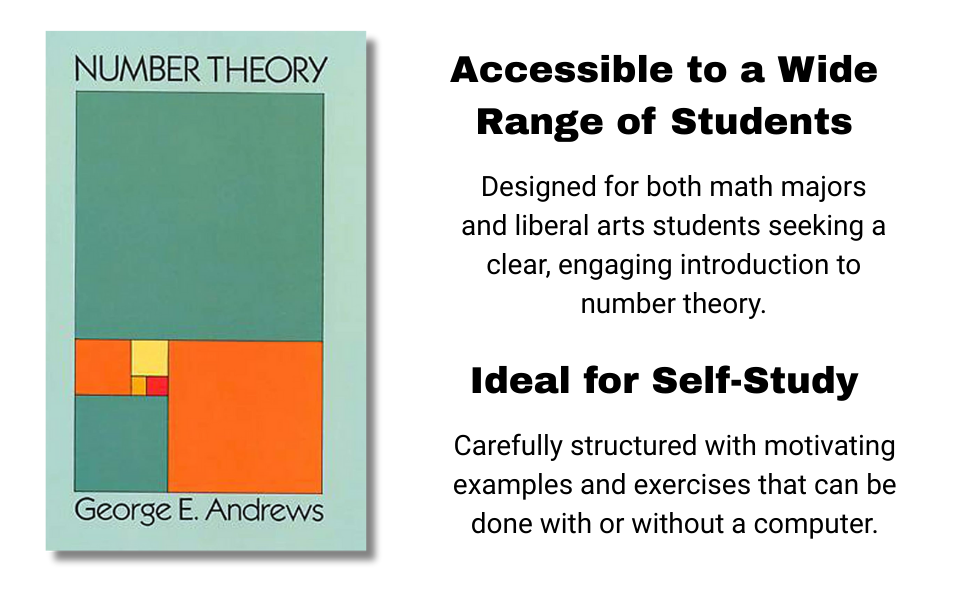
- Combinatorial Approach Keeps It Intuitive – Makes abstract concepts feel natural through patterns, examples, and thoughtful structure.
- Covers Core and Advanced Topics – Includes divisibility, congruences, arithmetic functions, primitive roots, quadratic congruences, and partition theory.
- Learn by Exploring Patterns – Numerical examples and computational exercises encourage students to make conjectures and discover theorems organically.
Editorial Reviews
About the Author
The Holy Grail of Number Theory
George E. Andrews, Evan Pugh Professor of Mathematics at Pennsylvania State University, author of the well-established text Number Theory (first published by Saunders in 1971 and reprinted by Dover in 1994), has led an active career discovering fascinating phenomena in his chosen field — number theory. Perhaps his greatest discovery, however, was not solely one in the intellectual realm but in the physical world as well.
In 1975, on a visit to Trinity College in Cambridge to study the papers of the late mathematician George N. Watson, Andrews found what turned out to be one of the actual Holy Grails of number theory, the document that became known as the "Lost Notebook" of the great Indian mathematician Srinivasa Ramanujan. It happened that the previously unknown notebook thus discovered included an immense amount of Ramanujan's original work bearing on one of Andrews' main mathematical preoccupations — mock theta functions. Collaborating with colleague Bruce C. Berndt of the University of Illinois at Urbana-Champaign, Andrews has since published the first two of a planned three-volume sequence based on Ramanujan's Lost Notebook, and will see the project completed with the appearance of the third volume in the next few years.
In the Author's Own Words:
"It seems to me that there's this grand mathematical world out there, and I am wandering through it and discovering fascinating phenomena that often totally surprise me. I do not think of mathematics as invented but rather discovered." — George E. Andrews
Product details
- ASIN : 0486682528
- Publisher : Dover Publications
- Publication date : October 12, 1994
- Edition : 1st
- Language : English
- Print length : 288 pages
- ISBN-10 : 9780486682525
- ISBN-13 : 978-0486682525
- Item Weight : 10.4 ounces
- Dimensions : 5.5 x 0.75 x 8.75 inches
- Part of series : Dover Books on Mathematics
- Best Sellers Rank: #131,707 in Books (See Top 100 in Books)
- #9 in Number Theory (Books)
- #94 in Mathematics (Books)
- Customer Reviews:
About the author

Discover more of the author’s books, see similar authors, read book recommendations and more.
Customer reviews
Customer Reviews, including Product Star Ratings help customers to learn more about the product and decide whether it is the right product for them.
To calculate the overall star rating and percentage breakdown by star, we don’t use a simple average. Instead, our system considers things like how recent a review is and if the reviewer bought the item on Amazon. It also analyzed reviews to verify trustworthiness.
Learn more how customers reviews work on AmazonCustomers say
Generated from the text of customer reviewsSelect to learn more
Reviews with images
Don't buy the Kindle version
Top reviews from the United States
There was a problem filtering reviews. Please reload the page.
- Reviewed in the United States on June 7, 2011Format: PaperbackVerified PurchaseI recently took a one-semester course using this text. I found it to be one of the best textbooks I've used so far. The exposition was clear and easy to digest, with just the right number of clarifications and examples. The exercises were numerous, challenging and illuminating. No background beyond very basic set theory is assumed, and in fact the writer goes very far out of his way to keep his exposition separate from abstract algebra. This is most evident in the chapter on primitive roots. I can't speak for the second half of the book, on additivity, but I can say with certainty that the first nine chapters are worth the effort.
- Reviewed in the United States on February 23, 2012Format: PaperbackVerified PurchaseA few years ago, I read this book by George Andrews of Penn State University into chapter 8 and this 1971 textbook by him already shows his long interest in both combinatorics and number theory. Where I stopped reading was when the author's proofs started being multiple pages long.
Here are the titles of the chapters with their starting pages:
// PART I Multiplicativity-Divisibility // 1. Basis Representation-3 / 2. The Fundamental Theorem of Arithmetic-12 / 3. Combinatorial and Computational Number Theory-30 / 4. Fundamentals of Congruences-49 / 5. Solving Congruences-58 / 6. Arithmetic Functions-75 / 7. Primitive Roots-93 / 8. Prime Numbers-100 // PART II Quadratic Congruences // 9. Quadratic Residues-115 / 10. Distribution of Quadratic Residues-128 // PART III Additivity // 11. Sums of Squares-141 / 12. Elementary Partition Theory-149 / 13. Partition Generating Functions-160 / 14. Partition Identities-175 // PART IV Geometric Number Theory // 15. Lattice Points-201 / There are four mathematical appendices and the full set of indices after the 15 chapters--213-259.
From the complicated table of contents above, one can see a broad sweep of combinatorial number theory. Part I is mostly pretty straight number theory, and that is what I did read. Part III on additivity is almost fully combinatorics more than number theory though. Still the price of this book is quite low to have access to all of this big range of mathematics to pick and choose what is most interesting to any given reader. Recommended.
- Reviewed in the United States on December 22, 2000Format: PaperbackVerified PurchaseGeorge Andrews is the reigning expert on partitions in the mathematical community who has written many seminal papers on the subject over the past half-century! If you don't know what partitions are in the theoretical sense, don't worry, the text provides ample introduction. I don't think you can find a more elementary introduction to the difficult, but extraordinarily powerful and elegant theory of partitions. The book covers the basics of number theory well, but it is the chapters on partitions that make this text stand out. It covers the Rogers-Ramanujan identities as well as the Jacobi triple product identity. It is rare in the mathematical community that an expert in a subject also writes a ground-level introductory text - but that's what you have here. Thanks to the dover edition, it's now quite affordable.
- Reviewed in the United States on December 18, 2024Format: PaperbackVerified PurchaseDefinitely not an easy read, but it was lots of fun and I liked it.
- Reviewed in the United States on August 10, 2016Format: KindleVerified PurchaseThe presentation is consistent and if you don't fight it, brings back pleasant memories. I remember being afraid of the notation, did I really understand it? There are multiple levels of abstraction to deal with. They pop up at odd times during a reading. Keep going until no new meanings jump out at you, then put it down, wait awhile and read it again. It's nice not to worry about an examination or presentation of the material.
- Reviewed in the United States on January 16, 2025Format: PaperbackVerified PurchaseGood book if you have someone with you but it has a really hard introduction. The proof is not for the faint of heart and is beautiful if you understand it but I would recommend a different book (probably not from springer either if you are self teaching lol)./
- Reviewed in the United States on February 11, 2012Format: PaperbackVerified PurchaseI had a number theory class back in the dark ages when i was studying Mathematics at OSU. Before I started this book I reviewed another number theory book. It was like deja vu - the method was exactly what I had seen before. In fact, it may have been the same book. Then I picked this up to go a little more in depth. I was a little thrown off at first. Pretty much the same things were covered but from such a vastly different angle it almost seemed like a whole different field of mathematics.
I can't say which viewpoint is the correct one (they both are, I guess) but, since the books are so inexpensive, I would suggest try each or using both. It is often eye-opening to see the same conclusion derived from attacking the problem from more than one angle.
Top reviews from other countries
Adam BeeblebrockReviewed in Canada on March 18, 20185.0 out of 5 stars Five Stars
Format: PaperbackVerified Purchasegood book
-
アーベル&ベルヌーイReviewed in Japan on October 1, 20194.0 out of 5 stars 分かりやすく、モダンな初学者向けの整数論
Format: PaperbackVerified Purchaseいわゆる平方剰余までの初等整数論の解説書であるが、数学専攻の学生を視野においた組み合わせ数学も随所に取り入れている。記述はふんだんに実例を取り上げて丁寧であるが定理等は簡潔にまとめられている。日本では、高木貞治の初等整数論が名著とされてはいるが、これは数学専攻の学生を対象としたかなり難解な書で、初学者にはハードルは高い。その点Number theoryは初学者には取っ付きやすく、高校の数学Aで学んだ学生にはスムーズに接続されるであろう。整数論は理科系の学生には基礎科目としては、通常カリキュラムには入っていない。しかし昨今ネットの暗号化、仮想通貨のブロックチェーンなどの時代の要請を鑑みると、整数論を学ぶことは理科系学生には必須と考えられる。その点で、このNumber theoryは英語も平易であるから整数論を学ぶ教科書として、十分選択肢になりうる。
M. A. PenaReviewed in Spain on January 14, 20265.0 out of 5 stars Great introductory book on Number Theory
Format: PaperbackVerified PurchaseA classic book that covers elementary number theory and some advanced topics as well.
The author used a "discovery" approach that it's not common in most modern texts on Number Theory. Each chapter and section is about a "question" that the author explores, and then uses to establish the theorems and proofs.
The exercises aren't too difficult, but they are good enough to keep you engaged.
As a downside, I should say that the approach is not as easy to revisit as other books that go directly into "theorem/proof" without too much exposure.
-
Flavia Regina Prado Teixeira BorjaReviewed in Brazil on May 23, 20225.0 out of 5 stars Interessante
Format: PaperbackVerified PurchaseLivro de leitura interessante
Thomas CullenReviewed in the United Kingdom on July 26, 20175.0 out of 5 stars Five Stars
Format: PaperbackVerified Purchasevery good introduction to number theory