
Discover products with sustainability features this Earth month
Enjoy fast, free delivery, exclusive deals, and award-winning movies & TV shows.
Kindle app logo image

Download the free Kindle app and start reading Kindle books instantly on your smartphone, tablet, or computer - no Kindle device required.

Read instantly on your browser with Kindle for Web.

Using your mobile phone camera - scan the code below and download the Kindle app.

QR code to download the Kindle App

  • Theory of Functions, Parts I and II (Dover Books on Mathematics)

Follow the author

Get new release updates & improved recommendations
Something went wrong. Please try your request again later.

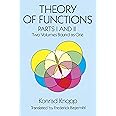
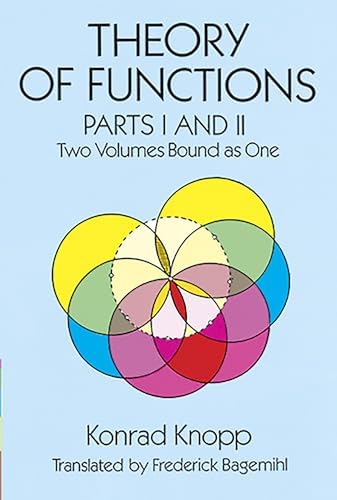
Theory of Functions, Parts I and II (Dover Books on Mathematics)


{"desktop_buybox_group_1":[{"displayPrice":"$16.95","priceAmount":16.95,"currencySymbol":"$","integerValue":"16","decimalSeparator":".","fractionalValue":"95","symbolPosition":"left","hasSpace":false,"showFractionalPartIfEmpty":true,"offerListingId":"WP86kz6KY0oiJ%2BIgzd%2Ba%2F%2FEodLpfb5%2BCtebhysmLcEkGyqWPb8D6F%2F%2BQT1lOh7LlibGPt7IDd%2FbP11OvBgq642NXbMJk7jcQhFefigcPRezt9nWpQ8diQUTkFayaGwEIunr4moGT7JI%3D","locale":"en-US","buyingOptionType":"NEW","aapiBuyingOptionIndex":0}]}

Purchase options and add-ons

This is a one-volume edition of Parts I and II of the classic five-volume set The Theory of Functions prepared by renowned mathematician Konrad Knopp. Concise, easy to follow, yet complete and rigorous, the work includes full demonstrations and detailed proofs.
Part I stresses the general foundation of the theory of functions, providing the student with background for further books on a more advanced level.
Part II places major emphasis on special functions and characteristic, important types of functions, selected from single-valued and multiple-valued classes.

Frequently bought together

This item: Theory of Functions, Parts I and II (Dover Books on Mathematics)
$16.95
Get it as soon as Thursday, Apr 16
Only 10 left in stock (more on the way).
Ships from and sold by Amazon.com.
+
$19.44
Get it as soon as Thursday, Apr 16
Only 13 left in stock (more on the way).
Ships from and sold by Amazon.com.
Total price: $00
To see our price, add these items to your cart.
Details
Added to Cart
One of these items ships sooner than the other.
Choose items to buy together.

Customers also bought or read

Loading...

Product details

About the author

Follow authors to get new release updates, plus improved recommendations.
Konrad Knopp
Brief content visible, double tap to read full content.
Full content visible, double tap to read brief content.

Discover more of the author’s books, see similar authors, read book recommendations and more.

Customer reviews

4.4 out of 5 stars
35 global ratings

Top reviews from the United States

  • Reviewed in the United States on August 17, 2019
    Format: PaperbackVerified Purchase
    The book is remarkably concise in covering a wide range of subject matter in a clear and coherent manner. There are four sections: I. "Fundamental concepts", II. "Integral Theorems", III. "Series and the Expansion of Analytic Functions in Series", and IV. "Singularities". While the third section is the longest, the emphasis throughout is on analytic functions, especially in regard to functions of a complex variable. Cauchy's contributions to the conditions met by analytic functions, and the evaluation of their singularities, are emphasized, as they should be.
    The translation, by Frederick Bagemihi, is remarkably clear, and the reprint(s), by Dover, are quite inexpensive and available in a choice of formats (one or two volumes). There is also a preliminary small volume, "Elements...", as well as
    problem books, available as one or two small volumes.

    2 people found this helpful
    Report
  • Reviewed in the United States on November 29, 2011
    Format: PaperbackVerified Purchase
    I have yet to work through the book, but its place in Knopp's original five-volume sequence was not apparent from Amazon's or Dover's product descriptions, so I list the entire sequence here (Dover English editions, translated from the German originals), followed by the tables of contents, which I had difficulty finding in one place:

    Volume 1: Elements of the Theory of Functions, ISBN-10: 0486601544, ISBN-13: 978-0486601540; this volume is cited as a prerequisite on page 1 the next volume. Unfortunately it is out of print but used copies (or substitutes) can be found.

    Volumes 2 and 3 (the current book): Theory of Functions, Parts I and II (Dover Books on Mathematics) (Pts. 1 & 2). ISBN-10: 0486692191, ISBN-13: 978-0486692197

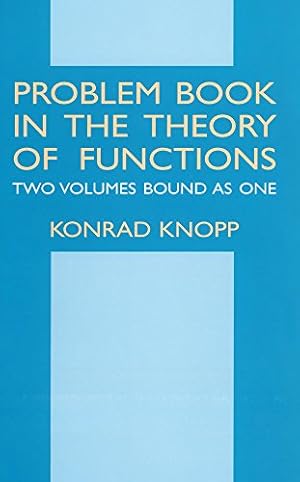
    Volumes 4 and 5: Problem Book in the Theory of Functions (Dover Books on Mathematics). ISBN-10: 0486414515, ISBN-13: 978-0486414515.

    Volume 1 (Elements of the Theory of Functions) Table of Contents:
    ------------------------------------------------------------
    Section I. Complex Numbers and their Geometric Representation

    Chapter I. Foundations
    1. Introduction
    2. The system of real numbers
    3. Pointgs and vectors of the plane

    Chapter II. The System of Complex Numbers and the Gaussian Plane of Numbers
    4. Historical remarks
    5. Introduction of complex numbers. Notation
    6. Equality and inequality
    7. Addition and subtraction
    8. Multiplication and division
    9. Derived rules. Powers
    10. The system of complex numbers as an extension of the system of real numbers
    11. Trigonometric representation of complex numbers
    12. Geometric representation of multiplication and division
    13. Inequalities and absolute values. Examples

    Chapter III. The Riemann Sphere of Numbers
    14. The stereographic projection
    15. The Riemann sphere of numbers. The point infinity. Examples

    Section II. Linear Functions and Circular Transformations

    Chapter IV. Mapping by Means of Linear Functions
    16. Mapping by means of entire linear functions
    17. Mapping by means of the function w = 1/z
    18. Mapping by means of arbitrary linear functions

    Chapter V. Normal Forms and Particular Linear Mappings
    19. The group-property of linear transformations
    20. Fixed points and normal forms
    21. Particular linear mappings. Cross ratios
    22. Further examples

    Section III. Sets and Sequences. Power Series

    Chapter VI. Point Sets and Sets of Numbers
    23. Point sets
    24. Sets of real numbers
    25. The Bolzano-Weierstrass theorem

    Chapter VII. Sequences of Numbers. Infinite Series
    26. Sequences of complex numbers
    27. Sequences of real numbers
    28. Infinite series

    Chapter VIII. Power Series
    29. The circle of convergence
    30. Operations on power series

    Section IV. Analytic Functions and Conformal Mapping

    Chapter IX. Functions of a Complex Variable
    31. The concept of a function of a complex variable
    32. Limits of functions
    33. Continuity
    34. Differentiability
    35. Properties of functions represented by power series

    Chapter X. Analytic Functions and Conformal Mapping
    36. Analytic functions
    37. Conformal mapping

    Section V. The Elementary Functions

    Chapter XI. Power and Root. The Rational Functions
    38. Power and root
    39. The entire rational functions
    40. The fractional rational functions

    Chapter XII. The Exponential, Trigonometric, and Hyperbolic Functions
    41. The exponential function
    42. The functions cos z and sin z
    43. The functions tan z and cot z
    44. The hyperbolic functions

    Chapter XIII. The Logarithm, the Cyclometric Functions, and the Binomial Series
    45. The logarithm
    46. The cyclometric functions
    47. The binomial series and the general power

    Bibliography; Index

    Volume 2 and 3 (Theory of Functions, Parts I and II) Table of Contents:
    ------------------------------------------------------------
    PART I: ELEMENTS OF THE GENERAL THEORY OF ANALYTIC FUNCTIONS

    Section I. Fundamental Concepts

    Chapter 1. Numbers and Points
    1. Prerequisites
    2. The Plane and Sphere of Complex Numbers
    3. Point Sets and Sets of Numbers
    4. Paths, Regions, Continua

    Chapter 2. Functions of a Complex Variable
    5. The Concept of a Most General (Single-valued) Function of a Complex Variable
    6. Continuity and Differentiability
    7. The Cauchy-Riemann Differential Equations

    Section II. Integral Theorems

    Chapter 3. The Integral of a Continuous Function
    8. Definition of the Definite Integral
    9. Existence Theorem for the Definite Integral
    10. Evaluation of Definite Integrals
    11. Elementary Integral Theorems

    Chapter 4. Cauchy's Integral Theorem
    12. Formulation of the Theorem
    13. Proof of the Fundamental Theorem
    14. Simple Consequences and Extensions

    Chapter 5. Cauchy's Integral Formulas
    15. The Fundamental Formula
    16. Integral Formulas for the Derivatives

    Section III. Series and the Expansion of Analytic Functions in Series

    Chapter 6. Series with Variable Terms
    17. Domain of Convergence
    18. Uniform Convergence
    19. Uniformly Convergent Series of Analytic Functions

    Chapter 7. The Expansion of Analytic Functions in Power Series
    20. Expansion and Identity Theorems for Power Series
    21. The Identity Theorem for Analytic Functions

    Chapter 8. Analytic Continuation and Complete Definition of Analytic Functions
    22. The Principle of Analytic Continuation
    23. The Elementary Functions
    24. Continuation by Means of Power Series and Complete Definition of Analytic Functions
    25. The Monodromy Theorem
    26. Examples of Multiple-valued Functions

    Chapter 9. Entire Transcendental Functions
    27. Definitions
    28. Behavior for Large z

    Section IV. Singularities

    Chapter 10. The Laurent Expansion
    29. The Expansion
    30. Remarks and Examples

    Chapter 11. The Various types of Singularities
    31. Essential and Non-essential Singularities or Poles
    32. Behavior of Analytic Functions at Infinity
    33. The Residue Theorem
    34. Inverses of Analytic Functions
    35. Rational Functions

    Bibliography; Index

    PART II: APPLICATIONS AND CONTINUATION OF THE GENERAL THEORY

    Introduction

    Section I. Single-valued Functions

    Chapter 1. Entire Functions
    1. Weierstrass's Factor-theorem
    2. Proof of Weierstrass's Factor-theorem
    3. Examples of Weierstrass's Factor-theorem

    Chapter 2. Meromorphic Func
    4. Mittag-Leffler's Theorem
    5. Proof of Mittag-Leffler's Theorem
    6. Examples of Mittag-Leffler's Theorem

    Chapter 3. Periodic Functions
    7. The Periods of Analytic Functions
    8. Simply Periodic Functions
    9. Doubly Periodic Functions; in Particular, Elliptic Functions

    Section II. Multiple-valued Functions

    Chapter 4. Root and Logarithm
    10. Prefatory Remarks Concerning Multiple-valued Functions and Riemann Surfaces
    11. The Riemann Surfaces for p(root)z and log z
    12. The Riemann Surfaces for the Functions w = root(z - a1)(z - a2) . . . (z - ak)

    Chapter 5. Algebraic Functions
    13. Statement of the Problem
    14. The Analytic Character of the Roots in the Small
    15. The Algebraic Function

    Chapter 6. The Analytic Configuration
    16. The Monogenic Analytic Function
    17. The Riemann Surface
    18. The Analytic Configuration

    Bibliography, Index

    Volume 4 and 5 (Problem Book in the Theory of Functions, Two Volumes Bound As One) Table of Contents:
    ------------------------------------------------------------
    Volume I: Problems in the Elementary Theory of Functions

    Chapter I. Fundamental Concepts
    1. Numbers and Points. Problems; Answers
    2. Point Sets. Paths. Regions

    Chapter II. Infinite Sequences and Series
    3. Limits of Sequences. Infinite Series with Constant Terms. Problems; Answers
    4. Convergence Properties of Power Series. Problems; Answers

    Chapter III. Functions of a Complex Variable
    5. Limits of Functions. Continuity and Differentiability. Problems; Answers
    6. Simple Properties of the Elementary Functions. Problems; Answers

    Chapter IV. Integral Theorems
    7. Integration in the Complex Domain. Problems; Answers
    8. Cauchy's Integral Theorems and Integral Formulas. Problems; Answers

    Chapter V. Expansion in Series
    9. Series with Variable Terms. Uniform Convergence. Problems; Answers
    10. Expansion in Power Series. Problems; Answers
    11. Behaviour of Power Series on the Circle of Convergence. Problems; Answers

    Chapter V. Conformal Mapping
    12. Linear Functions. Stereographic Projection. Problems; Answers
    13. Simple Non-Linear Mapping Problems. Problems; Answers

    Volume II: Problems in the Advanced Theory of Functions

    Foreword

    Chapter I. Additional Problems for I, Chs. 1-5
    1. Fundamental Concepts
    2. Infinite Sequences and Series
    3. Functions of a Complex Variable
    4. Integral Theorems
    5. Expansions in Series

    Chapter II. Singularities
    6. The Laurent Expansion
    7. The Various Types of Singularities
    8. The Residue Theorem, Zeros, and Poles

    Chapter III. Entire and Meromorphic Functions
    9. Infinite Products. Weierstrass's Factor-theorem
    10. Entire Functions
    11. Partial-fractions Series. Mittag-Leffler's Theorem
    12. Meromorphic Functions

    Chapter IV. Periodic Function
    13. Simply Periodic Functions
    14. Doubly Periodic Functions

    Chapter V. Analytic Continuation
    15. Behavior of Power Series on the Boundary of the Circle of Convergence
    16. Analytic Combination of Power Series
    17. Analytic Continuation of Arbitrarily Given Functions

    Chapter VI. Multiple-valued Functions and Riemann Surfaces
    18. Multiple-valued Functions in General
    19. Multiple-valued Functions; in Particular, Algebraic Functions

    Chapter VII. Conformal Mapping
    20. Concept and General Theory
    21. Specific Mapping Problems
    72 people found this helpful
    Report
  • Reviewed in the United States on June 20, 2000
    Format: Paperback
    Despite not being a very recent book, a graduate student of mathematics who has to prepare complex analysis as a general topic for his qualifying examinations may find that this text covers all the essential material in the subject.
    21 people found this helpful
    Report
  • Reviewed in the United States on May 24, 2016
    Format: eTextbookVerified Purchase
    This is one of the classics of complex analysis. It is not as theoretically detailed as Walter Rudin's "Real and Complex Analysis" but it is an excellent treatment of the subject. It is best used in conjunction with the "Problem Book" by the same author.
    4 people found this helpful
    Report
  • Reviewed in the United States on October 24, 2017
    Format: PaperbackVerified Purchase
    This book is an inexpensive but great introduction to the Theory of Functions. Combining 2 volumes into 1 is an excellent idea. I highly recommend this Dover reprint.
  • Reviewed in the United States on December 17, 2015
    Format: PaperbackVerified Purchase
    Good for math purists but a little too detailed for me.
  • Reviewed in the United States on August 9, 2015
    Format: PaperbackVerified Purchase
    Excellent
  • Reviewed in the United States on July 11, 2002
    Format: Paperback
    This elegant little book covers the elements of a senior or 1st year graduate course on complex analysis, although a really good mathematics program like at Berkeley may look upon it as providing some material for a junior course in advanced calculus. It is not a new book, i.e. it predates the space age and computers, but the material is timeless and fundamental. Highly recommended for those who want some exposure to a first-class style in mathematics.
    42 people found this helpful
    Report

Top reviews from other countries

  • Taro Nishino
    5.0 out of 5 stars A book of the good old days
    Reviewed in Japan on February 15, 2012
    Format: PaperbackVerified Purchase
    For the present I should like to recommend this book to the uninitiated concerning complex analysis inasmuch as Ahlfors's book is priced too high to get a copy easily. Why the heck is that book that expensive? I couldn't believe my eyes. Did a popular edition go out of print? To tell the truth, I hesitated to write my review concerning that book, but summoned up my courage to write that review in the sense that the worth of that book is one thing, and its price another. Be that as it may, it's desirable that a popular edition should be reissued.
    To cut this digression short, I must return to this book. Needless to say, the book is classic, and so passes down German mathematics of the good old days, especially the prewar days; consequently neither homology nor homotopy appears in the book. Even so, it must be sufficient for the uninitiated to learn the subject.