









Download the free Kindle app and start reading Kindle books instantly on your smartphone, tablet, or computer - no Kindle device required.
Read instantly on your browser with Kindle for Web.
Using your mobile phone camera - scan the code below and download the Kindle app.
Follow the authors
OK
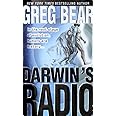
Darwin's Radio Mass Market Paperback – July 5, 2000
Purchase options and add-ons
Ancient diseases encoded in the DNA of humans wait like sleeping dragons to wake and infect again--or so molecular biologist Kaye Lang believes. And now it looks as if her controversial theory is in fact chilling reality. For Christopher Dicken, a "virus hunter" at the Epidemic Intelligence Service, has pursued an elusive flu-like disease that strikes down expectant mothers and their offspring. Then a major discovery high in the Alps --the preserved bodies of a prehistoric family--reveals a shocking link: something that has slept in our genes for millions of years is waking up.
Now, as the outbreak of this terrifying disease threatens to become a deadly epidemic, Dicken and Lang must race against time to assemble the pieces of a puzzle only they are equipped to solve--an evolutionary puzzle that will determine the future of the human race . . . if a future exists at all.
- Print length544 pages
- LanguageEnglish
- PublisherBallantine Books
- Publication dateJuly 5, 2000
- Dimensions4.2 x 1.15 x 6.75 inches
- ISBN-109780345435248
- ISBN-13978-0345435248
Book recommendations, author interviews, editors' picks, and more. Read it now.
Frequently bought together

Customers who viewed this item also viewed
Darwin's ChildrenHardcoverFREE Shipping on orders over $35 shipped by AmazonGet it as soon as Thursday, Apr 16Only 1 left in stock - order soon.
Red Mars (Mars Trilogy)PaperbackFREE Shipping on orders over $35 shipped by AmazonGet it as soon as Thursday, Apr 16
Dark Matter: A NovelPaperbackFREE Shipping on orders over $35 shipped by AmazonGet it as soon as Thursday, Apr 16
A Fire Upon The Deep (Zones of Thought, 1)PaperbackFREE Shipping on orders over $35 shipped by AmazonGet it as soon as Thursday, Apr 16
The Left Hand of Darkness: 50th Anniversary EditionMass Market PaperbackFREE Shipping on orders over $35 shipped by AmazonGet it as soon as Thursday, Apr 16
Editorial Reviews
Review
“Vintage Bear . . . [His] characters are as complex as his ideas.”—The Seattle Times
“Bear is one of our very best, and most imaginative, speculative writers.”—New York Daily News
“I’m not sure my heart's ever beaten as hard from reading fiction as it did while I read Darwin’s Radio. This is science fiction set pretty much in the world of today, but . . . it’s a world undergoing a profound change, one that's maybe even necessary.”—Stephen Graham Jones, New York Times bestselling author of The Only Good Indian
“A writer for anyone concerned with the human condition.”—Seattle Post-Intelligencer
“[A] riveting, near-future thriller.”—Publishers Weekly (starred review)
“Absorbing and ingenious.”—Kirkus Reviews
“If anyone is the complete master of the grand-scale SF novel, it’s Bear.”—Booklist
From the Inside Flap
Ancient diseases encoded in the DNA of humans wait like sleeping dragons to wake and infect again--or so molecular biologist Kaye Lang believes. And now it looks as if her controversial theory is in fact chilling reality. For Christopher Dicken, a "virus hunter" at the Epidemic Intelligence Service, has pursued an elusive flu-like disease that strikes down expectant mothers and their offspring. Then a major discovery high in the Alps --the preserved bodies of a prehistoric family--reveals a shocking link: something that has slept in our genes for millions of years is waking up.
Now, as the outbreak of this terrifying disease threatens to become a deadly epidemic, Dicken and Lang must race against time to assemble the pieces of a puzzle only they are equipped to solve--an evolutionary puzzle that will determine the future of the human race . . . if a future exists at all.
From the Back Cover
Ancient diseases encoded in the DNA of humans wait like sleeping dragons to wake and infect again--or so molecular biologist Kaye Lang believes. And now it looks as if her controversial theory is in fact chilling reality. For Christopher Dicken, a "virus hunter" at the Epidemic Intelligence Service, has pursued an elusive flu-like disease that strikes down expectant mothers and their offspring. Then a major discovery high in the Alps --the preserved bodies of a prehistoric family--reveals a shocking link: something that has slept in our genes for millions of years is waking up.
Now, as the outbreak of this terrifying disease threatens to become a deadly epidemic, Dicken and Lang must race against time to assemble the pieces of a puzzle only they are equipped to solve--an evolutionary puzzle that will determine the future of the human race . . . if a future exists at all.
About the Author
Excerpt. © Reprinted by permission. All rights reserved.
AUGUST
The flat afternoon sky spread over the black and gray mountains like a stage backdrop, the color of a dog's pale crazy eye.
His ankles aching and back burning from a misplaced loop of nylon rope, Mitch Rafelson followed Tilde's quick female form along the margin between the white firn and a dust of new snow on the field. Mingled with the ice boulders of the fall, crenels and spikes of old ice had been sculpted by summer heat into milky, flint-edged knives.
To Mitch's left, the mountains rose over the jumble of black boulders flanking the broken slope of the ice fall. On the right, in the full glare of the sun, the ice rose in blinding brilliance to the perfect catenary of the cirque.
Franco was about twenty yards to the south, hidden by the rim of Mitch's goggles. Mitch could hear him but not see him. Some kilometers behind, also out of sight now, was the brilliant orange, round fiberglass-and-aluminum bivouac where they had made their last rest stop. He did not know how many kilometers they were from the last hut, whose name he had forgotten; but the memory of bright sun and warm tea in the sitting room, the Gaststube, gave him some strength. When this ordeal was over, he would get another cup of strong tea and sit in the Gaststube and thank God he was warm and alive.
They were approaching the wall of rock and a bridge of snow lying over a chasm dug by meltwater. These now-frozen streams formed during the spring and summer and eroded the edge of the glacier. Beyond the bridge, depending from a U-shaped depression in the wall, rose what looked like a gnome's upside-down castle, or a pipe organ carved from ice: a frozen waterfall spread out in many thick columns. Chunks of dislodged ice and drifts of snow gathered around the dirty white of the base; sun burnished the cream and white at the top.
Franco came into view as if out of a fog and joined up with Tilde. So far they had been on relatively level glacier. Now it seemed that Tilde and Franco were going to scale the pipe organ.
Mitch stopped for a moment and reached behind to pull out his ice ax. He pushed up his goggles, crouched, then fell back on his butt with a grunt to check his crampons. Ice balls between the spikes yielded to his knife.
Tilde walked back a few yards to speak to him. He looked up at her, his thick dark eyebrows forming a bridge over a pushed-up nose, round green eyes blinking at the cold.
"This saves us an hour," Tilde said, pointing at the pipe organ. "It's late. You've slowed us down." Her English came precise from thin lips, with a seductive Austrian accent. She had a slight but well-proportioned figure, white blond hair tucked under a dark blue Polartec cap, an elfin face with clear gray eyes. Attractive, but not Mitch's type; still, they had been lovers of the moment before Franco arrived.
"I told you I haven't climbed in eight years," Mitch said. Franco was showing him up handily. The Italian leaned on his ax near the pipe organ.
Tilde weighed and measured everything, took only the best, discarded the second best, yet never cut ties in case her past connections should prove useful. Franco had a square jaw and white teeth and a square head with thick black hair shaved at the sides, an eagle nose, Mediterranean olive skin, broad shoulders and arms knotted with muscles, fine hands, very strong. He was not too smart for Tilde, but no dummy, either. Mitch could imagine Tilde pulled from her thick Austrian forest by the prospect of bedding Franco, light against dark, like layers in a torte. He felt curiously detached from this image. Tilde made love with a mechanical rigor that had deceived Mitch for a time, until he realized she was merely going through the moves, one after the other, as a kind of intellectual exercise. She ate the same way. Nothing moved her deeply, yet she had real wit at times, and a lovely smile that drew lines on the corners of those thin, precise lips.
"We must go down before sunset," Tilde said. "I don't know what the weather will do. It's two hours to the cave. Not very far, but a hard climb. If we're lucky, you'll have an hour to look at what we've found."
"I'll do my best," Mitch said. "How far are we from the tourist trails? I haven't seen any red paint in hours."
Tilde pulled away her goggles to wipe them, gave him a flash smile with no warmth. "No tourists up here. Most good climbers stay away, too. But I know my way."
"Snow goddess," Mitch said.
"What do you expect?" she said, taking it as a compliment. "I've climbed here since I was a girl."
"You're still a girl," Mitch said. "Twenty-five, twenty-six?"
She had never revealed her age to Mitch. Now she appraised him as if he were a gemstone she might reconsider purchasing. "I am thirty-two. Franco is forty but he's faster than you."
"To hell with Franco," Mitch said without anger.
Tilde curled her lip in amusement. "We are all weird today," she said, turning away. "Even Franco feels it. But another Iceman . . . what would that be worth?"
The very thought shortened Mitch's breath, and he did not need that now. His excitement curled back on itself, mixing with his exhaustion. "I don't know," he said.
Product details
- ASIN : 0345435249
- Publisher : Ballantine Books
- Publication date : July 5, 2000
- Language : English
- Print length : 544 pages
- ISBN-10 : 9780345435248
- ISBN-13 : 978-0345435248
- Item Weight : 8.8 ounces
- Dimensions : 4.2 x 1.15 x 6.75 inches
- Book 1 of 2 : Darwin's Radio
- Best Sellers Rank: #894,805 in Books (See Top 100 in Books)
- #712 in Hard Science Fiction (Books)
- #1,712 in Science Fiction Short Stories
- #5,212 in Science Fiction Crime & Mystery
- Customer Reviews:
About the authors

Greg Bear is the author of more than thirty books, spanning thrillers, science fiction, and fantasy, including Blood Music, Eon, The Forge of God, Darwin's Radio, City at the End of Time, and Hull Zero Three. His books have won numerous international prizes, have been translated into more than twenty-two languages, and have sold millions of copies worldwide. Over the last twenty-eight years, he has also served as a consultant for NASA, the U.S. Army, the State Department, the International Food Protection Association, and Homeland Security on matters ranging from privatizing space to food safety, the frontiers of microbiology and genetics, and biological security.

Discover more of the author’s books, see similar authors, read book recommendations and more.
Customer reviews
Customer Reviews, including Product Star Ratings help customers to learn more about the product and decide whether it is the right product for them.
To calculate the overall star rating and percentage breakdown by star, we don’t use a simple average. Instead, our system considers things like how recent a review is and if the reviewer bought the item on Amazon. It also analyzed reviews to verify trustworthiness.
Learn more how customers reviews work on AmazonCustomers say
Generated from the text of customer reviewsSelect to learn more
Reviews with images
Be careful about damages
Top reviews from the United States
There was a problem filtering reviews. Please reload the page.
- Reviewed in the United States on October 13, 2006I enjoyed this clever novel very much and unlike some reviewers think that the hard science is not at all tiresome. On the contrary, the careful explanations of genetics, bacteriophages, evolution and viruses are extremely helpful, even essential, for fully appreciating the story line. For readers who are not scientists, but who are smart and curious, this is a highly satisfying book.
One of the main reasons that I seek out great science fiction like Darwin's Radio is that I believe writers like Gregg Bear are creating a plausible cosmology for the 21st Century. The old religions certainly aren't believable any longer, so for a person who is educated and also spiritual there is not much out there in the way of a reasonant belief system. Religion and science seem to me to be two facets of the same thing. Just different aspects to examine the cosmos and imbue it with meaning. Writers like Bear, Baxter and, as ever, Arthur C. Clarke help us make sense of our high-tech environment and envision a future that is hopeful.
If you are one of those people who wonders "what if?" and believes that there are powers unseen and benign, you should read this novel. It is highly imaginative and highly recommended.

- Reviewed in the United States on October 23, 2010Format: Mass Market PaperbackVerified PurchaseDisgraced archaeologist Mitch Rafelson follows a pair of relic hunters across a glacier to a cave in the Alps that contains an impossible secret.
Biologist Kaye Lang investigates a mass grave near Geordi, in the former Soviet republic of Georgia, and makes a startling discovery.
Officials at the CDC struggle to comprehend a strange new disease killing expectant mothers and their babies.
Three events more intimately related than anyone might imagine. Something is rewriting our genetic blueprint, and time is running out for the human race.
In his Nebula Award-winning novel, Darwin's Radio, Greg Bear spins a globe-spanning tale that is one part apocalyptic thriller, one part near-future speculation, and one part meditation on the nature of humanity and the forces that drive us to adapt and thrive in a constantly-changing world.
How might coping with changes in our environment change us? What adaptations might be necessary? While the evolutionary mantra is "adapt or die," Bear draws our attention to the fact that it's easier said than done. Human beings don't take kindly to change, and when, in Darwin's Radio, evolution gets up-close and personal, society begins to crumble.
Perhaps more terrifying than the relentless progress of a genetic disease is the response of the federal health authorities and the scientific establishment. For the government bureaucrats, the first priority is protecting their own interests. Science takes a back seat to political expediency, even as the crisis spirals out of control. As for the scientists, the idea that our future as a species might be determined by something more sophisticated and intentional than random chance or brute-force competition gives them a collective case of the vapors. Even as the evidence stacks up for something disturbingly intelligent behind the new epidemic, they cling to the comfort of timeworn paradigms about how biological change happens.
The story shines in its well-researched speculations about human genetics, but follows the familiar formulas of the scientific thriller until Kaye Lang decides to become her own research subject. As she applies her intellect and skills to make sense of what exactly is going on, she finds herself swept along in the tide of forces physical and emotional that defy rational analysis. She begins to realize that nothing can stop the change that is coming, and fighting it may be precisely the wrong answer. At this point, the story really starts to wrestle not only with what might happen, but with what it could mean to us as individuals.
It's a gripping and very emotional story. A few characters border on cliche', like the self-interested government bureaucrats, corrupt scientists scrambling for research funding, and those eternal bogeymen of scientific "progress," fundamentalist Christian demagogues.
National governments promote abortion as a solution to the impact of the disease on the unborn, presumptively condemning an entire generation of children to death, but a groundswell of opposition to this policy arises and is sympathetically depicted. The ultimate message of the story is unambiguously pro-life.
Despite the caricatures, I found it striking that it was the idea of a design behind human creation and development that gave the scientific community their most profound shivers. It didn't seem to matter whether the source was God, some unfathomable intelligence, or an emergent process of our own genetic hardware, the scientists to a man (or woman) fought the idea of anything beyond aimless random chance guiding the biological fate of humanity, to their last tooth and nail. I don't think Bear is far off the mark in depicting that reaction. When science stops searching for truth and chooses instead to defend conventional thought and the status quo against all challenges, it stops being science and becomes something quite irrational, a religion without a moral compass, particularly dangerous in the kind of crisis described in Darwin's Radio.
The ending screams for a sequel, and there is one: Darwin's Children. Perhaps I'll get to it sooner than I did Darwin's Radio. Hey, it could happen.
I'd rate this at an R for adult situations, some explicit sexuality, and some rough language. Not for kids.
- Reviewed in the United States on December 16, 2014Format: KindleVerified PurchaseThis book is challenging in many ways. The writing is very good and Bear doesn't lose sight of the story. But, the real value in the book is the things that it forces you to consider. Evolutionary biology is as exciting to me as white water rafting! The science is excellent and thankfully there is a good glossary for the layperson. I suspect that after this many years some of it has already been confirmed or is outdated. One aspect of the book that rang true had to do with institutional response to a crisis. The government, organized religion, and the medical establishment are essentially conservative institutions that protect themselves from drastic change. This is portrayed well and realistically.
- Reviewed in the United States on January 8, 2025Format: KindleVerified PurchaseThis is a non-standard science fiction, which is good. We don't have faster than light, space battles, aliens or super powers. The question is what caused the rise of homo sapiens over Neanderthals, and could it happen again with a rise of a new species over the homo sapiens. Mr. Bear suggests the new species is caused by the release of a virus sequestered in our genes which is released under certain factors of social stress. Mr. Bear releases this information slowly which makes the book move very slowly at the beginning. The story line varies off the central theme on many occasions with the variations having no true significance to the story line. For instance, there's an irrational act of terrorism that results in the death of the president. The act portrays the chaos happening in the government and society, but could have been left out with no effect upon the story. There is a need to learn a large number of names of people that are significant to the story who appear, leave and reappear. You must not only learn their last names, but their first names, as they will frequently be mentioned alternately by either name. For instance, who is Sam? There is a lot of technical jargon which requires a dictionary to truly understand, but interestingly, the story can be read without an understanding as the jargon is not truly necessary to the storyline. Much of the story addresses an interplay between the academic field, research, and the government. There's also some discussion of private or corporate financing. The story also touches upon the effect of religion upon society. These various social issues are interestingly addressed and included in the storyline. Although the book starts agonizingly slowly, it builds to the point that I began finding it hard to put the book down. The ending, however, is a non-ending. It's more like a break between between the numerous episodes that have already occurred, and the next episode.
Top reviews from other countries
sf_houndReviewed in the United Kingdom on April 10, 20135.0 out of 5 stars Disease or Evolutionary Sea Change
If, as some believe, evolution occurs in rapid bursts, how would humans know when it's happening to them and what would it look like. Bear does a superb job of telling this tale from the top down (i.e. from the point of view of those responsible for the decisions such changes would invoke). The story is tight, compelling, thought-provoking and told with his customary care for the biological science involved. It also strikes me as a far more mature re-examination of many of the themes raised in Blood Dance. If you're a Greg Bear fan, this is a must.
sf_hound
-
scifiharlekinReviewed in Germany on April 12, 20025.0 out of 5 stars ein sozialkritischer Wissenschaftskrimi
Format: PaperbackVerified PurchaseLassen wir mal beiseite, dass der Schreibstil in Ordnung ist und der Author auch in angenehmer Weise fachliche Kompetenz zeigt.
In der ersten Haelfte entwickelt sich das Buch wie ein Krimi mit mehreren parallelen Handlungsstraengen. Allerdings recht konventionell im Muster aehnlicher Romane: sensationelle Funde werden gemacht und Wissenschaftler wittern Ruhm und Ehre. Selbst der 'boese Reiche' der den Ruhm an sich reissen will scheint nicht zu fehlen.
In der zweiten Haelfte tritt das Thriller-Element jedoch leicht in den Hintergrund. Der Roman beginnt ganz nebenbei die Auswirkungen der Entdeckung fuer die Menschheit zu diskutieren indem er die Gesellschaft in zwei Lager spaltet: konservative Ablehnung und nahezu blinde Begeisterung - ohne jedoch in Schwarzweiss-Malerei zu verfallen...
Der Leser kommt auf jeden Fall auf seine Kosten - ohne in den Zwang zu geraten persoenlich Stellung zu beziehen. Das Buch ist spannend bis zum Schluss - der Ausgang ist keineswegs vorherzusehen und die zugrundeliegende Idee faszinierend und gut ausgearbeitet. Fazit: empfehlenswerte kurzweilige Unterhaltung mit Tiefgang als Bonus.
Kevin FifieldReviewed in Canada on November 7, 20185.0 out of 5 stars The best kind of fiction, engrossing read that makes you think
Format: KindleVerified PurchaseBear's ability to draw you into the story and make you care about the characters is never overshadowed by the science aspects of the story. His characters feel like real people. There are no paragons of virtue, not any blatantly evil. Just people trying to figure out their new world.
-
ながぴいReviewed in Japan on December 23, 20115.0 out of 5 stars みんなの評価は低いが、俺は好き
今時珍しいミュータントもの。
不気味な新人類は迫害される、というのが定番。
スランを思い出す。
ただ、この本の新人類は超能力は使えない。
地味なので、あまり売れてないのでは?
でも、わしゃ好き。
この本はおそらく「ウィルス進化説」を取り入れているので、
そういう意味ではトンデモ理論を肯定していることになる(?)
たしか、続編も読んだ。
ん〜、Darwin's Childrenはいらなかったかな。
Stella Novaの運命は未知のままで終わらせておいたほうがよかったな。
"Did we make it again, Mitch?"
-
Client d'AmazonReviewed in France on November 29, 20175.0 out of 5 stars Greg Bear's best book
Format: Mass Market PaperbackVerified PurchaseIn my humble opinion, this is Bear's best novel. Much of the science he describes, e.g. the role of HERVs in our genome, or the interbreeding of Neanderthals with Homo Sapiens, was either state-of-the-art at the time he wrote it, or has been proven true (or at least plausible) subsequently.
The intrigue is sufficiently complex to keep you wondering to the last page, and the characters have genuine substance. Contrary to some other Sci-Fi novels, Bear's included, the plot and settings have the kind of adequate balance between actuality and anticipation of a plausible future that makes you think that something like it could really happen tomorrow, or next year, or in a not so distant future. The story continues in a second novel, Darwin's Children, that is quite good too, though not as good as this one. But you will want to read it because it's a damned good story.