keeping track of work things

I have dabbled with several different work journals, digital tools, and other things to keep track of what I’ve been doing for my own information and for reporting out as needed. For a while, I used Microsoft OneNote, but I grew tired of it. Sometime last year, I picked up the open source Obsidian, after someone recommended it on Kevin Sonney’s Productivity Alchemy podcast. (Come back, Kevin! We miss the pod!)

Obsidian uses markdown formatting, which took me a minute to get used to, and there are a ton of plugins for various uses. I haven’t found a need for any of them yet, but I expect as I think of more use cases, that will change. My main need was to have one place to keep all my meeting notes, to-dos, and completed tasks. This is something Obsidian does pretty well without any add-ons.


Meeting Notes

I have some regular standing meetings that I didn’t want to be creating a new note for every time, so instead I have one note with headers for the dates of the meetings, and I keep them in reverse chronological order so that the newest is on top. For more one-off or less frequent meetings, I will create a separate note page for them. Everything gets filed into four folders under the meetings folder: Library, University, Consortia, or Vendors.


To-Dos

I have a to-do folder with several notes under it. Three of them are permanent, and then I add notes for specific collections/acquisitions purchases or projects. The permanent notes are: a list of tasks I need to follow up on from meetings, ongoing collections decisions list (usually generated from a request for a trial or price quote), and my annual goals. I added that last one because I often forget what it was I said I was going to do that year, and it’s helpful to have it in a place I look at daily. The ongoing collections decision list came about when I was getting overwhelmed with tracking where we were on various things, especially near the end of the fiscal year. It’s something I review before the monthly collections meeting with the liaisons.

When I get a request for a large purchase with enough steps that I can’t rely on my email inbox to track it, I will create a note in this folder with the details. A recent example of this came from our rare books and special collections librarian, who wanted to place orders with about a half a dozen booksellers we did not already have in the university system. As you might imagine, this takes a lot more steps and keeping track of those steps versus simply placing an order with our main book supplier. Having a note with details about what we are ordering, from whom, and where that order is in the process has been very helpful.

I also create note files to keep track of the queue of ebooks we want to order from publishers that only do custom bundles of a minimum number or collections. Since we rarely need to buy the whole collection, this is the closest we can get to title-by-title purchases, and it can take a while to get to that minimum.


Completed Tasks

One aspect of this is a folder where I put those project/purchase notes into when they are done, and mainly it’s for reference for my future self when inevitably I get a question about them.

The other thing I’ve been attempting lately is a modified bullet journal method of planning my day and keeping track of what I accomplished. I create a note each month with a reverse chronological order of days within it. Under each date, I have some checkboxes for the things I plan to do that day, and then I add bullet points for the things that I end up doing that were outside of that plan. I have found this to be helpful in keeping me focused on days when I struggle, and if I don’t finish a task, it gets copied into the next day’s list. I also link to the meeting notes of any meetings I have that day, which is one of the more “advanced” features of Obsidian beyond organizing notes and lists.

An additional aspect of my daily notes is that it helps me identify the things I want to share in the weekly accomplishments email that goes out to all library staff from every department. Most of what I do doesn’t go on that list, but having it all lined out helps me see what could be informative/useful for other areas of the library.

running is kind of…fun?

Generally speaking, I like to be doing an actual thing like running out another ground ball to the short stop than gym cardio. However, if I want that 6-3 play to be a little harder to make, I gotta get faster. And getting faster means putting in time doing cardio in addition to the weight lifting that I prefer to do. Also, I sprained my left wrist at Christmas and it’s still healing, so no lifting for me, anyway.

All that is to say, I’ve gone a few times to the gym to do walking/jogging intervals over the past couple of weeks, and I don’t hate it like I thought I would. I’m focusing more on increasing the speed of the walking and jogging/running sections over time, and less about the total distance. Currently, 2.4 mph feels like active recovery, and 3.4 mph feels like I can keep going for 30-45 seconds without getting a cramp in my side.

board games played in Jan 2025

I played physical board games 9 times last month, which is more than I used to play, but not as much as I wanted to! Several were old favorites (Wyrmspan, 7 Wonders, Azul, and Carcassonne) and two were new-to-me.

Earth is a game that was described to me as Wingspan meets Cascadia, which are two games I really enjoy. I would add that there are elements of Sagrada in that you are using the cards to make a grid, and how that grid is laid out can generate more victory points. It’s also very pretty, and I find that I particularly enjoy nature-themed games. I picked up on aspects of the strategy fairly early, and I had some lucky draws to start with, so by the end, I was only two points behind the experienced player (who won the game). This is one I’m definitely looking to add to my collection.

Along that line, the other new-to-me game I played last month was Harmonies. In this game, you are drafting animal cards that have particular patterns of habitats required to attract them. You are also drafting randomly selected sets of them (kind of like Azul tiles on the factory floor) to place on your board to create those patterns. There are some additional patterns/placements that will result in end of game victory points, so strategy involves thinking about how to re-use habitat elements and also set things up to include those victory points. There’s enough complexity to make this very re-playable, and there’s an advanced element that we didn’t get into with this being my first (and subsequently second) time playing the game. I would probably want to own this game if my friends I played with were likely to be less frequent gaming companions, but for now I’ll look forward to playing it with them again.

2024 by the numbers

I love playing board games. I played a lot of them in 2024, but never as many or as often as I’d like. I spent a week playing games at the annual board game vacation mini convention thing I’ve been doing for a decade. I joined a meetup group for more local gameplay options. I got obsessed with in-box game organizers (thanks, Ky). It was a good year of games.

If you’re also a game player and use Board Game Geek, let’s be friends!

May be an image of 1 person, video games and text that says 'ပ #bgstats #bgstats2024 2024 6 50 PLAYS wofatucetrem WYRMSPAN SWHPELJPTEWE 4 BGG H-INDEX Splendor 29 GAMES 18 NEW 4 3 DICE FORGE 37 PLAYERS 10 LOCATIONS AGRICOLA 1 BG Stats 3 NGSPAN Jrmlaliaa 出 AZUL ご光だちちる有だり 2 AZUL BERMEE EPeuRe Moiture 2 !... JFMAMJJASOND Hallertau allertau DINDSAURS SA URS GESLELZ DINO 32 designers 2 2 Jamey Stegmaier Michael Kiesling Uwe Rosenberg Andreas Steiger Charlie Bink 6% 6% 6% 3% 3%' .

I switched to Apple Music in 2024, and also I have a huge personal collection, so Spotify Wrapped never really represented all of my music listening. This is a pretty good summary of my year in music.

Last.fm describes me as a nostalgic, eclectic adventurer when it comes to my music listening. I had a 38% mainstream score, which I am 100% attributing to my unexpected obsession with Chappell Roan.

Now that I’m no longer screening new music for the radio, I wonder just how adventurous or not mainstream my listening will be in 2025?

It’s always a bit of sprint at the end, but I managed to hit my goal of 12 books read this year. Only one was a re-read (Record of a Spaceborn Few by Becky Chambers). My favorite was Translation State by Ann Leckie, which works okay as a stand-alone, but makes more sense if you’ve read the other books in the Imperial Radch universe.

If you’re also using TheStoryGraph to track your reading and get recommendations, let’s be friends!

Books, pages, and minutes per month in 2024

it’s not about the change

I’ve been thinking a lot about change management over the past year or so. There are a couple big changes happening at work: a significant renovation of the library with the incorporation of a learning center and the migration from Banner to Workday for all financial and HR functions. I’ve gone through various stages of anticipation, frustration, anger, and resignation over the past year, and I want to write about some of this.

When I was early career, I regarded the mid- and late-career librarians who resisted change as roadblocks to work around, and vowed I wouldn’t become one. That was many poorly communicated/managed changes ago, and I have a lot more sympathy for those former colleagues who probably had similar experiences in their past. I don’t particularly have a resistance to change, it’s the change management and lack of accountability for when it’s poorly done that has led me to a cynical and slightly resistant state of mind.


The library staff and leadership were informed about the learning center plans in the same way the rest of the world found out — a press release in the local media. This project will relocate five existing student services into a space that will displace several existing library services and a large portion of the student collaborative study and instruction spaces in the library. Will it eventually be a good thing for our students? Hard to say. We won’t know for another two years from now when the construction slated to begin in May 2025 is finished.

Was the library and our existing services considered in these plans? Not until a new provost came in, and even then, it’s been a struggle to find solutions that result in improvements all around rather than winners and losers. I’m frustrated and angry about this, not because it’s change, but because it’s change predicated on decisions made without sufficient data or the expertise of those on the ground. Leadership will take no accountability for it, and we will be back in this same situation the next time.


The migration to Workday also came with some questionable decisions and poor communication. There were some genuine attempts at change management, but they fell short. I wasn’t overly concerned about this until quite late in the process, when it was finally revealed that the new system provided cover for some significant changes in purchasing workflows.

My understanding is that these changes put us more in line with the kinds of procurement rules and processes of state institutions, and our previous practices were much more free-form. However, by not informing me of this change until the week before winter break, I wasn’t given sufficient time to prepare. I need to communicate these changes with our vendors and the academic department liaisons in order to adjust expectations for purchasing at the beginning of this spring semester, when the migration and new policies are live. Even after being told that these changes were coming, there was no documentation provided and I had all of four working days to figure out what to do next.


I hope to do better about communicating and collaborating with those impacted by changes from the decisions I make. I will also continue to work on my feelings around poorly managed changes from those above me, because from what I can tell, they aren’t going to work on doing better themselves.

NASIG Annual 2023

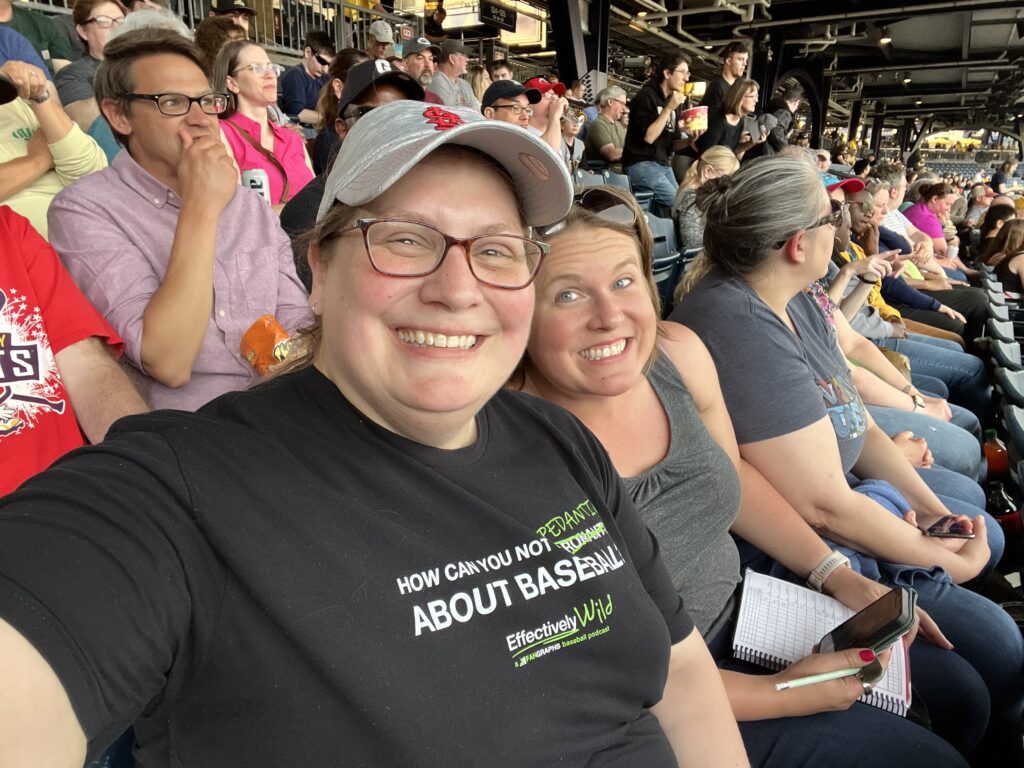
a white woman grins at the camera wearing a shirt that reads, "how can you not be pedantic about baseball?"; she is surrounded by a crowd of people watching a baseball game

“How can you not be pedantic about baseball?” –Effectively Wild

Last week was the 38th annual conference for NASIG. It was held in Pittsburgh, PA, at the same location where we met for our 34th annual. There was a smaller crowd, but as you can see above, this time we were able to attend a baseball game at PNC Park.

I’ve been a member of NASIG my whole career, attending every conference since 2002. But, just in case you are new here, or maybe need a refresher, “NASIG is an independent, non-profit organization working to advance and transform the management of information resources. [The] ultimate goal is to facilitate and improve the distribution, acquisition, and long-term accessibility of information resources in all formats and business models.”

In years past, I often took meticulous, almost transcription level notes of conferences sessions to share here. I fell out of practice with that even before the pandemic, but that certainly didn’t help. One great thing about NASIG is that all of the sessions will be included in the Proceedings, which are now Open Access and will be available in the next year.

I took quite a few offline notes for myself — a practice I’ve been trying to adopt for all work meetings now that my memory recall is declining while the number of candles on my birthday cake increases. I want to share a few highlights of things that I found valuable, and maybe you will, too.


Licensing stuff

We implemented Alma in June 2020, and until April 2022, I was attempting to handle all Acquisitions and Electronic Resources functions. I had no time for things that seemed pointless, and the license module was top of that list. There were so few default fields and I didn’t have the understanding to even look for the documentation that might have alerted me to how I could choose other (more useful) fields to be used. However, an off-hand comment at the Alma tech services user group on day one of the conference got me digging, and now I have plans to work with our Electronic Resources Librarian to flesh out the license information stored in Alma.

On day two of the conference, I attended the licensing workshop led by Claire Dygert. I was thrilled to have this opportunity, as Claire is one of my favorite NASIG people over the years, and she’s done a lot of great work in the areas of licensing and negotiation. Two things I’m taking away from it is plans to develop a template of terms we definitely want included in our license agreements, and a workflow for requesting price quotes well in advance of renewals as the opener for negotiations from a principled perspective.

Collections stuff

One of the sessions I attended on the third day of the conference was about documenting post-cancellation access to journals. My current institution has canceled relatively few journal subscriptions over the years, and I have not had a particularly thorough workflow for this. One big revelation for me was the order history tab in EBSCOnet, which I’m quite certain I’d never looked at before. No more guessing when our online subscription began based on the fund code we used (which is sometimes inconsistent)!

(I have not been great at documentation in the past, but due to the aforementioned loss of memory recall at the level I used to have, I’m working on that. I also attended part of a session about documentation in general that I peaced out on early when the first presenter was getting too much in the weeds of their particular situation. I heard the second presenter had more concrete workflows/ideas, so I look forward to reading that in the proceedings.)

My next steps will be to develop a workflow and documentation for recording this information in Alma. Possibly in conjunction with the license project I noted before.

what I do at WRIR, part 1

In 2009, I started volunteering at WRIR, a low-power FM community radio station located in the heart of Richmond, Virginia. Initially, I was simply an overnight DJ playing whatever music I felt like, moving time slots as more favorable to me options became available.

I liked playing anything from the new rock and “adult album alternative” (aka singer/songwriter, folk, etc.) shelves, as well as anything else that caught my eye. But around 2013, I noticed there weren’t many/any new releases being shelved.

That’s when I found out that the music director at the time was a college student who was away that year for study abroad, and no one had stepped up to fill in. Seeing my interest in the new music workflow, the World music director encouraged me to take this on. I’ve been doing it now for almost a decade, and I thought it might be interesting to share some of what I do every week, though it has changed quite a bit as the dominate format of music sent to us is digital files rather than physical media.


The first thing I do is go through the music director email inbox and download the albums and EPs sent by promoters or record labels. I keep a spreadsheet of all the details. Originally it was to also keep track of what got played and communicate that back to the sources, but it wasn’t sustainable and now that we use a playlist tool, I can theoretically run reports from that (or the interested parties can pay that provider to send them reports). Now I only use it for internal workflows.

Once I have everything downloaded and the compressed files unzipped, I use the spreadsheet to quickly format standard naming structures for each folder that represents an album or EP: Artist – Title (Label, Year). I’m a librarian — I can’t not impose some sort of structure to the way these get organized!

After that, I go back through all the emails. Promoters and record labels often send useful information about the recordings, such as recommended tracks, any songs with FCC prohibited language, similar artists, and often a brief description of the music. I will copy/paste that information (and reformat it somewhat so that the major points are consistent) into a text file that lives in the folder with the MP3s.

Then, I use a program to edit the MP3 tags. You’d be surprised by how many promoters and record labels send out MP3s to radio stations without ensuring that someone later on will know what the heck it is. About once every few months, I’ll even get one where the songs are just labeled track 1, track 2, etc., and I have to try to find the information elsewhere. This is also when I try to figure out the genre for the recording.

After all that is done, I move the folder to one of our large genre buckets: Rock, AAA, Hip-Hop, Loud, or RPM. If I get anything that might fall under World or Jazz, we still have genre directors for those areas and I just pass it along to them instead.

Tangent: These genre buckets have been around for a while because they were what the now defunct CMJ New Music Report used to designate genre charts. We switched over to reporting to the North American College & Community Radio Chart in 2017 when CMJ stopped publishing the New Music Report, and they changed a few of the genre labels. Namely, AAA went away and for us was replaced by Folk, and Loud became Heavy. It didn’t seem worth it to change our labeling at the time, and it still doesn’t.

When I’ve finished that week’s new music, I transfer the files to the station’s server where we keep a “digital music library” and send the details to the DJ list. Any of our active DJs can get access to this server and make use of the music for programming their shows.

At this point, about once I month I will sort through the physical media sent to the station. Some of it duplicates the digital copies we already have, and if it’s something that I know our DJs will like, I may slap a sticker on it with a review by a music reviewer and some recommended tracks, and put it on the shelf in the studio. Some of it is new to us and I may rip a copy for the digital music library. Some of it is “bless your heart, you tried” and it goes into the freebie bin for DJs to sort through and make choices about it for themselves.

The reality is, we get 30-50 recordings a week, and I don’t want to spend all of my free time on this volunteer work. The new music workflow is also not the only thing I do at the station, and I’ve worked to streamline it as much as possible. I still enjoy it and it definitely feels good to be able to impose some order on what would otherwise be a chaotic mess.

darkness and light

In which I ramble on about the weather.

It’s winter in North America. Living in Central Virginia, it’s not particularly harsh, and we get a lot of sunlight during the day on most days. But it’s still dark by 5pm, and while temperatures tend to stay above freezing during the day, there are plenty of days when it’s just above freezing.

I grew up in a place where winters were grey and dark and cold and miserable (for me). I hated it, even more after I moved to a warmer, sunnier place. I wonder how much my life would have improved if I had winter sun and a good therapist in my teenage years?

I have notice, though, that part of me treasures these dark and cold evenings for what they are. I make my home cozy with string lights and candles, and I go out in the evening even less than I do normally in these COVID times. I bundle up in warm, soft things and slow down with a cup of tea.

I’d like to continue to embrace the cold and dark times of the year as an opportunity to create my own light in the world. Long conversations with dear friends and a mug of (spiked) decaf coffee. Evenings spent listening to podcasts or audiobooks while assembling a puzzle or making a cross-stitch.

Spring will be here soon enough, and then my evenings will be filled with softball games and long walks in the park. Until then, I’ll be shining light in the darkness.

what if I’m (part of) the problem?

In which I ramble a bit about trying not to add to the toxicity of a toxic workplace.

The past six or seven years of my job have been challenging in ways my younger self could not have anticipated. During that time, I was in roles with personnel management that involved personnel that didn’t fit the textbook cases, and responsibilities that didn’t come with enough resources to effectively fulfill them. I often found myself in untenable situations with little more support than to “just deal with it.” Deal with it, I did. Sometimes more successfully than others.

A significant organizational reorganization a few years ago came with a change in my responsibilities, and later a significant turnover in staff resulted in a very different combination of personalities and approaches in my division. These days I find myself in a role that I am more than capable of executing, with the resources to do it well. And yet, I realize that I am still processing the trauma from all that occurred before, and that often clouds or colors my perception of current events/situations.

When I first arrived at my current library, the amount of old wounds and grudges held by my colleagues towards each other and university administrators was evident fairly early on. Most of those colleagues have either moved on or retired, and very few from that time remain, but I find I carry some those wounds/grudges now myself. I didn’t want to become a jaded, middle-aged librarian, and yet there are events that have led me down that path.

I don’t have to remain on that path, and I don’t have to take any of my new colleagues there with me. My feelings are not unjustified, but they also aren’t particularly productive at times. Knowing the lay of the land here, I can decide to be bitter and stagnant, or I can figure out how to work around the roadblocks.