Set Theory and Foundations of Mathematics
About (purpose and author) - Foundations of physics - Other topics and links
Other languages : FR − ES − IT − RU − TR − LT
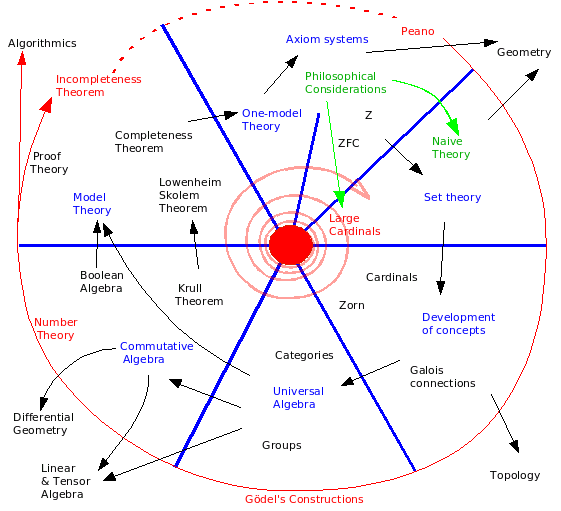
1. First foundations of mathematics (details) - all in 1 file (36 paper pages) - pdf version in 22 pages (15+7 - updated on Jan 16, 2026 by automatic conversion from html), or 37 pages (25+12 - feb 2026, from the same html file with different size settings).
2. Set theory - all in one file (40 paper pages), pdf (39 pages).
A notation change was done away from standards (see why) : from their definition in 2.6, the notation for direct images of sets by a graph R changed from R∗ to R⋆, and that for preimages changed from R* to R⋆.
3. Algebra 1 (all in one file)
4. Arithmetic and first-order foundations (all in one file : 30 paper pages)
5. Second-order foundations
More philosophical notes (uses Part 1 with philosophical aspects + recursion) :
6. Foundations of Geometry (draft)
7. Algebra 2 (draft)
Galois connections (11 pdf pages). Rigorously it only uses parts 1 (without complements) and 2. Its position has been moved from 3 for pedagogical reasons (higher difficulty level while the later texts are more directly interesting). The beginning was moved to 2.11.
Monotone Galois connections (adjunctions)
Upper and lower bounds, infimum and supremum
Complete lattices
Fixed point theorem
Transport of closure
Preorder generated by a relation
Finite sets
Generated equivalence relations, and more
Well-founded relations
Index of special words, phrases and notations, with references Drafts of more texts, to be reworked later
Diverse texts ready but not classified
Contributions to Wikipedia
I wrote large parts of the Wikipedia article on Foundations of mathematics (Sep. 2012 - before that, other authors focused on the more professional and technical article Mathematical logic instead; the Foundations of mathematics article is more introductory, historical and philosophical) and improved the one on the completeness theorem.
Something crazy
I wrote the following in reply to this post of r/math but got banned from there by admins just for this reason. What do you think ? I feel usual references on universal algebra as very heavy and difficult to read, a "cost" which may explain why the topic gets usually ignored by other works on algebra. I undertook to write a much shorter, optimized presentation of its few main concepts in my work in settheory.net among other fundamental topics of mathematics. The main pages on universal algebra there are from 3.2 to 4.3, assuming to have read all from the start (more pages are in plan for later sections that are partly written...)