
Level up your game
Kindle app logo image

Download the free Kindle app and start reading Kindle books instantly on your smartphone, tablet or computer – no Kindle device required.

Read instantly on your browser with Kindle for Web.

Using your mobile phone camera - scan the code below and download the Kindle app.

QR code to download the Kindle App

  • Generative Art: A Practical Guide Using Processing

Follow the author

Follow to get new release updates, special offers (including promotional offers), and improved recommendations.
Something went wrong. Please try your request again later.

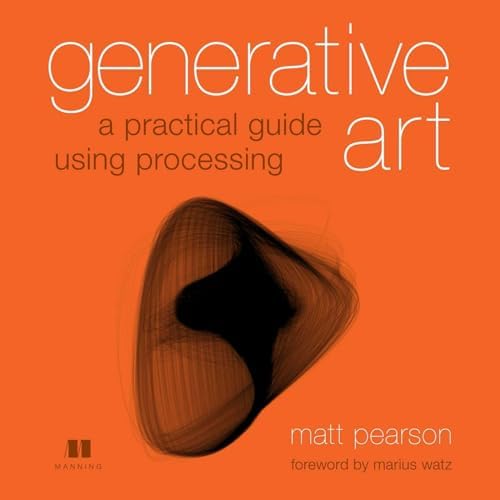
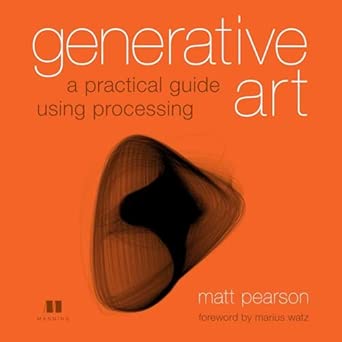
Generative Art: A Practical Guide Using Processing Paperback – 14 July 2011


DESCRIPTION
Artists have always explored new media, and computer-based artists
are no exception. Generative art, an emerging technique where print or
onscreen images are created by use of computer algorithms, finds the
artistic intersection between programming, computer graphics, and
individual expression.
Generative Art presents both the technique and the beauty of
algorithmic art. In it, you'll find dozens of high-quality examples of
generative art, along with the specific programmatic steps author and
artist Matt Pearson followed to create each unique piece. The book
includes concise tutorials for each of the technical components
required to create the book's examples, and it offers countless
suggestions for how you can combine and reuse the various techniques
to create your own works.


KEY POINTS
• Introduction to the principles of algorithmic art
• Brief Processing language tutorial
• Establishing artistic "ground rules" for a new work
• Using random, semi-random, emergent and fractal processes
• Finding fresh approaches to the discipline of programming
• Sixteen-page full-color section of beautiful artwork

Hundreds of audiobooks under £6
Discover Audible deals during the Big Book Sale. Shop now

From the brand

Product description

About the Author

Matt Pearson is a writer and coder based in Brighton UK. His popular blog http://zenbullets.com/ recently won "best blog" at the DiMAS awards. Matt is also the creative force behind the 100 Abandoned Artworks Generative Art project , where you can see many examples of his work.

Product details

About the author

Follow authors to get new release updates, plus improved recommendations.
Matt Pearson
Brief content visible, double tap to read full content.
Full content visible, double tap to read brief content.

Discover more of the author’s books, see similar authors, read book recommendations and more.

Customer reviews

4.5 out of 5 stars
107 global ratings

Top reviews from United Kingdom

  • Reviewed in the United Kingdom on 6 January 2023
    Format: PaperbackVerified Purchase
    This is an excellent companion to the Processing language, with plenty of code examples. Thankfully, it is not a dry programming reference manual for Processing/Java. It is thoughtfully written and introduces topics such as 3D, noise objects and recursion without getting bogged down in too much detail. It’s even humorous in places, I particularly like the idea that The Smiths and Echo and the Bunnymen are instances of class 80s English Indie Band!

    A very useful feature of the book is owning the physical book gives access to the online edition, which allows you to read the book side by side with a Processing sketch, cutting and pasting code directly into a sketch window.

    The book is over 10 years old and could do with a new edition. Not all the URLs work and I’m sure there are more recent art works that could now be listed.

    But still a very good book.
    2 people found this helpful
    Report
  • Reviewed in the United Kingdom on 27 May 2013
    Format: PaperbackVerified Purchase
    The author is well respected both by myself and many across the world.

    This book delves into the theory behind generative art and is full of examples and code and lovely images too.

    Its the generative art handbook for processing - an essential guide to those who want to explore creativity with code
    One person found this helpful
    Report
  • Reviewed in the United Kingdom on 16 July 2020
    Format: PaperbackVerified Purchase
    The book was perfect but came damaged so slightly disappointed
  • Reviewed in the United Kingdom on 29 December 2012
    Format: PaperbackVerified Purchase
    Pearson has put together a well structure introduction and tutorial guide into generative computational techniques. On par with Shiffman's books.
  • Reviewed in the United Kingdom on 13 February 2015
    Format: PaperbackVerified Purchase
    Top!
  • Reviewed in the United Kingdom on 15 August 2014
    Format: PaperbackVerified Purchase
    Excellent
  • Reviewed in the United Kingdom on 16 February 2012
    Format: Paperback
    "Generative Art" is easy. And fun. It takes two things: technique and enthusiasm, and this book gives you both.

    If you wanna make generative art, you have to code, and this book teaches that. Every artist needs craft. But making coding boring is easy, and this book avoids that by tying exercises in with interesting philosophical and artistic debates. Look at the chapter titles: "Emergence", "Autonomy", "The Wrong Way to Draw A Line". Take this last chapter for example. It introduces you to key generative tools like randomness, noise, and trigonometry, but with a light touch, and a continuing focus on their effect on the actual artwork, which is more ambiguous. The chapter title itself suggests this. What is the "wrong" way to draw a line? Artists have been arguing about it forever. Nowhere in this chapter is it explicitly stated. Tools are definable, art is not. Matt gives you the tools (the Processing language, emergent behaviour, Perlin noise, and the rest), and leaves the creativity to you.

    Except the images of course. The book is full of illustrations from generative luminaries like Robert Hodgin, Jared Tarbell, and of course Matt himself.
    2 people found this helpful
    Report
  • Reviewed in the United Kingdom on 1 January 2021
    Format: Paperback
    This is an introduction to producing generative art using the Processing language. Processing was invented to be an “easy” language for artists to learn. In its original form, it is based on a stripped down version of Java. (There is also a Python Mode available on the web.)

    The book has an introduction to generative art, and introduction to Processing (Java Mode), and three example sections on its use for art: emergent swarming behaviour, cellular automata, and fractals. There are lots of good examples to copy and modify, and also lots of pictures of somewhat more sophisticated examples of generative art.

    Note for publishers: don’t typeset your books in a minuscule typeface, grey text on white, with paper so thin that the text shows through, if you want anyone over the age of 25 to read it comfortably. I frankly skimmed in places. Nevertheless, this book should provide a good introduction to Processing for artists, providing basic skill that can then be incrementally upgraded as time goes by.

Top reviews from other countries

  • TheGrego
    5.0 out of 5 stars Great GenArt Book for Noobs and Not-So-Noobs
    Reviewed in the United States on 5 October 2011
    Format: PaperbackVerified Purchase
    As someone that was not completely new to processing, but wanted to get more into generative art, this book was perfect.

    He goes over some basic concepts in a not too detailed, but detailed enough way to get you up and running. I don't think this book was meant to be a comprehensive guide to processing, but more to expose you to techniques and concepts within the world of generative art. And that it did. It's sparked many ideas that I now have and can't wait to explore. I'm confident that the concepts that I learned in this book will be transferable to whichever creative coding programming environment I choose to explore next, be it flash, cinder, javascript/HTML5/canvas, etc.

    Thanks Matt.
  • G. R.
    5.0 out of 5 stars Grandios!
    Reviewed in Germany on 21 September 2011
    Format: PaperbackVerified Purchase
    Ich war dem Buch anfangs etwas kritisch gegenübergestellt, vor allem weil ich nicht genau wusste, was ich erwarten sollte. Nur Code-Snippets, nur Mathematik, einen Lehrpfad zum Künstler?
    Schon auf den ersten Seiten erklärt der Author, dass es bei dem Buch nicht ums Programmieren geht, oder um jemanden zum Künstler auszubilden.
    Mittels kleinen Codesnipptes gibt er Denkanstöße, um selbst kreativ zu werden. Toller Aufbau, sehr gut gewählte Inhalte (Processing, Flocking, Randomness etc.)

    Am besten hat mir das Kapitel gefallen, in dem er häufige Fehler aufzeigt.

    Tolles Buch, 5 Sterne, und auch für alle geeignet, die noch nie etwas mit Processing oder "Generative Art" zu tun hatten!
  • Client d'Amazon
    5.0 out of 5 stars hello from sofia
    Reviewed in France on 15 September 2016
    Format: PaperbackVerified Purchase
    Great art references and easy to read. I also appreciate a lot the sense of humour. A good choice for beginners.
  • XAVISA
    5.0 out of 5 stars Buen libro para iniciarse
    Reviewed in Spain on 6 July 2015
    Format: PaperbackVerified Purchase
    El libro es de lectura ágil; explica aspectos básicos de la programación con Processing y del arte generativo
    Se avanza con programas cortos de fácil comprensión, perfecto para iniciarse
    Bien editado
  • Luigi Fontana
    5.0 out of 5 stars Ottimo testo base.
    Reviewed in Italy on 15 October 2022
    Format: PaperbackVerified Purchase
    Ottimo testo per capire Processing. Forse un po' "didattico" e monotono, ma questi difetti vengono ampiamente compensati dalla facilita dell'apprendimento delle logiche del linguaggio.
    Se partite da zero è il testo che fa per voi.