Artificial Intelligence
Category: Learning Levels
How Condé Nast accelerated contract processing and rights analysis with Amazon Bedrock
In this post, we explore how Condé Nast used Amazon Bedrock and Anthropic’s Claude to accelerate their contract processing and rights analysis workstreams. The company’s extensive portfolio, spanning multiple brands and geographies, required managing an increasingly complex web of contracts, rights, and licensing agreements.
Building AI-Powered Voice Applications: Amazon Nova Sonic Telephony Integration Guide
Available through the Amazon Bedrock bidirectional streaming API, Amazon Nova Sonic can connect to your business data and external tools and can be integrated directly with telephony systems. This post will introduce sample implementations for the most common telephony scenarios.
University of California Los Angeles delivers an immersive theater experience with AWS generative AI services
In this post, we will walk through the performance constraints and design choices by OARC and REMAP teams at UCLA, including how AWS serverless infrastructure, AWS Managed Services, and generative AI services supported the rapid design and deployment of our solution. We will also describe our use of Amazon SageMaker AI and how it can be used reliably in immersive live experiences.
Optimizing Mobileye’s REM™ with AWS Graviton: A focus on ML inference and Triton integration
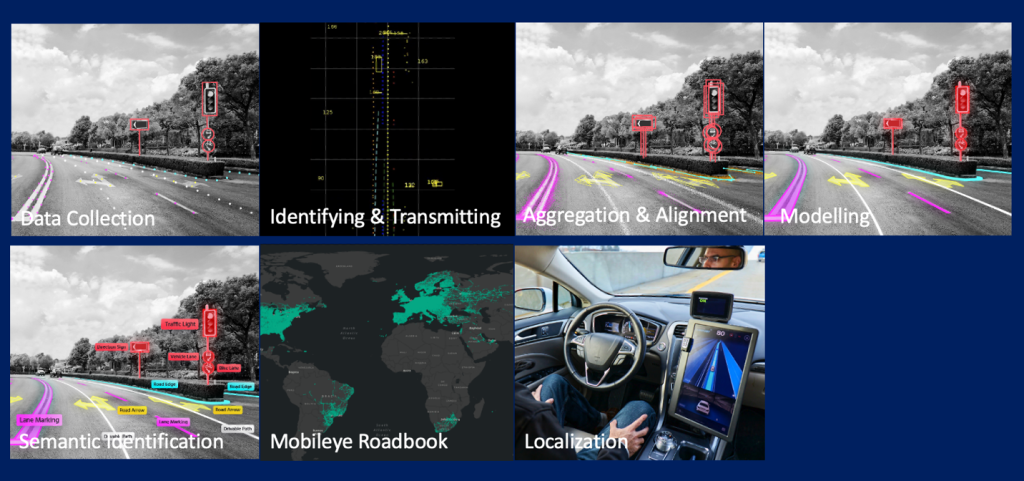
In this post, we focus on one portion of the REM™ system: the automatic identification of changes to the road structure which we will refer to as Change Detection. We will share our journey of architecting and deploying a solution for Change Detection, the core of which is a deep learning model called CDNet. We will share real-life decisions and tradeoffs when building and deploying a high-scale, highly parallelized algorithmic pipeline based on a Deep Learning (DL) model, with an emphasis on efficiency and throughput.
Warner Bros. Discovery achieves 60% cost savings and faster ML inference with AWS Graviton
Warner Bros. Discovery (WBD) is a leading global media and entertainment company that creates and distributes the world’s most differentiated and complete portfolio of content and brands across television, film and streaming. In this post, we describe the scale of our offerings, artificial intelligence (AI)/machine learning (ML) inference infrastructure requirements for our real time recommender systems, and how we used AWS Graviton-based Amazon SageMaker AI instances for our ML inference workloads and achieved 60% cost savings and 7% to 60% latency improvements across different models.

Power up your ML workflows with interactive IDEs on SageMaker HyperPod
Amazon SageMaker HyperPod clusters with Amazon Elastic Kubernetes Service (EKS) orchestration now support creating and managing interactive development environments such as JupyterLab and open source Visual Studio Code, streamlining the ML development lifecycle by providing managed environments for familiar tools to data scientists. This post shows how HyperPod administrators can configure Spaces for their clusters, and how data scientists can create and connect to these Spaces.
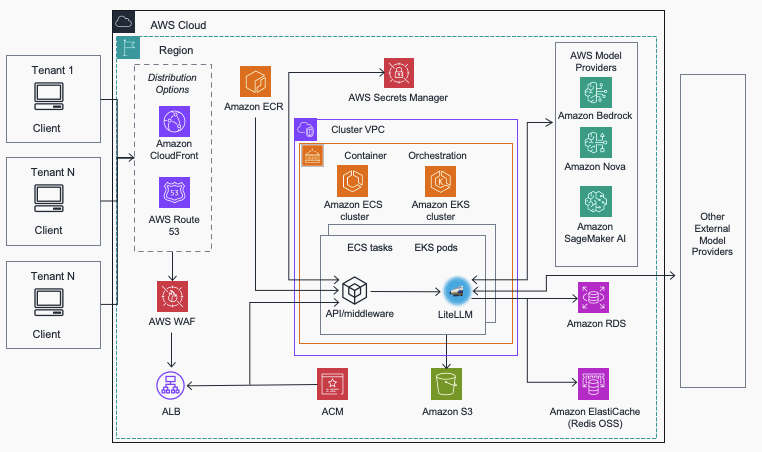
Streamline AI operations with the Multi-Provider Generative AI Gateway reference architecture
In this post, we introduce the Multi-Provider Generative AI Gateway reference architecture, which provides guidance for deploying LiteLLM into an AWS environment to streamline the management and governance of production generative AI workloads across multiple model providers. This centralized gateway solution addresses common enterprise challenges including provider fragmentation, decentralized governance, operational complexity, and cost management by offering a unified interface that supports Amazon Bedrock, Amazon SageMaker AI, and external providers while maintaining comprehensive security, monitoring, and control capabilities.
Deploy geospatial agents with Foursquare Spatial H3 Hub and Amazon SageMaker AI
In this post, you’ll learn how to deploy geospatial AI agents that can answer complex spatial questions in minutes instead of months. By combining Foursquare Spatial H3 Hub’s analysis-ready geospatial data with reasoning models deployed on Amazon SageMaker AI, you can build agents that enable nontechnical domain experts to perform sophisticated spatial analysis through natural language queries—without requiring geographic information system (GIS) expertise or custom data engineering pipelines.
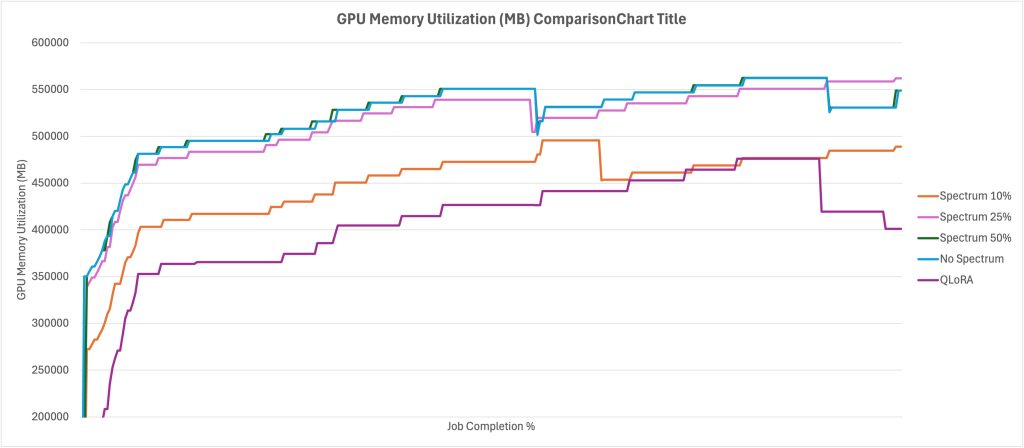
Using Spectrum fine-tuning to improve FM training efficiency on Amazon SageMaker AI
In this post you will learn how to use Spectrum to optimize resource use and shorten training times without sacrificing quality, as well as how to implement Spectrum fine-tuning with Amazon SageMaker AI training jobs. We will also discuss the tradeoff between QLoRA and Spectrum fine-tuning, showing that while QLoRA is more resource efficient, Spectrum results in higher performance overall.
HyperPod enhances ML infrastructure with security and storage
This blog post introduces two major enhancements to Amazon SageMaker HyperPod that strengthen security and storage capabilities for large-scale machine learning infrastructure. The new features include customer managed key (CMK) support for encrypting EBS volumes with organization-controlled encryption keys, and Amazon EBS CSI driver integration that enables dynamic storage management for Kubernetes volumes in AI workloads.