

























Arduino Quick Start
2. Devices & Examples
3. M5Unified
4. M5GFX
5. Extensions
Unit
Base
Cap
IoT
Accessories
Dial RFID (NFC)
APIs and example programs related to Dial RFID (NFC).
Example Program
Build Requirements
- M5Stack board manager version >= 3.2.2
- Board option = M5Dial
- M5Dial library version >= 1.0.3
Read UID Example
#include "M5Dial.h" void setup() { auto cfg = M5.config(); M5Dial.begin(cfg, false, true); // encoder, RFID Serial.begin(115200); } void loop() { // PICC: Proximity Integrated Circuit Card if (M5Dial.Rfid.PICC_IsNewCardPresent() && M5Dial.Rfid.PICC_ReadCardSerial()) { M5Dial.Display.clear(); uint8_t piccType = M5Dial.Rfid.PICC_GetType(M5Dial.Rfid.uid.sak); Serial.print(F("PICC type: ")); Serial.println(M5Dial.Rfid.PICC_GetTypeName(piccType)); // Check if the tag / card is of type MIFARE Classic if (piccType != MFRC522::PICC_TYPE_MIFARE_MINI && piccType != MFRC522::PICC_TYPE_MIFARE_1K && piccType != MFRC522::PICC_TYPE_MIFARE_4K) { Serial.println(F("This tag / card is not of type MIFARE Classic.\n")); delay(500); return; } // Output the stored UID data for (byte i = 0; i < M5Dial.Rfid.uid.size; i++) { Serial.printf("%02X ", M5Dial.Rfid.uid.uidByte[i]); } Serial.println("\n"); delay(500); } }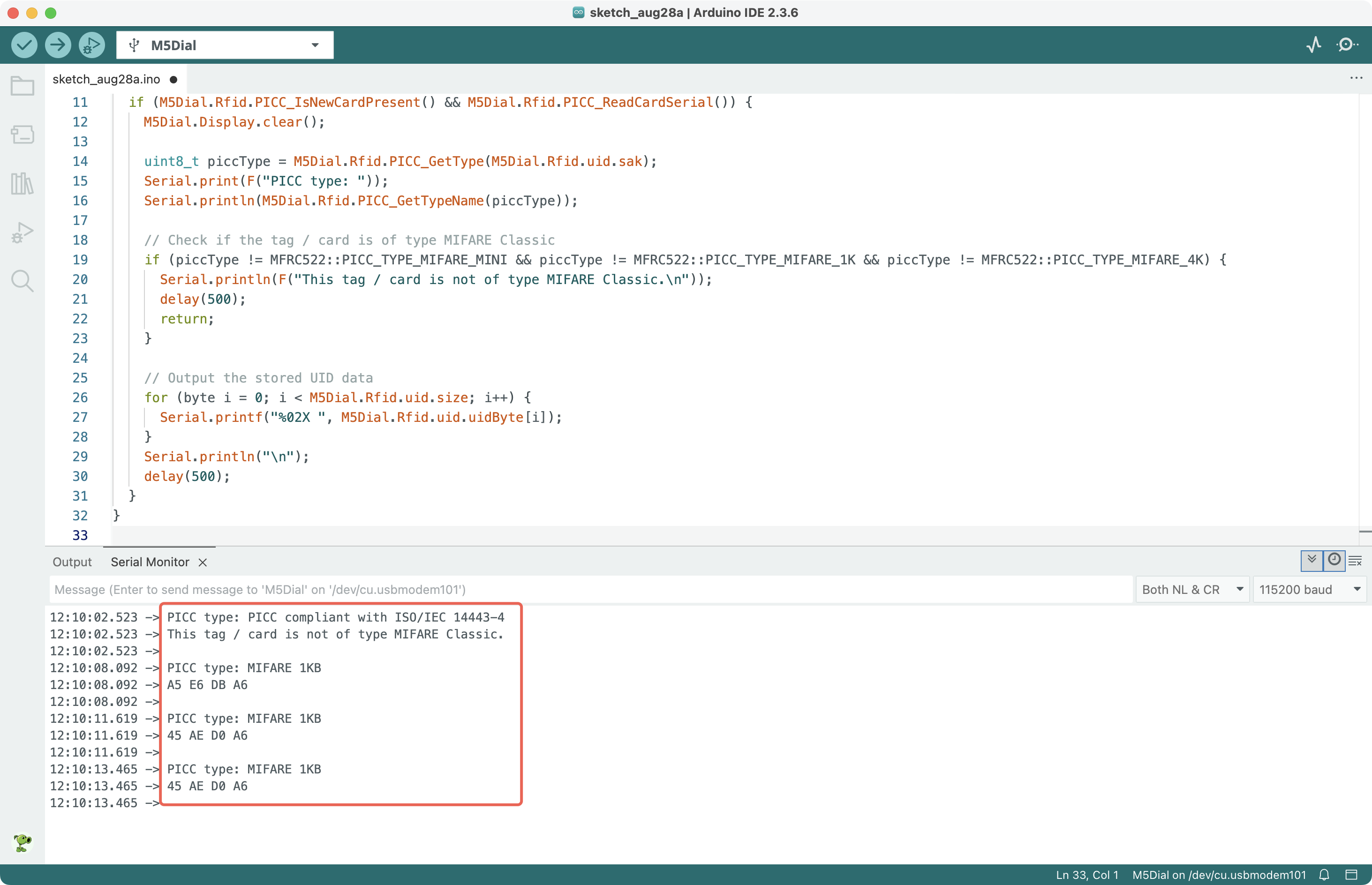
Read/Write Card Example
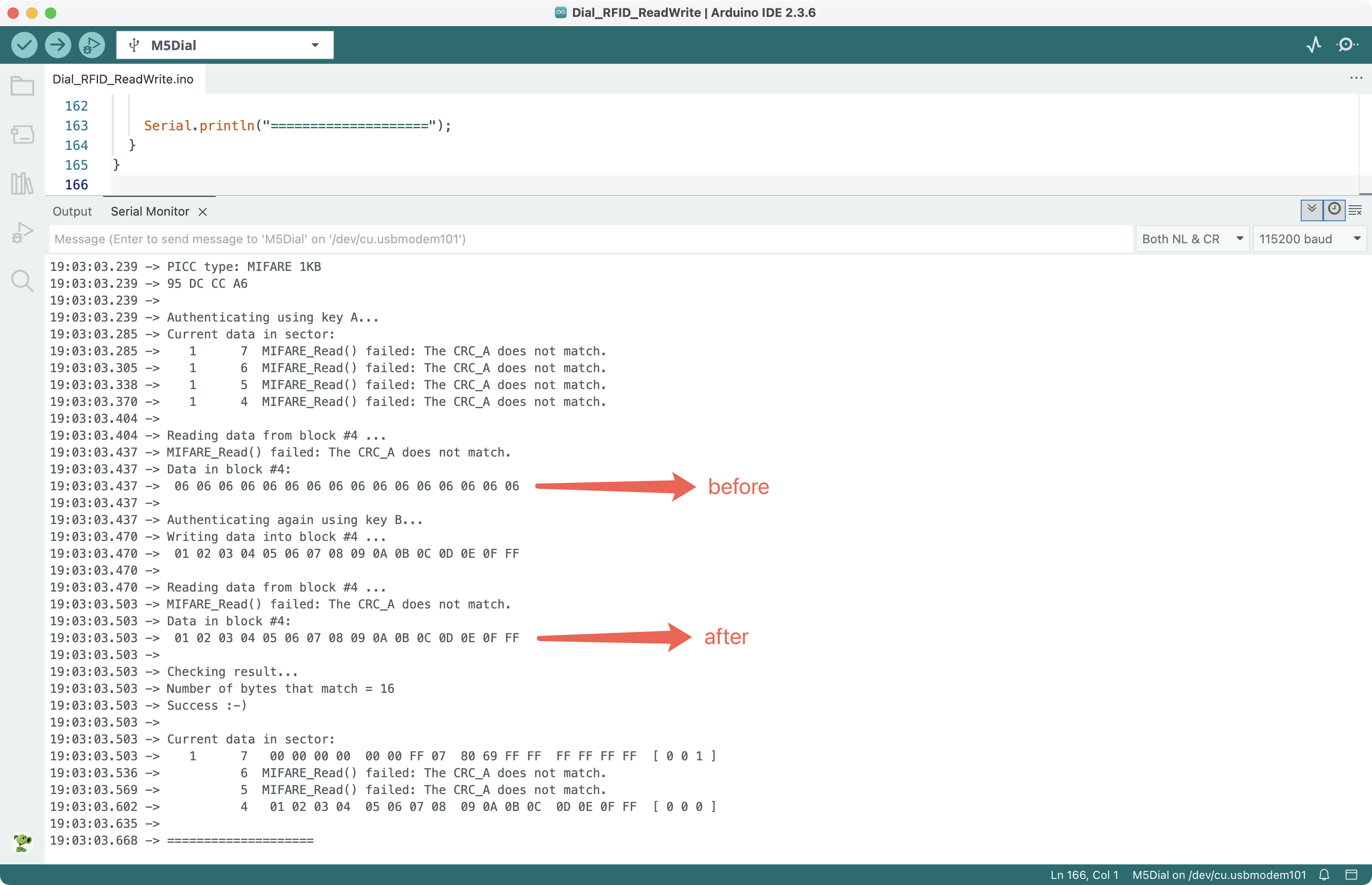
#include "M5Dial.h" MFRC522::MIFARE_Key key; void setup() { auto cfg = M5.config(); M5Dial.begin(cfg, false, true); // encoder, RFID Serial.begin(115200); // Prepare the key (used both as key A and as key B) with FFFFFFFFFFFFh, // which is the default at chip delivery from the factory. for (byte i = 0; i < 6; i++) { key.keyByte[i] = 0xFF; } } // Helper routine to dump a byte array as hex values to Serial. void dump_byte_array(byte *buffer, byte bufferSize) { for (byte i = 0; i < bufferSize; i++) { Serial.print(buffer[i] < 0x10 ? " 0" : " "); Serial.print(buffer[i], HEX); } } void loop() { M5Dial.update(); // PICC: Proximity Integrated Circuit Card if (M5Dial.Rfid.PICC_IsNewCardPresent() && M5Dial.Rfid.PICC_ReadCardSerial()) { M5Dial.Display.clear(); uint8_t piccType = M5Dial.Rfid.PICC_GetType(M5Dial.Rfid.uid.sak); Serial.print(F("PICC type: ")); Serial.println(M5Dial.Rfid.PICC_GetTypeName(piccType)); // Check if the tag / card is of type MIFARE Classic if (piccType != MFRC522::PICC_TYPE_MIFARE_MINI && piccType != MFRC522::PICC_TYPE_MIFARE_1K && piccType != MFRC522::PICC_TYPE_MIFARE_4K) { Serial.println(F("This tag / card is not of type MIFARE Classic.\n")); delay(500); return; } // Output the stored UID data String uid = ""; for (byte i = 0; i < M5Dial.Rfid.uid.size; i++) { Serial.printf("%02X ", M5Dial.Rfid.uid.uidByte[i]); uid += String(M5Dial.Rfid.uid.uidByte[i], HEX); } Serial.println("\n"); // M5Dial.Rfid.PICC_DumpToSerial(&(M5Dial.Rfid.uid)); // Serial.println("\n"); // In this example, we use the second sector (sector #1) including blocks #4, #5, #6, #7 byte sector = 1; byte blockAddr = 4; byte trailerBlock = 7; byte dataBlock[] = { 0x01, 0x02, 0x03, 0x04, // 1, 2, 3, 4, 0x05, 0x06, 0x07, 0x08, // 5, 6, 7, 8, 0x09, 0x0a, 0x0b, 0x0c, // 9, 10, 11, 12, 0x0d, 0x0e, 0x0f, 0xff // 13, 14, 15, 255 }; MFRC522::StatusCode status; byte buffer[18]; byte size = sizeof(buffer); // Authenticate using key A Serial.println(F("Authenticating using key A...")); status = (MFRC522::StatusCode)M5Dial.Rfid.PCD_Authenticate(MFRC522::PICC_CMD_MF_AUTH_KEY_A, trailerBlock, &key, &(M5Dial.Rfid.uid)); if (status != MFRC522::STATUS_OK) { Serial.print(F("PCD_Authenticate() failed: ")); Serial.println(M5Dial.Rfid.GetStatusCodeName(status)); return; } // Show the whole sector as it currently is Serial.println(F("Current data in sector: ")); M5Dial.Rfid.PICC_DumpMifareClassicSectorToSerial(&(M5Dial.Rfid.uid), &key, sector); Serial.println(""); // Read data from the block Serial.print(F("Reading data from block #")); Serial.print(blockAddr); Serial.println(F(" ...")); status = (MFRC522::StatusCode)M5Dial.Rfid.MIFARE_Read(blockAddr, buffer, &size); if (status != MFRC522::STATUS_OK) { Serial.print(F("MIFARE_Read() failed: ")); Serial.println(M5Dial.Rfid.GetStatusCodeName(status)); } Serial.print(F("Data in block #")); Serial.print(blockAddr); Serial.println(F(": ")); dump_byte_array(buffer, 16); Serial.println("\n"); // Authenticate using key B Serial.println(F("Authenticating again using key B...")); status = (MFRC522::StatusCode)M5Dial.Rfid.PCD_Authenticate(MFRC522::PICC_CMD_MF_AUTH_KEY_B, trailerBlock, &key, &(M5Dial.Rfid.uid)); if (status != MFRC522::STATUS_OK) { Serial.print(F("PCD_Authenticate() failed: ")); Serial.println(M5Dial.Rfid.GetStatusCodeName(status)); return; } // Write data to the block Serial.print(F("Writing data into block #")); Serial.print(blockAddr); Serial.println(F(" ...")); dump_byte_array(dataBlock, 16); Serial.println(); status = (MFRC522::StatusCode)M5Dial.Rfid.MIFARE_Write(blockAddr, dataBlock, 16); if (status != MFRC522::STATUS_OK) { Serial.print(F("MIFARE_Write() failed: ")); Serial.println(M5Dial.Rfid.GetStatusCodeName(status)); } Serial.println(""); // Read data from the block again, now it should be what we have written Serial.print(F("Reading data from block #")); Serial.print(blockAddr); Serial.println(F(" ...")); status = (MFRC522::StatusCode)M5Dial.Rfid.MIFARE_Read(blockAddr, buffer, &size); if (status != MFRC522::STATUS_OK) { Serial.print(F("MIFARE_Read() failed: ")); Serial.println(M5Dial.Rfid.GetStatusCodeName(status)); } Serial.print(F("Data in block #")); Serial.print(blockAddr); Serial.println(F(": ")); dump_byte_array(buffer, 16); Serial.println("\n"); // Check if the data in block is what we have written, by counting the number of bytes that are equal Serial.println(F("Checking result...")); byte count = 0; for (byte i = 0; i < 16; i++) { // Compare buffer (what we've read) with dataBlock (what we've written) if (buffer[i] == dataBlock[i]) { count++; } } Serial.print(F("Number of bytes that match = ")); Serial.println(count); if (count == 16) { Serial.println(F("Success :-)")); } else { Serial.println(F("Failure, no match :-(")); Serial.println(F(" perhaps the write didn't work properly...")); } Serial.println(); // Dump the sector data Serial.println(F("Current data in sector: ")); M5Dial.Rfid.PICC_DumpMifareClassicSectorToSerial(&(M5Dial.Rfid.uid), &key, sector); Serial.println(""); // Halt PICC M5Dial.Rfid.PICC_HaltA(); // Stop encryption on PCD M5Dial.Rfid.PCD_StopCrypto1(); Serial.println("===================="); } }This program reads the data from Block 4 in Sector 1 after completing Key A authentication, and then modifies the data of Block 4 in Sector 1 after completing Key B authentication. During this process, the tag / card must remain close to the Dial. The program output is as follows:
Init API
Below are usage notes for the common APIs. A typical flow for reading / writing a MIFARE card is:
- Initialize RFID
- Detect the presence of a new card and obtain the card UID (Unique Identifier)
- Select the card by UID to enter the active state
- Unlock the target Block using Key A or Key B
- Read / Write data
- Set the card to the sleep state
Operation return status codes
enum StatusCode { STATUS_OK = 1, // Success STATUS_ERROR = 2, // Error in communication STATUS_COLLISION = 3, // Collision detected STATUS_TIMEOUT = 4, // Timeout in communication STATUS_NO_ROOM = 5, // The buffer is not big enough STATUS_INTERNAL_ERROR = 6, // Internal error in the code. Should not happen ;-) STATUS_INVALID = 7, // Invalid argument STATUS_CRC_WRONG = 8, // The CRC_A does not match STATUS_MIFARE_NACK = 9 // The MIFARE PICC responded with NAK };begin
Function Prototype:
void begin();Description:
- Initialize RFID.
When calling M5Dial.begin(), you can set the parameter enableRFID to true to initialize it together.
M5Dial.begin(m5::M5Unified::config_t cfg, bool enableEncoder, bool enableRFID);Input Parameters:
- null
Return Value:
- null
PICC_IsNewCardPresent
Function Prototype:
bool PICC_IsNewCardPresent();Description:
- Scan to check whether there is a card that has not been detected yet and is in the
IDLEstate. Cards in theHALTstate will be ignored.
Input Parameters:
- null
Return Value:
- bool
- true: A new card was detected
- false: No new card was detected
PICC_ReadCardSerial
Function Prototype:
bool PICC_ReadCardSerial();Description:
- Read the card UID. After a successful read, the UID can be accessed from the class member
Uid uid;. Before performing the read operation, you must callPICC_IsNewCardPresent(),PICC_RequestA(), orPICC_WakeupA()to ensure a card is detected.
for (byte i = 0; i < M5Dial.Rfid.uid.size; i++) { Serial.printf("%02X ", M5Dial.Rfid.uid.uidByte[i]); }Input Parameters:
- null
Return Value:
- bool
- true: Read successful
- false: Read failed
PICC_RequestA
Function Prototype:
uint8_t PICC_RequestA(uint8_t *bufferATQA, uint8_t *bufferSize);Description:
- Scan and detect Type A standard cards within reading range.
Input Parameters:
- uint8_t *bufferATQA
- Buffer to store the ATQA (Answer To Request) response.
- uint8_t *bufferSize
- Length of the buffer (>2 byte).
Return Value:
- uint8_t
- StatusCode
PICC_WakeupA
Function Prototype:
uint8_t PICC_WakeupA(uint8_t *bufferATQA, uint8_t *bufferSize);Description:
- Wake up Type A standard cards within range.
Input Parameters:
- uint8_t *bufferATQA
- Buffer to store the ATQA (Answer To Request) response.
- uint8_t *bufferSize
- Length of the buffer (>2 byte).
Return Value:
- uint8_t
- StatusCode
PICC_Select
Function Prototype:
uint8_t PICC_Select(Uid *uid, uint8_t validBits = 0);Description:
- Select a card by UID and set it to the active state.
Input Parameters:
- Uid *uid
- Pointer to the UID structure obtained by scanning the card.
- uint8_t validBits
- Number of valid bits in the last uint8_t; 0 means all 8 bits are valid.
Return Value:
- uint8_t
- StatusCode
PICC_HaltA
Function Prototype:
uint8_t PICC_HaltA();Description:
- Put the currently selected card into the sleep state.
Input Parameters:
- null
Return Value:
- uint8_t
- StatusCode
MIFARE API
PCD_Authenticate
Function Prototype:
uint8_t PCD_Authenticate(uint8_t command, uint8_t blockAddr, MIFARE_Key *key, Uid *uid);Description:
- Perform MIFARE authentication. Before calling this function, the card must be selected to enter the active state. After communication with the authenticated PICC is completed, you must call
PCD_StopCrypto1(); otherwise, new communication cannot be started.
Input Parameters:
- uint8_t command
- PICC_CMD_MF_AUTH_KEY_A
- PICC_CMD_MF_AUTH_KEY_B
- uint8_t blockAddr
- Block address
- MIFARE_Key *key
- By default, both Key A and Key B are set to
FFFFFFFFFFFF
- By default, both Key A and Key B are set to
- Uid *uid
Return Value:
- uint8_t
- StatusCode
PCD_StopCrypto1
Function Prototype:
void PCD_StopCrypto1();Description:
- Exit the authentication state of the PCD. After communication with the authenticated PICC is completed, you must call
PCD_StopCrypto1(); otherwise, new communication cannot be started.
Input Parameters:
- null
Return Value:
- null
MIFARE_Read
Function Prototype:
uint8_t MIFARE_Read(uint8_t blockAddr, uint8_t *buffer, uint8_t *bufferSize);Description:
- Read data from the specified blockAddr.
Input Parameters:
- uint8_t blockAddr
- Block address in the actual card sector.
- uint8_t *buffer
- Pointer to the buffer for receiving data.
- uint8_t *bufferSize
- Length of the buffer for receiving data (>= 18 byte).
Return Value:
- uint8_t
- StatusCode
MIFARE_Write
Function Prototype:
uint8_t MIFARE_Write(uint8_t blockAddr, uint8_t *buffer, uint8_t bufferSize);Description:
- Write data to the specified blockAddr.
Input Parameters:
- uint8_t blockAddr
- Block address in the actual card sector.
- uint8_t *buffer
- Pointer to the buffer containing the data to be written.
- uint8_t *bufferSize
- Length of the buffer for writing data (16 byte).
Return Value:
- uint8_t
- StatusCode
Reference Links
- The Dial RFID module uses the
MFRC522library as its driver. For more related APIs, see MFRC522 Source Code. - ISO/IEC 14443 - Wikipedia
- MFRC522 - NXP Docs (Standard performance MIFARE and NTAG frontend)
- MFRC523 - NXP Docs (Standard performance ISO/IEC 14443 A/B frontend)
- MIFARE Classic EV1 1K - NXP Docs
- MIFARE Classic EV1 4K - NXP Docs
- AN1305 - NXP Docs (MIFARE Classic as NFC Type MIFARE Classic Tag)
- AN10833 - NXP Docs (MIFARE type identification procedure)
- AN10834 - NXP Docs (MIFARE ISO/IEC 14443 PICC selection)