trivial edit to let people cancel votes
Source Link
jhocking
  • 15.8k
  • 2
  • 45
  • 59

Is it a physical phenomena ? or numerical ?

This question sorta implies to me that you don't actually know what aliasing/anti-aliasing means. I mean, you say you "know what it looks like" but if you actually knew what the terms mean, you'd probably realize your question is nonsensical. Aliasing is a side-effect of how computer graphics are rendered, and computer graphics are pretty much by definition not physical phenomena.

"Aliasing" just refers to the stair-step look on angled lines because computer graphics are actually comprised of lots of tiny squares in a grid. Here's an image to illustrate what I'm talking about: enter image description here
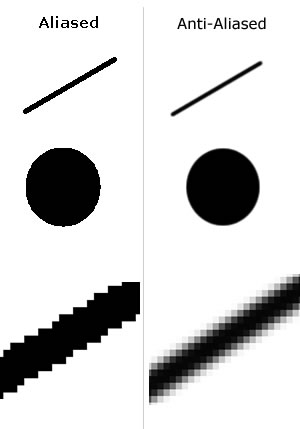
This is an issue whenever you render the pixels in an image, whether you're drawing freehand or are writing an algorithm to calculate the pixels for a 3D polygon. It's just a side-effect of the fact that the image is a square grid of pixels. "Anti-aliasing" is when you disguise the stair-step look by blending the colors together along the edge pixels.

Is it a physical phenomena ? or numerical ?

This question sorta implies to me that you don't actually know what aliasing/anti-aliasing means. I mean, you say you "know what it looks like" but if you actually knew what the terms mean, you'd probably realize your question is nonsensical. Aliasing is a side-effect of how computer graphics are rendered, and computer graphics are pretty much by definition not physical phenomena.

"Aliasing" just refers to the stair-step look on angled lines because computer graphics are actually comprised of lots of tiny squares in a grid. Here's an image to illustrate what I'm talking about: enter image description here

This is an issue whenever you render the pixels in an image, whether you're drawing freehand or are writing an algorithm to calculate the pixels for a 3D polygon. It's just a side-effect of the fact that the image is a square grid of pixels. "Anti-aliasing" is when you disguise the stair-step look by blending the colors together along the edge pixels.

Is it a physical phenomena ? or numerical ?

This question sorta implies to me that you don't actually know what aliasing/anti-aliasing means. I mean, you say you "know what it looks like" but if you actually knew what the terms mean, you'd probably realize your question is nonsensical. Aliasing is a side-effect of how computer graphics are rendered, and computer graphics are pretty much by definition not physical phenomena.

"Aliasing" just refers to the stair-step look on angled lines because computer graphics are actually comprised of lots of tiny squares in a grid. Here's an image to illustrate what I'm talking about: enter image description here

This is an issue whenever you render the pixels in an image, whether you're drawing freehand or are writing an algorithm to calculate the pixels for a 3D polygon. It's just a side-effect of the fact that the image is a square grid of pixels. "Anti-aliasing" is when you disguise the stair-step look by blending the colors together along the edge pixels.

added 29 characters in body
Source Link
jhocking
  • 15.8k
  • 2
  • 45
  • 59

Is it a physical phenomena ? or numerical ?

This question sorta implies to me that you don't actually know what aliasing/anti-aliasing means. I mean, you say you "know what it looks like" but if you actually knew what the terms mean, you'd probably realize your question is nonsensical. Aliasing is a side-effect of how computer graphics are rendered, and computer graphics are pretty much by definition not physical phenomena.

"Aliasing" just refers to the stair-step look on angled lines because computer graphics are actually comprised of lots of tiny squares in a grid. Here's an image to illustrate what I'm talking about: enter image description here

This is an issue whenever you render the pixels in an image, whether you're drawing freehand or are writing an algorithm to calculate the pixels for a 3D polygon. It's just a side-effect of the fact that pixels arethe image is a square grid of pixels. "Anti-aliasing" is when you disguise the stair-step look by blending the colors together along the edge pixels.

Is it a physical phenomena ? or numerical ?

This question sorta implies to me that you don't actually know what aliasing/anti-aliasing means. I mean, you say you "know what it looks like" but if you actually knew what the terms mean, you'd probably realize your question is nonsensical. Aliasing is a side-effect of how computer graphics are rendered, and computer graphics are pretty much by definition not physical phenomena.

"Aliasing" just refers to the stair-step look on angled lines because computer graphics are actually comprised of lots of tiny squares. Here's an image to illustrate what I'm talking about: enter image description here

This is an issue whenever you render the pixels in an image, whether you're drawing freehand or are writing an algorithm to calculate the pixels for a 3D polygon. It's just a side-effect of the fact that pixels are square. "Anti-aliasing" is when you disguise the stair-step look by blending the colors together along the edge pixels.

Is it a physical phenomena ? or numerical ?

This question sorta implies to me that you don't actually know what aliasing/anti-aliasing means. I mean, you say you "know what it looks like" but if you actually knew what the terms mean, you'd probably realize your question is nonsensical. Aliasing is a side-effect of how computer graphics are rendered, and computer graphics are pretty much by definition not physical phenomena.

"Aliasing" just refers to the stair-step look on angled lines because computer graphics are actually comprised of lots of tiny squares in a grid. Here's an image to illustrate what I'm talking about: enter image description here

This is an issue whenever you render the pixels in an image, whether you're drawing freehand or are writing an algorithm to calculate the pixels for a 3D polygon. It's just a side-effect of the fact that the image is a square grid of pixels. "Anti-aliasing" is when you disguise the stair-step look by blending the colors together along the edge pixels.

Source Link
jhocking
  • 15.8k
  • 2
  • 45
  • 59

Is it a physical phenomena ? or numerical ?

This question sorta implies to me that you don't actually know what aliasing/anti-aliasing means. I mean, you say you "know what it looks like" but if you actually knew what the terms mean, you'd probably realize your question is nonsensical. Aliasing is a side-effect of how computer graphics are rendered, and computer graphics are pretty much by definition not physical phenomena.

"Aliasing" just refers to the stair-step look on angled lines because computer graphics are actually comprised of lots of tiny squares. Here's an image to illustrate what I'm talking about: enter image description here

This is an issue whenever you render the pixels in an image, whether you're drawing freehand or are writing an algorithm to calculate the pixels for a 3D polygon. It's just a side-effect of the fact that pixels are square. "Anti-aliasing" is when you disguise the stair-step look by blending the colors together along the edge pixels.