

Security Testing Management in Jira
Organize and track security test cases and vulnerability verification
Security testing verifies that applications are protected against threats and vulnerabilities. Consider a healthcare SaaS platform that processes patient records and insurance claims. A single unpatched SQL injection vulnerability or misconfigured access control could expose thousands of sensitive records, trigger regulatory penalties, and destroy patient trust. Your security team runs periodic penetration tests and your automated scanners flag issues daily, but without a centralized system to track which vulnerabilities have been verified, which fixes have been retested, and which security requirements have been validated, critical gaps go unnoticed until an auditor or an attacker finds them. BesTest helps you manage security test cases, track vulnerabilities through remediation, and maintain the compliance documentation that keeps auditors satisfied and patients safe.
The Challenge
Security testing requires specific management discipline that goes beyond standard functional QA. The stakes are higher because a missed security defect does not just inconvenience a user; it can lead to data breaches, regulatory fines, and reputational damage that takes years to recover from. Security testing also involves coordination between multiple specialized teams, including application security, infrastructure, compliance, and development, each with their own tools and processes. The most common management challenges include:
- •Achieving comprehensive coverage of security requirements that span authentication, authorization, input validation, encryption, session management, and dozens of other security controls, each with multiple test scenarios.
- •Aligning tests with OWASP Top 10, CWE classifications, and compliance frameworks like SOC 2, HIPAA, PCI DSS, or GDPR, which each have their own vocabulary and coverage requirements that need to be mapped to your test cases.
- •Tracking vulnerability remediation through the full lifecycle from discovery to fix to retesting to closure, especially when vulnerabilities are found by multiple tools and need to be deduplicated and prioritized.
- •Coordinating security testing with automated scanning tools, manual penetration testing, and code reviews that each produce findings in different formats and need to be consolidated into a single view of security posture.
- •Maintaining an audit trail for compliance that demonstrates not just that security tests exist, but that they have been executed, reviewed, and their results have been acted upon within acceptable timeframes.
- •Keeping security tests current as the application evolves, because new features introduce new attack surfaces and deprecated features may leave behind orphaned security configurations that are still exploitable.
- •Communicating security testing status to stakeholders who range from deeply technical (the security architect) to non-technical (the compliance officer), each needing different levels of detail.
- •Prioritizing which security tests to execute first when time is limited, since the risk profile of a SQL injection vulnerability in a public-facing login form is very different from a CSRF issue in an internal admin panel.
How BesTest Helps
BesTest supports security testing workflows with compliance-ready features that bring structure and traceability to a discipline that often relies on ad-hoc processes and disconnected tools. By managing security tests as first-class entities in Jira, linked to security requirements, defects, and compliance objectives, BesTest gives your security team the same level of management rigor that development teams get from issue tracking. The result is a security testing program that is auditable, repeatable, and integrated into the broader development lifecycle rather than running as a disconnected side process.
Security Requirements
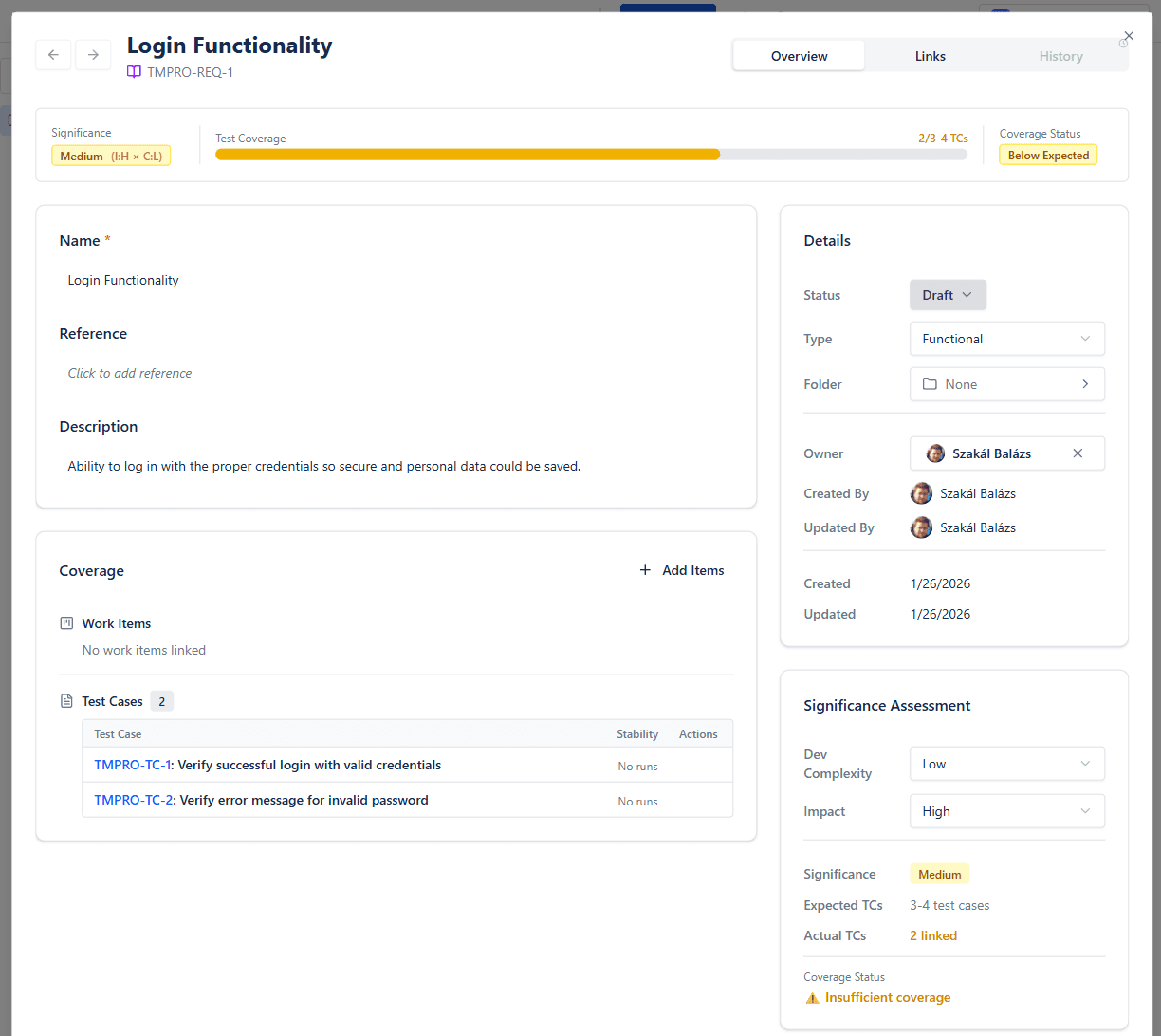
Create requirements for security controls and track their coverage with full traceability. Each security requirement can map to one or more compliance framework controls, such as OWASP A01:2021 (Broken Access Control) or PCI DSS Requirement 6.5.1. The traceability matrix shows at a glance which security controls have been tested, which are pending, and which have outstanding vulnerabilities.
OWASP-Aligned Tests
Organize tests by OWASP categories or security domains such as authentication, authorization, cryptography, and input validation. This alignment makes it straightforward to demonstrate compliance coverage to auditors who think in terms of security frameworks rather than application features. It also helps testers ensure that their test suite addresses each major threat category systematically.
Vulnerability Tracking
Link tests to security defects and track remediation through the fix-verify-close cycle. When a security scan or penetration test discovers a vulnerability, create a linked defect and associate it with the relevant test cases. After the development team applies a fix, the linked tests make it clear exactly what needs to be retested to verify the remediation, preventing the common mistake of closing a vulnerability without proper verification.
Compliance Documentation
Maintain audit-ready test documentation with complete execution history, including who executed each test, when, what the result was, and what actions were taken for failures. This documentation satisfies auditor requirements for evidence of due diligence and can be generated on demand rather than compiled manually before each audit cycle.
Review Workflow
Security tests go through the review workflow for accuracy before execution, ensuring that test steps correctly validate the intended security control. This is especially important for security tests because an incorrectly written test can give a false sense of security by passing when it should fail, which is arguably worse than having no test at all.
Risk-Based Prioritization
Tag security tests with risk levels based on the threat model and the criticality of the assets they protect. Use these tags to create Smart Collections that prioritize high-risk security tests for every release while scheduling lower-risk tests on a rotating basis. This approach ensures that the most dangerous vulnerabilities are always checked without requiring the entire security suite to run every time.
Penetration Test Coordination
Use BesTest to plan and track penetration testing engagements, documenting the scope, findings, and remediation status of each engagement. Link pen test findings to the relevant security test cases so that the automated and manual testing coverage is visible in a single view.
Key Benefits
How to Implement
Define Security Requirements
Document security requirements based on compliance frameworks, threat models, and organizational security policies. Map each requirement to the relevant compliance controls (OWASP, PCI DSS, HIPAA, etc.) so that auditors can see the linkage directly. Involve the security architect and compliance officer in this step to ensure completeness and alignment with the organization's risk appetite.
Create Security Test Cases
Write tests for authentication, authorization, input validation, encryption, session management, error handling, and other security controls identified in the requirements. Each test should specify the exact steps to verify the control, including both positive tests (authorized user can access the resource) and negative tests (unauthorized user is denied access with the correct error response). Include the tools and configurations needed in the preconditions.
Organize by Framework
Create folders aligned with OWASP Top 10, CWE categories, or your organization's security framework. This structural alignment makes it easy to generate compliance reports that map directly to the framework's control categories. Within each category folder, organize tests by application module or feature area to maintain a practical grouping for day-to-day testing.
Execute and Document
Run security tests manually, coordinate with automated scanning tools, and conduct or facilitate penetration testing engagements. Document findings thoroughly, including reproduction steps, evidence screenshots, risk assessment, and recommended remediation. For automated scan results, import findings into BesTest and link them to the relevant test cases so that all security evidence lives in one place.
Track Remediation
Link security defects to the tests that discovered them and track remediation through fix, retest, and closure. Set clear SLAs for vulnerability resolution based on severity (e.g., critical vulnerabilities fixed within 48 hours, high within one week). Re-execute the relevant security tests after each fix to verify the remediation before closing the vulnerability. Document the entire lifecycle for audit purposes.
Best Practices
- •Align tests with OWASP Top 10 and relevant compliance frameworks to ensure systematic coverage of known threat categories rather than testing only the vulnerabilities you can think of.
- •Document exact steps to reproduce security issues, including payloads, headers, and tool configurations. Security defects are notoriously difficult to reproduce without precise instructions.
- •Include both positive (access allowed) and negative (access denied) tests for every security control. A system that correctly denies unauthorized access but also denies authorized access has a different problem that still needs to be caught.
- •Retest all security fixes before closing vulnerabilities. A fix that addresses the specific payload in the bug report but does not address the underlying vulnerability class will be exploited again with a slightly different approach.
- •Maintain security test documentation for audits with full execution history. Auditors do not just want to see that tests exist; they want evidence that they were executed, when, by whom, and what the results were.
- •Conduct security test reviews with the security team before execution to verify that tests actually validate the intended controls. A test that checks for SQL injection by submitting a single quote but does not check the response for error disclosure is incomplete.
- •Schedule security testing as a recurring activity, not a one-time pre-release gate. New code introduces new attack surfaces, and security testing must be continuous to remain effective.
- •Create a security regression suite of tests for previously discovered vulnerabilities and run it with every release to ensure that fixed vulnerabilities do not reappear due to code changes or configuration drift.
- •Track the time between vulnerability discovery and remediation verification as a key metric. This "mean time to remediation" is a strong indicator of your organization's security posture and a metric that auditors and insurers increasingly care about.
Ready to Improve Your Security Testing Management?
BesTest provides all the tools you need—requirements traceability, smart collections, review workflows, and a Jira-native experience. Free for up to 10 users.
Try BesTest FreeRelated Use Cases
Regression Testing in Jira
Automate your regression test cycles with smart collections and traceability
API Testing Management in Jira
Organize, execute, and track API test cases alongside your functional tests
Test Case Review Workflow
Implement quality gates for test cases with built-in review and approval