

12 Best Anonymous Crypto Wallets without KYC in 2026
Financial privacy is a growing concern in the digital age. Over 40% of users worry about exposing their transaction history, fueling demand for secure solutions. The market has responded with a 25% yearly increase in adoption of privacy-focused tools.
Regulators worldwide are tightening rules, making non-KYC options essential for those valuing discretion. This guide explores 12 leading anonymous crypto wallets for 2026, balancing robust encryption with true decentralization. You’ll find hardware and software choices, each vetted for reliability.
Top picks integrate privacy coins like Monero and Zcash while catering to all skill levels. Beginners get intuitive interfaces, while experts access advanced features. We’ll also clarify myths about blockchain transparency to help you choose wisely.
Best Anonymous Crypto Wallets Without KYC in 2026
Looking for privacy in your crypto transactions? Here are the best Anonymous Crypto Wallets that don’t require KYC verification:
- Best Wallet: Balanced option with biometric authentication, coin control features, cold storage integration, and support for 50+ assets including privacy coins like Monero and Zcash.
- Margex: Zero-KYC trading platform with leverage up to 100x, proprietary matching engine, and support for privacy coins, operating under Seychelles regulations.
- Exodus Wallet: User-friendly interface with robust privacy features supporting 1,000+ assets, Trezor hardware integration, and ShapeShift API for instant swaps.
- Tangem: Credit card format hardware wallet with NFC technology, certified secure element (EAL6+), and tap-to-sign functionality that withstands 10,000+ bends.
- Trezor: Open-source hardware wallets with passphrase nesting, U2F authentication, and CoinJoin compatibility for enhanced privacy and transparent security.
- Ledger: Industry leader in cold storage with military-grade encryption, touchscreen STAX wallet, and opt-in key backup service for institutional-grade security.
- Ellipal Titan: True air-gapped protection with military-grade security, solar power, and QR code transaction signing for complete isolation from networks.
- Zengo: Innovative keyless wallet using Multi-Party Computation (MPC) technology instead of seed phrases, with three-factor authentication and social recovery.
- SecuX: Enterprise-grade protection with FIPS 140-2 Level 3 certification, multi-signature capability, and compliance reporting for institutional users.
- SafePal: Affordable hardware wallets backed by Binance Labs with built-in DEX swaps, starting at just $49 for the S1 model with self-destruct mechanisms.
- Cypherock: Eliminates seed phrase vulnerabilities with Shamir Secret Sharing, splitting private keys into encrypted fragments across secure locations.
- NGRAVE: Highest EAL7 certification with graphene construction, quantum-safe algorithms, and Tempest certification against data leaks and electromagnetic attacks.
In-Depth Reviews of the Best Anonymous Crypto Wallets
Let’s take a closer look at the top anonymous crypto wallets we highlighted earlier. In this section, you’ll find detailed insights into each wallet’s privacy tools, security protocols, network compatibility, ease of use, and any associated costs.
Whether you’re prioritizing stealth transactions, decentralized control, or multi-chain support, we’ve got you covered. For those specifically seeking enhanced Bitcoin privacy, we also review the best anonymous bitcoin wallet options, ensuring you can maintain a high level of confidentiality while transacting.
1. Best Wallet: Top Pick for Balanced Privacy
Balancing privacy with convenience requires the right tools. Our top pick excels by merging security features with intuitive design, making it ideal for both beginners and experts. Multi-platform support ensures access anywhere, while integrated DEX features let you trade without compromising anonymity.
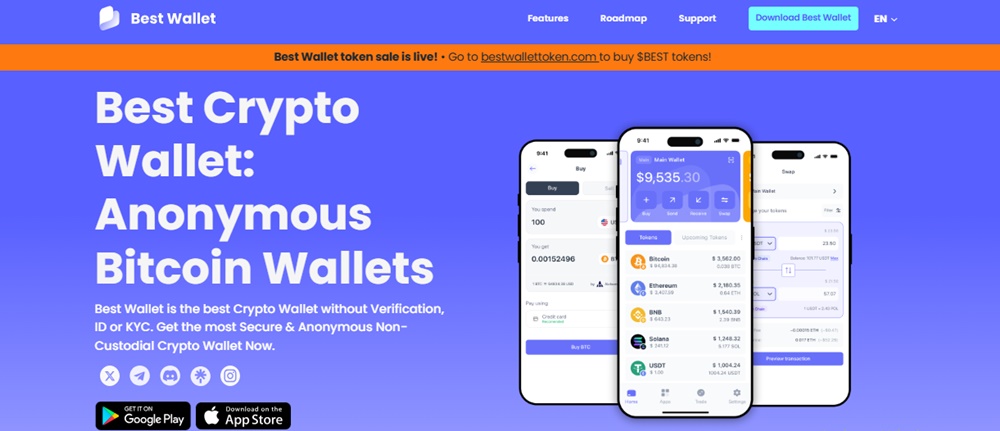
For those seeking enhanced security and privacy, anonymous crypto wallets offer the perfect blend of usability and robust protection, ensuring your transactions remain secure and private..
This wallet supports 50+ assets, including privacy coins like Monero and Zcash. Its security features stand out:
- Biometric Authentication: Fingerprint/Face ID for mobile app logins.
- Coin Control: Handpick UTXOs to obscure transaction trails.
- Cold Storage Integration: Pair with hardware devices for offline safety.
Fiat on-ramps allow USD deposits via partner gateways, though these may require minimal KYC. Fee customization lets you adjust for speed or discretion.
- Best anonymous option for user experience—clean GUI with privacy presets.
- Seed phrase backups + optional Shamir’s Secret Sharing for redundancy.
- Desktop/mobile parity ensures full functionality across devices.
- Staking rewards may link to your wallet, reducing anonymity.
- Advanced features (CLI) have a learning curve.
2. Margex: Secure Trading Without KYC
This platform lets you leverage assets up to 100x while keeping identities hidden. Unlike exchanges that require KYC, Margex uses order book obfuscation to mask trader activity, ensuring that your trading actions remain private.
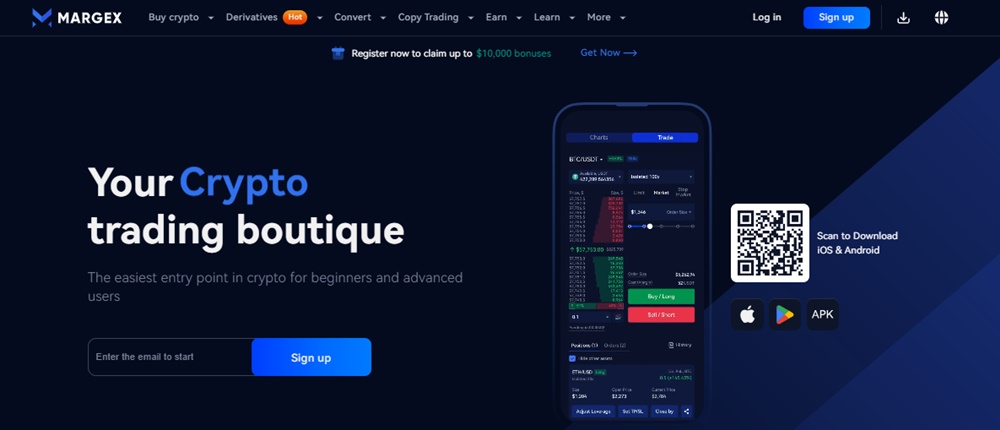
For users looking for the Best Anonymous Crypto Wallets to complement their trading activities, Margex offers a seamless experience that prioritizes privacy and security, allowing you to trade without exposing your personal information.
Key privacy features include:
- Proprietary matching engine: Splits large orders to prevent tracking.
- API key security: IP whitelisting and encrypted signatures protect automated trades.
- Offshore jurisdiction: Operates under Seychelles regulations, reducing data-sharing risks.
Liquidity pools draw from decentralized sources, avoiding centralized choke points. Futures contracts support privacy coins like Monero—a rarity among margin platforms. Withdrawal whitelisting adds another layer, restricting transfers to pre-approved addresses.
Compared to centralized alternatives, Margex’s crypto wallet integration allows direct asset control. Cross-chain swaps work seamlessly, avoiding third-party intermediaries. The trade-off? Slippage can be higher during low-liquidity periods.
For traders prioritizing anonymity, Margex balances advanced tools with jurisdictional safeguards. Its anonymous crypto features set a new standard for high-stakes, private trading.
3. Exodus Wallet: User-Friendly and Private
Managing digital assets shouldn’t require compromising ease of use. Exodus combines a user-friendly interface with robust privacy features, supporting 1,000+ assets. Its integration with Trezor hardware adds offline security without complexity.

The ShapeShift API powers instant swaps within the wallet. No need for external exchanges—just select coins and confirm. Portfolio tracking tools auto-update values across devices.
Live charts and migration wizards simplify transitions from other wallets support systems. Browser extensions exist, but desktop apps (Windows/macOS) offer better security. Mobile and desktop versions sync seamlessly via encrypted backups.
- NFT management: View and transfer collectibles without third-party apps
- Community plugins: Add features like tax reporting or liquidity mining
- Roadmap updates: Quantum-resistant encryption and CoinJoin mixing in development
The mobile app includes biometric logins, while desktop users benefit from air-gapped transaction signing. For beginners, it’s the most accessible user-friendly interface among privacy tools.
4. Tangem: The Card-Sized Hardware Solution
Innovation in secure storage comes in unexpected forms. Tangem redefines hardware wallet design with a credit card format, leveraging NFC for contactless transactions. Its certified secure element (EAL6+) matches bank card protection levels—a rarity for consumer digital assets tools.

The card withstands 10,000+ bends in durability tests, surviving daily wear. Unlike USB devices, it requires no batteries or charging. Tap-to-sign functionality simplifies transactions while keeping keys offline.
EAL6+ certification means Tangem’s chip resists:
- Side-channel attacks (power analysis, electromagnetic leaks)
- Physical tampering (microscopy, laser fault injection)
- Logical exploits (malware, buffer overflows)
Batch verification risks are mitigated through individualized key generation during manufacturing. Each card undergoes third-party audits before shipment.
The card’s 0.8mm thickness enables:
- Discreet storage in standard wallets
- Faster transactions than Bluetooth devices (avg. 1.2 sec signing time)
- Multi-card implementations for shared business accounts
For enterprises, bulk provisioning supports 10,000+ cards with centralized policy controls. Custom holograms deter counterfeiting—a critical security feature for institutional adoption.
While traditional hardware wallets excel for long-term storage, Tangem excels in mobility. Its IP68 rating outperforms most USB devices in water/dust resistance, making it ideal for active users.
5. Trezor: Offline Security for Long-Term Holders
Keeping digital assets safe requires more than basic protection. Trezor’s hardware wallets offer military-grade security with user-friendly features. Their open-source approach ensures transparency, letting you verify every line of code.

The Model T’s color touchscreen simplifies navigation. Unlike button-based devices, it supports:
- Passphrase nesting: Create hidden wallets for plausible deniability
- U2F authentication: Secure logins for Google, GitHub, and more
- CoinJoin compatibility: Mix transactions directly from the device
Bitcoin-only firmware reduces attack surfaces by removing unused code. Third-party apps like Electrum integrate seamlessly, while Tor routing hides your IP during transactions.
| Feature | Model T | Safe 3 |
| Display | Color touchscreen | OLED |
| Secure Element | No | Yes (EAL6+) |
| Price | $219 | $79 |
Tamper-evident packaging ensures no one intercepts your device. Supply chain audits verify each component’s origin. Legacy coins like Dogecoin work alongside privacy-focused assets.
For long-term storage, Trezor balances advanced security features with everyday usability. SD card encryption adds another layer for sensitive backups.
6. Ledger: Industry Leader in Cold Storage
Ledger’s hardware wallets set the benchmark, blending military-grade encryption with user-friendly designs.
Their devices secure private keys offline, thwarting remote attacks. Ledger Recover sparked debate by offering key backup via third parties, which some critics argue contradicts decentralization principles.

However, the opt-in service uses sharded encryption, ensuring that no single entity holds complete keys. For users seeking additional security alongside privacy, best anonymous crypto wallets like Ledger provide a reliable solution, combining robust protection with the flexibility to keep your assets secure and private.
The touchscreen STAX wallet introduces:
- E-ink display: Reduces power use while maintaining readability
- Bluetooth 5.2: Faster pairing than Nano X, with optional air-gapped mode
- NFT gallery: View collectibles without third-party apps
Ledger Enterprise caters to institutions with:
- Multi-signature vaults (3-of-5 approval thresholds)
- Custom compliance tools for FATF Travel Rule adherence
- Direct DeFi access via Ledger Live’s integrated gateways
Their security measures include tamper-proof secure elements (EAL5+ certified). JBOK (Just a Bunch Of Keys) implementations are discouraged—Ledger’s hierarchical deterministic wallets generate keys securely.
For beginners, Ledger Academy offers free courses on self-custody. Advanced users leverage CLI tools for granular control. Whether you’re securing ETH or XMR, Ledger balances robustness with accessibility.
7. Ellipal: Air-Gapped and Tamper-Proof
The Ellipal Titan stands out with military-grade security features, combining an IP68 waterproof rating with CC EAL5 certification.
Its 4-inch touchscreen simplifies navigation while maintaining complete isolation from networks. For those seeking the highest level of privacy and security, anonymous bitcoin wallets like the Ellipal Titan offer unmatched protection, ensuring your assets remain safe and private, even in outdoor or remote environments.

Ellipal uses visual data transfer for true air-gapped protection. You sign transactions by scanning QR codes—no Bluetooth or USB vulnerabilities. The process:
- Generates unsigned QR on mobile app
- Scans code via Titan’s camera
- Verifies details on tamper-proof screen
- Exports signed transaction via new QR
The anti-disassembly design triggers automatic memory wipes if tampered with. A proprietary alloy casing resists:
- Drill penetration (tested to 5 minutes)
- Extreme temperatures (-4°F to 140°F)
- Electromagnetic interference (30kV ESD protection)
| Feature | Ellipal Titan | Bluetooth Wallets |
| Connection type | QR only | Wireless |
| Battery life | 30 days (solar assist) | 7 days avg. |
| Water resistance | IP68 (10m/1hr) | IP54 (splash-proof) |
Firmware updates occur via microSD with cryptographic verification. The digital assets supported now include 10,000+ coins after recent Cardano and Polkadot integrations.
For merchants, Titan supports NFC payments through its companion app. The disaster recovery mode lets you regenerate keys from encrypted fragments—no single point of failure.
Supply chain transparency is verified through batch-tracking QR codes. Each unit’s secure element ships pre-tested by Swiss-based auditors.
8. Zengo: Keyless Recovery for Beginners
Losing access to your funds shouldn’t mean losing them forever. Zengo’s keyless wallet replaces seed phrases with Multi-Party Computation (MPC) technology. Your private keys split into encrypted fragments, stored locally and with trusted guardians.

Three-factor authentication combines:
- Biometric scans (Face ID/fingerprint)
- Device authentication (your smartphone)
- Social recovery (approved contacts)
Lose your phone? Two guardians can help restore access—no single point of failure. Cloud backups are encrypted, visible only via your biometrics.
The Web3 firewall blocks malicious dApp interactions. Watch-only mode lets you monitor balances without exposing keys. SIM swaps are thwarted by device-binding and biometric checks.
| Feature | Traditional Multisig | Zengo MPC |
| Recovery Method | Seed phrase + hardware | 3FA + social recovery |
| User Experience | Complex setup | One-tap restoration |
| Institutional Use | Custom setups | Pre-built compliance tools |
For estates, Zengo’s inheritance tool designates beneficiaries. They gain access after a waiting period, verified via legal docs. Partnerships with Fireblocks and Chainalysis ensure regulatory compatibility without sacrificing privacy.
9. SecuX: Enterprise-Grade Protection
Corporate asset protection demands specialized solutions beyond consumer-grade tools. SecuX delivers military-level security with its FIPS 140-2 Level 3 certified hardware wallets. These devices meet strict government standards for sensitive data handling.

The enterprise version integrates Hardware Security Modules (HSMs) for institutional use. These tamper-proof devices store cryptographic keys separately from transaction processors. Three-layer encryption protects against both physical and digital attacks.
- Compliance reporting: Auto-generates audit trails for SOC 2 and ISO 27001 requirements
- Asset tagging: Labels digital holdings by department, project, or compliance status
- Custom firmware: Allows whitelisting of specific transaction types per corporate policy
Transaction workflows require multiple approvals based on amount thresholds. Managers can set rules like:
- 2 signatures for transfers over $50,000
- Geo-fenced approvals for international transactions
- Time-delayed executions for large withdrawals
Employee access follows role-based permissions. Junior staff might only view balances, while treasury teams can initiate transactions. All actions log immutable timestamps to blockchain.
| Feature | Consumer Devices | SecuX Enterprise |
| User accounts | Single | Unlimited with hierarchy |
| Compliance tools | None | Built-in |
| Audit trails | Basic | Granular |
The B2B model focuses on financial institutions and corporate treasuries. Custom implementations support:
- Banking API integrations
- Cold storage for institutional investors
- Payment processors handling high-volume transactions
With these security features, SecuX establishes itself as the gold standard for enterprise digital asset protection. Their solutions address regulatory needs while maintaining operational flexibility.
10. SafePal: Affordable Hardware with DEX Access
SafePal’s hardware wallet lineup, backed by Binance Labs, delivers enterprise-grade protection at retail prices.
The S1 model stands out with built-in DEX swaps and a focus on emerging markets. In-app token swaps utilize Binance’s liquidity pool for over 1,000 digital assets, while real-time price tracking tools keep you updated on market shifts.

A 1.3-inch LCD screen ensures visibility even in sunlight, making it critical for outdoor transactions. For those seeking a secure and cost-effective solution, anonymous bitcoin wallets like SafePal provide the perfect balance of privacy, security, and affordability.
Manufacturing costs stay low through streamlined designs. BNB Chain integrations enable staking directly from the device. Supply chain audits verify tamper-proof packaging at each step.
| Feature | S1 | S Pro |
| Display | 1.3″ LCD | 2.4″ Touchscreen |
| Battery | Non-rechargeable | USB-C charging |
| NFT Support | Basic thumbnails | Full metadata display |
| Price | $49 | $129 |
The S1 targets first-time buyers with essential security features. The Pro version adds multisig support for advanced users. Both models include a self-destruct mechanism if tampered with.
Emerging markets benefit from localized firmware and low data usage. SafePal’s roadmap includes Lightning Network integration, further reducing fees for small transactions.
11. Cypherock: Shattering Seed Phrase Vulnerabilities
Cypherock revolutionizes protection with military-grade security features, eliminating single points of failure.
Their approach combines cryptography with physical safeguards to ensure maximum security. The system uses Shamir Secret Sharing to split your private keys into encrypted fragments, which are geographically distributed across secure locations.

Even if one fragment is compromised, your assets remain protected. For those looking for advanced protection, anonymous crypto wallets like Cypherock offer a secure and private way to safeguard your digital assets, combining innovative technology with robust privacy features.
Social recovery works through trusted contacts, not centralized services. You choose guardians who collectively help restore access. Quantum-resistant algorithms future-proof the encryption against next-gen computing threats.
Bank vault integration allows institutional clients to:
- Store fragments in HSMs (Hardware Security Modules)
- Set jurisdiction-specific access rules
- Automate inheritance protocols with time-locked releases
Compliance tools meet FINRA and SEC requirements. Audit trails track fragment access without revealing contents. The system logs all recovery attempts instantly.
| Feature | Cypherock | Paper Wallets |
| Disaster Recovery | Multi-location fragments | Single copy risk |
| Durability | Titanium/ceramic hybrids | Paper degradation |
| Access Control | Biometric+geofenced | Physical possession only |
Unlike traditional seed phrase methods, Cypherock’s approach removes human error risks. Fragments automatically regenerate if compromised, maintaining constant protection. The system works offline, ensuring air-gapped security.
For high-net-worth individuals, custom solutions include:
- Decoy wallets for plausible deniability
- Multi-signature fragment releases
- Legal document integration for estates
As regulations tighten, Cypherock’s design adapts without sacrificing self-custody principles. Their technology bridges personal security with institutional requirements seamlessly.
12. NGRAVE: Military-Grade Cold Wallet
NGRAVE combines military-grade protection with advanced blockchain security in its cutting-edge cold wallet design. With an EAL7 certification the highest available for hardware wallets NGRAVE exceeds the security standards of traditional banking systems. The wallet’s graphene construction ensures unparalleled durability, protecting it against both physical and electromagnetic attacks.

Equipped with Tempest certification, the wallet prevents data leaks caused by radio frequencies, making it nearly impossible for sophisticated eavesdropping tools to intercept private keys during transactions. Additionally, its bilateral communication feature verifies the device’s authenticity before signing, ensuring a secure experience.
NGRAVE takes security a step further with biometric authentication, replacing traditional passwords with fingerprint scans.
Quantum-safe algorithms also future-proof assets, protecting them from the future threat of supercomputers. For those seeking enhanced privacy and protection, NGRAVE offers an ideal solution as one of the most reliable anonymous crypto wallets, making it an excellent choice for secure and private transactions in the crypto space.
Institutional custody features include:
- Multi-user role permissions (admin/auditor/operator)
- Geo-fenced transaction approvals
- HSM integration for enterprises
Supply chain security is audited from raw materials to delivery. NATO standards validate its resilience in combat scenarios. Consumer devices pale in comparison—NGRAVE’s security features cater to militaries and crypto whales alike.
| Feature | NGRAVE | Consumer Wallets |
| Tamper Response | 0.1ms wipe | 2–5 sec delay |
| Material | Graphene alloy | Plastic/metal |
| Certifications | EAL7 + Tempest | EAL5 max |
Partnerships with defense contractors highlight its strategic value. For assets requiring Fort Knox-level safeguards, NGRAVE is the gold standard.
Why Privacy Matters in Cryptocurrency

Your financial footprint on public ledgers reveals more than you realize.
Every Bitcoin transaction links to a wallet address, creating permanent trails. While these addresses seem random, chain analysis firms can connect them to your real identity. For those seeking enhanced privacy, anonymous bitcoin wallets offer a crucial layer of security, helping to protect your identity and prevent third parties from tracking your transactions on the blockchain.
The IRS uses these tools to track tax compliance and, in 2024, recovered $1.8 billion from unreported Bitcoin sales. Businesses face risks too competitors can monitor supply chain payments or R&D investments. Authoritarian regimes exploit blockchain transparency. Activists and journalists have been targeted after their transactions were de-anonymized, with a 2023 report showing 12 cases where dissidents’ funds were frozen. In this environment, anonymous crypto wallets offer a crucial layer of privacy and security, protecting individuals and organizations from unwanted exposure.
Traditional banks offer more privacy than blockchain technology, as card purchases don’t appear on public databases. However, crypto’s transparency fuels corporate surveillance, with 85% of exchanges now sharing data with regulators. For those seeking true anonymity, privacy-focused wallets are essential.
Privacy isn’t just for illicit activities. Ethical uses include:
- Protecting trade secrets
- Shielding donors to sensitive causes
- Preventing price manipulation in OTC trades
Recent laws like the EU’s Transfer of Funds Regulation demand stricter identity checks. Without anonymous crypto options, your personal information becomes vulnerable by default.
Understanding Anonymous Crypto Wallets
As cryptocurrency adoption grows, so does the need for privacy. Every digital transaction leaves behind data points—timestamps, amounts, addresses—that can be used to trace activity. While many wallets market themselves as private, not all deliver true anonymity. An effective anonymous crypto wallet must go beyond basic pseudonymity to provide real protection.
Traditional wallets like Bitcoin Core offer limited privacy since addresses and transactions remain publicly visible. Even though names aren’t attached, blockchain analysis tools can uncover identities based on behavior patterns, address reuse, or IP data. In contrast, privacy-focused wallets integrate features such as stealth addresses, RingCT, and zero-knowledge proofs to obscure sender, receiver, and amount.
Another important factor is whether a wallet connects to centralized servers. Light wallets often leak metadata through third-party nodes, compromising privacy. A truly anonymous crypto wallet minimizes reliance on centralized infrastructure and supports decentralized networks like Tor or I2P.
Seed phrase protection and backup methods also affect privacy. Solutions like Shamir’s Secret Sharing or MPC offer more secure recovery without revealing sensitive information.
Ultimately, understanding the technology behind each wallet—how it handles keys, connections, and recovery—is key to preserving your anonymity. Not all privacy tools are equal, so choosing a wallet built for true discretion is essential in today’s surveillance-heavy landscape.
Pseudonymous vs. Truly Anonymous Transactions
Bitcoin operates pseudonymously—your identity isn’t tied to addresses, but patterns reveal connections. Reusing addresses links transactions, making them traceable. A 2024 study showed 73% of Bitcoin users inadvertently do this.
Monero uses three layers of obfuscation:
- Ring signatures: Mixes your transaction with others
- Stealth addresses: Generates one-time receiving addresses
- Confidential transactions: Encrypts transaction amounts
| Feature | Bitcoin | Monero |
| Address reuse risk | High | None |
| Transaction visibility | Public ledger | Private ledger |
| Default privacy | None | Full |
How Blockchain Technology Affects Privacy
Public ledgers like Bitcoin’s allow anyone to track unspent transaction outputs (UTXOs). Chain analysis firms leverage this transparency to map wallet activity. While techniques like CoinJoin a mixing method can enhance privacy, they still have limitations if not executed properly.
Zcash’s zk-SNARKs provide a way to achieve selective transparency, yet only 15% of users fully enable privacy features. Furthermore, light wallets can increase risks as they often rely on third-party servers for data, compromising user privacy.
The key takeaway is that true anonymity requires a combination of robust tools—private keys alone aren’t enough. To achieve stronger privacy, one must also consider factors like entropy (randomness) in transaction timing and amounts, which further obscure transaction trails.
For those seeking a higher level of security, Anonymous Crypto Wallets can provide an essential layer of privacy, helping users maintain their confidentiality while engaging in blockchain transactions.
Key Features of Anonymous Wallets
Control over your digital assets starts with understanding wallet security. The best tools combine robust security features with user-friendly designs. Below, we break down what sets top performers apart. While ease of use matters, true financial privacy depends on the technology behind the interface.
An anonymous crypto wallet should shield your identity, prevent transaction tracking, and reduce reliance on third parties. Key aspects like encryption, decentralization, and secure recovery mechanisms are critical. Choosing the right wallet helps ensure your crypto remains secure and private over time.
Essential Wallet Features
Key features to look for in an anonymous crypto wallet:
- Non-custodial architecture – Gives you full ownership and control of your private keys.
- Advanced encryption protocols – Utilizes AES-256 or quantum-resistant algorithms to protect sensitive data.
- Decentralized design – Reduces exposure to centralized surveillance or data leaks.
- Integrated privacy tools – Features like CoinJoin, stealth addresses, or zero-knowledge proofs to obscure transaction details.
- Secure recovery options – Supports seed phrases, Shamir Secret Sharing, or MPC for resilient backup and access recovery.
Non-Custodial vs. Custodial: Who Controls Your Keys?
Non-custodial wallets let you manage private keys directly. No third party can freeze or access your funds. An example is Ledger’s Secure Element Chip, which isolates keys in hardware for maximum security.

The Risk of Custodial Services
Custodial services hold keys for you, much like traditional banks. While convenient, they’re significantly riskier. Mt. Gox lost 850,000 BTC in 2014 due to poor security safeguards.
For those prioritizing privacy and security, anonymous crypto wallets offer a safer alternative, allowing users to maintain full control over their assets without relying on third-party services.
Recovery Process Differences
- Non-custodial: Seed phrases restore access (if stored safely)
- Custodial: Password resets rely on provider policies
The Critical Role of Encryption
Encryption is the backbone of any anonymous crypto wallet. Without strong encryption, your private keys, transaction data, and personal identity are left exposed to cyber threats. The best anonymous crypto wallets use AES-256 encryption, a military-grade standard known for its resistance to brute-force attacks.
This level of protection ensures your digital assets remain safe—even if your device is compromised.
Future-Proof Security
As blockchain adoption grows, so do the risks from emerging technologies. Quantum computing poses a serious future threat.
Leading providers like NGRAVE and Cypherock are integrating quantum-resistant encryption algorithms such as XMSS and SPHINCS+.
Advanced Privacy Features
Modern privacy wallets utilize Multi-Party Computation (MPC), splitting private keys into multiple encrypted parts. This ensures no single point of failure exists. Zengo removes seed phrases entirely, simplifying user experience without compromising security.
Air-Gapped Security Solutions
For even greater privacy, air-gapped solutions like Ellipal Titan sign transactions offline using QR codes. This removes the possibility of remote attacks. If you’re serious about financial privacy, using an anonymous crypto wallet with end-to-end encryption is not optional—it’s essential.
How Decentralization Enhances Anonymity

Decentralized networks reshape financial privacy by eliminating single points of control. Unlike centralized exchanges (CEXs), which require ID checks, blockchain technology distributes authority across nodes. This makes tracking harder—no central server stores your data.
DEXs processed $1.2 trillion in 2024, proving users prefer peer-to-peer trading. Tornado Cash’s sanctions revealed risks: even privacy tools face scrutiny if centralized components exist. Here’s how true decentralization protects you:
- Node distribution: More nodes mean fewer chokeholds for surveillance. Monero’s 2,500+ nodes obscure transaction paths better than Bitcoin’s 10,000+ (which prioritize speed over privacy).
- Atomic swaps: Directly trade coins across chains without KYC. Komodo’s protocol hides participants by splitting transactions into untraceable steps.
- TOR/I2P overlays: Mask IP addresses. Wasabi Wallet routes traffic through TOR, making location tracking impossible.
Automated market makers (AMMs) log trades publicly. For better anonymity, use decentralized storage like IPFS for transaction records it shreds data across nodes. Governance tokens add complexity; holding them may reveal your wallet if votes are public. Crypto wallets with stealth addresses (e.g., Zcash’s z-addresses) solve this by default.
Mempool privacy is often overlooked. Transactions waiting to be mined are visible. Samourai Wallet’s Whirlpool mixes coins before broadcasting, adding noise. For those looking to protect their identity further, using a crypto wallet without id ensures that no personal information is tied to your wallet, helping to safeguard your privacy in the crypto space.
Conclusion: Choosing Your Anonymous Wallet
Selecting the right privacy-focused tool requires careful consideration of several factors. Prioritize security features such as air-gapped signing or multisig if you handle significant amounts of cryptocurrency. Jurisdiction is also important, as some regions enforce stricter data-sharing laws, which could impact the privacy of your transactions. For enhanced privacy, anonymous crypto wallet can provide a crucial layer of protection, allowing you to maintain confidentiality and security while managing your digital assets.
Match the wallet to your asset types, as privacy coins like Monero require specialized support for optimal privacy. For compliance with the travel rule, consider decentralized options that come with built-in obfuscation to help maintain privacy.
Future-proof your choice by opting for quantum-resistant encryption, ensuring that your wallet is secure against future technological advancements. Enterprises may require audit trails for regulatory reasons, while individuals often prefer simplicity and ease of use. The 25% adoption growth in privacy wallets highlights the increasing demand for anonymous crypto wallets that offer true financial discretion.
Final tip: Always test your wallet’s recovery options before committing fully. A tool is only as strong as its weakest link, which is often user error. Choosing the right anonymous crypto wallet and understanding its features helps ensure that your assets remain secure and private in an ever-evolving digital world.