


There are two kinds of Bell polynomials.
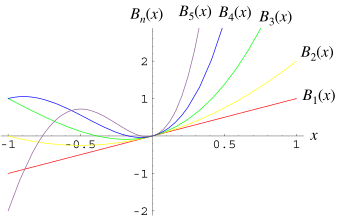
A Bell polynomial  , also called an exponential polynomial and denoted
  (Bell 1934, Roman 1984, pp. 63-67) is a polynomial
  that generalizes the Bell number
  and complementary Bell number
  such that
 |  |  | (1) |
 |  |  | (2) |
These Bell polynomial generalize the exponential function.
Bell polynomials should not be confused with Bernoulli polynomials, which are also commonly denoted  .
.
Bell polynomials are implemented in the Wolfram Language as BellB[n, x].
The first few Bell polynomials are
 |  |  | (3) |
 |  |  | (4) |
 |  |  | (5) |
 |  |  | (6) |
 |  |  | (7) |
 |  |  | (8) |
 |  |  | (9) |
(OEIS A106800).
 forms the associated Sheffer sequence for
 | (10) |
so the polynomials have that exponential generating function
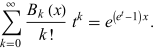 | (11) |
Additional generating functions for  are given by
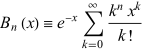 | (12) |
or
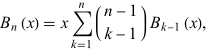 | (13) |
with  , where
  is a binomial coefficient.
The Bell polynomials  have the explicit formula
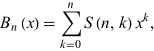 | (14) |
where  is a Stirling number of the second kind.
A beautiful binomial sum is given by
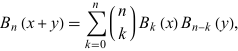 | (15) |
where  is a binomial coefficient.
The derivative of  is given by
 | (16) |
so  satisfies the recurrence equation
![B_(n+1)(x)=x[B_n(x)+B_n^'(x)].](https://mathworld.wolfram.com/images/equations/BellPolynomial/NumberedEquation8.svg) | (17) |
The second kind of Bell polynomials 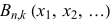 are defined by
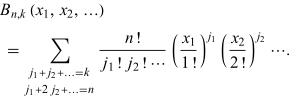 | (18) |
They have generating function
 | (19) |
