
LeetCode .905 Sort Array By Parity : Hey there, coding enthusiasts! Welcome back to another exciting coding session. Today’s problem is a treat—literally! We’re going to solve the “ Sort Array By Parity” or “LeetCode .905”
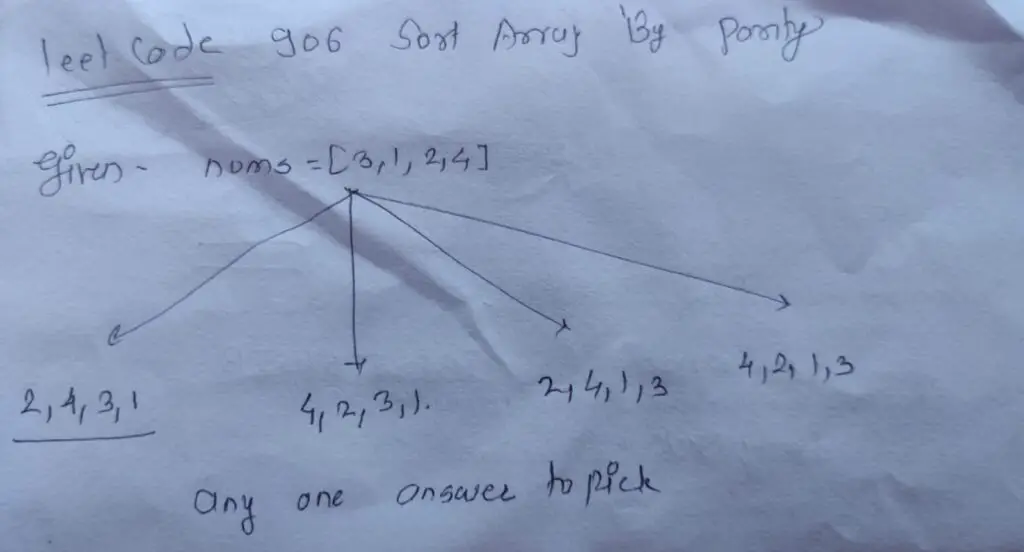
1 Approach : Two vector (Array) : Leet Code 950
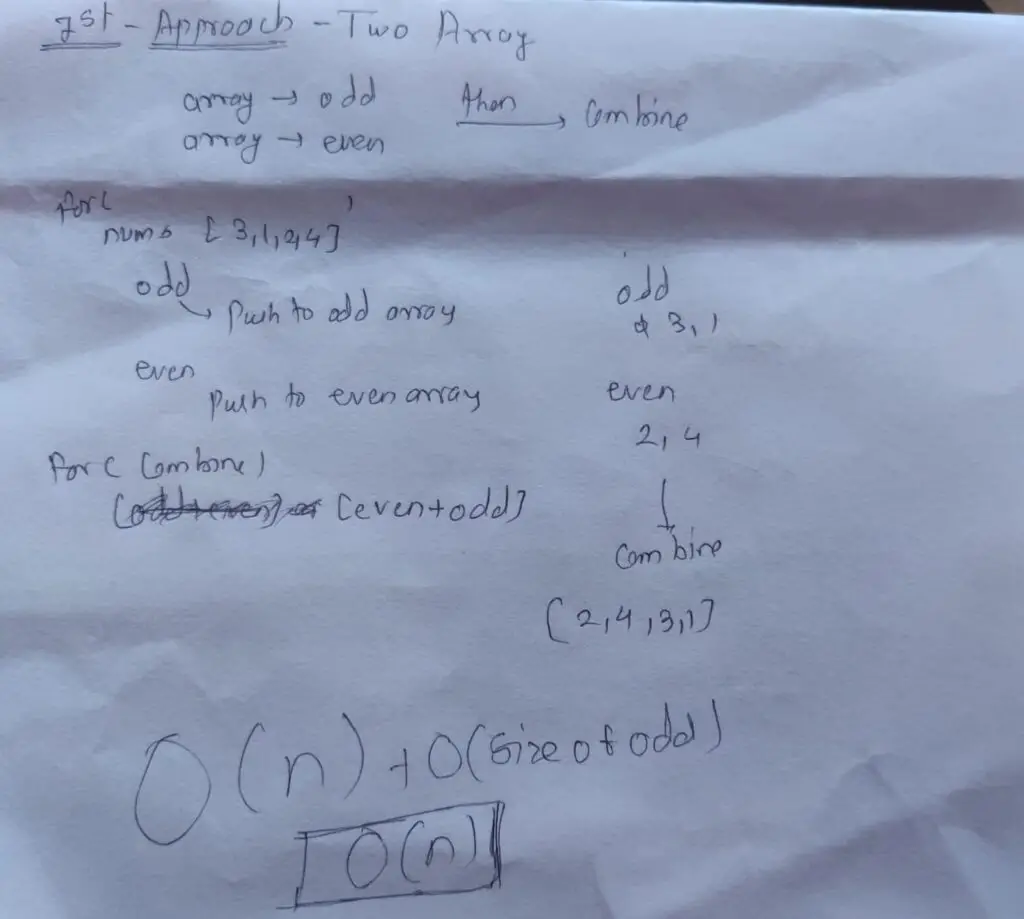
Step for Two array approach
1: Initialize Lists
- Begin by creating three empty array ,lists:
ans,odd, andeven.
2: Iterate Through Array
- Loop through the given array from “Leetcode 905,” examining each number.
3: Separate Even and Odd Numbers
- For each number, check if it’s even or odd based on its remainder when divided by 2.
- If it’s even, add it to the
evenlist; otherwise, add it to theoddlist.
4: Combine Lists
- After processing all numbers, concatenate the
evenandoddlists in that order. This combines the numbers while preserving their respective orders.
Step 5: Return Sorted Array
- The
anslist now holds the sorted array with even numbers appearing before odd numbers. - Return this sorted array as the result of the function.
C++: Sort Array By Parity (Two Array Approach)
class Solution { public: vector<int> sortArrayByParity(vector<int>& nums) { vector<int> ans; vector<int> odd; vector<int> even; for(int i = 0; i < nums.size(); i++) { if(nums[i] % 2 == 0) { even.push_back(nums[i]); } else { odd.push_back(nums[i]); } } ans = even; for(int i = 0; i < odd.size(); i++) { ans.push_back(odd[i]); } return ans; } };Java: Sort Array By Parity (Two Array Approach)
import java.util.ArrayList; import java.util.List; class Solution { public List<Integer> sortArrayByParity(int[] nums) { List<Integer> ans = new ArrayList<>(); List<Integer> odd = new ArrayList<>(); List<Integer> even = new ArrayList<>(); for (int num : nums) { if (num % 2 == 0) { even.add(num); } else { odd.add(num); } } ans.addAll(even); ans.addAll(odd); return ans; } }Python: Sort Array By Parity (Two Array Approach)
class Solution: def sortArrayByParity(self, nums): ans = [] odd = [] even = [] for num in nums: if num % 2 == 0: even.append(num) else: odd.append(num) ans.extend(even) ans.extend(odd) return ansJavaScript: Sort Array By Parity (Two Array Approach)
/** * @param {number[]} nums * @return {number[]} */ var sortArrayByParity = function(nums) { let ans = []; let odd = []; let even = []; for (let i = 0; i < nums.length; i++) { if (nums[i] % 2 === 0) { even.push(nums[i]); } else { odd.push(nums[i]); } } ans = even.concat(odd); return ans; }; 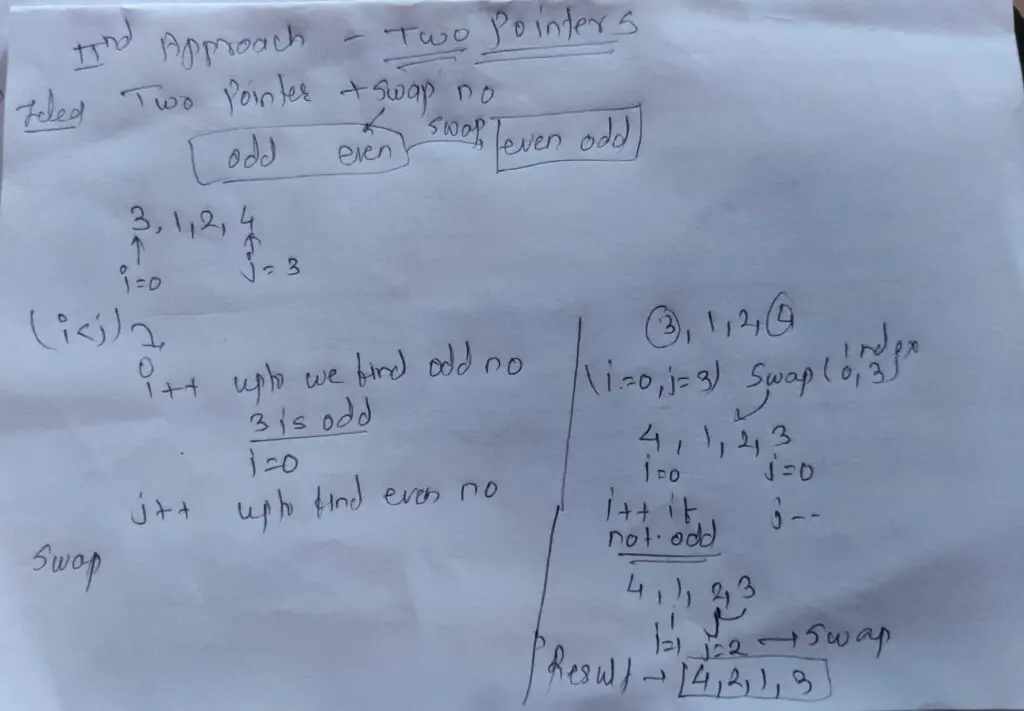
2 Approach 1: Two-Pointer Approach
To solve the “Sort Array By Parity” problem using the two-pointer approach:
Key Data Structures:
- i and j: Two pointers initialized to the start and end of the array, respectively.
Enhanced Breakdown:
- Initialization:
- Initialize
ito 0 andjto the last index of the array.
- Initialize
- While Loop:
- Keep iterating until
iis less thanj. - Increment
iif the element atiis even. - Decrement
jif the element atjis odd. - Swap the elements at
iandjif the above conditions aren’t met.
- Keep iterating until
- Return the Modified Array:
- After the loop completes, the array will be sorted by parity.
Codes for Leet code 905 Two Pointer Approach
C++: Leet code 905
class Solution { public: vector<int> sortArrayByParity(vector<int>& nums) { int i = 0, j = nums.size() - 1; while (i < j) { while (i < j && nums[i] % 2 == 0) { i++; } while (i < j && nums[j] % 2 == 1) { j--; } swap(nums[i], nums[j]); } return nums; } };Java: Leet code 905
class Solution { public int[] sortArrayByParity(int[] nums) { int i = 0, j = nums.length - 1; while (i < j) { while (i < j && nums[i] % 2 == 0) { i++; } while (i < j && nums[j] % 2 == 1) { j--; } int temp = nums[i]; nums[i] = nums[j]; nums[j] = temp; } return nums; } }Python : Leet code 905
class Solution: def sortArrayByParity(self, nums: List[int]) -> List[int]: i, j = 0, len(nums) - 1 while i < j: while i < j and nums[i] % 2 == 0: i += 1 while i < j and nums[j] % 2 == 1: j -= 1 nums[i], nums[j] = nums[j], nums[i] return numsLeet Code 1658. Minimum Operations to Reduce X to Zero (Medium)
JavaScript: Leet code 905
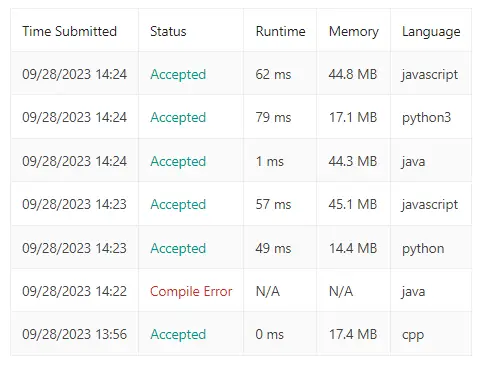
function sortArrayByParity(nums) { let i = 0, j = nums.length - 1; while (i < j) { while (i < j && nums[i] % 2 === 0) { i++; } while (i < j && nums[j] % 2 === 1) { j--; } [nums[i], nums[j]] = [nums[j], nums[i]]; } return nums; }Result Analysis :
List Of Some Important leetcode Question :