
edited by Lucy & Groff Conklin
(Philadelphia: Lippincott, 1953, $3.95, 349pp, hc)
- 11 · Introduction · Lucy and Groff Conklin · in
- 19 · The Angel with Purple Hair · Herb Paul · ss The Magazine of Fantasy and Science Fiction (F&SF) Dec 1950
- 34 · For the Blood Is the Life · F. Marion Crawford · ss Collier’s Dec 16 1905
- 50 · The Stranger · Richard Hughes · ss The Weekly Westminster Gazette May 26 1923
- 58 · Mrs. Manifold · "Stephen Grendon" (August Derleth) · ss The Girl With the Hungry Eyes and Other Stories, ed. Donald A. Wollheim, Avon 1949
- 71 · Piffingcap · A. E. Coppard · ss Adam and Eve and Pinch Me, Golden Cockerell Press: Berkshire 1921
- 82 · Shottle Bop · Theodore Sturgeon · nv Unknown: Fantasy Fiction Feb 1941
- 109 · Gabriel-Ernest · H. H. Munro · ss The Westminster Gazette May 29 1909
- 116 · The Lost Room · Fitz-James O’Brien · ss Harper’s Sep 1858; Weird Tales Oct 1929
- 132 · The Traitor · James S. Hart · ss F&SF Fall 1950
- 147 · Angus MacAuliffe and the Gowden Tooch · Charles R. Tanner · ss Other Worlds Science Stories Mar 1951
- 167 · Are You Run-Down, Tired— · Babette Rosmond & Leonard M. Lake · ss Unknown Worlds Oct 1942
- 174 · The Nature of the Evidence · May Sinclair · ss Fortune May 1923
- 186 · The Tree’s Wife · Mary Elizabeth Counselman · ss Weird Tales Mar 1950
- 198 · The Pavilion · E. Nesbit · ss The Strand Nov 1915
- 215 · Pick-up for Olympus · Edgar Pangborn · vi * [first publication]
- 218 · The Swap · H. F. Heard · ss The Great Fog and Other Weird Tales, Vanguard 1944
- 235 · The Tombling Day · Ray Bradbury · ss Shenandoah Fall 1952
- 243 · Minuke · Nigel Kneale · ss Tomato Cain, London: Collins 1949
- 255 · Bird of Prey · John Collier · ss Presenting Moonshine, New York: Viking 1941; Playboy Jan 1954
- 264 · The Thing in the Cellar · David H. Keller, M.D. · ss Weird Tales Mar 1932
- 271 · Devil’s Henchman · Will F. Jenkins · ss Argosy May 1952
- 286 · Lost Hearts · M. R. James · ss The Pall Mall Magazine Dec 1895
- 296 · Thirteen at Table · Lord Dunsany · ss The Last Book of Wonder, J.W. Luce 1916
- 305 · Lights · Philip M. Fisher, Jr. · ss Argosy All-Story Weekly Jul 15 1922
- 316 · The Silver Highway · Harold Lawlor · ss Weird Tales May 1946
- 332 · The Moonlit Road · Ambrose Bierce · ss Cosmopolitan Jan 1907
- 342 · The Curate’s Friend · E. M. Forster · ss The Pall Mall Magazine Oct 1907

ghost-edited by Gordon R. Dickson
(Bantam, Feb ’67, 212pp, pb)
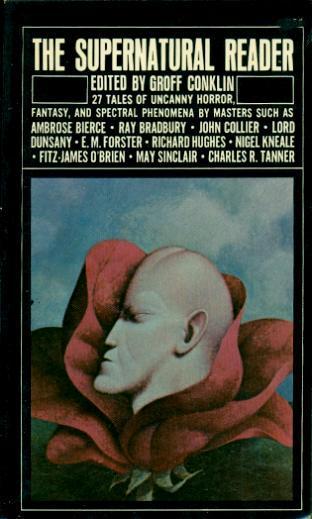 The 1966 paperback edition of the Conklins' anthology, sharing rack space with the 1967 Dickson/ "Serling" volume (and seeing at least four printings over the next several years)...the Collier pb, with more pages (and twice as many stories) on better paper, would set you back 95c, while the Bantam volume was 60c (by the 11th printing in the early '70s, the price would rise to 75c). I have this edition of the Conklins' book (though I find the cover on the first Collier paperback, from 1962, the handsomest of the packages the book has sported). In the wake of the remarkable success of Ira Levin's Rosemary's Baby, the televised horror soap opera Dark Shadows catching fire, and a number of paperback houses discovering that tagging anything remotely relevant as a Gothic was a guaranteed selling-strategy...perhaps that both books saw more reprints in 1967, and just after, than the Reader had had or either would have again is less surprising in retrospect than it might be (the Serling-branded book might've had a bump both from The Twilight Zone's entry into the syndicated television repeats market and from his initial-draft scripting the 1968 film Planet of the Apes). It doesn't hurt that they are both fine collections, even if the lack of concern for detail on Bantam's part (managing to refer Worlds of Tomorrow magazine in the publication credits as "The World of Tomorrow", for example), as well as featuring a slightly larger proportion of (theoretically) public domain stories (if good and mostly not overly familiar ones, in both volumes) than the scrupulously credited Conklins' volume might discourage a few potential readers.


(Bantam, Feb ’67, 212pp, pb)
- vii · Introduction · Rod Serling · in
- 1 · The Montavarde Camera · Avram Davidson · ss F&SF May 1959
- 14 · The Coach · Violet Hunt · ss The English Review Mar 1909
- 31 · Adapted · Carol Emshwiller · ss F&SF May 1961
- 40 · Death Cannot Wither · Judith Merril · nv F&SF Feb 1959
- 61 · The Story of the Goblins Who Stole a Sexton · Charles Dickens · ss The Posthumous Papers of the Pickwick Club Jan 1837
- 72 · Pollock and the Porroh Man · H. G. Wells · ss New Budget May 23 1895
- 87 · Stars, Won’t You Hide Me? · Ben Bova · ss Worlds of Tomorrow Jan 1966
- 101 · The Bottle Imp · Robert Louis Stevenson · nv New York Herald Feb 8-Mar 1 1891
- 129 · The Adventure of the German Student · Washington Irving · ss Tales of a Traveller, John Murray 1824
- 135 · The Four-Fifteen Express · Amelia B. Edwards · nv Routledge’s Christmas Annual, 1867 1866
- 160 · The Blue Sphere · Theodore Dreiser · ss The Smart Set Dec 1914
- 177 · The Bisara of Pooree · Rudyard Kipling · ss The Civil and Military Gazette Mar 4 1887
- 182 · A Time to Keep · Kate Wilhelm · ss F&SF Jan 1962
- 197 · Brother Coelestin · Jaroslav Vrchlický (as by Emil Frida) · ss Lumír Jan 20 1878 (trans./ed. Edna Worthley Underwood, from"Flétna", in Short Stories from the Balkans, Marshall Jones Co., 1919)
Groff Conklin and Rod Serling were busy, productive, eventually frustrated people, who both chain-smoked their way into early graves. Both had been rather broad-scope in literary and narrative arts in their early careers, and eventually found themselves locked into working in fantastica, which they enjoyed but to some extent wished they didn't have to rely on, particularly as the rewards contracted. Conklin, who as a young man contributed to Poetry magazine, began his anthology-editing career with volumes drawn from The Smart Set and The New Republic, and wrote benchmark guides to home repair which would remain in print for decades, was 63 when he died of emphysema in 1968; Serling, a playwright who began his career in radio, was at least as widely-known for his teleplays Patterns and Requiem for a Heavyweight (and hassles with sponsors and censors) at the height of his career as he was for creating The Twilight Zone and its offshoots; and who found himself as prominent as a voice-over man and narrator as as a writer at the end of his career, was 50 when the third heart attack in a brief period, while he was on the table for open-heart surgery to repair damage from his second, essentially killed him in 1975. Conklin's wife and co-editor on The Supernatural Reader, Lucy Conklin, had died the year after the first edition was published, in 1954, and her husband added a note to reprints of the book stating that she had fully collaborated on the selections and the introduction with him; I have to wonder why her name is missing from the later editions otherwise. Presumably as lazy a marketing strategy as having Gordon Dickson, a talented writer and occasional editor, ghost the "Serling" book (he had also previously ghost-edited Rod Serling's Triple W: Witches, Warlocks and Werewolves for publication in 1963). I suspect Serling did write his two-page introduction... it has his cadences down.
The stories I loved decades before I encountered either volume include, among the Conklins' selections, were Sturgeon's "Shottle Bop", "Saki"'s "Gabriel-Ernest" and Bierce's "The Moonlit Road"; from the Dickson, Davidson's "The Montavarde Camera" and Stevenson's "The Bottle Imp", and I was a late-comer to the Wells, but only as late as reading it some years ago in Fraser and Wise's Great Tales of Terror and the Supernatural. A couple of the others, I liked rather than loved from my early reading, remembering them less well till refreshing my memories.
Among the stories new to me in our volumes for today:
The Supernatural Reader:
"Pick-up for Olympus" by Edgar Pangborn is the one story original to either volume, a slight but amusing vignette about a 1960s (in this 1953 story) small-town garage mechanic enchanted by the durable but neglected 1930s Chevy truck that rolls into his gas station one day. So taken with the truck, he barely notes the rather unusual owners.
John Collier's "Bird of Prey" is good, mid-level Collier, a writer one can only suspect was high on Patricia Highsmith's inspiration list. And both students of Ambrose Bierce. A very happy couple (with only one notable sore spot between them) and their beloved pet parrot do not have a good time after a certain visitation by Another sort of bird.
Devils and Demons:
Carol Emshwiller's "Adapted" is a typically urgent recounting, not quite stream of consciousness but almost so, of the life of a woman who is of Other folk, at least on her father's side, and how she realizes this only rather late in life, and hopes she hasn't managed to cut this realization off in her quarter-Other daughter.
"A Time to Keep" by Kate Wilhelm is an interesting approach to her protagonist's free-floating anxiety, expressed in sustained hallucinations occasionally triggered by passing through doorways. Not completely successful, but a stepping-stone toward more assured work from later in her career.
 |
| First US edition |
 |
| First UK hardcover edition |
 |
| UK paperback edition |
For more of today's entries, please see Patti Abbott's blog.





12 comments:
I was a big fan of these ALFRED HITCHCOCK anthologies when I was a kid. In the 1980s, I lost interest but now I'm buying the missing anthologies whenever I run across them.
I never quite lost interest, but the ALFRED HITCHCOCK'S ANTHOLOGY issues published in the 1980s reflected the blander nature of the magazine as edited by Cathleen Jordan (not awful, and featuring a scrap more horror fiction than Eleanor Sullivan had before her, but blander)(sadly notable, how Davis Publications editors Sullivan and Jordan both died rather young, in their early '60s...crime fiction doesn't Usually do that to one).
Editors: (from the FictionMags Index)
William Manners - Editor: Alfred Hitchcock’s Mystery Magazine, Dec 1956 – Aug 1961.
Lisa Belknap - Editor: Alfred Hitchcock’s Mystery Magazine, Sep 1961 – Jan 1963.
Richard E. Decker - Editor: Alfred Hitchcock’s Mystery Magazine, Feb 1963 – Sep 1964.
G. F. Foster - Editor: Alfred Hitchcock’s Mystery Magazine, Oct 1964 – May 1967.
Ernest M. Hutter - Editor: Alfred Hitchcock’s Mystery Magazine, Jun 1967 – Feb 1976.
Eleanor Sullivan - Editor: Alfred Hitchcock’s Mystery Magazine, Mar 1976 – Nov 1981.
Cathleen Jordan - Editor: Alfred Hitchcock’s Mystery Magazine, Dec 1981 – Jun 2002.
Linda Landrigan - Editor: Alfred Hitchcock’s Mystery Magazine, Jul 2002—.
Publishers:
Davis Publications, Inc.; New York: Alfred Hitchcock’s Anthology
Editors:
Eleanor Sullivan - Editor: Alfred Hitchcock’s Anthology, 1977 – Mar 1982.
Cathleen Jordan - Editor: Alfred Hitchcock’s Anthology, Sep 1982 – 1989.
Awesome post Todd (and thanks for the nice shout out) - I had no idea the Sturgeon book had been published in one of the Hitchcock anthologies. One would imagine that more readers would have found it this way than in the original paperback, do you think?
Considering how well most paperbacks were still selling in the early '60s in the US, no, unless there was some distributor resistance to that title or Ballantine. But given how many AHP: books were in libraries, it might have eventually come close (in those bad old days that paperbacks weren't so welcome in libraries and paperbacks rack life in non-booskstores could be as little as a few days or a week...
Check ISFDB's record of editions for the Sturgeon novel here: http://www.isfdb.org/cgi-bin/title.cgi?14529
I read this anthology (and all of Arthur's AHP anthologies) when I was much younger. They have stayed with me as an example of what an anthology should be. Thanks for the review, Todd.
Two points: "Andrew Benedict" was an Arthur pseudonym; and you published this review on Gerald Kersh's birthday.
Thanks! I was utterly unaware of Benedict, and really should've mentioned Kersh, as well as reading the ISFDB page of birthdays...AHP anthologies introduced me to his work...
Thanks for the link Todd - had far more reprints than I would have imagined!
The face even a mother would have trouble loving.
Todd, do you have any idea what story by Robert Arthur was used as the source for the Hitchcock hour "The Cadaver"? I've searched everywhere but have not found it yet. I am sure the story was not called "The Cadaver" and I know it wasn't in AHMM.
Other than to guess *maybe* "The Jokester" as by Anthony Morton (The Mysterious Traveler Magazine Mar 1952; The Saint Detective Magazine (UK) Jan 1956) or "Welcome Home"(Dime Mystery Magazine Oct 1948, as “Calling All Corpses!” by Robert Jay Arthur; The Mysterious Traveler Magazine Jun 1952). not even a vague suspicion. I will ask around.