


GOES-19
.png/330px-GOES-U_night_(53390148447).png) Artistic rendering of GOES-U once deployed | |
| Names | Geostationary Operational Environmental Satellite-U |
|---|---|
| Mission type | Earth weather forecasting |
| Operator | NOAA / NASA |
| COSPAR ID | 2024-119A |
| SATCAT no. | 60133 |
| Mission duration | 15 years (planned) 636 days, 3 hours, 59 minutes (in progress) |
| Spacecraft properties | |
| Bus | A2100 |
| Manufacturer | Lockheed Martin |
| Launch mass | 5,000 kg (11,023 lb) |
| Dry mass | 2,925 kg (6,449 lb) |
| Start of mission | |
| Launch date | 25 June 2024, 21:26 UTC[2] (5:26 pm EDT) |
| Rocket | Falcon Heavy |
| Launch site | Kennedy Space Center, LC-39A |
| Contractor | SpaceX |
| Entered service | 7 April 2025[1] |
| Orbital parameters | |
| Reference system | Geocentric orbit |
| Regime | Geostationary orbit |
| Longitude | 75.2° west (planned)[3] |
| Semi-major axis | 41,845 km (26,001 mi)[4] |
| Eccentricity | 0.0045031[4] |
| Perigee altitude | 35,286.4 km (21,926.0 mi)[4] |
| Apogee altitude | 35,663.3 km (22,160.1 mi)[4] |
| Inclination | 0.1204°[2] |
| Period | 24 hours[4] |
| Epoch | July 12, 2024 |
 GOES-U mission insignia | |
GOES-19 (designated GOES-U prior to reaching geostationary orbit) is a weather satellite, the fourth and last of the GOES-R series of satellites operated by the National Oceanic and Atmospheric Administration (NOAA). The GOES-R series will extend the availability of the Geostationary Operational Environmental Satellite (GOES) system until 2036. The satellite is built by Lockheed Martin, based on the A2100 platform.[5][6] The satellite was placed into service as the GOES-East position and GOES-16 was stored as backup on April 7, 2025.[7]
Launch
[edit].jpg/250px-NASA's_SpaceX_GOES-U_Liftoff_(KSC-20240625-PH-KMO02_0003).jpg)
The satellite was successfully launched into space atop a SpaceX Falcon Heavy rocket on 25 June 2024 at 21:26 UTC (5:26 pm EDT local time at the launch site),[2] from the Kennedy Space Center in Florida, United States. The redesign of the loop heat pipe to prevent an anomaly, as seen in GOES-17, was not expected to delay the launch as with GOES-T.[8] GOES-19 has a dry mass of 2,925 kg (6,449 lb) and a fueled mass of 5,000 kg (11,023 lb).[9]
GOES-19 also carries a copy of the Naval Research Laboratory's Compact CORonagraph (CCOR) instrument designated as CCOR-1 which, along with the CCOR carried onboard Space weather Observations at L1 to Advance Readiness - 1 (SOLAR-1), will allow continued monitoring of solar wind after the retirement of the NASA-ESA SOHO satellite in 2025.[10][11] CCOR-1 on GOES-19 provides a field of view of 3.7 to 18.7 solar radii, partially comparable to LASCO C3's field of view onboard SOHO, with a 33 arcsecond spatial resolution.[12]
Comet discoveries through CCOR-1
[edit]The CCOR instrument carried aboard GOES-19 has allowed for the discovery of several sungrazer comets by researchers analyzing CCOR imagery. As of 28 May 2025, GOES-19's CCOR-1 has found 47 comets.[13]
The faint comet 3I/ATLAS was observable from 18–24 October 2025 with GOES-19 as the satellite can see objects down to magnitude 12.[14]
References
[edit]
- ^ "OSPO Administrative Message declaring GOES 19 Operational". NOAA Office of Satellites And Product Operations Satellite Alert Messages. 7 April 2025. Retrieved 7 April 2025.
- ^ a b c Garofalo, Meredith (25 June 2024). "Powerful GOES-U weather satellite launches to orbit atop SpaceX Falcon Heavy rocket". space.com.
- ^ "NOAA's GOES-U Reaches Geostationary Orbit, Now Designated GOES-19". NESDIS. NOAA. 8 July 2024. Retrieved 14 July 2024.
 This article incorporates text from this source, which is in the public domain.
 - ^ a b c d e "GOES-19 (GOES-U)". n2yo.com. Retrieved 14 July 2024.
- ^ "GOES-R, S, T, U Spacecraft Overview". Spaceflight101. Archived from the original on 5 June 2024. Retrieved 17 January 2024.
- ^ Andrews, Hillary (27 March 2024). "GOES-U weather satellite to launch June 25 after leak causes delay". FOX Weather. Retrieved 8 April 2024.
- ^ "NOAA's GOES-19 satellite now operational, providing critical new data to forecasters". NOAA.gov. National Oceanic and Atmospheric Administration. Retrieved 8 April 2025.
- ^ Werner, Debra (9 January 2019). "Lockheed Martin halts work on GOES-T to wait for instrument fix". SpaceNews. Retrieved 26 May 2019.
- ^ "GOES-R Series Spacecraft Overview". GOES-R Series. Retrieved 17 January 2024.
- ^ Vargas, Marco (7 January 2019). "The NOAA Space Weather Follow-On Program to Ensure Continuity of CME Imagery and Solar Wind Space-Based Observations". American Meteorilogical Society 99th Annual Meeting. AMS. Retrieved 24 March 2020.
- ^ "Space Weather Follow On-Lagrange 1". NESDIS. NOAA. Retrieved 24 March 2020. This article incorporates text from this source, which is in the public domain.
- ^ "SWFO Instruments". NESDIS. NOAA. Retrieved 22 February 2026.
- ^ "April and May 2025 Confirmations".
- ^ Worachate Boonplod on Comets-ML

| SMS (predecessor) | 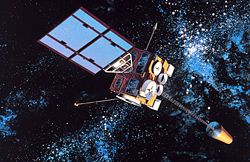 | |
|---|---|---|
| SMS derived | ||
| 1st generation | ||
| 2nd generation | ||
| 3rd generation | ||
| 4th generation | ||
