Nutrition and Health in North Korea: What's New, What's Changed and Why It Matters
Last updatedAbstract
Structured Abstract Article Type: Research Paper Purpose—To examine the changing health and nutritional status of the North Korean population since the famine of the mid–1990s and the dominant perspective that little has changed since in the DPRK. Design, Methodology, Approach—Using hitherto neglected data from major international organizations, this research charts the little-known changes in patterns of food availability and food accessibility in aggregate, national terms, with some disaggregation of the data by gender and age. The DPRK is compared to other poor countries, other Asian countries and near neighbors in East Asia. Findings—Despite a precarious economy, the end of systematic food provision by the government, and a decline in aid from international organizations after 2001, the data shows that by the mid–2010s, national levels of severe wasting, an indication of famine-like conditions in the population, were lower than in other low income countries globally and lower than those prevailing in other developing countries in East Asia and the Pacific. Poverty and ill-health remained—as shown especially in terms of maternal health and infant mortality—but the incidence of malaria sharply declined and although the incidence of tuberculosis was up, the numbers of fatalities from both malaria and TB sharply declined. Practical Implications—This research contributes to a shift in North Korean Studies from securitized, opinion-based discussions in which North Koreans are either " victims or villains, " and which very often obscures or ignores mundane but important facts on the ground, towards careful, qualified, data-based analysis of societal change in the post-famine era of marketization in the DPRK. Originality, Value—The research shows that post-famine DPRK is not the out-lier state that is commonly presented in scholarly, policy and global media analysis.
Key takeaways
AI
AI
- Post-famine, severe wasting rates in North Korea decreased significantly, outperforming many low-income countries.
- National maternal health and infant mortality rates remain concerning, despite some improvements since the 1990s famine.
- DPRK's health indicators show a notable shift towards non-communicable diseases as leading causes of death.
- International organizations provided critical data, shaping a more nuanced understanding of DPRK's health and nutrition post-famine.
- This research aims to challenge the perception of North Korea as an outlier in health and nutrition compared to other low-income countries.
References (71)
- I would like to note that this article is written partly to correct an editing mistake in my recent book North Korea: Markets and Military Rule (Cambridge University Press, 2015), http://dx. doi. org/ 10.1017/CBO9781139021692. The book correctly reports the fall in deaths from TB (p. 270) but also infers a fall in the incidence of TB (p. 270). The falling incidence of disease should have referred, in this context, only to the falling incidence rate of malaria. In fact, TB incidence rates have increased while fatalities from TB have decreased. The correct and more granulated figures are given in this paper.
- Standard accounts include Stephan Haggard and Marcus Noland, Famine in North Korea: Markets, Aid and Reform (New York: Columbia University Press, 2007);
- Suk Lee, "Food Shortages and Economic Institutions in the Democratic People's Republic of Korea," doctoral dissertation (Department of Economics, University of Warwick, January 2003);
- Hazel Smith, Hungry for Peace: International Security, Humanitarian Assistance and Social Change in North Korea (Washington, D.C.: United States Institute of Peace Press, 2005).
- The United Nations Commission of Inquiry (COI) on human rights in the DPRK that identifies food rights as a key issue in terms of alleged abuse such that, if verified, would justify identifying the DPRK government as committing crimes against humanity. The COI did not, however, engage in a detailed analysis of the extant data on nutrition and health in the DPRK from the United Nations agencies food, agriculture and health agencies that had been resident in the DPRK for 25 years and those agencies did not endorse the COI report. For comment see Hazel Smith, "Crimes against Humanity? Unpacking the North Korean Human Rights Debate," in Hazel Smith and Christine Hong (eds) Critical Asian Studies 46. 1, March 2014, pp. 127-143. In the process of writing this article, I came across a technical analysis of some of the issues I touch on here. It deserves to be very widely known. See Yo Han Lee, Seok-Jun Yoon, Young Ae Kim, Ji Won Yeom and In-Hwan Oh, "Overview of the Burden of Diseases in North Korea," Journal of Preventive Medicine and Public Health, Vol. 43, No 3, May 2013, pp. 111-117, http://www.ncbi.nlm. nih. gov/pmc/articles/PMC3677063/, accessed August 9, 2015.
- I give some comparative data in Smith (2014). Much more detail is in this article.
- World Health Organization, "Democratic People's Republic of Korea WHO Statistical Profile," http://www.who.int/gho/countries/prk.pdf?ua=1, accessed August 9, 2015.
- It remains common to read throwaway remarks in the scholarly literature from very reputable academics such as, in 2012, "The North Korean economy has been in disastrous shape for many years, causing starvation and extreme poverty." See Kim, Byung-Yeon and Roland, Ger- ard, "Scenarios for a Transition to a Prosperous Market Economy in North Korea," International Economic Journal, Vol. 26. No. 3, September 2012, p. 511), http://dx.doi.org/10.1080/10168737. 2012. 707878. Perhaps the best example of the policy discourse are President Obama's remarks in his 22 January 2015 YouTube broadcast, when he stated that that "[North Korea] can't really even feed its own people" and that "over time, a regime like this will collapse." White House, 2015, The YouTube Interview with President Obama, available on https://www.youtube.com/watch?v= GbR6iQ62v9k, accessed 27 July 2015.
- Hong Sun Won, "Analysis of 1993 Population Census Data DPR Korea" (Pyongyang: Population Center, 1996); "Democratic People's Republic of Korea Preliminary Report of the National Nutrition Survey, October 2012" (Pyongyang: Central Bureau of Statistics, 2012);
- Chang Su Kim, "DPR Korea 2008 Population Census National Report" (Pyongyang: Central Bureau of Statistics Pyongyang, 2009), https://unstats.un.org/unsd/demographic/sources/census/2010_PHC/ North_Korea/Final%20national%20census%20report.pdf, accessed July 24, 2015.
- Chang Su Kim (2009)
- Hong Sun Won (1996).
- Hazel Smith, "North Korea: Market Opportunity, Poverty and the Provinces," New Polit- ical Economy, Vol. 14, No. 3, June 2009, pp. 231-56, http://dx.doi.org/10.1080/13563460902826005. 11. Bank of Korea, "Gross Domestic Product Indicators for the North Korean Economy," Annual Reports, 2000-2013, except for the years 2003, 2004, and 2005, http://www.nkeconwatch. com/ north-korea-statistical-sources/, accessed August 5, 2015.
- Minkyu Sung, "The Psychiatric Power of Neo-Liberal Citizenship: The North Korean Human Rights Crisis, North Korean Settlers, and Incompetent Citizens," Citizenship Studies Vol.
- No. 2, pp. 127-144, http://dx.doi.org/10.1080/13621021003594783; Sung Kyung Kim, "'I am well- cooked food': Survival Strategies of North Korean Female Border-Crossers and Possibilities for Empowerment," Inter-Asia Cultural Studies Vol. 15., No 4, pp. 553-571, http://dx.doi. org/10.1080/14649373.2014.972663; Andrew Wolman, "North Korean Asylum Seekers and Dual Nationality," International Journal of Refugee Law Vol. 24, No 4, 2013, pp. 793-814. http://dx.doi.org/ 10.1093/ijrl/ees052.
- Hyung-min Joo, "Visualizing the Invisible Hands: The Shadow Economy in North
- Korea," Economy and Society, Vol. 39, No. 1, 2010, pp. 110-145, http://dx.doi.org/10.1080/ 0308 5140903424618; Hyung-min Joo, "Hidden Transcripts in Marketplaces: Politicized Discourses in the North Korean Shadow Economy," The Pacific Review, Vol. 27, No. 1, 2014, pp. 49-71, http://dx.doi.org/10.1080/09512748.2013.846931; Byung-Yeon Kim and Dongho Song, "The Par- ticipation of North Korean Households in the Informal Economy: Size, Determinants, and Effect," Seoul Journal of Economics, Vol. 21, No. 2, Summer 2008, pp. 361-85.
- See, notably, UNICEF, "Statistical Tables: Economic and Social Statistics on the Countries and Areas of the World, with Particular Reference to Children's Well-Being," in UNICEF, State of the World's Children 2014 Executive Summary, Reimagine the Future: Innovation for Every Child (New York/ Geneva: UNICEF, 2015), pp. 27-116, http://www.unicef.org/publications/ files/ SOWC_2015_Summary_and_Tables.pdf, accessed July 28, 2015; World Health Organization (WHO)," World Health Statistics 2015 (Geneva: WHO, 2015), http://www.who.int/gho/publica tions/world_health_statistics/WHS2015_IndicatorCompendium.pdf?ua=1, accessed July 28, 2015;
- FAO, IFAD and WFP, Achieving Zero Hunger: The Critical Role of Investments in Social Protection and Agriculture (Rome: FAO, 2015), http://www.fao.org/3/a-i4777e.pdf, accessed July 28, 2015;
- UNDP, Human Development Report 2014, Sustaining Progress: Reducing Vulnerabilities and Build- ing Resistance (New York: UNDP, 2015), http://hdr.undp.org/sites/default/files/hdr14-report-en- 1.pdf, accessed July 28, 2015; World Bank, Atlas of Global Development, Fourth Edition (Glasgow/Washington, D.C.: Collins Bartholomew/World Bank, 2013), http://data.worldbank.org/ products/ atlas, accessed July 28, 2015; World Bank, World Development Indicators 2015 (Wash- ington, D.C.: International Bank for Reconstruction and Development/The World Bank, 2015) available on http://data.worldbank.org/products/wdi, accessed 28 July 2015. 15. United Nations Statistical Commission, International Statistical Classifications E/CN.3/2013/28 in UN Statistical Commission, Forty-fourth Session, Item 4 (m) of the provisional agenda, 26 February-1 March 2013, (New York: United Nations Economic and Social Council, 2013), http://unstats.un.org/unsd/statcom/doc13/2013-28-Classifications-E.pdf, accessed July 28, 2015.
- Suk Lee (2003);
- Daniel Goodkind and Loraine West, "The North Korean Famine and Its Demographic Impact," in Population and Development Review, Vol. 27, No. 2, June 2001, pp. 219-38, http://dx.doi.org/10.1111/j.1728-4457.2001.00219.x.
- Hazel Smith (2005).
- Ibid.
- Bank of Korea, "Gross Domestic Product Indicators for the North Korean Economy" (Annual report, 2013), http://www.nkeconwatch.com/nk-uploads/GDP_of_North_Korea_in_ 2013_ F.pdf, accessed August 5, 2015.
- Bank of Korea, "Gross Domestic Product Indicators for the North Korean Economy" (Annual report, 2000-2013, except for the years 2003, 2004 and 2005), http://www. nk econ watch. com/ north-korea-statistical-sources/, accessed August 5, 2015.
- Mark E. Manyin and Mary Beth D. Nikitin, Foreign Assistance to North Korea (Wash- ington, D.C.: Congressional Research Service, 2 April 2014), p. 10, https://www.fas.org/sgp/crs/row/ R40095.pdf, accessed August 6, 2015. It should probably be noted that the COI reported that "[m]ultilateral agencies have played a relatively minor role in the delivery of aid to the DPRK." This is the exact opposite of the truth. See United Nations Human Rights Council, "Report of the Detailed Findings of the Commission of Inquiry on Human Rights in the Democratic People's Republic of Korea, A/HRC/25/CRP.1," in Human Rights Council, Twenty-fifth session, Agenda item 4 (Geneva: Human Rights Council, 7 February 2014), p. 199, http://www.ohchr.org/EN/ HR Bodies/ HRC/CoIDPRK/Pages/Documents.aspx, accessed August 6, 2014.The COI report goes on to assert that "An estimated 75 percent of the total amount of food aid delivered since 1995 has been provided by China, the Republic of Korea, the United States of America, and Japan." See Ibid. Here presumably the report is conflating "funding" and "delivered" and does not understand the difference between the two and why it matters.
- Hazel Smith (2005).
- World Food Programme, http://kp.one.un.org/content/uploads/2013/03/WFP-Factsheet- 2013.pdf, accessed August 5, 2015.
- Mark E. Manyin and Mary Beth D. Nikitin (2014).
- The DPRK government banned residential NGOs in 2005 (although not non-residential foreign NGOs) but in practice six resident foreign NGOs work in the DPRK. They have been rebranded as "European Union Support Units" and work under the aegis of the European Com- mission.
- See UN DPR Korea, "Non-UN Actors in DPRK," http://kp.one.un.org/non-un-actors- in-dprk/, accessed August 5, 2015.
- DPRK government and United Nations Country Team, Strategic Framework for Coop- eration Between the United Nations and the Government of the Democratic People's Republic of foods." See FAO/ WFP, The FA)/WFP Crop and Food Security Assessment Mission (CFSAM) to the DPRK (Rome: FAO/ WFP, 28 November 2013), p. 25, http://www.fao.org/docrep/019/ aq118e/ aq118e.pdf, accessed August 8, 2015. 28. United Nations Country Team (2015).
- FAO, Food and Agriculture Organization of the United Nations Statistics Division, http://faostat3.fao.org/compare/E, accessed August 6, 2015.
- Hazel Smith, North Korea: Markets and Military Rule (Cambridge: Cambridge University Press, 2015), http://dx.doi.org/10.1017/CBO9781139021692.
- Lola Nathanail, Food and Nutrition Assessment Democratic People's Republic of Korea, 16 March-24 April 1996 (Pyongyang: World Food Programme, 1996).
- Suk Lee (2003).
- Hazel Smith (2005);
- Hazel Smith (2015).
- Key worker information in WFP/FAO/UNICEF, Special Report: Rapid Food Security Assessment Mission to the Democratic People's Republic of Korea, 24 March 2011 (Rome: WFP, 2011), p. 18, http://ko.wfp.org/sites/default/files/english_rfsa.pdf, accessed June 22, 2014. 35. Hyung-min Joo, "Visualizing the Invisible Hands" pp. 110-45; Changyong Choi, "'Every- day Politics' in North Korea," The Journal of Asian Studies Vol. 72, No.3, August 2013, pp. 655- 673, http://dx.doi.org/10.1017/S0021911813000545.
- Hazel Smith (2005);
- Hazel Smith, "North Korea: Market Opportunity, Poverty and the Provinces," pp. 231-56; Hazel Smith (2015).
- UNICEF, Analysis of the Situation of Women and Children in the Democratic People's Republic of Korea 2006 (Pyongyang: UNICEF, 2006), p. 33, http://kp.one.un.org/content/uploads/ 2012/ 03/ 03.19_ ChildrenWomen2006.pdf, accessed August 8, 2015. 38. Ibid.
- United Nations Country Team, "DPR Korea 2015: Needs and Priorities" (Pyongyang: UN Country Team, 2015), http://kp.one.un.org/content/uploads/2015/04/Humanitarian-Needs- and-Priorities-DPR_Korea_-2015.pdf, accessed August 6, 2015.
- World Bank, World Development Indicators 2015 (Washington, D.C.: International Bank for Reconstruction and Development/The World Bank, 2015), http://data.worldbank.org/products/ wdi, accessed August 13, 2015.
- UNICEF, Analysis of the Situation of Women and Children in the Democratic People's Republic of Korea 1999 (Pyongyang: UNICEF, 2000);
- Hazel Smith (2005).
- UNICEF, "DPRK National Nutrition Survey: Executive Summary," http://www. unicef. org/dprk/support_20884.html, accessed August 6, 2015.
- The United States Center for Disease Control and Prevention points out that "The infant mortality rate… is often used as an indicator to measure the health and well-being of a nation, because factors affecting the health of entire populations can also impact the mortality rate of infants" [emphasis in original]. Center for Disease Control and Prevention, "Reproductive Health." http://www.cdc.gov/reproductivehealth/maternalinfanthealth/infantmortality.htm, accessed August 8, 2015.
- Yo et. al., "Overview of the Burden of Diseases in North Korea," (2013), pp. 111-117, avail- able on http://www.ncbi.nlm.nih.gov/pmc/articles/PMC3677063/, accessed 9 August 2015. 45. World Bank, Data, http://data.worldbank.org/indicator/SP.DYN.IMRT.IN, accessed August 8, 2015. 46. Ibid.
- UNICEF, "DPRK at a Glance 2013 (February)," http://www.unicef.org/dprk/ DPRK_at_ a_ glance_April_2013.pdf.
- UNICEF, Analysis of the Situation of Women and Children in the Democratic People's Republic of Korea 2006 (Pyongyang: UNICEF, 2006), p. 33, http://kp.one.un.org/content/ uploads/ 2012/03/03.19_ChildrenWomen2006.pdf, accessed August 8, 2015. 50. World Health Organization (WHO), "Democratic People's Republic of Korea Neonatal and Child Health Country Profile," http://www.who.int/maternal_child_adolescent/epidemiol ogy/ profiles/neonatal_child/prk.pdf, accessed August 9, 2015.
- UNICEF, Analysis of the Situation of Women and Children in the Democratic People's Republic of Korea 1999 (Pyongyang: UNICEF, 2000).
- World Bank, World Development Indicators 2015 (Washington, D.C.: International Bank for Reconstruction and Development/The World Bank, 2015), http://data.worldbank.org/products/ wdi, accessed August 13, 2015.
- Some observers were reporting an outbreak of measles in 2014 in the border province of North Pyongyang but as at the date of writing these figures were not included in the WHO data summaries. See Radio Free Asia, "Deadly Measles Outbreak in North Korean Province Bordering China," 25 June 2014, http://www.rfa.org/english/news/korea/outbreak-06252014174732.html, accessed August 9, 2015.
- World Health Organization (WHO), "WHO Vaccine-Preventable Diseases: Monitoring System. 2015 Global Summary," http://apps.who.int/immunization_monitoring/ global summary/ countries?countrycriteria[country][]=PRK&commit=OK, accessed August 9,2015. 56. International Vaccine Institute, DPRK Program, http://www.ivi.int/web/www/02_05_08, accessed 9 September 2015.
- Yo et al., "Overview of the Burden of Diseases in North Korea," pp. 111-117.
- United Nations DPR Korea, "Fighting Malaria and TB in DPR Korea-A Partnership Approach," http://kp.one.un.org/health-in-dprk/, accessed August 10, 2015. 59. Ibid.
- WHO, Global Tuberculosis Report 2014: Executive Summary (Geneva: WHO, 2014), http://www.who.int/tb/publications/global_report/gtbr14_executive_summary.pdf?ua=1, accessed August 11, 2015.
- World Health Organization, "Global Tuberculosis Report 2014: Key Indicators for the WHO South-East Asia Region," http://www.who.int/tb/ publications/global_report/ indicators_ south_ east_asia_region.pdf?ua=1, accessed August 12, 2015. The report notes that the data was taken from the WHO global TB database on 16 July 2015 and the data should be used with care. It is useful, however in that it shows trends over time. It also indicates a gap in the data for the DPRK between 1990 and 1996.
- World Health Organization, "Democratic People's Republic of Korea Tuberculosis Report," https://extranet.who.int/sree/Reports?op=Replet&name=%2FWHO_HQ_Reports% 2FG2%2FPROD%2FEXT%2FTBCountryProfile&ISO2=KP&LAN=EN&outtype=pdf, accessed August 13, 2015. The report notes that the data was generated on 13 August 2015. 63. Information on global TB trends from Philippe Glaziou, Charalambos Sismanidis, Katherine Floyd, and Mario Raviglione, "Global Epidemiology of Tuberculosis," Cold Spring Har- bor Perspectives in Medicine, February 2015, http://perspectivesinmedicine. org/ content/ 5/2/a017798.full, accessed August 12, 2015. http://dx.doi.org/10.1101/cshperspect.a017798 64. World Health Organization, "Estimated Tuberculosis (TB) Cases and Deaths, 1990- 2012," http://gamapserver.who.int/gho/interactive_charts/tb/cases/atlas.html, accessed August 12, 2015. 65. Ibid.
- Information on global TB trends from Philippe Glaziou et al., "Global Epidemiology of Tuberculosis," Cold Spring Harbor Perspectives in Medicine (2015).
- World Health Organization, "Democratic People's Republic of Korea Tuberculosis Report," https://extranet.who.int/sree/Reports?op=Replet&name=%2FWHO_HQ_Reports% 2FG2%2FPROD%2FEXT%2FTBCountryProfile&ISO2=KP&LAN=EN&outtype=pdf, accessed August 13, 2015. The report notes that the data was generated on 13 August 2015. 68. 2002 figures from World Health Organization, WHO Country Cooperation Strategy Dem- ocratic People's Republic of Korea 2009-2013 (New Delhi: World Health Organization Regional office for South-East Asia, 2009.
- World Health Organization, Non-Communicable Disease and Tobacco Control (Pyong - yang: WHO, 2015), http://www.dprk.searo.who.int/LinkFiles/WHO_DPRKorea_ncd.pdf, accessed August 13, 2015.
- Discussion in Hazel Smith (2015), p. 33. Population data from Suk Lee, "Food Shortages and Economic Institutions in the Democratic People's Republic of Korea" (2003), pp. 8-9. See also Hwan Ju Pang, Korean Review (Pyongyang: Foreign Languages Publishing House, 1987), p. 188. 71. For figures, sources and discussion see Hazel Smith, North Korea: Markets and Military Rule (Cambridge: Cambridge University Press, 2015), pp. 30, 260, 267; World Bank, World Devel- opment Indicators 2015 (Washington, D.C.: International Bank for Reconstruction and Develop- ment/The World Bank, 2015), http://data.worldbank.org/products/wdi, accessed August 13, 2015. 72. World Bank, World Development Indicators 2015 (Washington, D.C.: International Bank for Reconstruction and Development/The World Bank, 2015), http://data.worldbank.org/prod ucts/ wdi, accessed August 16, 2015. 73. Ibid. 74. Ibid.
- All figures in this paragraph from World Bank 2015, accessed August 13, 2015.
- World Bank, World Development Indicators 2015 (Washington, D.C.: International Bank for Reconstruction and Development/The World Bank, 2015), http://data.worldbank.org/prod- ucts/wdi, accessed August 16, 2015.
- All figures in this paragraph from World Bank, World Development Indicators 2015 (Washington, D.C.: International Bank for Reconstruction and Development/The World Bank, 2015), http://data.worldbank.org/products/wdi, accessed August 13, 2015. 78. Ibid.
- United Nations Human Rights Council, "Report of the Detailed Findings of the Com- mission of Inquiry on Human rights in the Democratic People's Republic of Korea, A/HRC/ 25/ CRP.1," in Human Rights Council, Twenty-Fifth session, Agenda item 4 (Geneva: Human Rights Council, 7 February 2014), p. 204, available on http://www.ohchr.org/EN/HRBodies/HRC/CoID PRK/ Pages/Documents.aspx, accessed 6 August 2014.
- In March 2014, China condemned the United Nations Human Rights Council COI report on North Korean human rights abuses as "divorced from reality." See Tom Miles and Stephanie Nebehay, "China Rejects N. Korean Crimes Report, Hits Chance of Prosecution," Reuters, 17 March 2014, http://in.reuters.com/article/2014/03/17/korea-north-un-idINDEEA 2G07 N20140317, accessed August 16, 2015.
- I use the phrase "victims or villains" in Hazel Smith, North Korea: Markets and Military Rule (2015).
FAQs
AI
What changes occurred in malnutrition rates in North Korea since the mid-1990s?
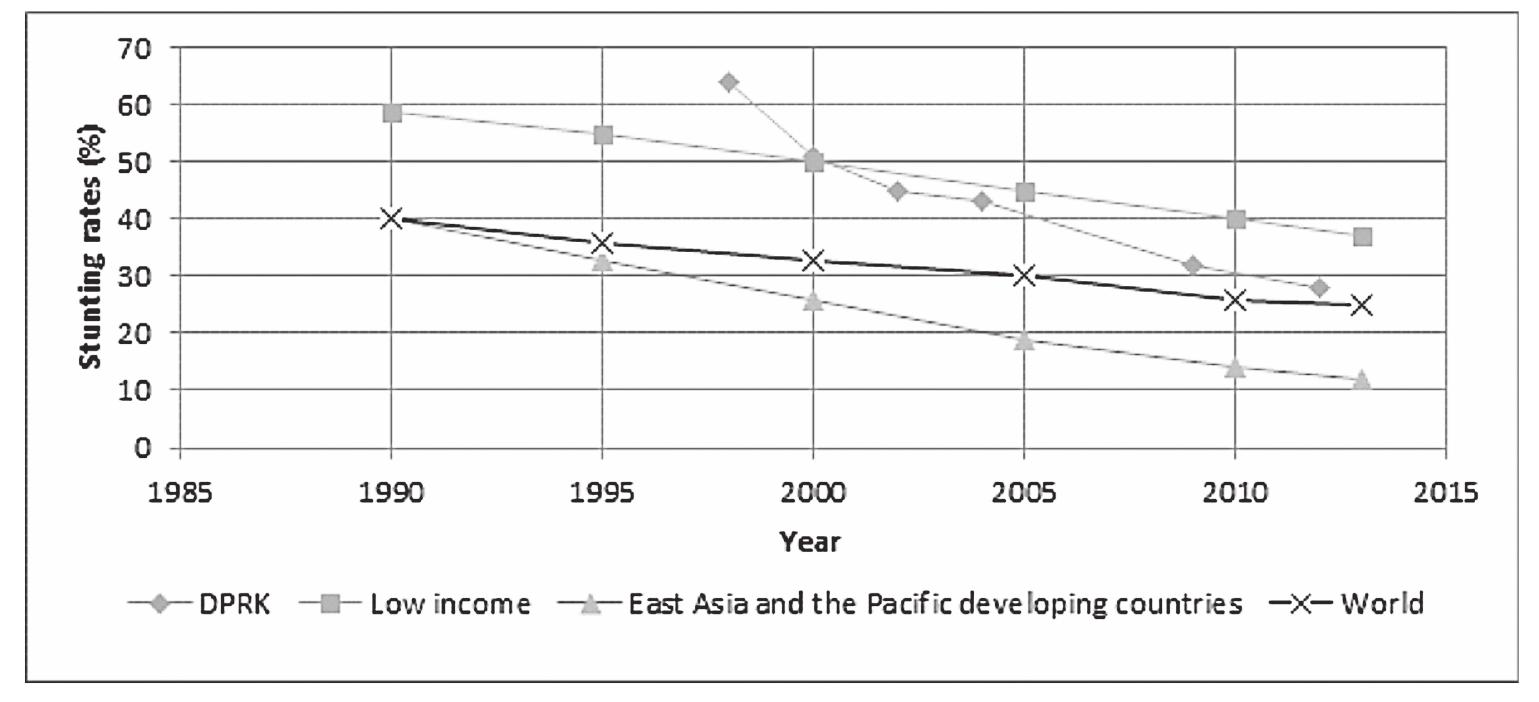
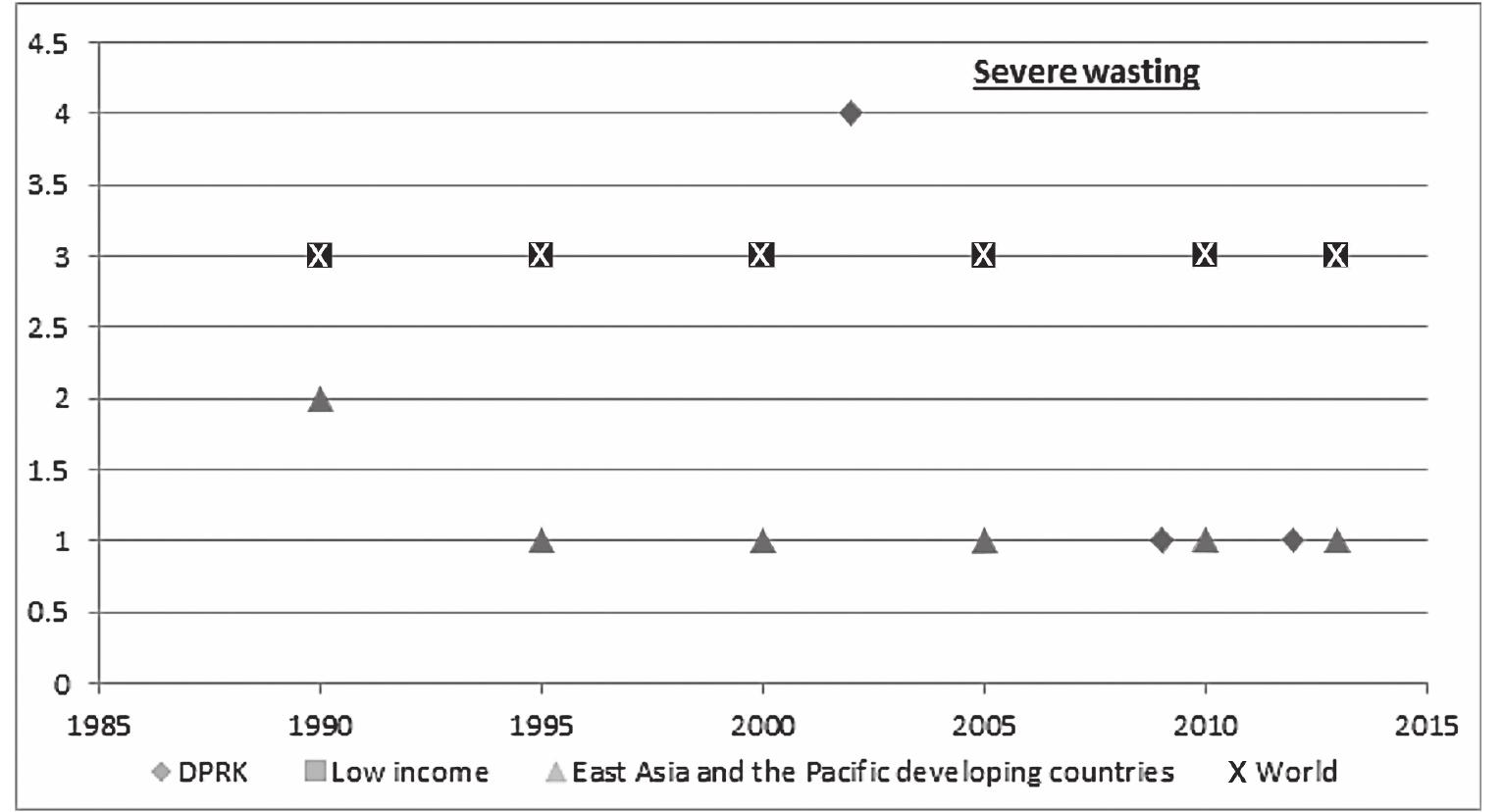
Malnutrition rates in North Korea decreased significantly post-famine, with severe wasting dropping to 1% by 2009, matching figures for developing countries in East Asia.
How did the post-famine health landscape evolve in North Korea?
By 2013, non-communicable diseases accounted for 80.2% of deaths in North Korea, reflecting a shift from infectious diseases.
What role did international organizations play in North Korean nutritional assessments?
International organizations like UNICEF and WHO established data collection and analysis systems in North Korea, providing crucial insights into nutrition and health statuses post-famine.
How does North Korea's health status compare with other low-income countries?
North Korea's stunting and malnutrition figures have been consistently better than those of many other low-income countries since the 2000s, indicating relative improvement.
What implications do post-famine health trends indicate for North Korean governance?
Improved public health outcomes suggest a recovery in administrative capacity, yet persistent challenges indicate underlying governance issues stemming from economic hardship.
Smith Hazel