
Holiday Hosting Essentials for the Kitchen
Kindle app logo image

Download the free Kindle app and start reading Kindle books instantly on your smartphone, tablet, or computer - no Kindle device required.

Read instantly on your browser with Kindle for Web.

Using your mobile phone camera - scan the code below and download the Kindle app.

QR code to download the Kindle App

  • A Concise History of Poland (Cambridge Concise Histories)

Follow the author

Get new release updates & improved recommendations
Something went wrong. Please try your request again later.

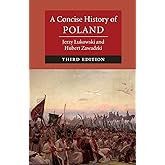
A Concise History of Poland (Cambridge Concise Histories) 2nd Edition


The second edition of this guide to Poland has been updated to take account of the years from 1989–2005. This period marked its liberation from the Soviet Union, the birth of Poland's 'Third Republic' and, recently, its accession to the European Union in 2004. Poland's history has been marked by its resilience. Once a dominant force in central and eastern Europe and home to a remarkable experiment in consensual politics, it was excised from the map by its neighbours in 1795. Resurrected in 1918, partitioned afresh during the Second World War, it survived to become a satellite of the Soviet Union. Yet in the 1980s, it was Poland which blazed the trail in casting off communism, and was finally able to reassert its Christian heritage. With its updated bibliography and new chronology, the book is the ideal companion for all looking for a comprehensive survey of this fascinating country.

There is a newer edition of this item:

A Concise History of Poland (Cambridge Concise Histories)
$74.05
(88)
Only 2 left in stock (more on the way).
Books with Buzz
Discover the latest buzz-worthy books, from mysteries and romance to humor and nonfiction. Explore more

Editorial Reviews

Review

"By any measure...Jerzy Lukowski and Hubert Zawadzki's Concise History of Poland is the best one-volume history of Poland available. In just under three hundred pages, the authors portray a Poland whose history is constantly being negotiated."
-Padraic Kenney, University of Colorado, The Journal of Modern History

Book Description

An updated and expanded second edition covering Polish history from medieval times to the present day.

Product details

  • Publisher ‏ : ‎ Cambridge University Press
  • Publication date ‏ : ‎ July 24, 2006
  • Edition ‏ : ‎ 2nd
  • Language ‏ : ‎ English
  • Print length ‏ : ‎ 408 pages
  • ISBN-10 ‏ : ‎ 052185332X
  • ISBN-13 ‏ : ‎ 978-0521853323
  • Item Weight ‏ : ‎ 1.45 pounds
  • Dimensions ‏ : ‎ 5.5 x 1 x 8.5 inches
  • Part of series ‏ : ‎ Cambridge Concise Histories
  • Best Sellers Rank: #2,601 in European History (Books)
  • Customer Reviews:

About the author

Follow authors to get new release updates, plus improved recommendations.
Jerzy Lukowski
Brief content visible, double tap to read full content.
Full content visible, double tap to read brief content.

Discover more of the author’s books, see similar authors, read book recommendations and more.

Customer reviews

4.6 out of 5 stars
39 global ratings

Top reviews from the United States

  • Reviewed in the United States on January 25, 2012
    Format: PaperbackVerified Purchase
    It must be remembered that Lukowski and Zawadzki have written a concise history. For a more detailed hisory of Poland in the English language one would need to read the two volumes of 'God's Playground' written by Norman Davies. For a more depictive, rather than deeply analytical history of Poland, Adam Zamoyski's 'The Polish Way' makes for an engrossing read.

    What I note about the Lukowski and Zawadzki work is its objectivity, particularly in examining the aspirations of other nations, namely the Lithuanians, Ruthenians (today's Ukrainians and Belarusians), whose respective fates were strongly linked to the fate of the Polish-Lithuanian Commonwealth and the period following the wars of Polish succession and eventual partition. It also examines how the Duchy of Prussia was able to gradually break away from Polish rule as the Commonwealth declined. The rise and fall and the powerful re-emergence of the Polish Nation is well covered. For those who want to understand the Poland of today as an important member of NATO and the EU the Lukowski and Zawadzki tome is a good place to start.

    11 people found this helpful
    Report
  • Reviewed in the United States on June 3, 2018
    Format: PaperbackVerified Purchase
    Here is a concise history of a small country with a complex history. It seems to me the authors have done their job well, despite its inherent difficulties. My interest in this book cames from curiosity about the partitions of Poland, by which the country was divided among its neighbors during the years 1772-1795 without any major war. Although I found the narrative difficult, I obtained an explanation which I augmented on my own. The book feels disorganized in places. But it is still easier to understand than the first edition.

    For all of its history, Poland has been surrounded by often hostile neighbors: Germany to the West and Russia to the East, and others less hostile North and South. Therefore, protection against conquest was the most important issue. The first definitely known ruler, Mieszko I, recognized the suzerainty of the Germans during most of his reign of 960 to 992. Probably he accepted Christianity as a way to hold possible German aggression at bay by obtaining approval from the Pope and admitting Christian clergy to his country, for Germany at least was officially Christian. At a time when much of Europe was forest and and swamp, inhabited only by pagan tribes and wild animals, Christianity meant access to civilization with its technology and orderly legal structure.

    Germans were continually moving from the West to settle in the Polish region since it had so much new cultivable land. There was continual movement of Germans to the East, where new cultivable lands were. Likewise Poles would move even further East. The acquisition and defense of landholdings was often a violent affair. The more stalwart came to have larger domains. The combining of small holdings into larger and larger tracts led to some chiefs having power over large areas, which led to the problem of holding a territory together.

    At this time there was no real Polish nation but only a patchwork of tribal areas with the chieftain presumed to be king and his closest associates as the nobility, who were highly suspicious of royal claimants. (The first three claimants to royalty were hacked up alive.) The great event of the Polish Middle Ages was the combination of Poland and Lithuania. Casimir III (The Great) of Poland had numerous daughters but no son. He needed a son to constitute his family’s strongest claim. He died a few days after willing his territory and kingship to Louis of Hungary (of the famous Anjou family). But Louis had the same problem of daughters but no son. Louis managed to get daughter Jadwiga married to Jogaila (more often known as Jagiello), an illiterate heathen who happened to be Grand Duke of Lithuania, its neighbor to the east. He converted to Catholicism and annexed his kingdom to Poland, creating in 1386 the largest country in Europe at the time. But the fact of marriage did not combine laws and institutions.

    The authors comment that because of Jogaila’s conversion, Lithuania became a Christian state, so conflict with other Christian states was less likely. But after the arrival of the Protestant reformation, commonality of faiths did not guarantee a secure defense. Poland and Lithuania would have to merge rather than remain a double monarchy. Sigismund II felt that only a new Union on terms acceptable to both the Crown and Grand Duchy would give his nobles a real stake in the survival of a reconstructed polity. When the last objections were overcome, the Treaty of Lublin created a unified state 1n 1562.

    The rise of Russia provided another good reason for a completely unified nation. Russia threw off Mongol domination in 1380 and began an expansion for hundreds of years in all directions of the compass. By this time religion was a crucial factor in national unity, but it was not enough simply to be Christian. Poland was mainly Catholic, with some Protestants and Jews, while Russia was now Orthodox. (The Polish king Casimir III understood the usefulness of the Jews in expanding economic life, encouraging them to come in from other areas of Europe even though among the people the faiths did not coexist well.) Lithuania had to serve in a geo-strategic sense as a buffer against an expansionist Russia.

    The military defense problem would not have been so serious if Polish government and society were socially more unified. The monarchy was elective; the electorate was the noble (szlachta) class, all members of whom were supposed to be to at least some extent landowners. Their rights came to be spelled out in a charter of “Golden Liberties”, which were mostly acts of their assembly, the Sejm. They enjoyed a monopoly of state offices. Tax increases could not be imposed without their consent. A noble’s peasants were subject to his personal jurisdiction and a peasant’s right to leave his village was limited. Compulsory military service could not be imposed on them without their general consent. They had the right to mint money. They were the only people who could serve in the Sejm. Their debates in the Sejm were at risk of the liberum veto, which meant that one member could could cancel discussion on a topic and the significance of everything said on it at will, so that many sessions were wasted. Naturally the szlachta did not like paying taxes. Armed with the liberum veto, they could keep taxation minimal, even though their country was involved in endless off-and-on wars. Soldiers mutinied for lack of pay. Poland produced at least one glorious military commander, John III Sobieski who in 1683 relieved the siege of Vienna by the Ottomans, but the authors comment: “Sobieski was always in a position of weakness ... [politically].” There was no charter of rights for burghers or peasants.

    The years from the Treaty of Lublin to the Partition of 1772, 1793, and 1795 were a period of almost continual wars. As well as greed for territory, religious differences were a cause.The distinguishing mark of most of these wars is the foolishness of Poland’s behavior (although neighboring countries are equally foolish.) It is necessary only to cite one example. The Great Northern War of 1700-1721 was the result of an agreement with Russia to despoil Sweden. A Polish invasion of Livonia (then under Swedish control) was countered by a Swedish invasion of Poland successful enough to temporarily take Warsaw and Cracow. In response the wealthiest members of the szlachta dethroned Augustus II and by purchasing votes in the Sejm elected a puppet-king, Standislaw Leszczynski. Sweden was defeated in 1709, but Poland gained nothing.

    The final incident before partition was a conspiracy of Catherine of Russia with Poland’s Stanislas Poniatowsky, who happened to be her lover. She nursed ambitious plans to push back the Ottomans and gain influence in the Holy Roman Empire, which meant some control over Poland. She made common cause with the Protestants in Poland, who were more important in government than their low status would suggest. Her manipulations of the Sejm set off a rebellion in Poland and caused the Ottomans to declare war on Russia and provoked aggressive behavior from France, Austria, and Turkey. At this point Frederick the Great of Prussia feared a general European conflagration. The authors comment that his warnings of a bloodbath were “disinformation of the highest order --neither Austria nor France was in any condition to fight a major war.” Frederick advised her to obtain compensation for past Polish behavior. His way to make the seizure “fair” was to propose slices of territory for Austria and Russia as well. Under the partition governments many of the old abuses were corrected, but the partition remained until World War I when the responsible governments were overthrown or defeated.

    Partition seems to me the most significant aspect of Poland's history now that the Nazis and Communists are out of power. It explains why Poland joined the European Union but keeps its distance.
    2 people found this helpful
    Report
  • Reviewed in the United States on June 23, 2013
    Format: PaperbackVerified Purchase
    This book is steeped in history where Poland had it's glory days, then there was no Poland. They managed to fight to get their country back. This book shows that through all the adversity they have been through including World War 2, when they were given away to Stalin by Roosevelt and Churchill, they managed to find their fighting courage again starting with the striking of the shipyards at Gdansk. The Polish people are experiencing a young Democracy, but the fighters that they are, they will grow this time. People forget how hard the Polish fought for our freedom yet their's was taken away and they were forced to live under communism starting with the brutal Stalin. People forget the holocaust that occurred in Poland or they just don't want to know. This is an excellent book on the hard working, proud Polish people.
    2 people found this helpful
    Report
  • Reviewed in the United States on October 24, 2016
    This history has so many twists your head will be spinning. But it clearly summarizes the chaotic and exciting history of Poland, even when it was not a country. Great preparation for my recent trip to Poland.
    One person found this helpful
    Report
  • Reviewed in the United States on October 28, 2016
    Format: KindleVerified Purchase
    A clear overview of Polish history for those interested in exploring this complex, fascinating, and colorful topic. Reading it prompted me to buy other, more detailed works on specific periods of Polish history. One other observation: this is the kind of survey that opens your mind to a subject and stays in your memory as the first time that something unfamiliar becomes part of your knowledge on the subject; i.e., I know that I'll be going back to Lukowski when I want a clear, lucid explanation for an aspect of Polish history.
    4 people found this helpful
    Report
  • Reviewed in the United States on January 13, 2023
    Format: PaperbackVerified Purchase
    Excellent text book. I read in connection with Michener’s Poland. Very good. I feel like I finally know where Poland came from and pretty good as to how it got to where it is today.

Top reviews from other countries

  • atticusfinch1048
    5.0 out of 5 stars Fantastic and consice book
    Reviewed in the United Kingdom on February 21, 2013
    Format: PaperbackVerified Purchase
    To start with this book does everything it says in the title and covers over 1000 years of history and spreads it over 350 ages.

    Any historian is able to tell you that the history of any Eastern European country is complex at best and confusing most of the time. This book is excellent at explaining that Poland did not just appear after the First World War, it takes you to before the Russian, Austrian and Prussian annexation and partition in 1795.

    It explains the rich history that the Poles have and how their neighbours have taken from the country, usued and abused the people and the land. They cover a long period bringing it up to the 1989 when Poland became a free country once again when the Soviet war invader finally went back to Russia.

    This is an excellent very readable and well researched book that I would recommend.
  • PERFECT4GIFT
    5.0 out of 5 stars Very interesting and informative
    Reviewed in Canada on September 14, 2013
    Format: PaperbackVerified Purchase
    Lots of work, time and effort went into writing this book. With Vincenty Kadlubek’s Chronicles and Gall Anonim’s narratives, here comes a historical picture of this beautiful country. By their political contacts with neighbouring peoples, the Slav tribes help to shape the geography of medieval Europe. Through conflicts and alliances, through marriages or wars, new countries are formed. Read about Piast Dynasty, Jagiellonian Poland, and the Commonwealth of the Two Nations. Learn about the two-faced Teutonic Knights, Sweden Deluge, Russian wars, uprising of 1648, and Partitions of Poland. See correlation between Poland and other contemporary nations through ages, well into the 21st century;
  • Mieczyslaw Kasprzyk
    5.0 out of 5 stars Definative
    Reviewed in the United Kingdom on February 19, 2005
    This is beyond a doubt the best history of Poland I have read so far (and I run a website on Polish History). It is concise yet detailed enough for any reader or for the curious. There are fascinating facts that one does not come across in any of the other histories which add to the general background and it is written in a eminently readable fashion. Lukowski is a very familiar name amongst students of Polish History - his account of the Partitions is a classic and the partnership with Zawadzki makes me want to read that historian's work also. I cannot recommend this book enough. If you want a History of Poland then this is the definative version.
  • Rafal Stanislaw Lebda
    5.0 out of 5 stars :)
    Reviewed in the United Kingdom on February 9, 2020
    Format: PaperbackVerified Purchase
    A very good product. Meets all my expectations.
  • José
    5.0 out of 5 stars Five Stars
    Reviewed in the United Kingdom on July 18, 2017
    O.K.