
Download the free Kindle app and start reading Kindle books instantly on your smartphone, tablet or computer—no Kindle device required.
Read instantly on your browser with Kindle for Web.
Using your mobile phone camera, scan the code below and download the Kindle app.
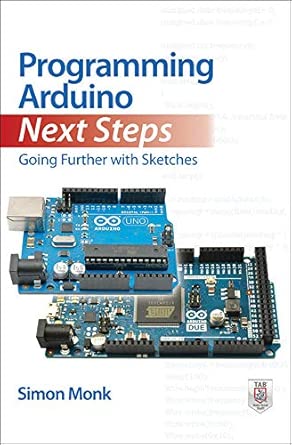
Programming Arduino Next Steps: Going Further with Sketches Paperback – 16 October 2013
In this practical guide, electronics guru Simon Monk takes you under the hood of Arduino and reveals professional programming secrets. Featuring coverage of the Arduino Uno, Leonardo, and Due boards, Programming Arduino Next Steps: Going Further with Sketches shows you how to use interrupts, manage memory, program for the Internet, maximize serial communications, perform digital signal processing, and much more. All of the 75+ example sketches featured in the book are available for download.
Learn advanced Arduino programming techniques, including how to:
- Use hardware and timer interrupts
- Boost performance and speed by writing time-efficient sketches
- Minimize power consumption and memory usage
- Interface with different types of serial busses, including I2C, 1-Wire, SPI, and TTL Serial
- Use Arduino with USB, including the keyboard and mouse emulation features of the Leonardo and Due boards
- Program Arduino for the Internet
- Perform digital signal processing
- Accomplish more than one task at a time―without multi-threading
- Create and release your own code library
- ISBN-100071830251
- ISBN-13978-0071830256
- Edition1st
- PublisherMcGraw-Hill Education TAB
- Publication date16 October 2013
- LanguageEnglish
- Dimensions13.97 x 1.65 x 21.59 cm
- Print length288 pages
Customers who viewed this item also viewed
Product description
About the Author
Dr. Simon Monk has a degree in Cybernetics and Computer Science and a PhD in Software Engineering. He spent several years as an academic before he returned to industry, co-founding the mobile software company Momote Ltd. Dr. Monk has been an active electronics hobbyist since his early teens and is a full-time writer on hobby electronics and open source hardware. He is the author of numerous electronics books, including Programming the Raspberry Pi: Getting Started with Python; Programming Arduino: Getting Started with Sketches; 30 Arduino Projects for the Evil Genius; Arduino + Android Projects for the Evil Genius, and Practical Electronics for Inventors, Third Edition (co-author).
Product details
- Publisher : McGraw-Hill Education TAB
- Publication date : 16 October 2013
- Edition : 1st
- Language : English
- Print length : 288 pages
- ISBN-10 : 0071830251
- ISBN-13 : 978-0071830256
- Item weight : 336 g
- Dimensions : 13.97 x 1.65 x 21.59 cm
- Best Sellers Rank: 181 in Digital Design (Books)
- 236 in C Programming Language
- 436 in Single Board Computers
- Customer Reviews:
About the author

For electronic kits to accompany my books, see: http://www.monkmakes.com
Customer reviews
Top reviews from Australia
There was a problem filtering reviews. Please reload the page.
- Reviewed in Australia on 8 November 2015Format: KindleVerified PurchaseWell written, with in-depth explanations and excellent code examples for a range of topics.
- Reviewed in Australia on 5 October 2015Format: KindleVerified PurchaseI have been unable to download the book into my Kindle. At each attempt the download aborts at 91.6% download.
Top reviews from other countries
G BarryReviewed in the United Kingdom on 6 March 20155.0 out of 5 stars The author's style is clear and easy to understand and I found this book
Format: PaperbackVerified PurchaseThe author's style is clear and easy to understand and I found this book, like the first, very readable. This gives confidence and the feeling that it's not so difficult after all. For me Monk's books have been an excellent companion into the world of Arduino with each section giving a good introduction to each subject. I found I was quite quickly able to progress to relatively complex areas with this book's help. As the author says the books are primarily about the software with the first giving a good start in C and the second building on practical topics. Thoroughly recommended.
-
Guido G.Reviewed in Germany on 13 January 20145.0 out of 5 stars Nächste Schritte - sehr passend
Format: PaperbackVerified PurchaseEndlich!
Also endlich mal ein Buch für den schon fortgeschrittenen Arduinista.
Nette Hinweise mit brauchbaren Beispielen.
Nichts was die Welt in ihren Grundfesten erschüttern würde, aber doch "good stuff".
Programmieren sollte man etwas können.
Begriffe wie "digital io" oder Kürzel wie "ADC" sollten geläufig sein.
Wer des Englischen mächtig und den Arduino-Kinderschuhen entwachsen ist sollte
es riskieren dieses Buch zu lesen.
Hey, das Ding kostet keine 16€ und ist *wirklich* nützlich.
Fazit:
Wenn man natürlich schon *alles* über den ATmega weiss, dann doch lieber nicht.
Oder wenn man noch nix weiss (also noch ganz am Anfang steht), dann lieber noch warten.
Für alle dazwischen ein gutes und vor allem informatives Buch.
Glenn WiorekReviewed in the United States on 21 February 20145.0 out of 5 stars Nice book and a good author
Format: KindleVerified PurchaseI have several of Simon's book both for Arduino and recently the Raspberry PI. I like his writing style and find it very clear, concise and yet easy going. He packs a ton of information and supporting material and does it in a way that I find enjoyable. His intro book Programming Arduino Getting Started with Sketches got me hooked on the Arduino. Next Steps is now taking me to new levels of understanding and ideas. I am looking forward to finishing this and his Programming the Rasberry PI.
-
Amazon CustomerReviewed in Italy on 14 November 20155.0 out of 5 stars ben fatto e molto interessante
Format: PaperbackVerified PurchaseHo imparato molte cose non facili da trovare altrove in questo libro che si spinge oltre le solite guide introduttive per approfondire aspetti relativi all'architettura, alle performances ed agli 'internals' delle varie schede arduino per darti una visione molto più approfondita delle potenzialità della piattaforma.
E' il miglior libro su Arduino che abbia letto ad oggi.
Altamente raccomandato.