Project Summary
ATOME’s flagship 145MW Villeta Project in Paraguay is a first-of-its-kind green fertiliser plant, set to be the largest such dedicated facility in the world on commencement of operations in 2028.
Led by local, experienced management, the Project is expected to produce industrial scale volumes of affordable, low-carbon Calcium Ammonium Nitrate (CAN) fertiliser for distribution into Latin America – the largest fertiliser import market in the world.
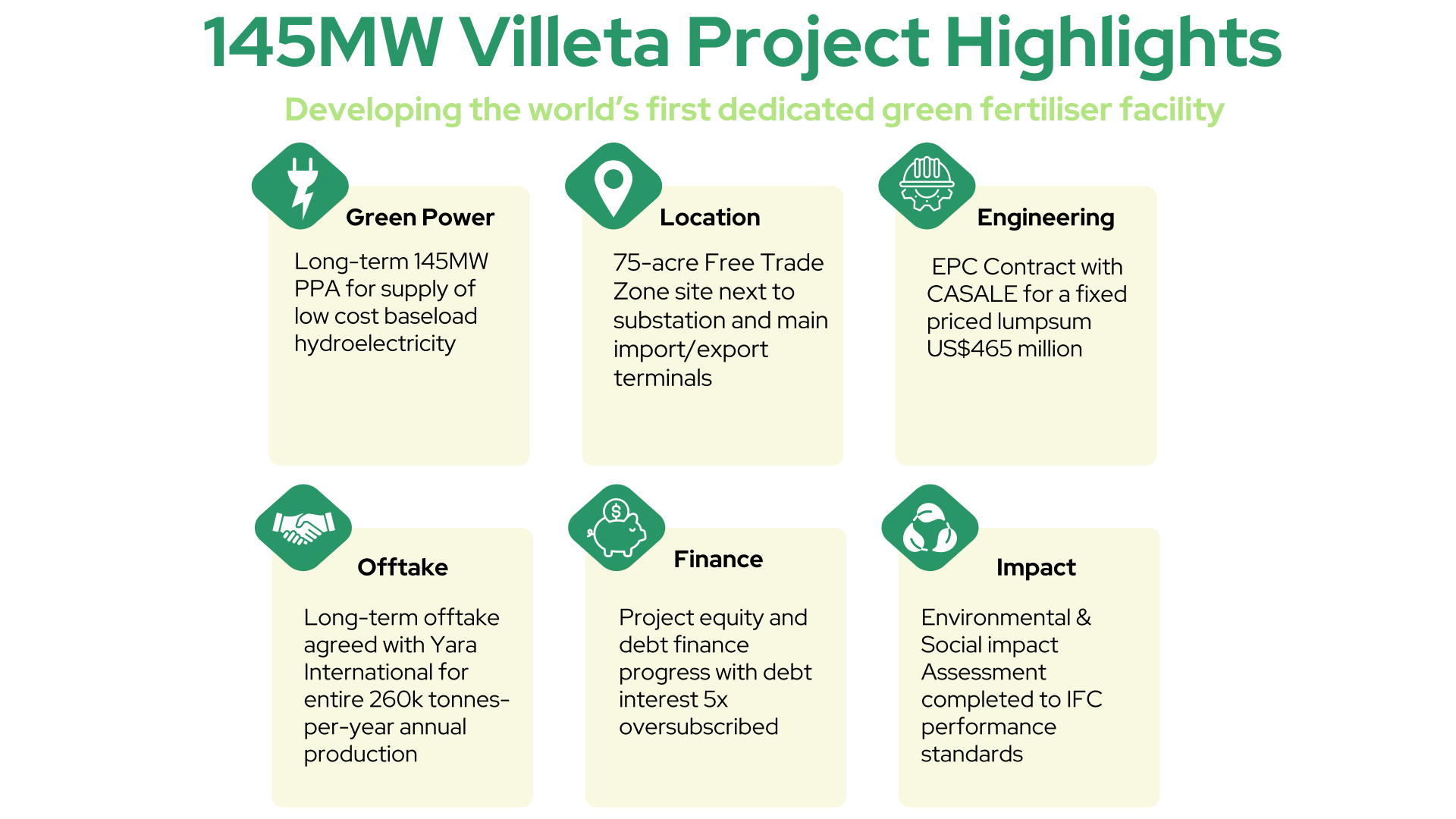
ATOME has already secured a long-term supply of 145MW of low-cost hydroelectric power (renewable power being fundamental to a project’s viability as it constitutes 60-70% of the production cost), completed Front End Engineering Design (FEED) and secured offtake with Yara International, the world-leading fertiliser company, for 100% of Villeta’s production. In February 2025, ATOME signed Heads of Terms signed with Hy24 – the world’s largest low-carbon hydrogen asset manager with more than US$2 billion under management – for its Clean H2 Infra Fund to serve as anchor and lead equity investor with an up to US$115 million investment into the Villeta Project. In April 2025, ATOME signed the EPC Contract with CASALE for a fixed priced lumpsum US$465 million.
Our selection of location, partnerships and build-out approach means that the project is not dependent on subsidies, government funding or green premiums – all of which may add considerable time to project development – and allows us to supply the farmers with a cost-effective sustainable alternative.
Project Highlights
How does it work?
ATOME uses 100% baseload renewable hydroelectric power from the Itaipu dam to produce green hydrogen, which is then combined with nitrogen to create zero-carbon ammonia and converted into green fertiliser.
This process means that the fertiliser produced at Villeta is estimated to displace up to 12.5 million tonnes of CO2 over its lifespan – equivalent to displacing the consumption of 29 million barrels of oil.
Each step in the process relies on proven, low-risk technologies without the need for costly, time-consuming buildout of major infrastructure.
Why Paraguay?
Optimal locations to develop green fertiliser first and foremost require ample availability of low-cost renewable power. Other key considerations include proximity and ease of access to the end-use market, water, land, logistics and local environment. Paraguay ticks all the boxes.
Critically, Paraguay is home to the 14GW Itaipu dam (co-owned with Brazil) which stands as the world’s second largest hydroelectric dam, providing Paraguay with over 90% of its energy needs. In fact, it produces so much that Paraguay only uses 30% of its 50% share of Itaipu’s power generation. With this surplus, Paraguay has become the world’s largest exporter of renewable energy, having sent US$1.3 billion worth of electricity to Brazil in 2020. Even then, plentiful renewable power remains in Paraguay meaning the country has an abundance of renewable electricity providing the potential for some of the cheapest production of green fertiliser in the world.
In parallel, Mercosur (Argentina, Brazil, Paraguay, and Uruguay) is one of the bread baskets of the world. Food products from this region line the shelves of supermarkets in the UK and Europe, from Argentinian beef to Brazilian coffee and Paraguayan sugarcane. Paraguay itself is the world’s largest exporter of organic sugar, third-largest soy exporter, and eighth-largest beef exporter.
Of course, significant volumes of fertiliser are needed to maintain crop yields and grow these products. However, Mercosur has very limited domestic production. It imports approximately 30 million tonnes per year of fertiliser (95% of its demand), making it the world’s largest nitrogen fertiliser import markets.
Considering this, Paraguay is a prime location to develop a world-class decentralised production facility in a market where fertiliser is most needed with the ability to compete with and displace volatile, costly, and dirty fertiliser imports.
Paraguay itself one of the region’s most stable and fastest growing economies. S&P Global Ratings, the leading international rating agency, updated Paraguay to investment grade in December 2025 noting that investments in ammonia and agro-industry are expected to provide Paraguay with favourable export prospects and boost consistent growth. Paraguay is a stable export-oriented economy with one of the fastest GDP growth rates in the region (4.2% in 2024). Tariffs are low (10% Corporate and Personal Tax Rate) and obstacles to business and trade are minimal in comparison to other countries in the region.
Project Documents
| Document Name | Download |
|---|---|
| Gender-Based Violence and Harassment Prevention Policy (English) | 249 KB |
| Gender-Based Violence and Harassment Prevention Policy (Spanish) | 250 KB |
| ESIA Annexes (Spanish) | 70 MB |
| ESIA (Spanish) | 51 MB |
| ESIA Annexes (English) | 66 MB |
| ESIA (English) | 50 MB |
| Sustainability Policy (Spanish) | 253 KB |
| Sustainability Policy (English) | 250 KB |
| HR Policy (Spanish) | 260 KB |
| HR Policy (English) | 255 KB |
| Health and Safety Policy (Spanish) | 259 KB |
| Health and Safety Policy (English) | 253 KB |
| ATOME ESAP (Spanish) | 824 KB |
| ATOME ESAP (English) | 818 KB |