Find Simple Closed Path for a given set of points
Last Updated : 23 Jul, 2025
Given a set of points, connect the dots without crossing.
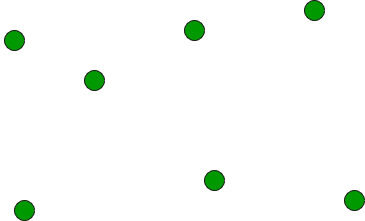
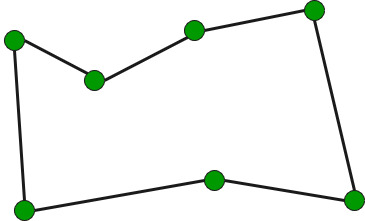
Example:
Input: points[] = {(0, 3), (1, 1), (2, 2), (4, 4), (0, 0), (1, 2), (3, 1}, {3, 3}}; Output: Connecting points in following order would not cause any crossing {(0, 0), (3, 1), (1, 1), (2, 2), (3, 3), (4, 4), (1, 2), (0, 3)}
We strongly recommend you to minimize your browser and try this yourself first.
The idea is to use sorting.
- Find the bottom-most point by comparing y coordinate of all points. If there are two points with same y value, then the point with smaller x coordinate value is considered. Put the bottom-most point at first position.
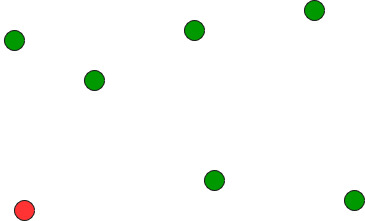
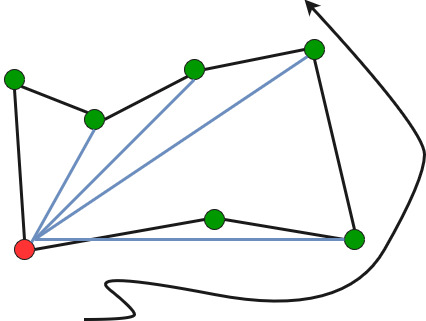
- Consider the remaining n-1 points and sort them by polar angle in counterclockwise order around points[0]. If polar angle of two points is same, then put the nearest point first.
- Traversing the sorted array (sorted in increasing order of angle) yields simple closed path.
How to compute angles?
One solution is to use trigonometric functions.
Observation: We don’t care about the actual values of the angles. We just want to sort by angle.
Idea: Use the orientation to compare angles without actually computing them!
Below is C++ implementation of above idea.
C++ // A C++ program to find simple closed path for n points // for explanation of orientation() #include <bits/stdc++.h> using namespace std; struct Point { int x, y; }; // A global point needed for sorting points with reference // to the first point. Used in compare function of qsort() Point p0; // A utility function to swap two points int swap(Point &p1, Point &p2) { Point temp = p1; p1 = p2; p2 = temp; } // A utility function to return square of distance between // p1 and p2 int dist(Point p1, Point p2) { return (p1.x - p2.x)*(p1.x - p2.x) + (p1.y - p2.y)*(p1.y - p2.y); } // To find orientation of ordered triplet (p, q, r). // The function returns following values // 0 --> p, q and r are collinear // 1 --> Clockwise // 2 --> Counterclockwise int orientation(Point p, Point q, Point r) { int val = (q.y - p.y) * (r.x - q.x) - (q.x - p.x) * (r.y - q.y); if (val == 0) return 0; // collinear return (val > 0)? 1: 2; // clockwise or counterclock wise } // A function used by library function qsort() to sort // an array of points with respect to the first point int compare(const void *vp1, const void *vp2) { Point *p1 = (Point *)vp1; Point *p2 = (Point *)vp2; // Find orientation int o = orientation(p0, *p1, *p2); if (o == 0) return (dist(p0, *p2) >= dist(p0, *p1))? -1 : 1; return (o == 2)? -1: 1; } // Prints simple closed path for a set of n points. void printClosedPath(Point points[], int n) { // Find the bottommost point int ymin = points[0].y, min = 0; for (int i = 1; i < n; i++) { int y = points[i].y; // Pick the bottom-most. In case of tie, choose the // left most point if ((y < ymin) || (ymin == y && points[i].x < points[min].x)) ymin = points[i].y, min = i; } // Place the bottom-most point at first position swap(points[0], points[min]); // Sort n-1 points with respect to the first point. // A point p1 comes before p2 in sorted output if p2 // has larger polar angle (in counterclockwise // direction) than p1 p0 = points[0]; qsort(&points[1], n-1, sizeof(Point), compare); // Now stack has the output points, print contents // of stack for (int i=0; i<n; i++) cout << "(" << points[i].x << ", " << points[i].y <<"), "; } // Driver program to test above functions int main() { Point points[] = {{0, 3}, {1, 1}, {2, 2}, {4, 4}, {0, 0}, {1, 2}, {3, 1}, {3, 3}}; int n = sizeof(points)/sizeof(points[0]); printClosedPath(points, n); return 0; } import java.util.*; class Point { int x, y; Point(int x, int y) { this.x = x; this.y = y; } } class ConvexHull { static Point p0; static void swap(Point p1, Point p2) { Point temp = p1; p1 = p2; p2 = temp; } static int dist(Point p1, Point p2) { return (int)Math.pow(p1.x - p2.x, 2) + (int)Math.pow(p1.y - p2.y, 2); } static int orientation(Point p, Point q, Point r) { int val = (q.y - p.y) * (r.x - q.x) - (q.x - p.x) * (r.y - q.y); if (val == 0) return 0; // collinear return (val > 0)? 1: 2; } static int compare(Point p1, Point p2) { int o = orientation(p0, p1, p2); if (o == 0) return (dist(p0, p2) >= dist(p0, p1))? -1 : 1; return (o == 2)? -1: 1; } static void printClosedPath(Point points[], int n) { int ymin = points[0].y, min = 0; for (int i = 1; i < n; i++) { int y = points[i].y; if ((y < ymin) || (ymin == y && points[i].x < points[min].x)) ymin = points[i].y; min = i; } swap(points[0], points[min]); p0 = points[0]; Arrays.sort(points, 1, n, (p1, p2) -> compare(p1, p2)); for (int i=0; i<n; i++) System.out.println("(" + points[i].x + ", " + points[i].y + "), "); } public static void main(String[] args) { Point[] points = {new Point(0, 3), new Point(1, 1), new Point(2, 2), new Point(4, 4), new Point(0, 0), new Point(1, 2), new Point(3, 1), new Point(3, 3)}; int n = points.length; printClosedPath(points, n); } } from functools import cmp_to_key # A Python program to find simple closed path for n points # for explanation of orientation() # A global point needed for sorting points with reference # to the first point. Used in compare function of qsort() p0 = None # A utility function to return square of distance between # p1 and p2 def dist(p1, p2): return (p1[0] - p2[0])*(p1[0] - p2[0]) + (p1[1] - p2[1])*(p1[1] - p2[1]) # To find orientation of ordered triplet (p, q, r). # The function returns following values # 0 --> p, q and r are collinear # 1 --> Clockwise # 2 --> Counterclockwise def orientation(p, q, r): val = (q[1] - p[1]) * (r[0] - q[0]) - (q[0] - p[0]) * (r[1] - q[1]) if val == 0: return 0 # collinear return 1 if val > 0 else 2 # clockwise or counterclock wise # A function used by library function qsort() to sort # an array of points with respect to the first point def compare(vp1, vp2): p1 = vp1 p2 = vp2 # Find orientation o = orientation(p0, p1, p2) if o == 0: return -1 if dist(p0, p2) >= dist(p0, p1) else 1 return -1 if o == 2 else 1 # Prints simple closed path for a set of n points. def printClosedPath(points, n): global p0 # Find the bottommost point ymin = points[0][1] min = 0 for i in range(1,n): y = points[i][1] # Pick the bottom-most. In case of tie, choose the # left most point if (y < ymin) or (ymin == y and points[i][0] < points[min][0]): ymin = points[i][1] min = i # Place the bottom-most point at first position temp = points[0] points[0] = points[min] points[min] = temp # Sort n-1 points with respect to the first point. # A point p1 comes before p2 in sorted output if p2 # has larger polar angle (in counterclockwise # direction) than p1 p0 = points[0] points.sort(key=cmp_to_key(compare)) # Now stack has the output points, print contents # of stack for i in range(n): print("(",points[i][0],",",points[i][1],"), ", end="") # Driver program to test above functions points = [[0, 3], [1, 1], [2, 2], [4, 4], [0, 0], [1, 2], [3, 1], [3, 3]] n = len(points) printClosedPath(points, n) using System; using System.Collections.Generic; public class Point { public int x, y; public Point(int x, int y) { this.x = x; this.y = y; } } public class ClosestPath { static Point p0; static int dist(Point p1, Point p2) { return (p1.x - p2.x) * (p1.x - p2.x) + (p1.y - p2.y) * (p1.y - p2.y); } static int orientation(Point p, Point q, Point r) { int val = (q.y - p.y) * (r.x - q.x) - (q.x - p.x) * (r.y - q.y); if (val == 0) return 0; // collinear return (val > 0) ? 1 : 2; // clockwise or counterclockwise } static int compare(Point p1, Point p2) { int o = orientation(p0, p1, p2); if (o == 0) return (dist(p0, p2) >= dist(p0, p1)) ? -1 : 1; return (o == 2) ? -1 : 1; } static void printClosedPath(List<Point> points, int n) { // Find the bottommost point int ymin = points[0].y; int min = 0; for (int i = 1; i < n; i++) { int y = points[i].y; if ((y < ymin) || (ymin == y && points[i].x < points[min].x)) { ymin = points[i].y; min = i; } } // Place the bottom-most point at first position Point temp = points[0]; points[0] = points[min]; points[min] = temp; // Sort n-1 points with respect to the first point. // A point p1 comes before p2 in sorted output if p2 // has larger polar angle (in counterclockwise // direction) than p1 p0 = points[0]; points.Sort(compare); // Now stack has the output points, print contents // of stack for (int i = 0; i < n; i++) { Console.Write("(" + points[i].x + ", " + points[i].y + "), "); } } public static void Main() { List<Point> points = new List<Point>() { new Point(0, 3), new Point(1, 1), new Point(2, 2), new Point(4, 4), new Point(0, 0), new Point(1, 2), new Point(3, 1), new Point(3, 3) }; int n = points.Count; printClosedPath(points, n); } } // This code is contributed by user_dtewbxkn77n // A javascript program to find simple closed path for n points // for explanation of orientation() // A global point needed for sorting points with reference // to the first point. Used in compare function of qsort() let p0; // A utility function to return square of distance between // p1 and p2 function dist(p1, p2) { return (p1[0] - p2[0])*(p1[0] - p2[0]) + (p1[1] - p2[1])*(p1[1] - p2[1]); } // To find orientation of ordered triplet (p, q, r). // The function returns following values // 0 --> p, q and r are collinear // 1 --> Clockwise // 2 --> Counterclockwise function orientation(p, q, r) { let val = (q[1] - p[1]) * (r[0] - q[0]) - (q[0] - p[0]) * (r[1] - q[1]); if (val == 0) return 0; // collinear return (val > 0)? 1: 2; // clockwise or counterclock wise } // A function used by library function qsort() to sort // an array of points with respect to the first point function compare(vp1, vp2) { let p1 = vp1; let p2 = vp2; // Find orientation let o = orientation(p0, p1, p2); if (o == 0) return (dist(p0, p2) >= dist(p0, p1))? -1 : 1; return (o == 2)? -1: 1; } // Prints simple closed path for a set of n points. function printClosedPath(points, n) { // Find the bottommost point let ymin = points[0][1]; let min = 0; for (let i = 1; i < n; i++) { let y = points[i][1]; // Pick the bottom-most. In case of tie, choose the // left most point if ((y < ymin) || (ymin == y && points[i][0] < points[min][0])){ ymin = points[i][1]; min = i; } } // Place the bottom-most point at first position let temp = points[0]; points[0] = points[min]; points[min] = temp; // Sort n-1 points with respect to the first point. // A point p1 comes before p2 in sorted output if p2 // has larger polar angle (in counterclockwise // direction) than p1 p0 = points[0]; points.sort(compare); // Now stack has the output points, print contents // of stack for (let i=0; i<n; i++) console.log("(" + points[i][0] + "," + points[i][1] + "), "); } // Driver program to test above functions let points = [[0, 3], [1, 1], [2, 2], [4, 4], [0, 0], [1, 2], [3, 1], [3, 3]]; let n = points.length; printClosedPath(points, n); // The code is contributed by Nidhi goel. Output:
(0, 0), (3, 1), (1, 1), (2, 2), (3, 3), (4, 4), (1, 2), (0, 3),
Time complexity of above solution is O(n Log n) if we use a O(nLogn) sorting algorithm for sorting points.
Auxiliary Space: O(1), since no extra space has been taken.
Source:
https://www.dcs.gla.ac.uk/~pat/52233/slides/Geometry1x1.pdf
Explore
DSA Fundamentals
Data Structures
Algorithms
Advanced
Interview Preparation
Practice Problem