This document contains class notes on behavioral descriptions in HDL from a professor at PESIT South Campus. The notes cover: - Behavioral descriptions model how outputs behave with inputs without knowing logic structure - Behavioral code uses always statements and signal assignments - Sequential statements like IF, CASE are used to represent logic Examples shown include a full adder, D latch, and case statement code. Reference books on HDL programming are also listed.
Overview of HDL behavioral descriptions, including structure, sequential statements (IF, CASE, loops), and applications in modeling systems.
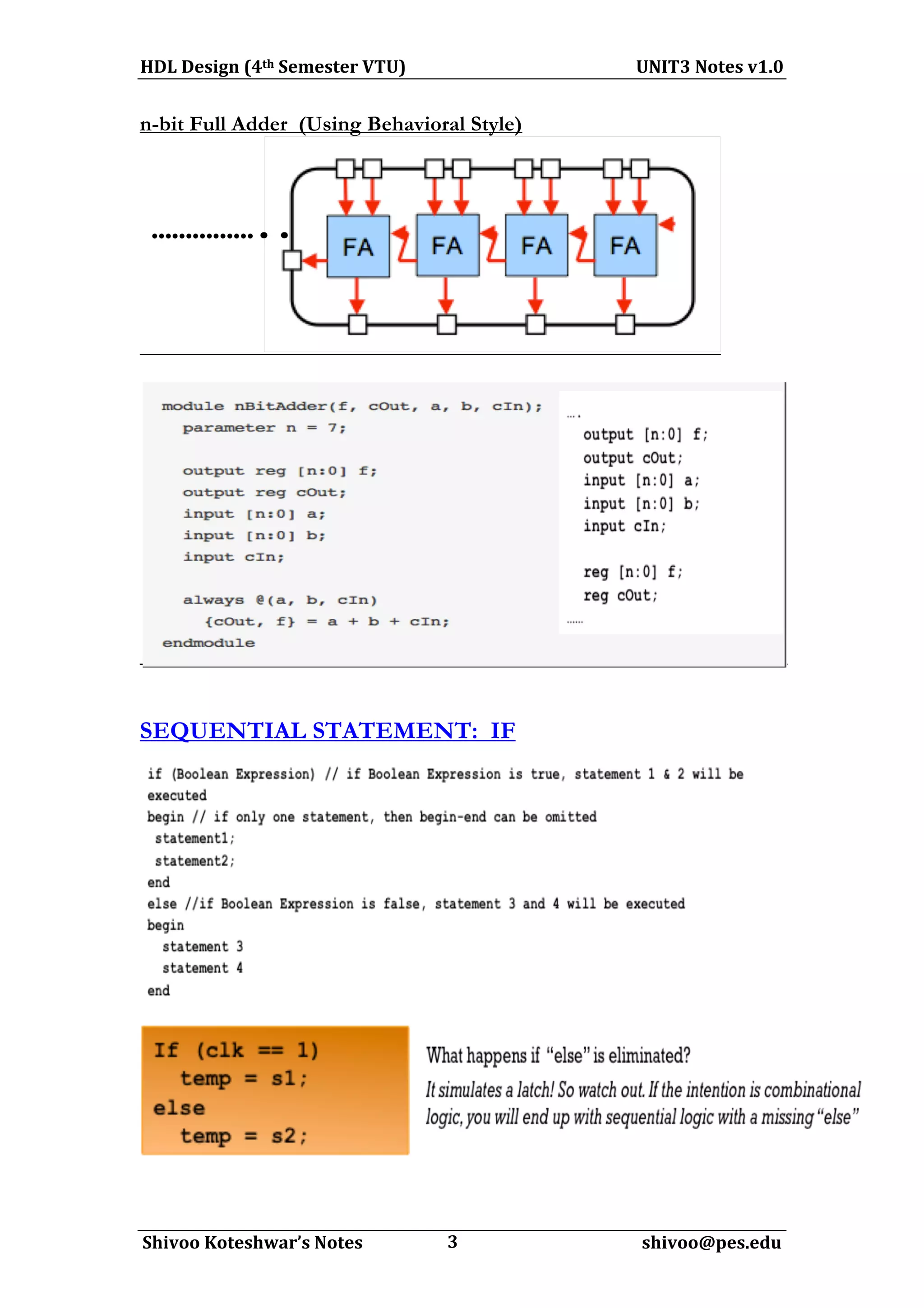
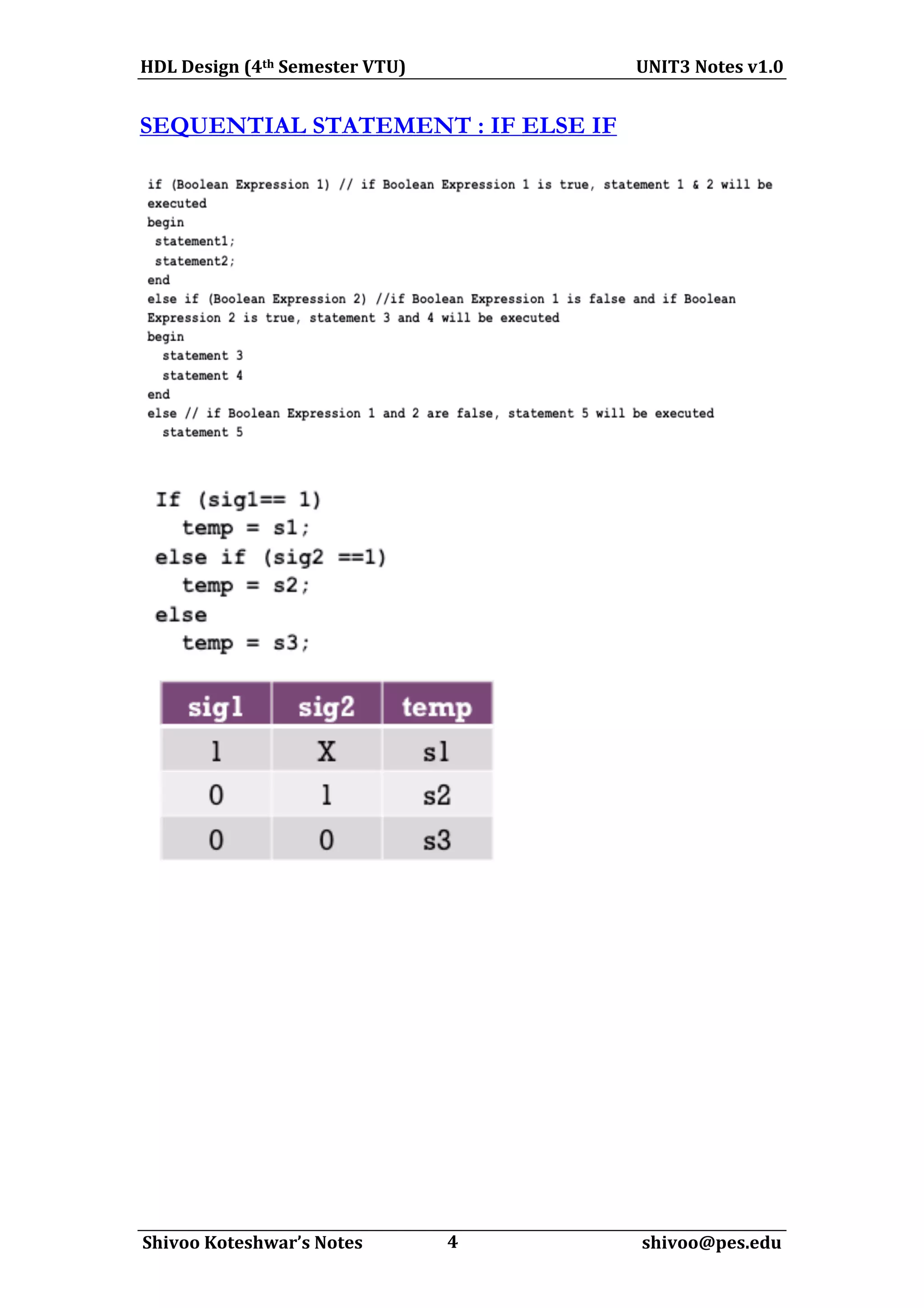
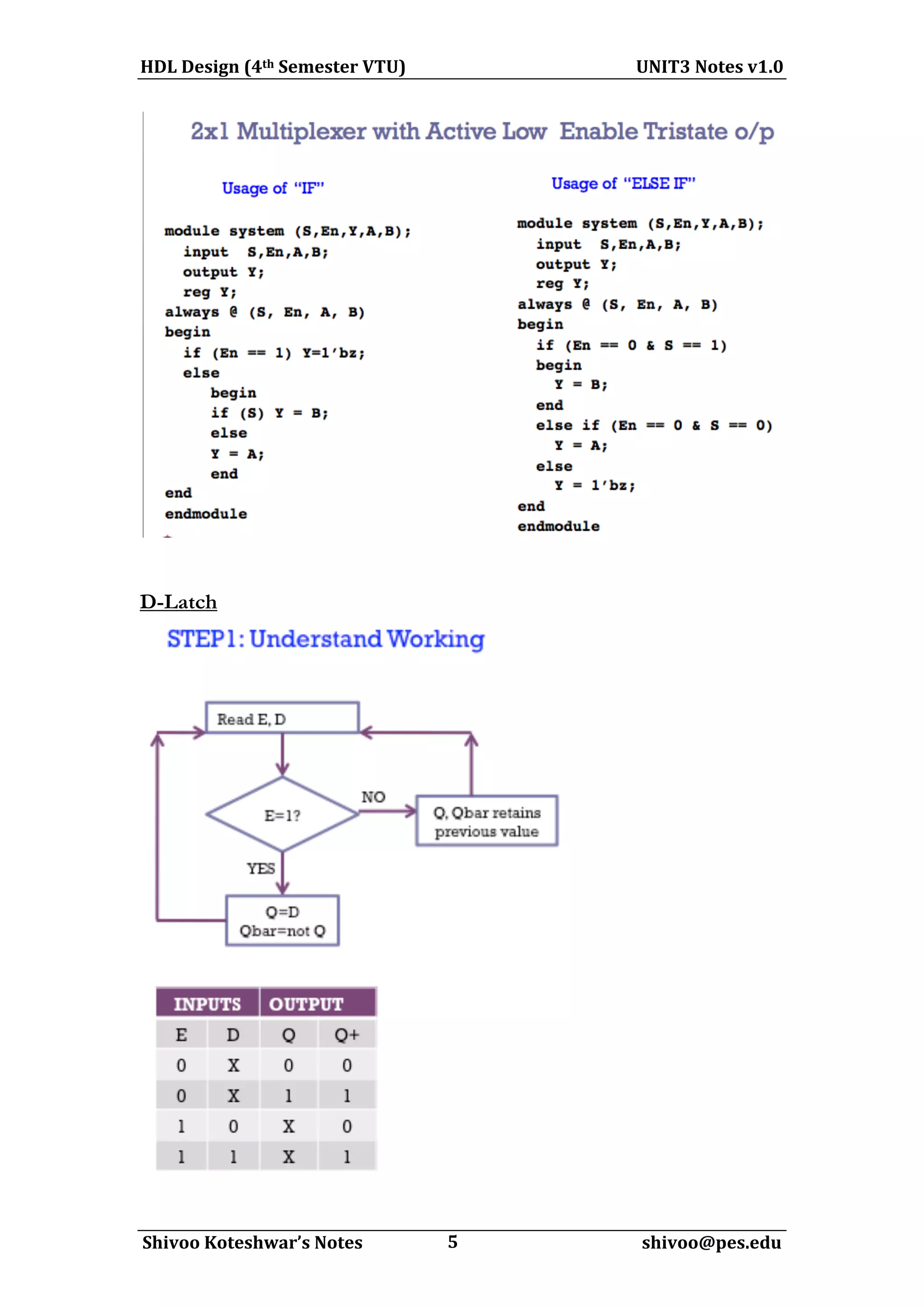
Focus on sequential statements like IF, ELSE IF, and CASE in HDL designs, including examples like n-bit Full Adder and D-Latch.
Detailed explanation of CASEX and CASEZ statements and their usage in HDL designs, including a conversion question for practice.
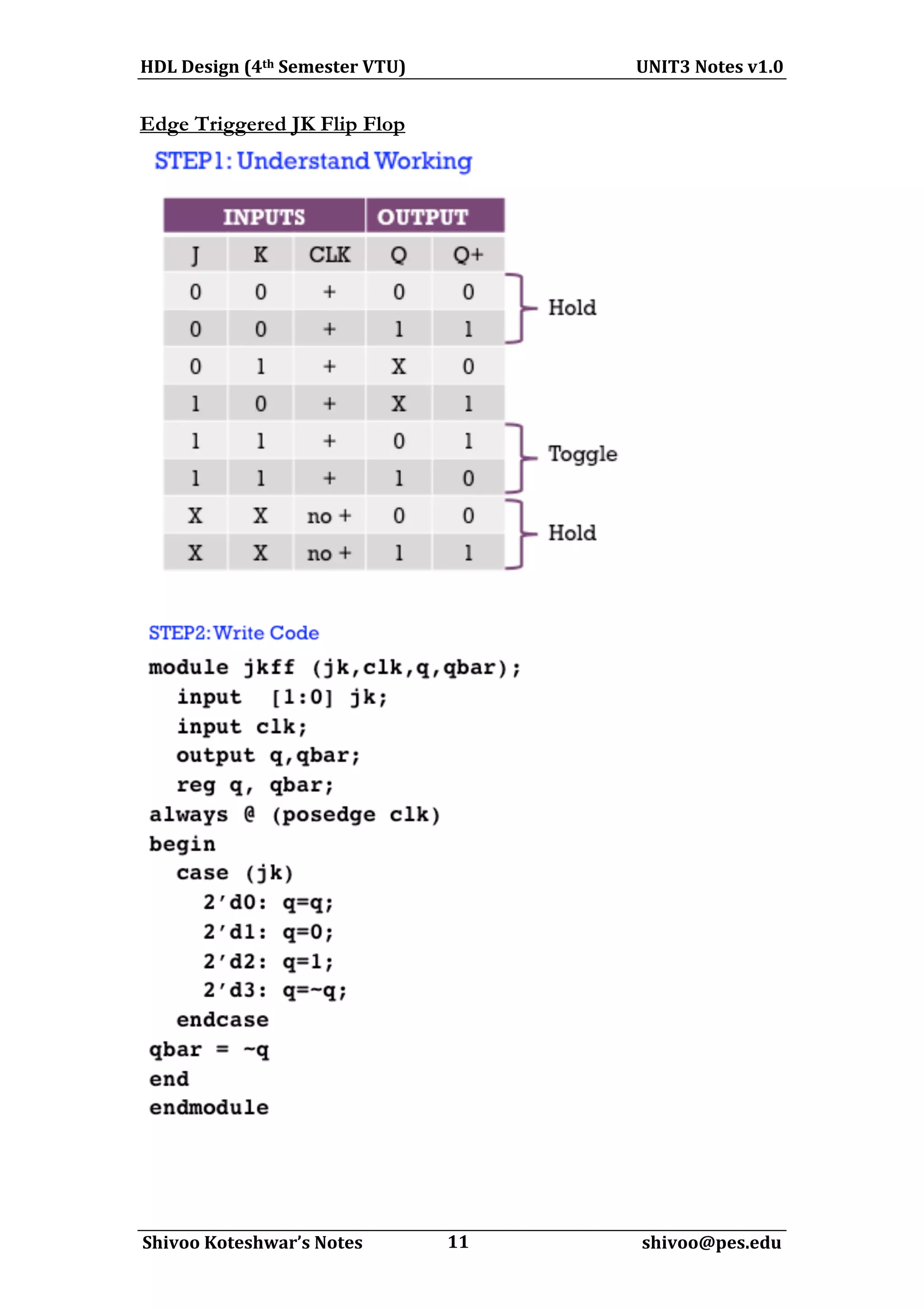
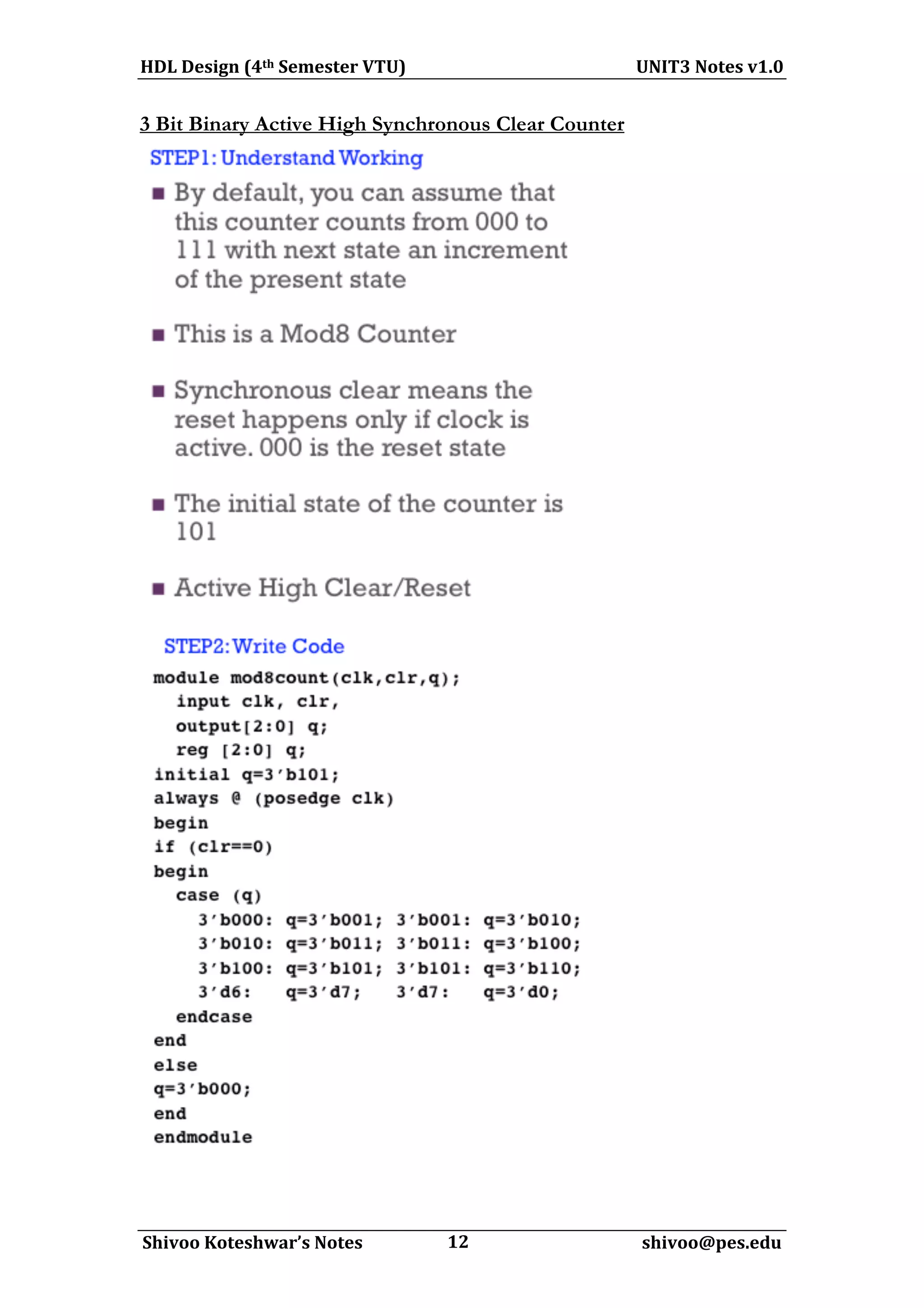
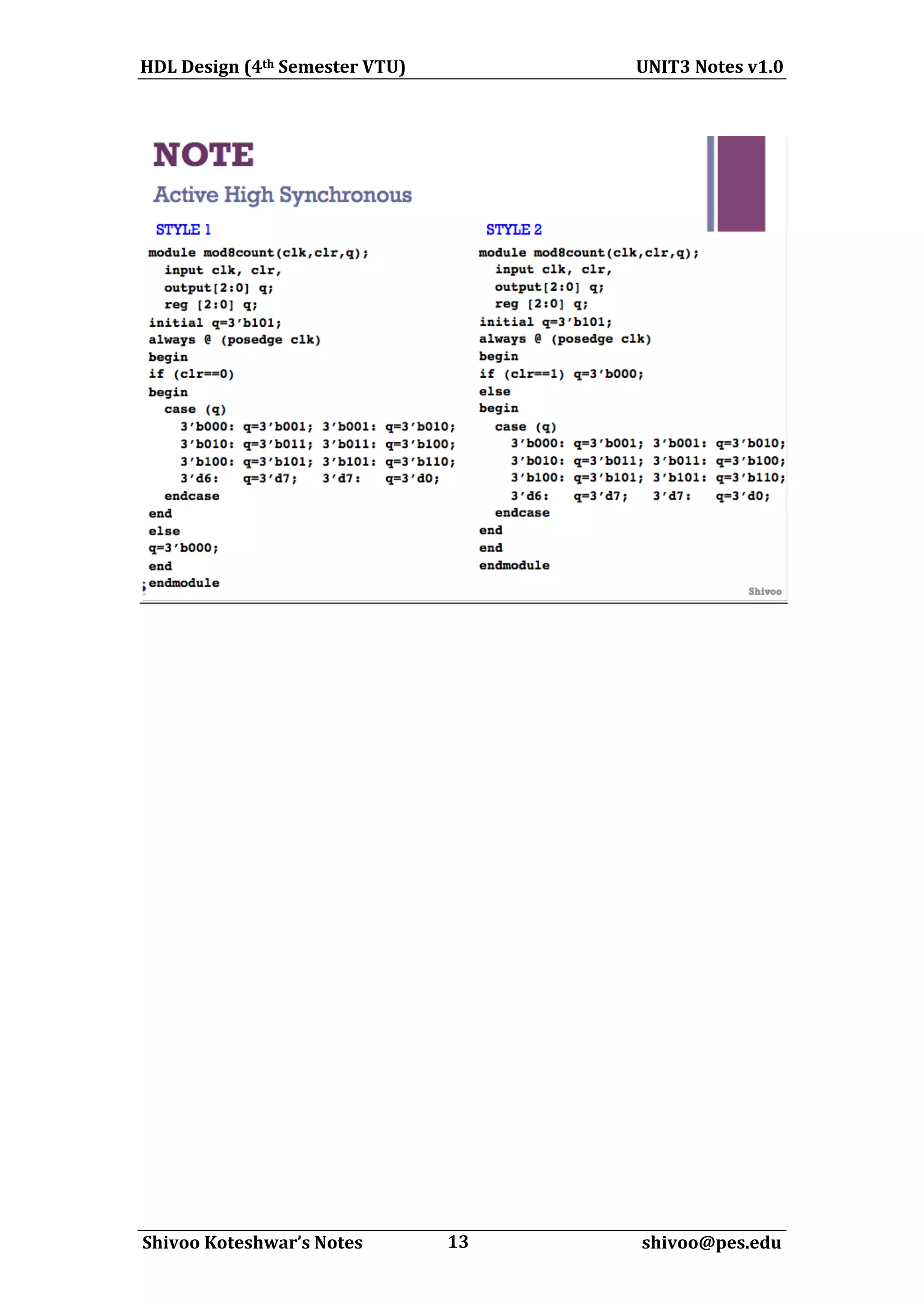
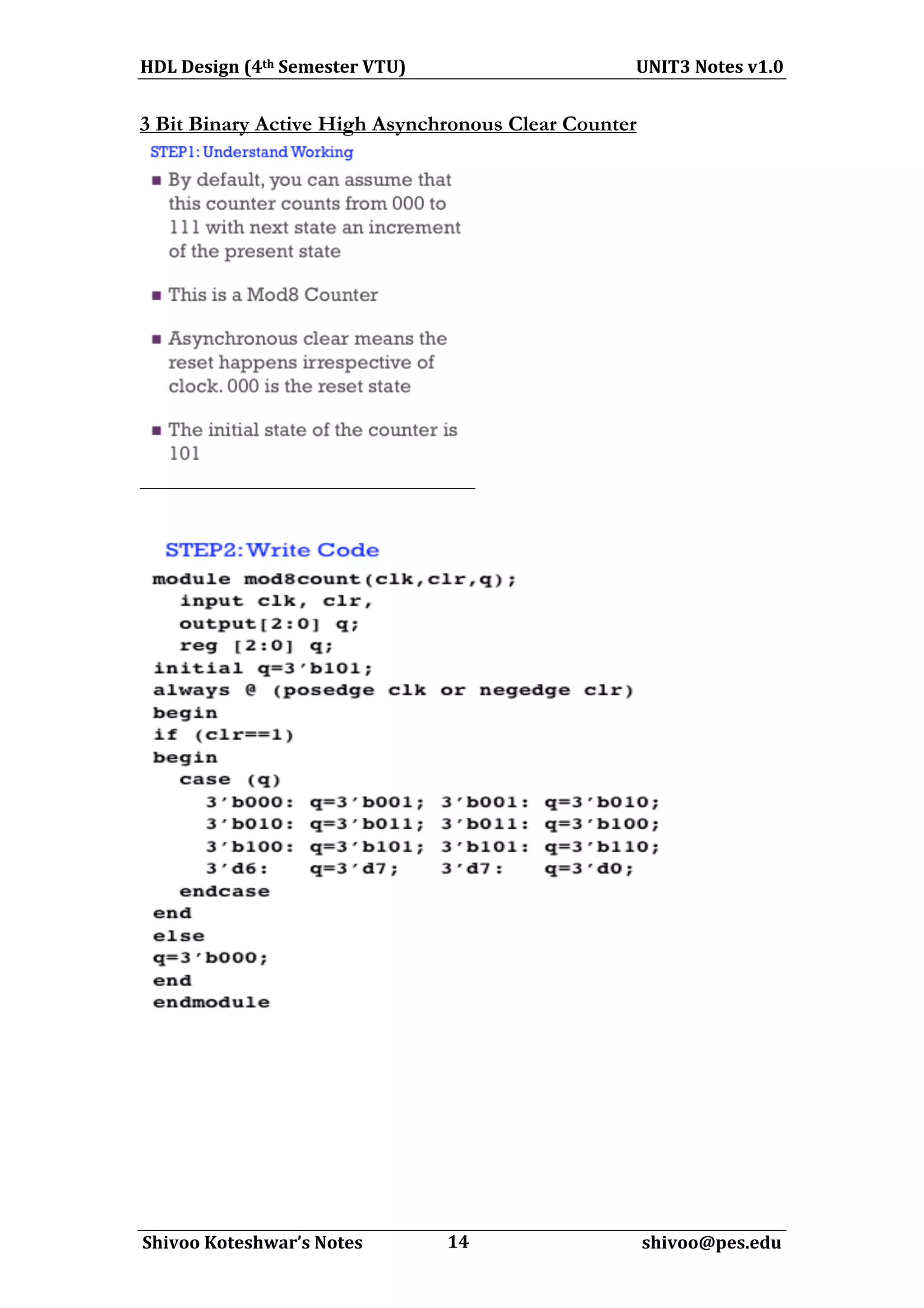
Creating stimulus blocks and implementing different flip-flops and counter designs in HDL. Topics include JK Flip Flop and synchronous/asynchronous counter.
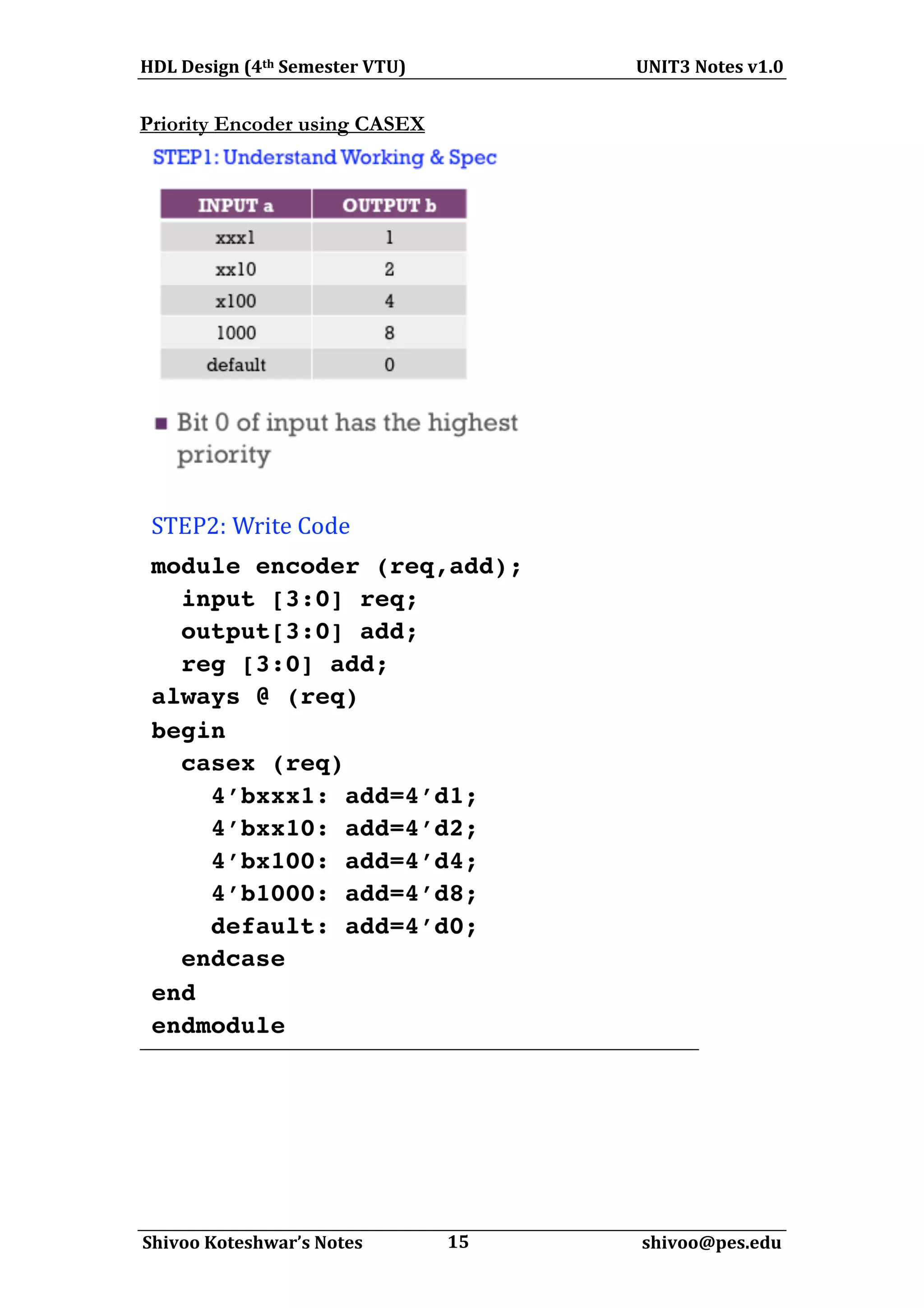
Applications of CASEX in designing priority encoders and the use of loops for sequential execution in HDL, focusing on real-world counting mechanisms.
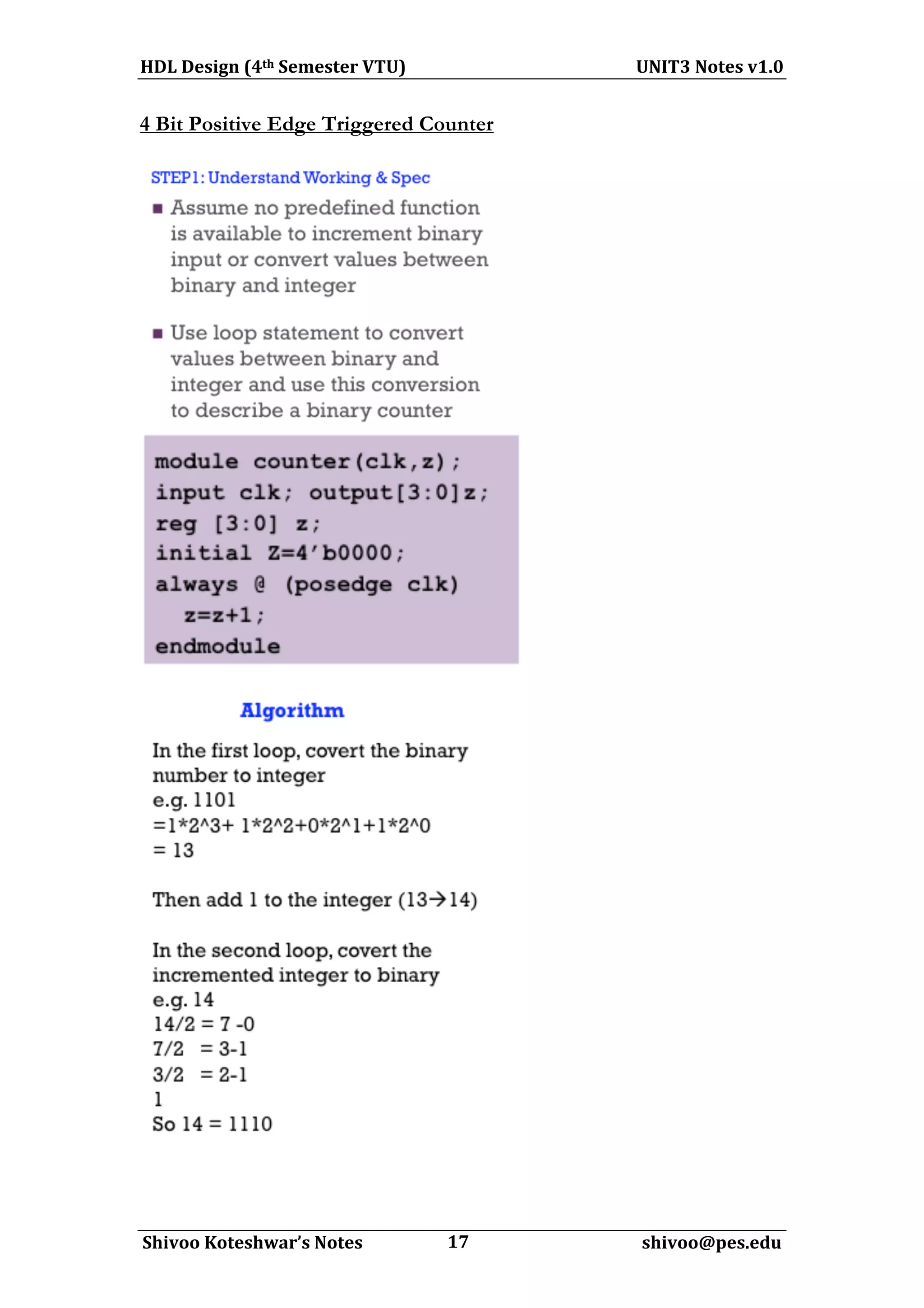
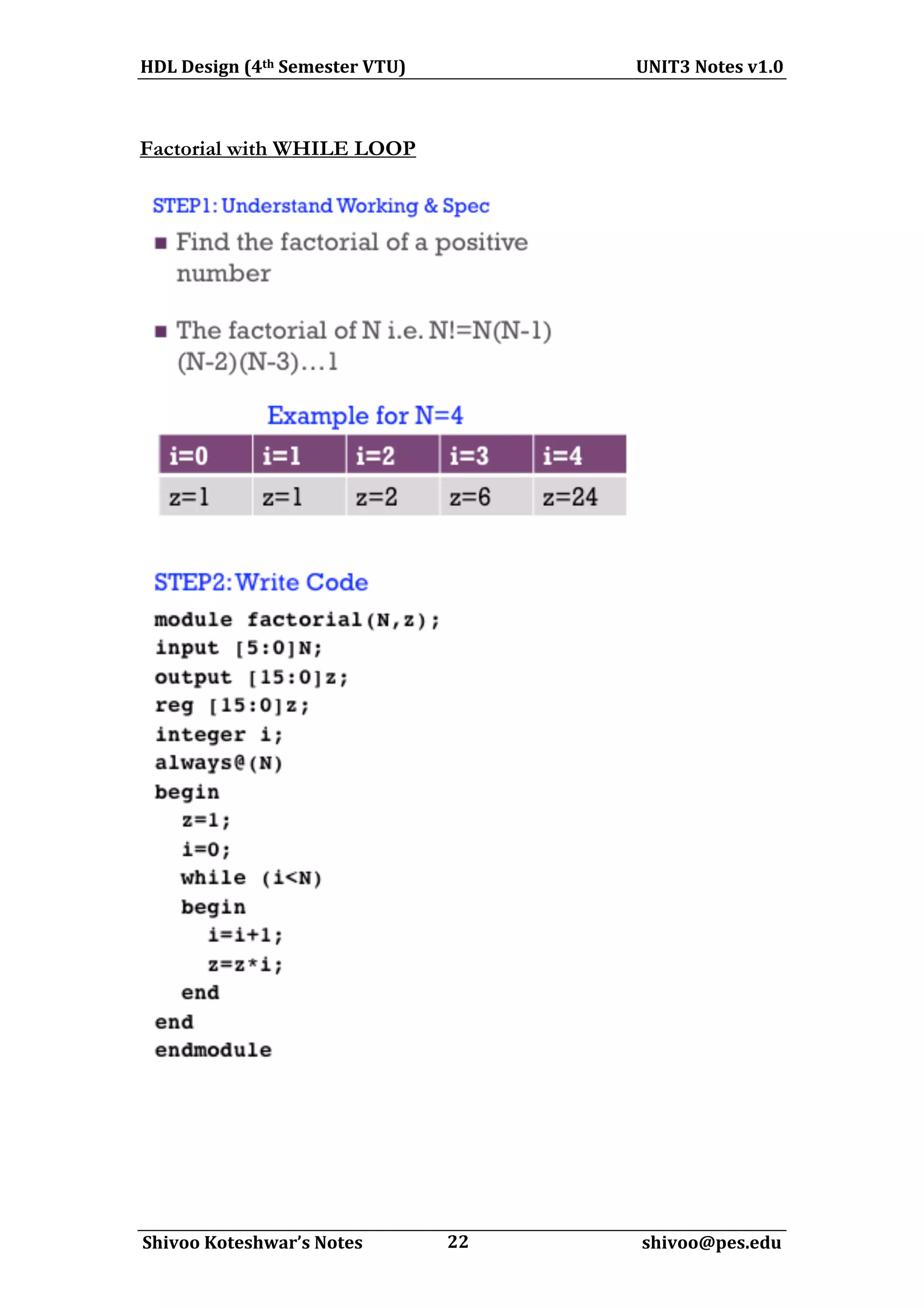
Implementing 4-bit counters and factorial calculations using WHILE loops, encapsulating real-world applications of HDL design.
EVEN SEMESTER Professor, E&C Department, PESIT SC Behavioral Descriptions • Highlights • Structure • Sequential Statements: IF, CASE, FOR LOOP, WHILE LOOP, REPEAT, FOREVER Reference Books: • HDL Programming (VHDL and Verilog)-‐ Nazeih M.Botros-‐ John Weily India Pvt. Ltd. 2008. UNIT 3: Behavioral Descriptions: Behavioral Description highlights, structure of HDL behavioral Description, The VHDL variable –Assignment Statement, sequential statements. 6 Hours HDL DESIGN-‐4-‐CLASS NOTES – UNIT3 Shivananda (Shivoo) Koteshwar P e o p l e s E d u c a t i o n S o c i e t y S o u t h C a m p u s ( w w w . p e s . e d u ) 14
2.
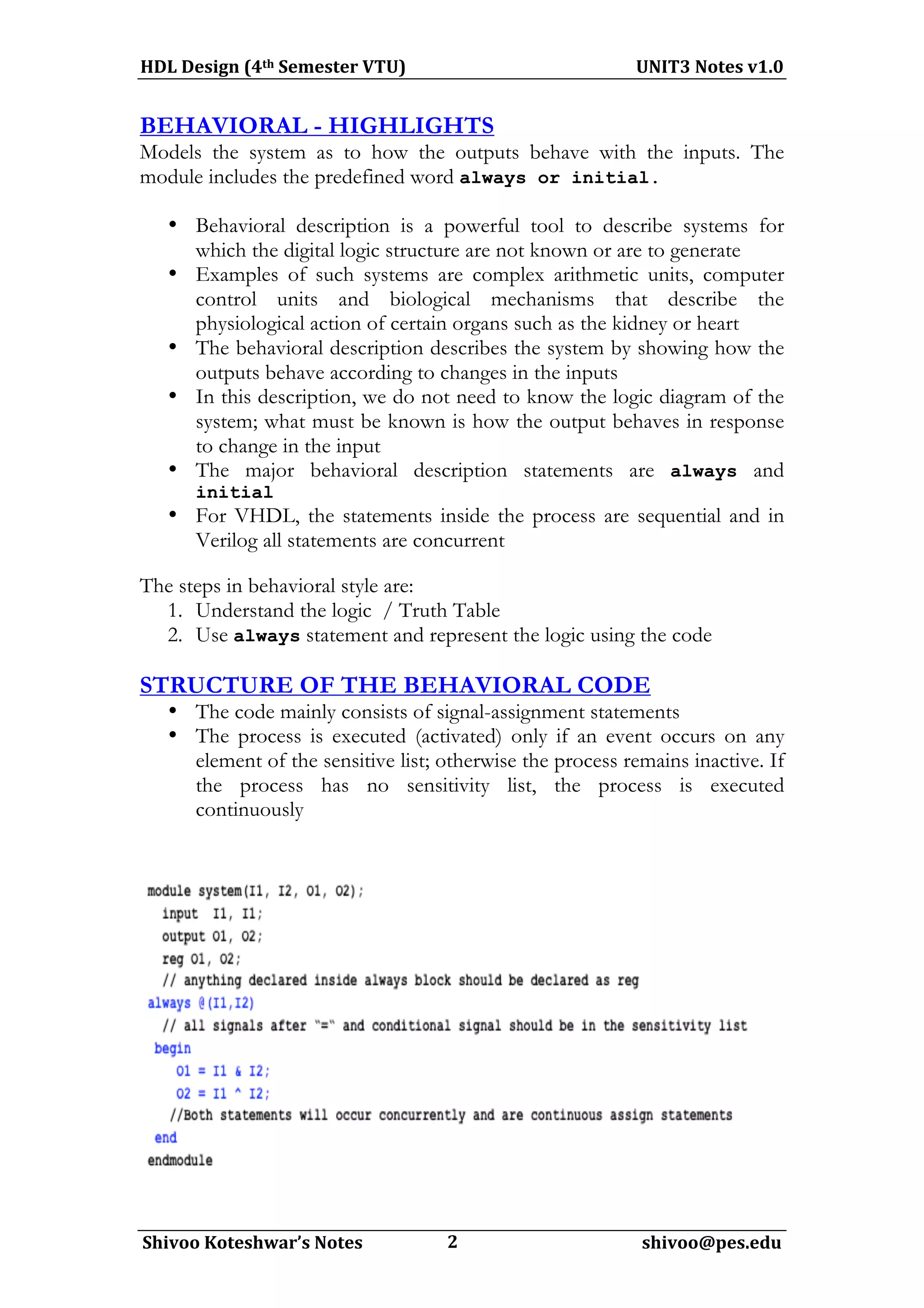
HDL Design (4th Semester VTU) UNIT3 Notes v1.0 BEHAVIORAL - HIGHLIGHTS Models the system as to how the outputs behave with the inputs. The module includes the predefined word always or initial. • Behavioral description is a powerful tool to describe systems for which the digital logic structure are not known or are to generate • Examples of such systems are complex arithmetic units, computer control units and biological mechanisms that describe the physiological action of certain organs such as the kidney or heart • The behavioral description describes the system by showing how the outputs behave according to changes in the inputs • In this description, we do not need to know the logic diagram of the system; what must be known is how the output behaves in response to change in the input • The major behavioral description statements are always and initial • For VHDL, the statements inside the process are sequential and in Verilog all statements are concurrent The steps in behavioral style are: 1. Understand the logic / Truth Table 2. Use always statement and represent the logic using the code STRUCTURE OF THE BEHAVIORAL CODE • The code mainly consists of signal-assignment statements • The process is executed (activated) only if an event occurs on any element of the sensitive list; otherwise the process remains inactive. If the process has no sensitivity list, the process is executed continuously Shivoo Koteshwar’s Notes 2 shivoo@pes.edu
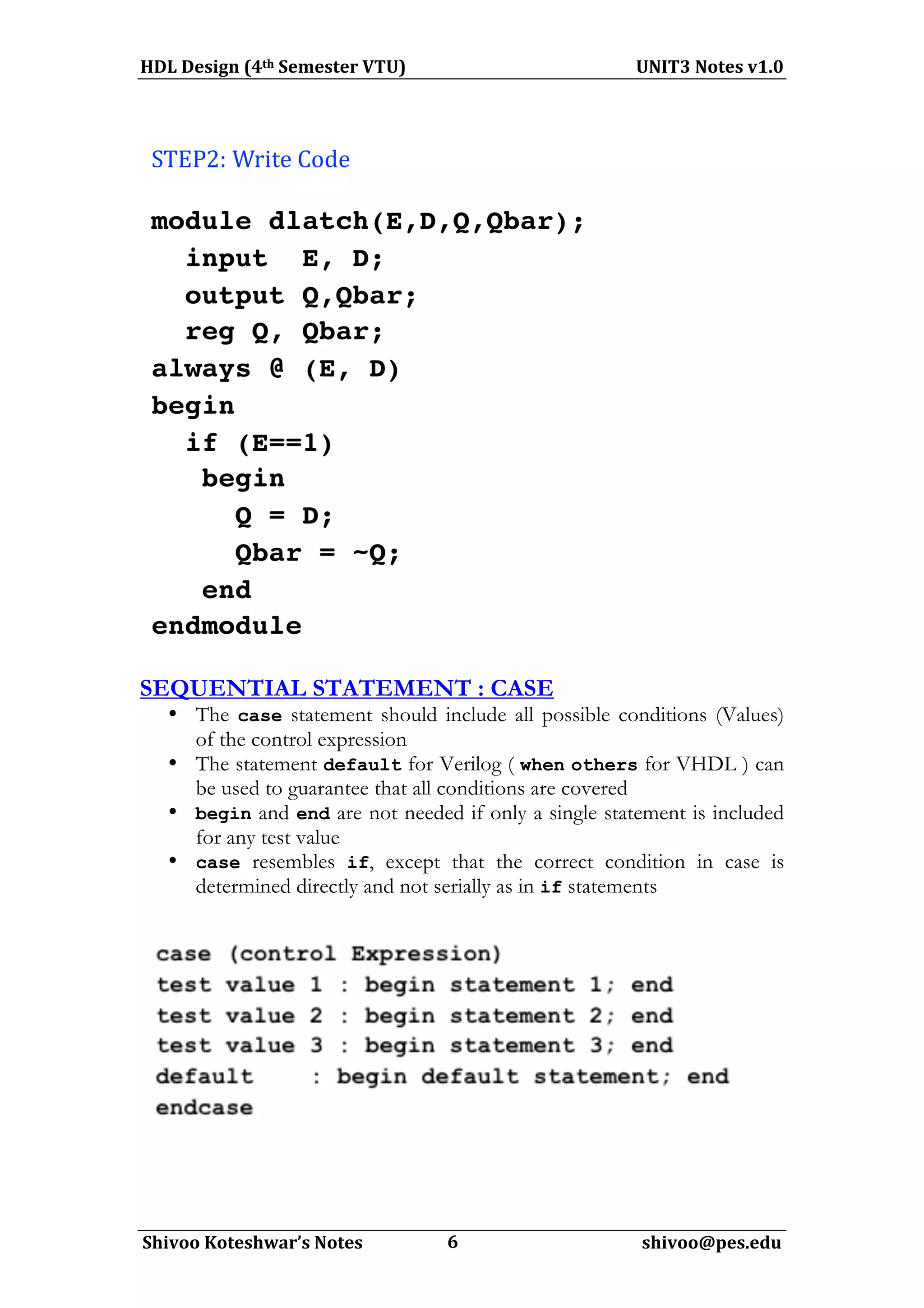
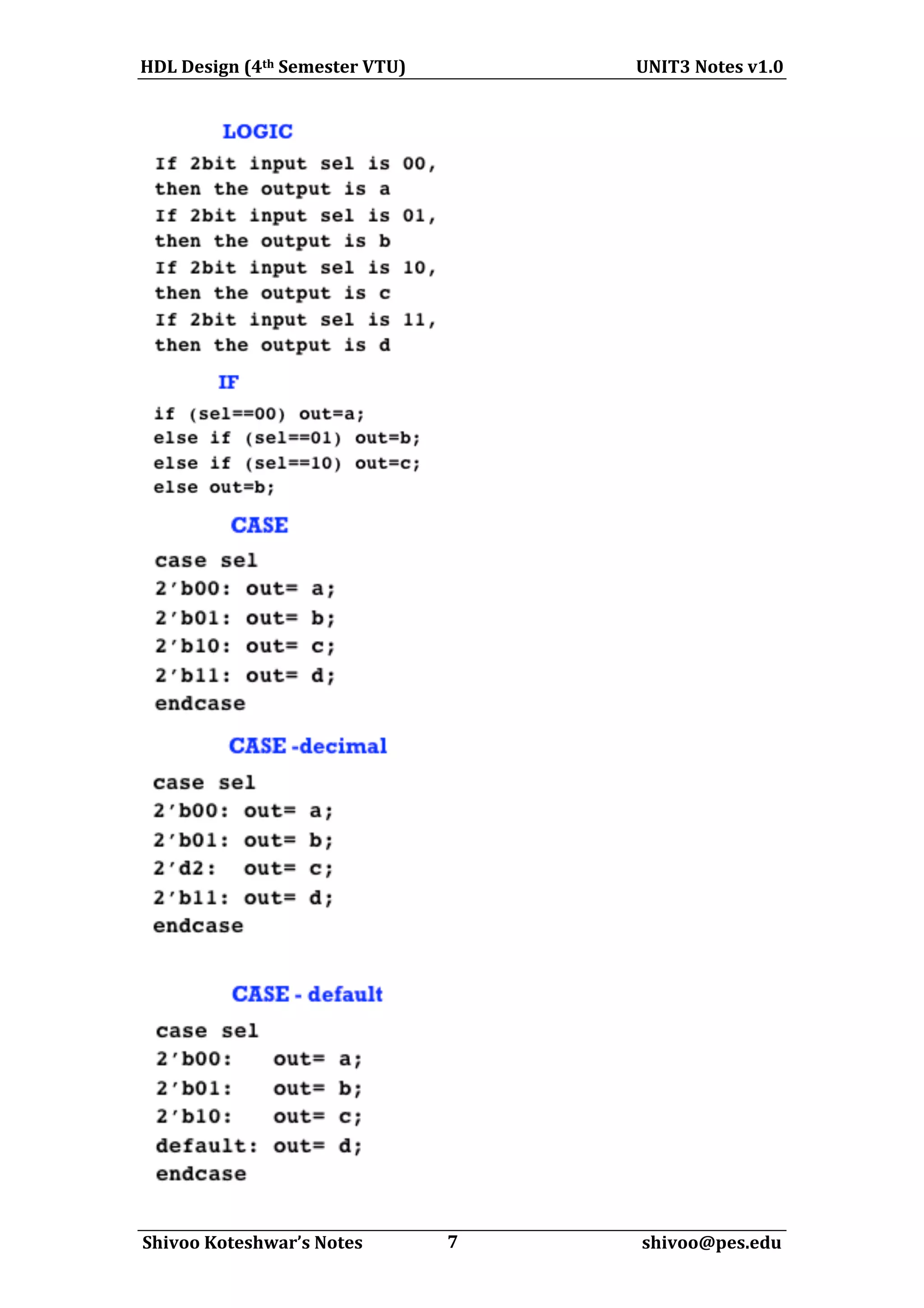
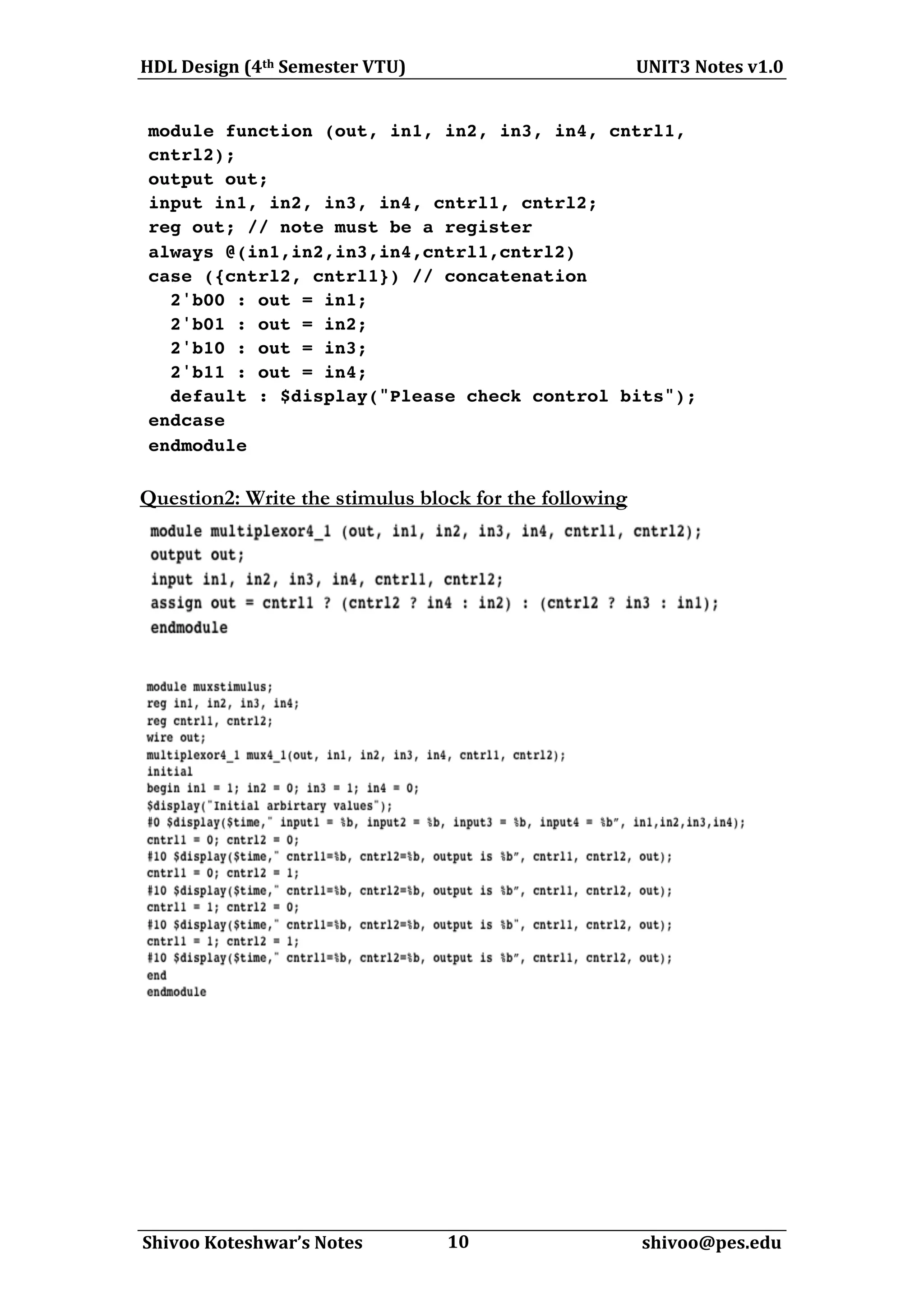
HDL Design (4th Semester VTU) UNIT3 Notes v1.0 SEQUENTIAL STATEMENT : CASE • The case statement should include all possible conditions (Values) of the control expression • The statement default for Verilog ( when others for VHDL ) can be used to guarantee that all conditions are covered • begin and end are not needed if only a single statement is included for any test value • case resembles if, except that the correct condition in case is determined directly and not serially as in if statements Shivoo Koteshwar’s Notes 6 shivoo@pes.edu
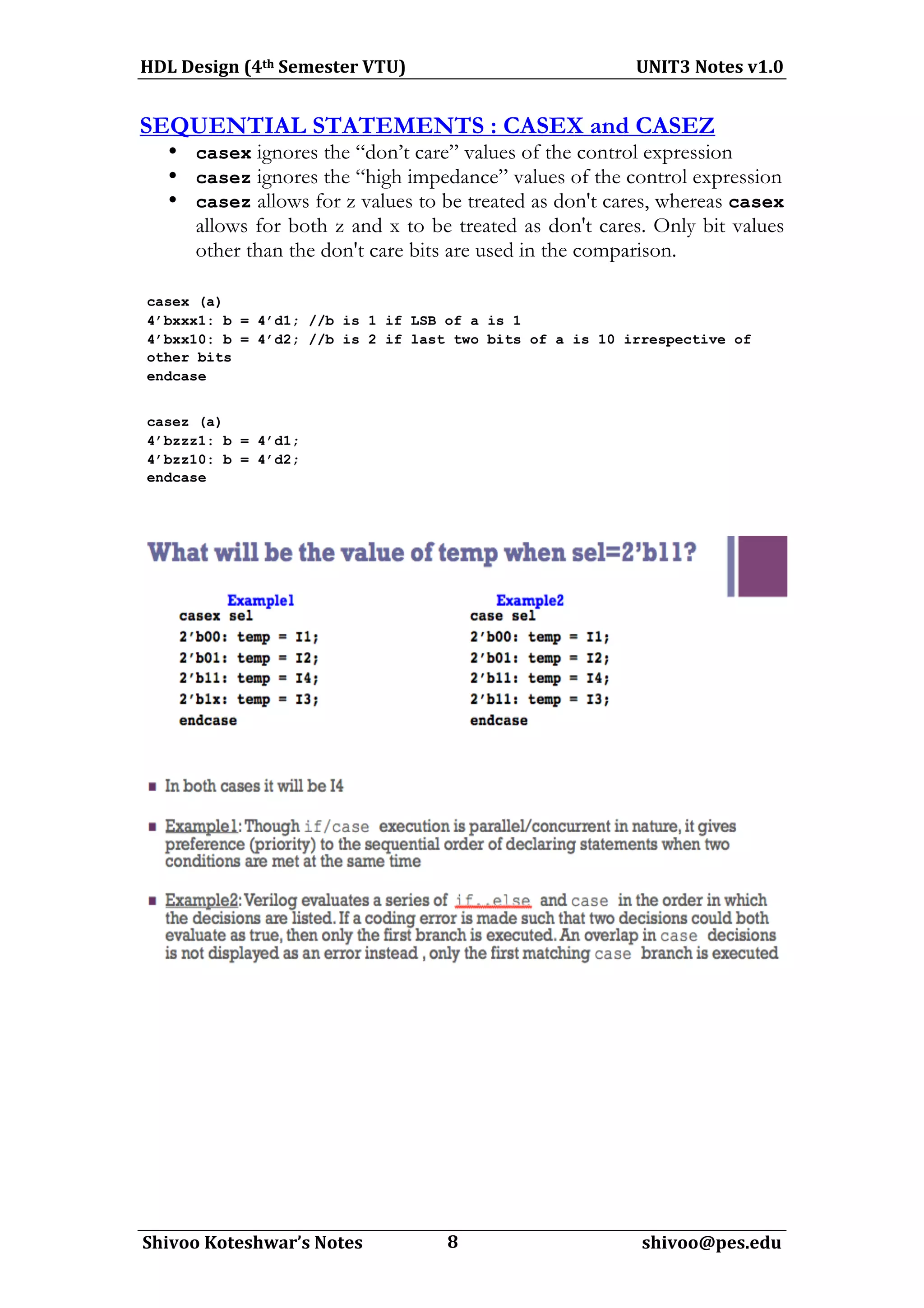
HDL Design (4th Semester VTU) UNIT3 Notes v1.0 SEQUENTIAL STATEMENTS : CASEX and CASEZ • casex ignores the “don’t care” values of the control expression • casez ignores the “high impedance” values of the control expression • casez allows for z values to be treated as don't cares, whereas casex allows for both z and x to be treated as don't cares. Only bit values other than the don't care bits are used in the comparison. Shivoo Koteshwar’s Notes 8 shivoo@pes.edu
9.
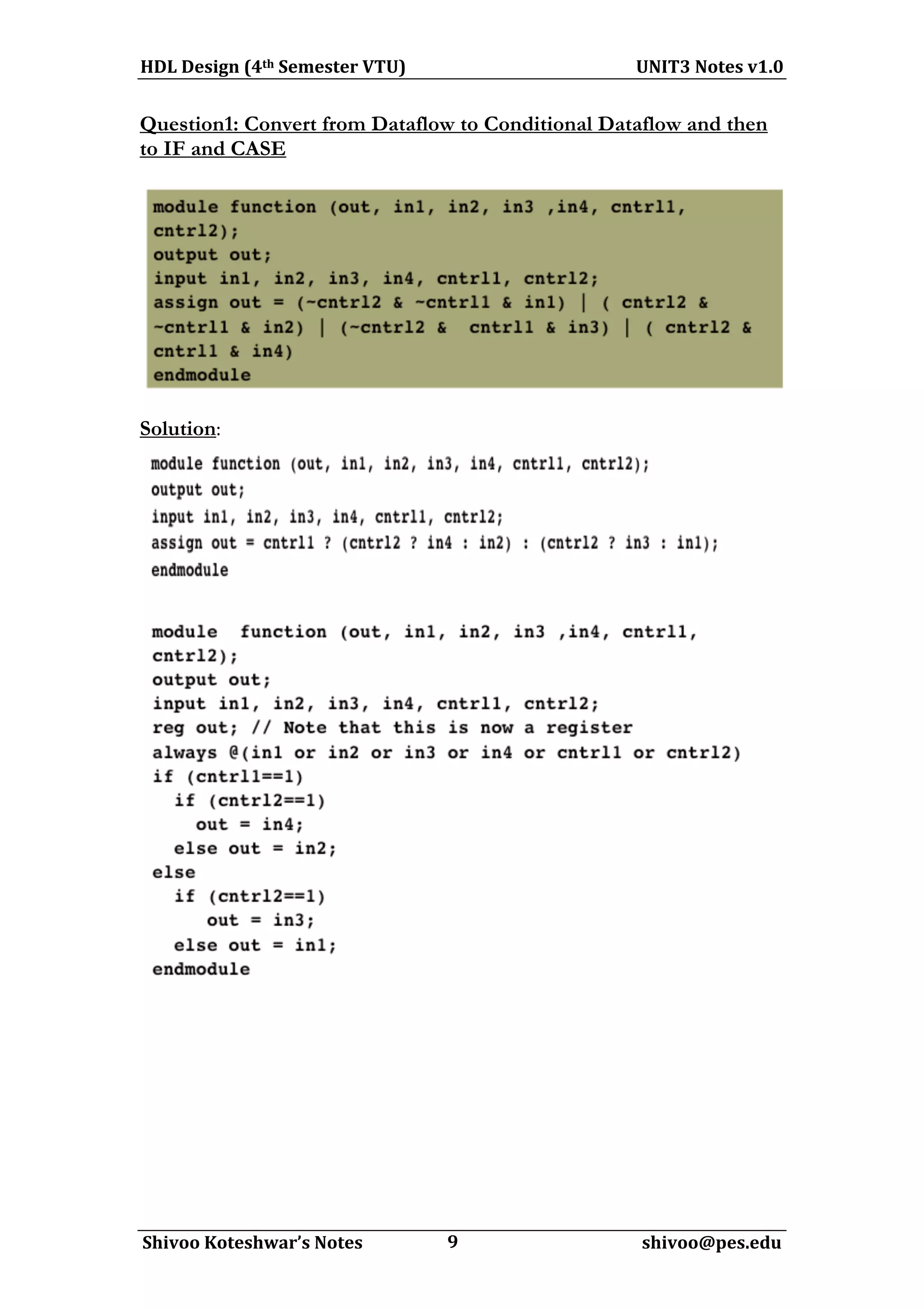
HDL Design (4th Semester VTU) UNIT3 Notes v1.0 Question1: Convert from Dataflow to Conditional Dataflow and then to IF and CASE Solution: Shivoo Koteshwar’s Notes 9 shivoo@pes.edu
10.
HDL Design (4th Semester VTU) UNIT3 Notes v1.0 Question2: Write the stimulus block for the following Shivoo Koteshwar’s Notes 10 shivoo@pes.edu
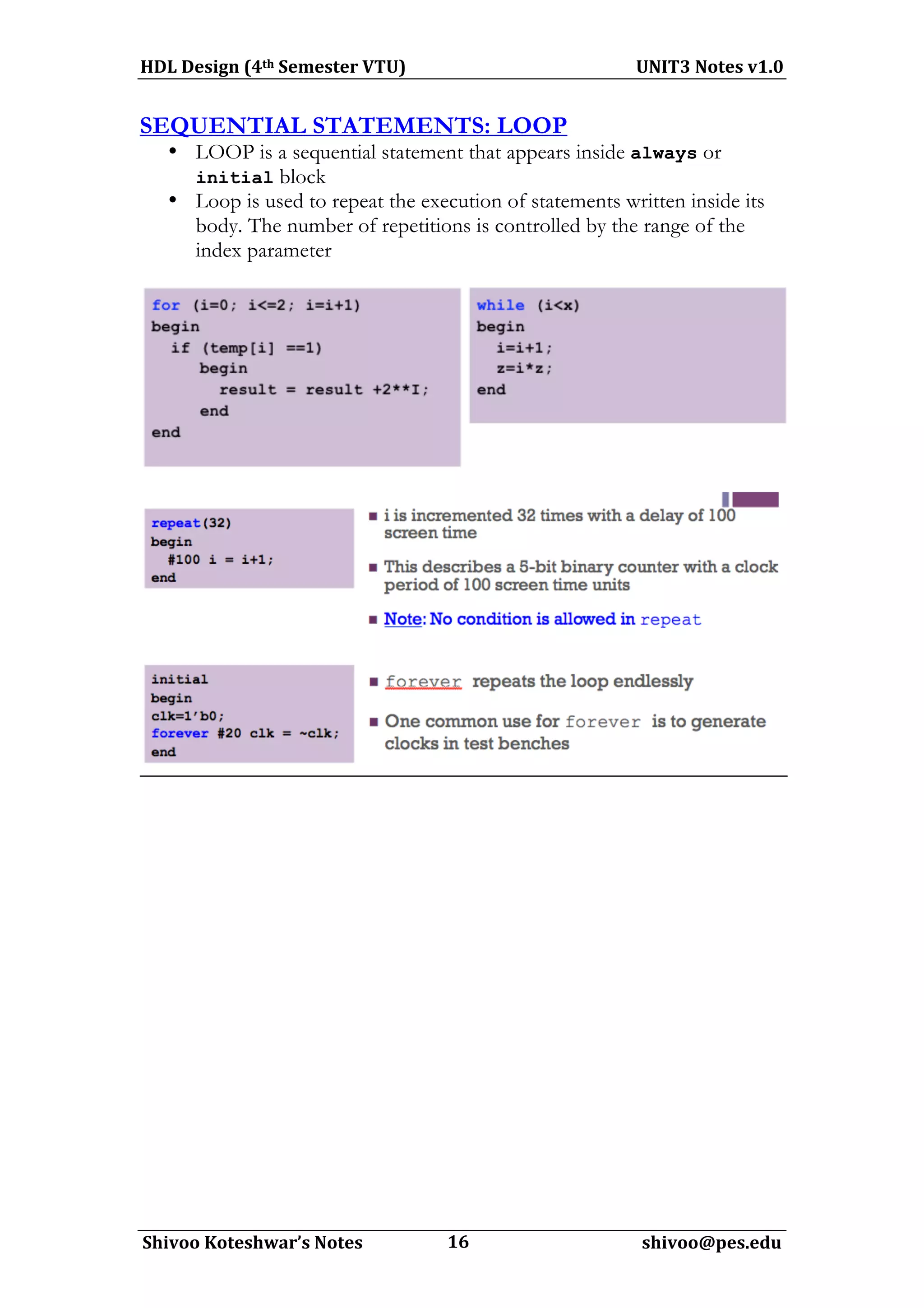
HDL Design (4th Semester VTU) UNIT3 Notes v1.0 SEQUENTIAL STATEMENTS: LOOP • LOOP is a sequential statement that appears inside always or initial block • Loop is used to repeat the execution of statements written inside its body. The number of repetitions is controlled by the range of the index parameter Shivoo Koteshwar’s Notes 16 shivoo@pes.edu