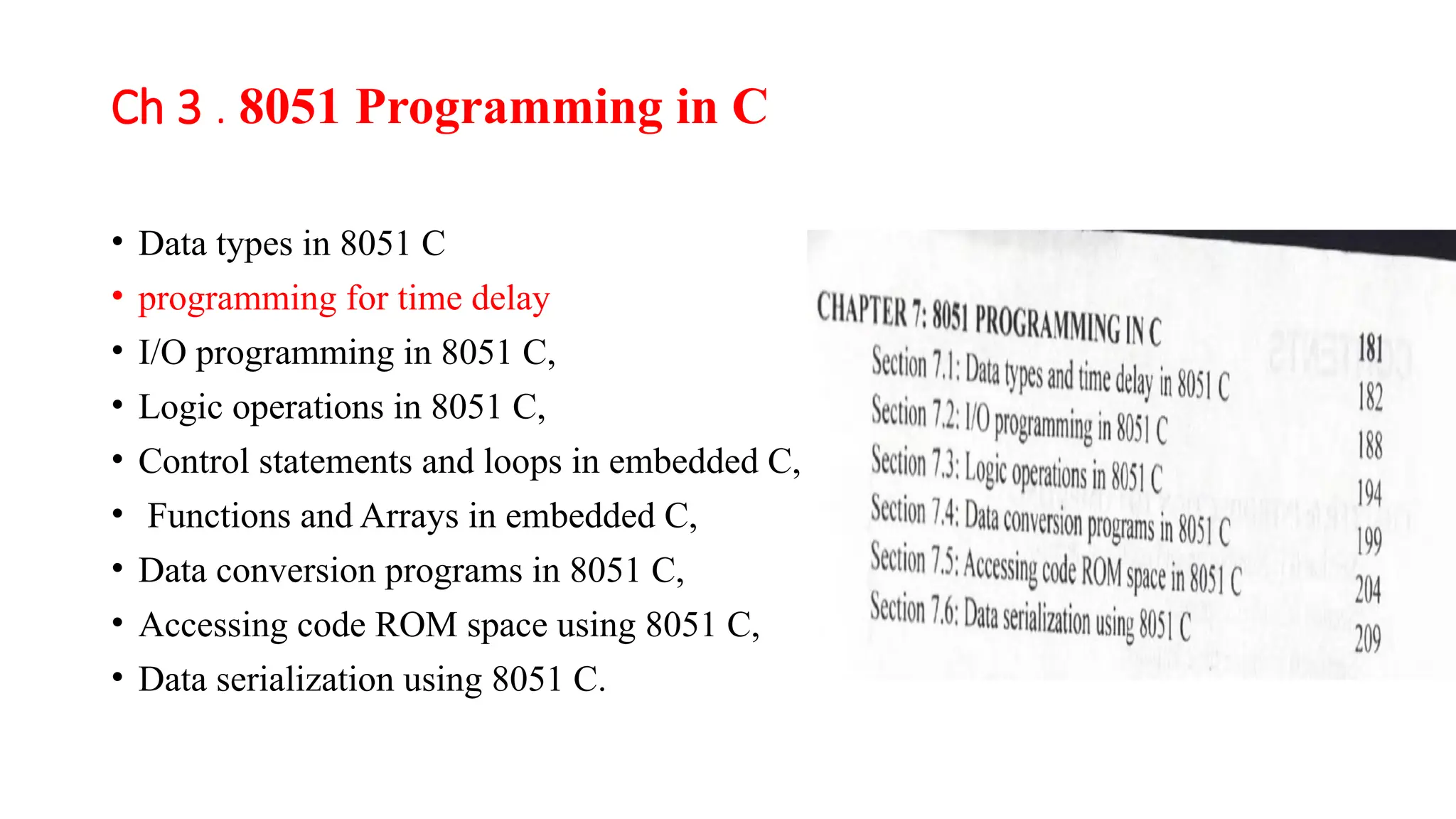
8051 Microcontroller Programming – Detailed Description (3000+ Words) 1. Introduction to 8051 Microcontroller 1.1 What is a Microcontroller? A microcontroller is a compact integrated circuit designed to govern a specific operation in an embedded system. It typically includes a processor, memory, and input/output peripherals on a single chip. Microcontrollers are used in automatically controlled products and devices, such as automobile engine control systems, remote controls, office machines, appliances, power tools, toys, and many more. 1.2 Introduction to the 8051 Microcontroller The 8051 microcontroller is one of the most popular and widely used microcontrollers in embedded systems. Developed by Intel in 1980, it belongs to the MCS-51 family of microcontrollers. It is an 8-bit microcontroller, meaning it can process 8 bits of data at a time. Despite its age, the 8051 remains widely used due to its simplicity, availability, and the large base of existing software and development tools. --- 2. 8051 Microcontroller Architecture The architecture of the 8051 microcontroller is the backbone of its programming. 2.1 Key Features 8-bit CPU 4 KB on-chip ROM (program memory) 128 bytes on-chip RAM (data memory) 32 I/O lines divided into four 8-bit ports (P0 – P3) Two 16-bit timers/counters Full-duplex UART for serial communication Six interrupt sources Clock oscillator and control circuitry 2.2 Block Diagram Overview The 8051's block diagram includes: ALU (Arithmetic Logic Unit): Performs arithmetic and logic operations. Registers: Includes accumulator (A), B register, stack pointer, data pointer, etc. Timers/Counters: Two 16-bit timers (T0 and T1) used for timing operations. Interrupt Control: Handles interrupt signals from internal or external devices. I/O Ports: Four 8-bit parallel ports (P0 to P3) for input/output. Serial Communication Port: Used for communication with other devices. --- 3. Programming the 8051 Programming the 8051 involves writing instructions in assembly language or embedded C, then compiling and uploading them to the microcontroller. Understanding instruction sets, memory organization, and peripheral interfacing is essential. 3.1 Programming Languages Assembly Language: Low-level language specific to 8051. Embedded C: High-level language more readable and portable. 3.2 Development Tools Keil µVision IDE: Popular development environment for 8051 programming. Proteus: Simulation tool for testing hardware circuits. Flash Magic or 8051 burner: Tools for burning hex files into the microcontroller. --- 4. 8051 Memory Organization 4.1 Code Memory (Program Memory) 4 KB ROM (internal program memory). Can be extended using external ROM. 4.2 Data Memory (RAM) 128 bytes internal RAM. First 32 bytes (00H to 1FH): Working registers (R0–R7) organized in 4 banks. 80 bytes (30H to 7FH): General-purpose RAM. Bit-addressable area (20H to 2FH): Each bit can be accessed individually. These are mem