TOPIC ALGORITHM
Computational Thinking  Computational thinking means thinking or solving problems like a computer scientist.  There are four key techniques to computational thinking:  Decomposition  Pattern Recognition  Abstraction  Algorithm
Computational Thinking  Pattern recognition:  Looking for similarities among and within problems.  Abstraction:  Focusing on the important information only, ignoring irrelevant detail.
Decomposition  The process of breaking down a complex problem into smaller, simple and easy to manage parts.  We do many tasks on a daily without even thinking about or decomposing them, such as getting ready to school, finishing school work  Breaking the problem down into smaller parts means that each smaller problem can be examined in more detail.
What is Algorithm?  An algorithm is a process or set of rules to be followed in calculations or other problem-solving operations, especially by a computer.  It is a set of rules to obtain the expected output from the given input.   An algorithm is simply a set of steps used to complete a specific task
Algorithm Around Us  Algorithms are everywhere around us.  We humans follow and perform daily tasks in the form of algorithms without knowing that they are algorithms.  One of the most obvious examples of an algorithm is a recipe. It’s a finite list of instructions used to perform a task.  Example: making tea, cross the road
Algorithm in Computer Science  Algorithm are one of the four cornerstones of computational thinking.  Algorithmic programming is all about writing a set of rules with a finite number of steps that instruct the computer how to perform a task.  A computer program is essentially an algorithm that tells the computer what specific steps to execute, in what specific order, in order to carry out a specific task.
Algorithm in Computer Science  An algorithm are written using a particular syntax, depending on the programming language being used.
Algorithm in Computer Science  Find the product of two numbers.  Find the number 1.  Find the number 2.  What is operator?  Where to store the result?
Algorithm in Computer Science  Find the product of two numbers.  Enter number 1  Store number 1 in x  Enter number 2  Store number 2 in y  Multiple x & y  Store result in z (z=x*y)  Display number Note: now these instructions can be easily translated into computer program
What is Computer Program?  In computer program, a sequence of instructions is given to computer to solve a specific problem.  Computer programs consist of a series of instructions to tell a computer exactly what to do and how to do it.  Programing:  Programing is writing computer code to create a program, in order to solve a problem.  Code:  Code is the process of translating an algorithm into a programming language.
Algorithm in Computer Science  Solve: 8+9*7+2(9-3)  Write a computer program that ensures that everyone who is under 15 years of age will get discount.
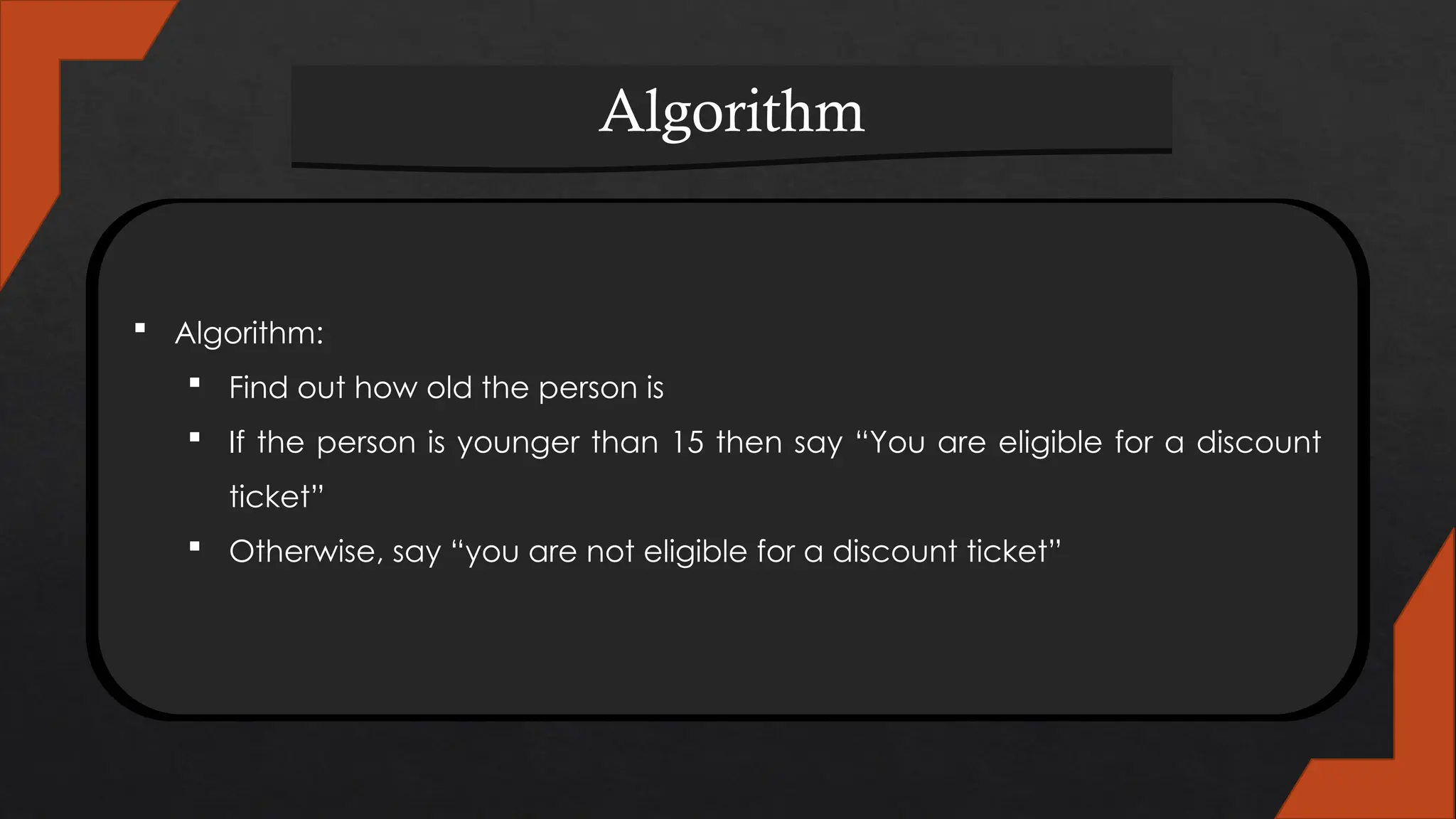
Algorithm  Algorithm:  Find out how old the person is  If the person is younger than 15 then say “You are eligible for a discount ticket”  Otherwise, say “you are not eligible for a discount ticket”
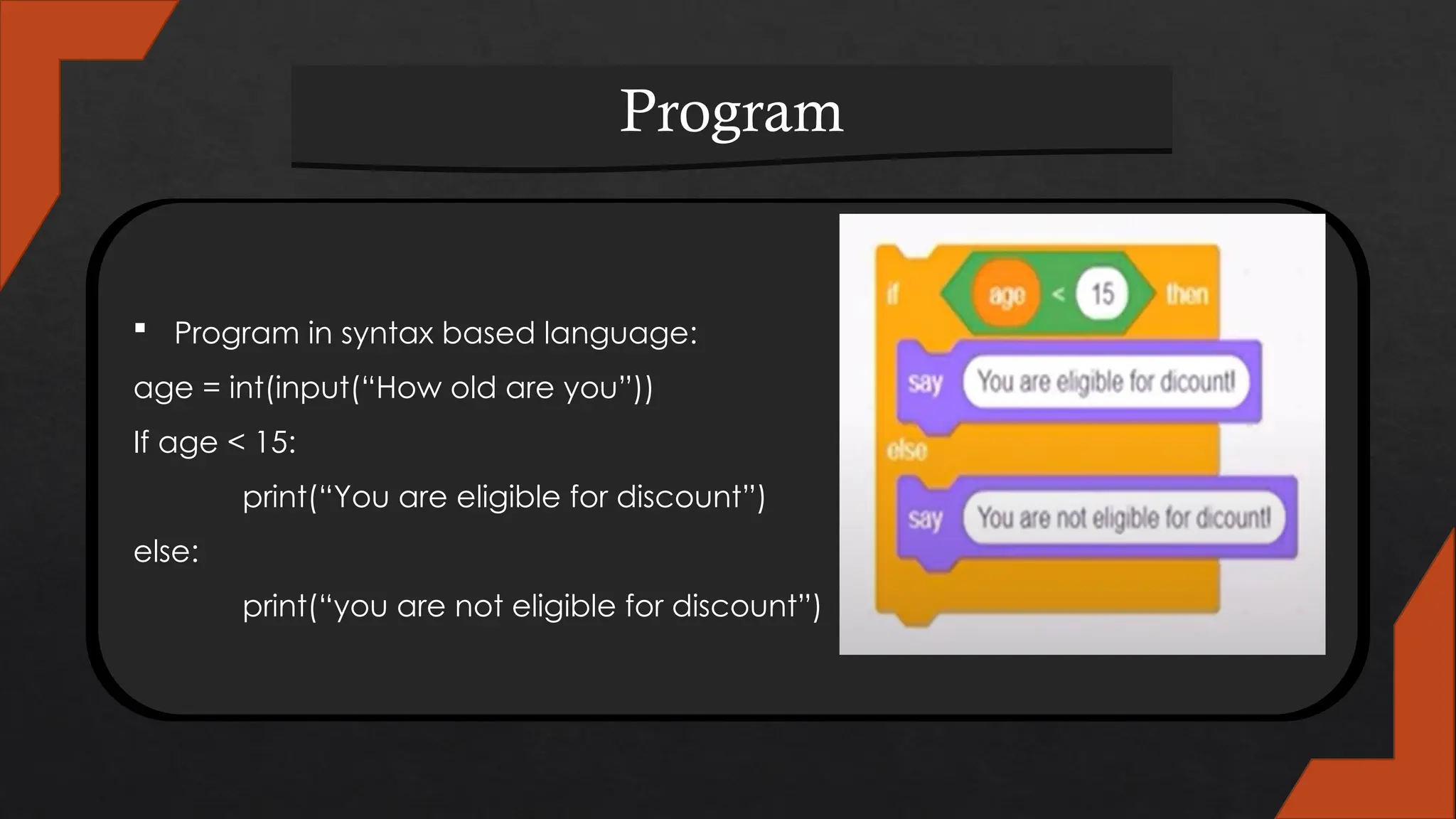
Program  Program in syntax based language: age = int(input(“How old are you”)) If age < 15: print(“You are eligible for discount”) else: print(“you are not eligible for discount”)
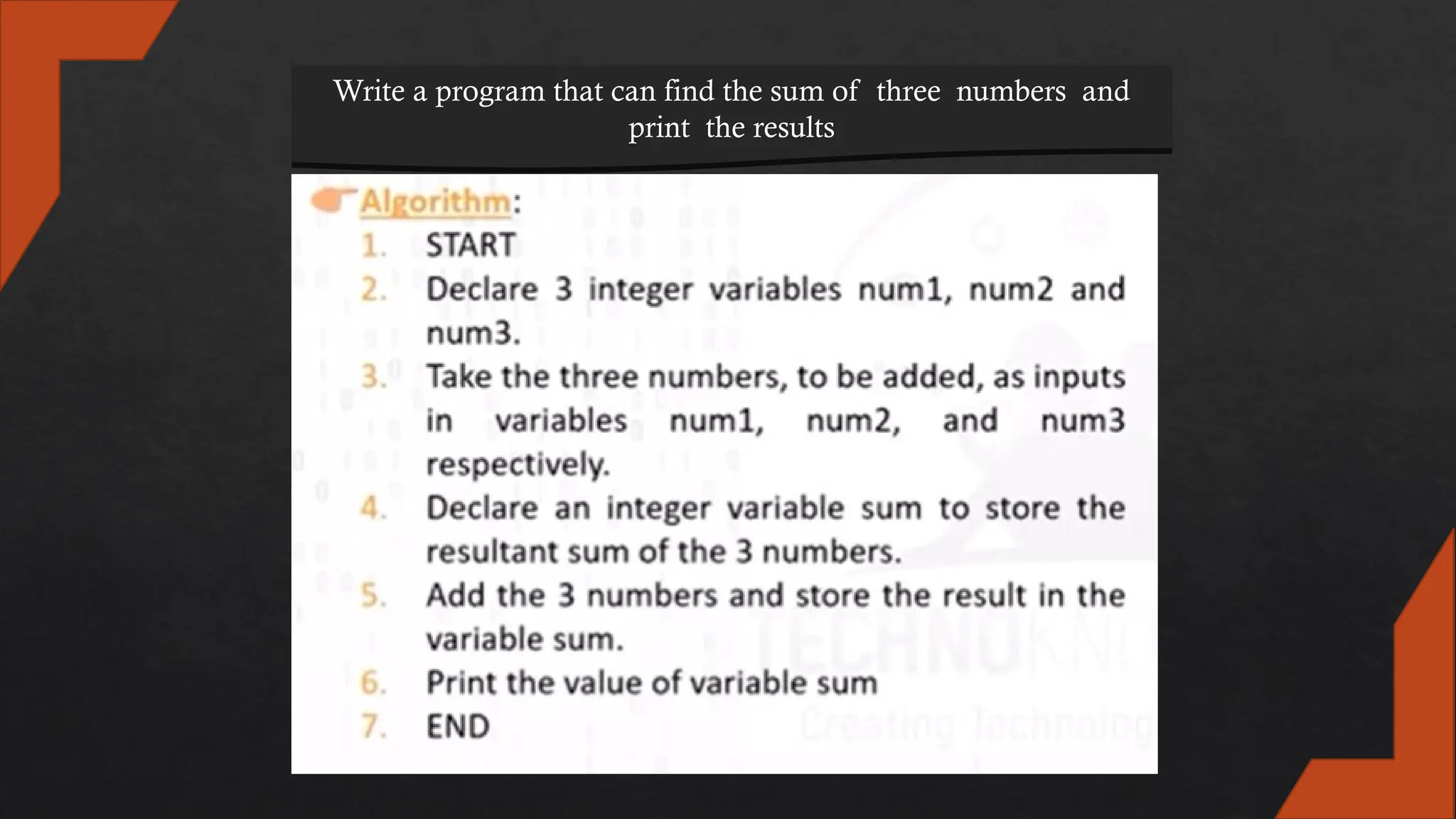
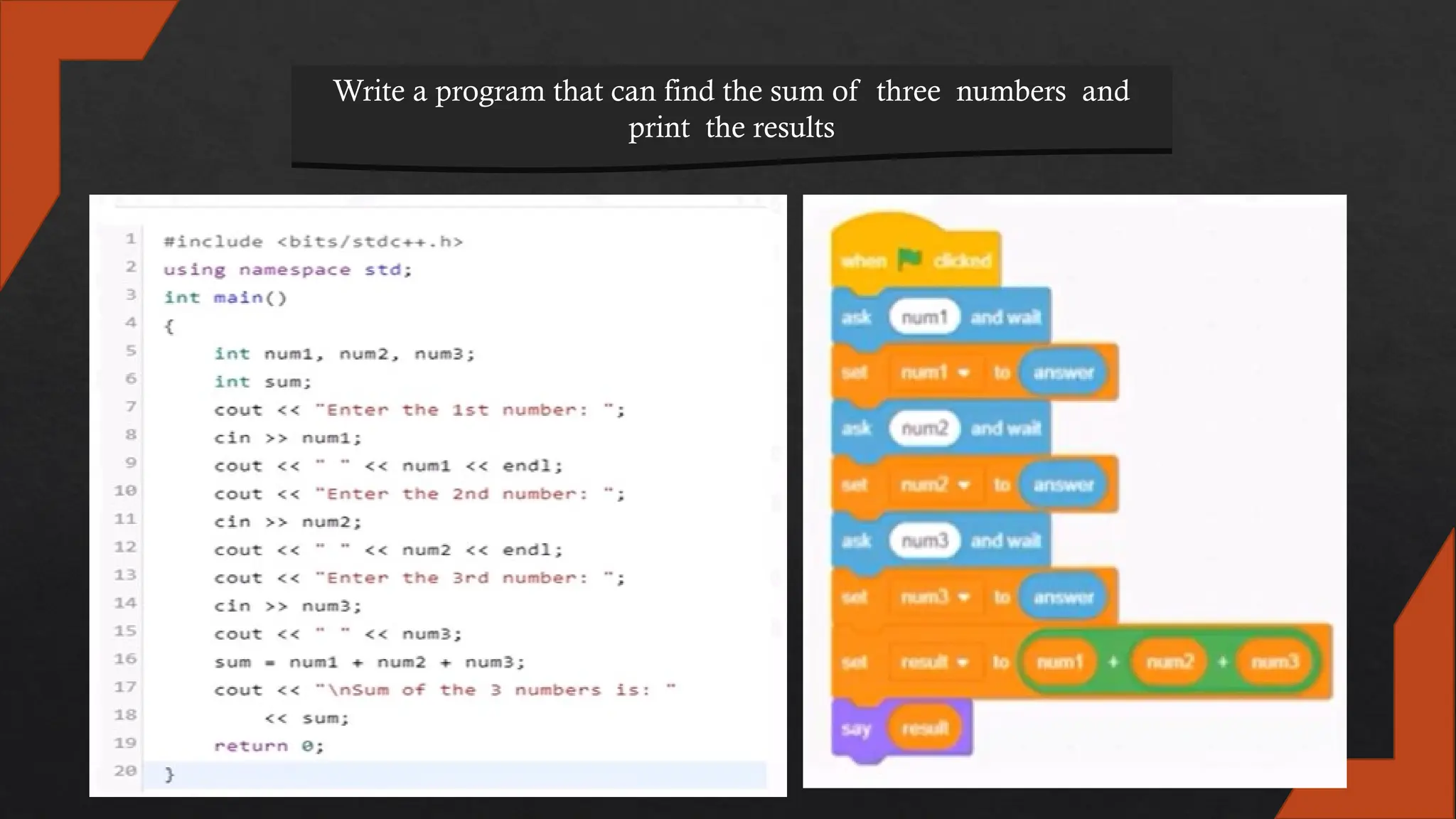
Write a program that can find the sum of three numbers and print the results
‫!شکریہ‬ ‫کا۔۔۔‬ ‫توجہ‬ ‫کی‬ ‫آپ‬

Algorithm (Basic Algorithm Presentation).pptx

  • 2.
  • 3.
    Computational Thinking  Computationalthinking means thinking or solving problems like a computer scientist.  There are four key techniques to computational thinking:  Decomposition  Pattern Recognition  Abstraction  Algorithm
  • 4.
    Computational Thinking  Patternrecognition:  Looking for similarities among and within problems.  Abstraction:  Focusing on the important information only, ignoring irrelevant detail.
  • 5.
    Decomposition  The processof breaking down a complex problem into smaller, simple and easy to manage parts.  We do many tasks on a daily without even thinking about or decomposing them, such as getting ready to school, finishing school work  Breaking the problem down into smaller parts means that each smaller problem can be examined in more detail.
  • 6.
    What is Algorithm? An algorithm is a process or set of rules to be followed in calculations or other problem-solving operations, especially by a computer.  It is a set of rules to obtain the expected output from the given input.   An algorithm is simply a set of steps used to complete a specific task
  • 7.
    Algorithm Around Us Algorithms are everywhere around us.  We humans follow and perform daily tasks in the form of algorithms without knowing that they are algorithms.  One of the most obvious examples of an algorithm is a recipe. It’s a finite list of instructions used to perform a task.  Example: making tea, cross the road
  • 8.
    Algorithm in ComputerScience  Algorithm are one of the four cornerstones of computational thinking.  Algorithmic programming is all about writing a set of rules with a finite number of steps that instruct the computer how to perform a task.  A computer program is essentially an algorithm that tells the computer what specific steps to execute, in what specific order, in order to carry out a specific task.
  • 9.
    Algorithm in ComputerScience  An algorithm are written using a particular syntax, depending on the programming language being used.
  • 10.
    Algorithm in ComputerScience  Find the product of two numbers.  Find the number 1.  Find the number 2.  What is operator?  Where to store the result?
  • 11.
    Algorithm in ComputerScience  Find the product of two numbers.  Enter number 1  Store number 1 in x  Enter number 2  Store number 2 in y  Multiple x & y  Store result in z (z=x*y)  Display number Note: now these instructions can be easily translated into computer program
  • 12.
    What is ComputerProgram?  In computer program, a sequence of instructions is given to computer to solve a specific problem.  Computer programs consist of a series of instructions to tell a computer exactly what to do and how to do it.  Programing:  Programing is writing computer code to create a program, in order to solve a problem.  Code:  Code is the process of translating an algorithm into a programming language.
  • 13.
    Algorithm in ComputerScience  Solve: 8+9*7+2(9-3)  Write a computer program that ensures that everyone who is under 15 years of age will get discount.
  • 14.
    Algorithm  Algorithm:  Findout how old the person is  If the person is younger than 15 then say “You are eligible for a discount ticket”  Otherwise, say “you are not eligible for a discount ticket”
  • 15.
    Program  Program insyntax based language: age = int(input(“How old are you”)) If age < 15: print(“You are eligible for discount”) else: print(“you are not eligible for discount”)
  • 16.
    Write a programthat can find the sum of three numbers and print the results
  • 17.
    Write a programthat can find the sum of three numbers and print the results
  • 18.