Karamjeet Singh Virk Int. Journal of Engineering Research and Applications www.ijera.com ISSN : 2248-9622, Vol. 5, Issue 6, ( Part -1) June 2015, pp.91-96 www.ijera.com 91 | P a g e An Efficient Algorithm for Edge Detection of Corroded Surface Karamjeet Singh Virk*, Dr. Sukhjeet K. Ranade** *(Department of Computer Science, Punjabi University, Patiala) ** (Department of Computer Science, Punjabi University, Patiala) ABSTRACT Inspection process in industrial applications plays a vital role as it directly hinders the outages of industry. Thereby the inspection especially in case of corroded surfaces is to be fast, precised and accurate. Visual inspection has been very liable to mistakes because of numerous facts. The automatic inspection systems remove subjective aspects and can provide fast and accurate inspection. Inspection of corroded surfaces is very important concern, thus it is required to detect corroded surfaces. A new algorithm is developed by certain changes in mask and thresholding selection to detect corroded surfaces. The paper is about how we can amend the weak edges of input images and discarding false edges to overcome the problem of traditional techniques in this field. Proposed operator also compared with two commonly used edge detection algorithms which are Canny and Sobel. Keywords - Canny edge detector, Corroded Surfaces, Edges, Proposed modified edge detector, Sobel edge detector I. INTRODUCTION Edge detection is a procedure that perceives the existence and position of edges established by sharp variations in brightness or colour intensity of an image. Subsequently, it can be verified that the incoherence in surface alignment, variations in properties of material and deviations in scene brightness. In the idyllic situation, the outcomes of implementing an edge detector to an image may results into a set of associated curves that specifies the outlines of an object, the outlines of surface design also curves that resembles to incoherence in surface alignment. In industry, technical and scientific advances in computer technologies, digital image processing, image pattern recognition and artificial intelligence made industrial image analysis easier and effective. Visual inspection applications are present in industries that include visual quality control. In particularly, the main point of our interest is corroded surfaces in industry and visual inspection of that. Visual control has been usually performed by human vision: corroded surfaces have been inspected by workers that verify the quality and age of that. This way of inspected has been very liable to mistakes. So, there was a large influence of human errors and subjectivity on the result of inspection. The automatic inspection systems remove subjective aspects and can provide fast and accurate inspection. These inspection systems are based on image processing so the so many edge detection techniques are present. In all edge detection algorithms, the main objective is to locate the edge from the scene neither with prior information nor with human interpretation. Some popular algorithms include Sobel, Roberts, Prewitt, LOG and Canny Algorithm. These edge detection operators share almost the same concept which is to find the abrupt change in intensity level and locate true and false edges accurately. Canny edge detector has proven to be superior over many of the available edge detection algorithms and thus was chosen mostly for real time implementation and testing. Canny edge detector is not simply a noise disturbed and makes an even trade-off between noise and edge detection of an image. Canny edge detector has precise edge detection but quite sensitive to noise and find the accurate weak edges. A pixel position is professed by an edge position, if gradient magnitude surpasses some threshold, an edge can be detected for every value that surpasses the threshold. The above mentioned issue is of a great importance in noisy images or industrial application where many false edges resulting from noise are detected. In this paper, a new Proposed modified edge detection algorithm has been developed and is applied to various applications of the industry to detect the corroded surfaces. In this paper we studied the various techniques of image edge detection firstly and come to know how to detect the corroded surfaces and then used various morphological operations like dilation followed by hole filling and at last used erosion and then computed true and false edges of corroded surfaces. Corrosion detection is very important part of industrial inspection process and this paper represents it. This paper is organized into various sections which are as follows: Background of approach is described in Section 2. The proposed modified edge detection algorithm is described in Section 3. Results are drowned and discussed in Section 4. Finally, conclusions and future scope are drawn in Section 5. RESEARCH ARTICLE OPEN ACCESS
Karamjeet Singh Virk Int. Journal of Engineering Research and Applications www.ijera.com ISSN : 2248-9622, Vol. 5, Issue 6, ( Part -1) June 2015, pp.91-96 www.ijera.com 92 | P a g e II. BACKGROUND This method was presented by John F. Canny in 1986. Even though this method is quite old but is still used because of its precision in image edge detection. Canny edge detector is not simply a noise disturbed and makes an even trade-off between noise and edge detection of an image. It can also find the weak edges accurately. A pixel position is professed by an edge position, if gradient magnitude surpasses some threshold, an edge can be detected for every value that surpasses the threshold. Typical implementation of the Canny edge detector as follows: 2.1 Noise reduction by smoothing: Noise contained image is smoothed by convolving the image I(i, j) with Gaussian filter G. Mathematically, the resultant smoothing image is given by: (i, j) G*I(i, j)F  (1) 2.2 Finding gradients: In this step we detect the edges where the change in grey scale intensity is at maximum level. Gradient of an image helps us to determine the required areas. Usually, canny operator is used to determine the gradient at each pixel of a smoothed image. Canny operators in i and j directions are given below: 1 0 1 2 0 2 1 0 1 iD              , 1 2 1 0 0 0 1 2 1 jD               (2) These Canny masks are convolved with smoothed image and gives gradients in i and j directions: *F(i, j)i iG D , *F(i, j)j jG D (3) Therefore magnitude of gradient of a pixel of input image is given by: 2 2 i jG G G  (4) The direction of gradient is given by: arctan j i G G         (5) iG and jG are the gradients given in the i and j directions respectively. 2.3 Non maximum suppressions: Non maximum suppression is carried out to preserves all local maxima in gradient image, and discarding everything else, the result is presented in thin edges. • Firstly round the gradient direction  nearly 45°, then compare the gradient magnitude of the pixels in positive and negative gradient directions i.e. if the gradient direction is in east then compare gradient of the pixel with the west direction say E (i, j) and W (i, j) respectively. • If the edge strength of image pixel is larger than that of E (i, j) and W (i, j), then preserves the value of gradient and mark as edge pixel, if not then suppressed. 2.4 Hysteresis thresholding: The output of non-maxima suppression still contains the local maxima created by noise in image. Instead of choosing a single threshold value, we use two thresholds values to overcome the problem of streaking i.e. hight and lowt are used. The Sobel edge detection is commonly used method edge detection The Sobel edge detection technique is presented by Sobel in the year 1970. The Sobel technique of edge detection is based on image segmentation detects edges by Sobel estimation to the derivative value. It points the edges to individual points wherever the gradient is high. The Sobel operator consists of a pair of 3×3 convolution kernels as revealed in Table 3.1. One kernel is just replica of other by rotating it by 90°. Table 1. Sobel operator mask. -1 -2 -1 +1 0 -1 0 0 0 +2 0 -2 +1 +2 +1 +1 0 -1 These kernels are intended to reply extremely to edges run horizontally and vertically comparative to pixel grid, one kernel for both two perpendicular alignments. The kernels can yield distinct quantities of the gradient component for each alignment (Gx and Gy). III. PROPOSED MODIFIED EDGE DETECTION ALGORITHM The proposed modified operator draw attentions to the regions of high spatial frequency correspond to the edges of the image and also perform the 2-D spatial gradient quantity. Edges are running diagonally corresponding to the horizontally and vertically relative to the pixel, which get maximum responds from the two designed kernels and one kernel is for each orientation. The Proposed modified edge detector algorithm intended by using a new mask motivated by the mask of Sobel edge detector and by assortment of suitable threshold value that adapts itself according to the needs of an the application. The proposed modified edge detector consists of 3×3 pair of matrix of convolution kernels as shown in Table 2. These values are taken from traditional
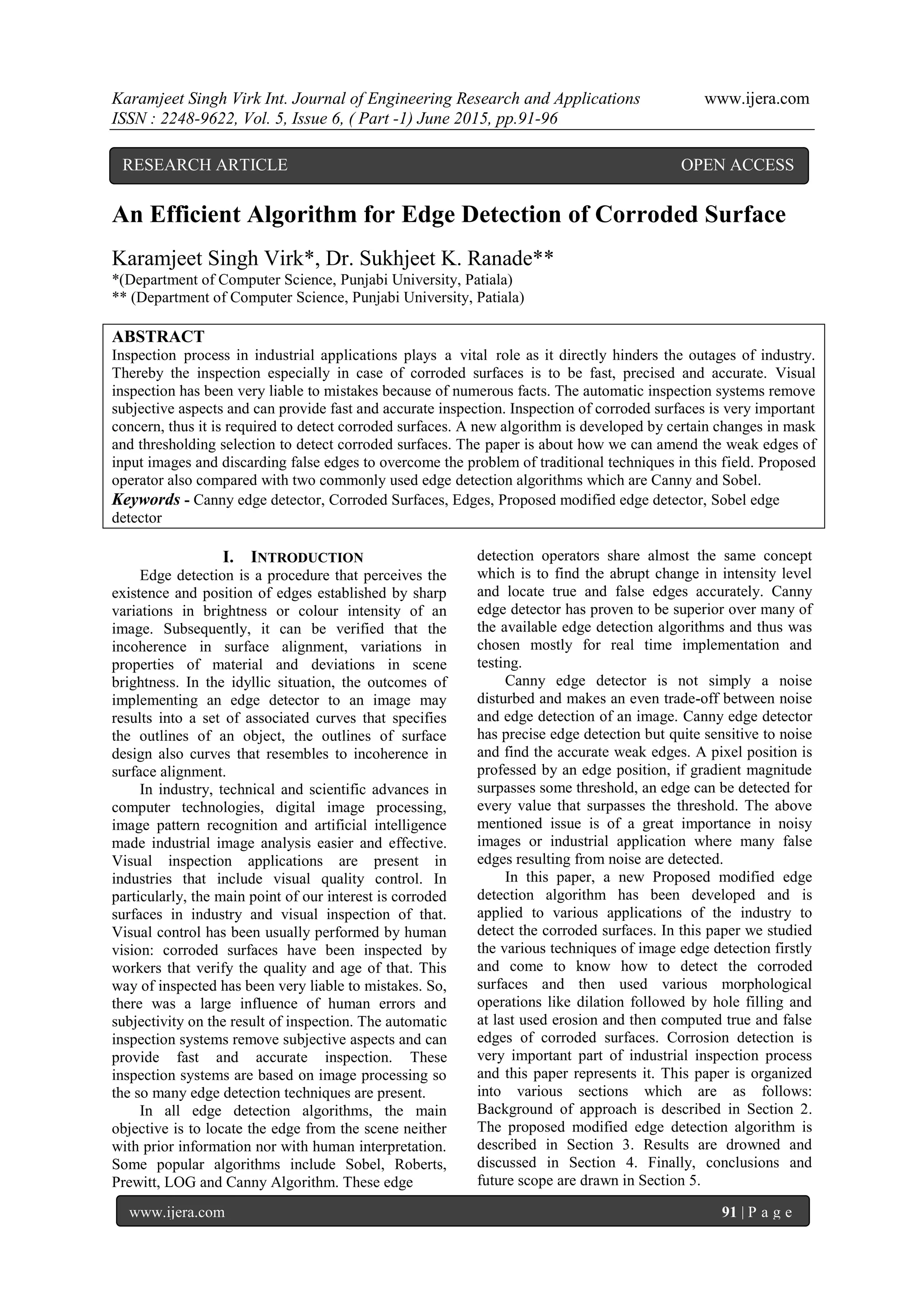
Karamjeet Singh Virk Int. Journal of Engineering Research and Applications www.ijera.com ISSN : 2248-9622, Vol. 5, Issue 6, ( Part -1) June 2015, pp.91-96 www.ijera.com 93 | P a g e operator; however, these are rotated diagonally over the axis to make the new mask. Similar to Canny filter and Sobel filter, the new masks generated also has zero value in central rows and columns of the mask. Now, the above kernels are used to generate the separate gradient components (Gx and Gy) in each orientation by applying the kernels to the image, which is as follows: Gx=(f(i,j-2)+f(i,j-1)+f(i,j))-(f(i-2,j-2)+f(i-2,j-1) +f(i-2,j)) (6) Gy=(f(i-2,j)+f(i-1,j)+f(i,j))-(f(i-2,j-2)+f(i-1,j-2)+ f(i,j-2)) (7) Now Gx and Gy are combined and gives the result of absolute magnitude of gradient at each point which is presented below in the form of equation: |G|= Gx2+Gy2 (8) Table 2. Masks used by the Proposed modified operator. -1 -2 -1 +1 0 -1 0 0 0 +2 0 -2 +1 +2 +1 +1 0 -1 Gx Gy Table 3. Selection of pixels by the Proposed modified operator. i-2,j i,j i-2,j i-1,j i,j i-2,j-1 i,j-1 i-2,j-2 i,j-2 i-2,j-2 i-1,j-2 i,j-2 Gx Gy Sobel and Canny edge detectors are used to apply on established industrial application. Whereas proposed modified algorithm is efficient to adapt itself according to the needs of the industrial applications. In this manner, an outcome of proposed modified algorithm seems to be more accurate and precised in case of industrial requirements when compared with Sobel and Canny algorithms. IV. RESULTS AND DISCUSSION This section presents the results of the Proposed modified filter in comparison to the Sobel and Canny edge detection methods. These edge detection techniques were implemented using Matlab 2012, and tested for many practical images. 4.1 Original Image 1 (a) Original image 1 (b) Sobel Operator (c) Canny operator (d) Proposed modified operator figure 1. (a) original image 1, (b) sobel operator, (c) canny operator and (d) proposed modified operator
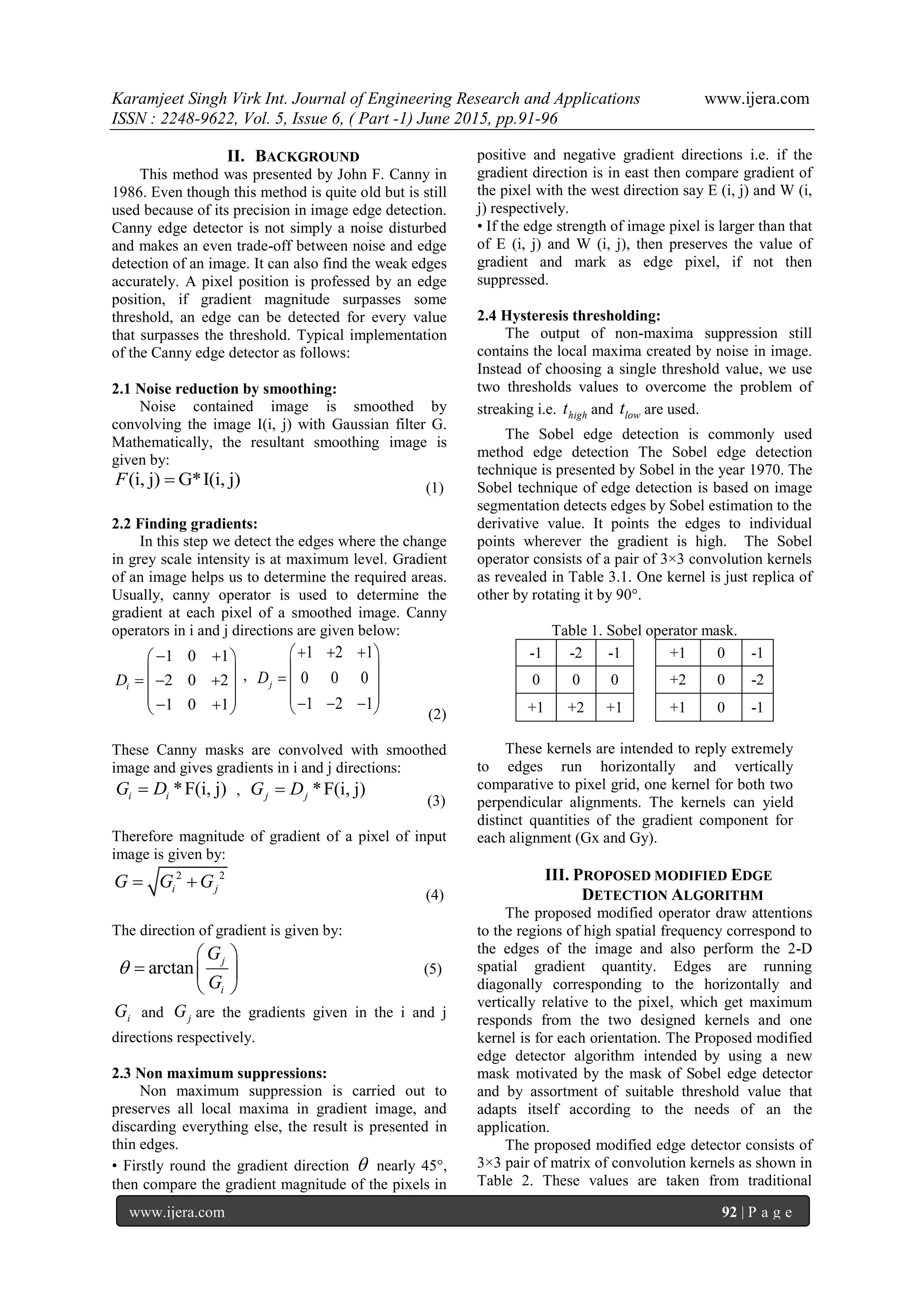
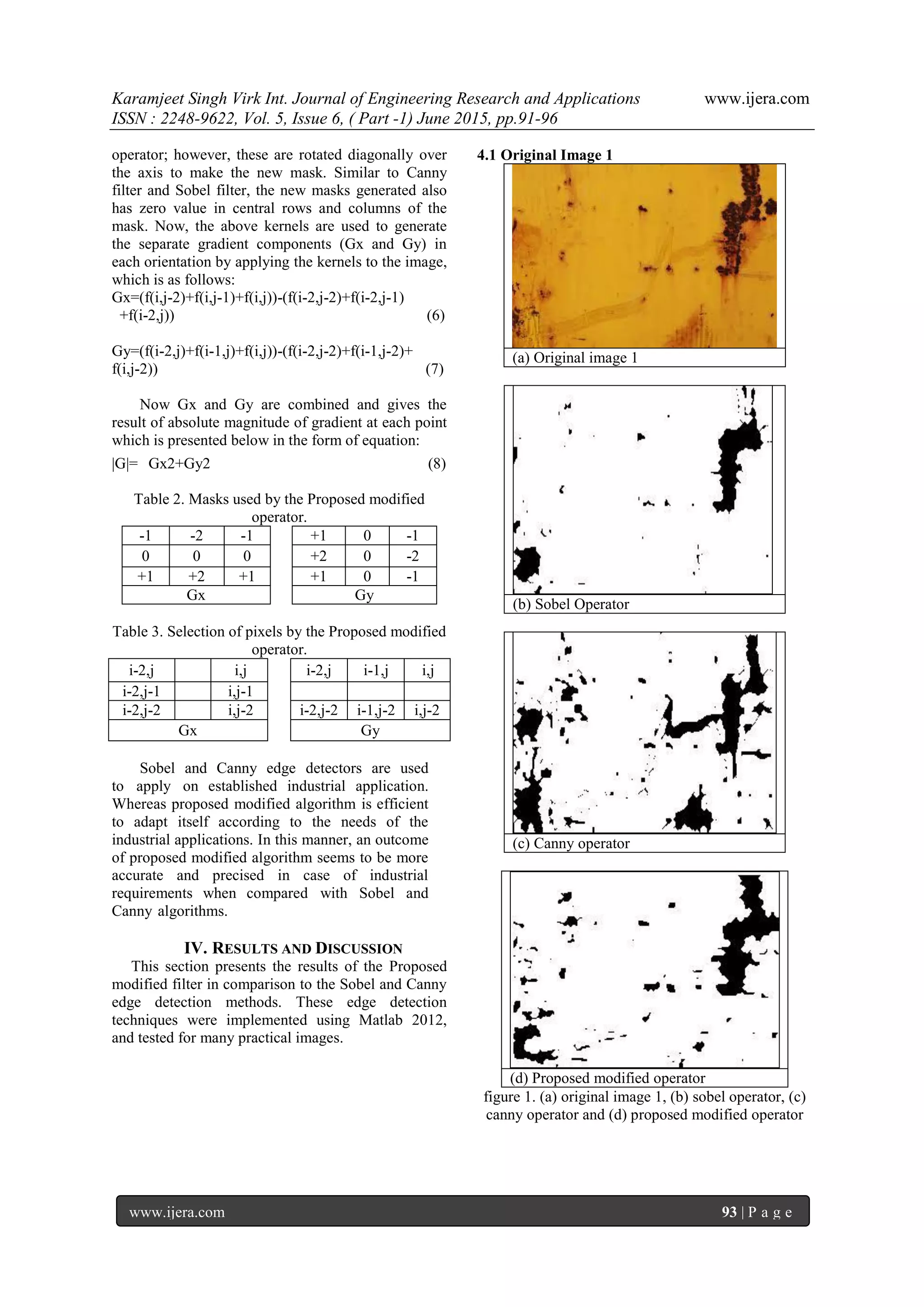
Karamjeet Singh Virk Int. Journal of Engineering Research and Applications www.ijera.com ISSN : 2248-9622, Vol. 5, Issue 6, ( Part -1) June 2015, pp.91-96 www.ijera.com 94 | P a g e 4.2 Original Image 2 (a) Original image 2 (b) Sobel operator (c) Canny operator (d) Proposed modified operator figure 2. (a) original image 2, (b) sobel operator, (c) canny operator and (d) proposed modified operator 4.3 Original Image 3 (a) Original image 3 (b) Sobel operator (c) Canny operator (d) Proposed modified operator figure 3. (a) original image 3, (b) sobel operator, (c) canny operator and (d) Proposed modified operator
Karamjeet Singh Virk Int. Journal of Engineering Research and Applications www.ijera.com ISSN : 2248-9622, Vol. 5, Issue 6, ( Part -1) June 2015, pp.91-96 www.ijera.com 95 | P a g e 4.4 Comparative study Table 4. Comparative study of Original Image 1 Image Total pixel (T) Accepte d pixel (A) Rejected pixel (R) Accurac y (%) Original image 1 (Grey) 50325 3662 46663 100 Sobel inverted segmented image 50325 2082 48243 56.8 Canny inverted segmented image 50325 4395 45930 80 Proposed inverted segmented image 51245 3343 47902 91.2 Table 5. Comparative study of Original Image 2 Image Total pixel (T) Accepted pixel (A) Rejecte d pixel (R) Accur acy (%) Original image 2 (Grey) 220675 35337 185338 100 Sobel inverted segmented image 220675 8996 211679 25.4 Canny inverted segmented image 220675 60092 160583 30 Proposed inverted segmented image 222559 37505 185054 93.9 Table 6. Comparative study of Original image 3 Image Total pixel (T) Accepted pixel (A) Rejected pixel (R) Accuracy (%) Original image 3 (Grey) 140125 25864 114261 100 Sobel inverted segmente d image 140125 4978 135147 19.2 Canny inverted segmente d image 140125 37815 102310 53.8 Proposed inverted segmente d image 141669 27008 114661 95.6 V. CONCLUSION AND FUTURE SCOPE From the above study, we concluded the proposed modified edge detector is very effective for edge detection purposes. It is observed that for the four images used, there are less false edges in the proposed modified edge detector. From the results, it is concluded that results obtained from the modify detector shows that it detect less false edges and also improve intensity level of edges as compared to Sobel and Canny edge detector. Edge detection is the foremost field of inspection in modern industry in now a day. Canny detector is universally accepted technique but it is not suited all the way as it fails to give accurate performance in certain areas. It detects large number of weak edges also. Application of the corroded surfaces detection is one in which canny and sobel detector are not ideally performed. Thus, to overcome such type of problems a new edge detector is developed and outcome of this detector reflects its performance. The work can be improved in the future by using the same mask with image sharpening filters. For example, we can use median filtering to improve the method. Noisy contents are removed from the image by using the above filter. In some cases the noisy contents are taken as false edges. So the median filter can be used as a preprocessing step prior to image sharpening and can help to take out unwanted components present within an image. The improved filter can also further implemented on different type of applications. In the case of critical and complex application, evolutionary algorithms may evolve with this design. This can further improve the filter in the terms of performance. REFERENCES [1] Wang B. and Fan S. (2009) “An improved CANNY edge detection algorithm”, 2009 Second International Workshop on Computer Science and Engineering. [2] Zhao H., Qin G. and Wang X. (2010), “Improvement of Canny Algorithm Based on Pavement Edge Detection”, 2010 3rd International Congress on Image and Signal Processing (CISP2010). [3] Gao W. and Yang L. (2010), “An Improved Sobel Edge Detection”, 978-1-4244-5540- 9/10/$26.00 ©2010 IEEE. [4] Hocenski Z. (2006), “Improved Canny Edge Detector in Ceramic Tiles Defect Detection”, 1-4244-0136-4/06/2006 IEEE. [5] Pithadiya K.J. (2011), “Selecting the Most Favourable Edge Detection Technique for Liquid Level Inspection in Bottles”, International Journal of Computer Information Systems and Industrial Management Applications (IJCISIM) ISSN: 2150-7988 Vol.3 (2011), pp.034-044
Karamjeet Singh Virk Int. Journal of Engineering Research and Applications www.ijera.com ISSN : 2248-9622, Vol. 5, Issue 6, ( Part -1) June 2015, pp.91-96 www.ijera.com 96 | P a g e [6] Rui W. (2007, “Edge Enchancement and filtering of Medical Ultrasonic Images using a Hybrid Method”, 1-4244-1120- 3/07/$25.00 ©2007 IEEE. [7] Ma M., Liang J., Guo M., Fan Y. and Yin Y., "SAR image segmentation based on Artificial Bee Colony algorithm," Applied Soft Computing, vol. 11, no. 8, pp. 5205- 5214, 2011. [8] Marr D. and Hildreth E. (1980), “Theory of edge detection”, Proceedings of the Royal Society of London, Vol. 207, pp. 187-217. [9] Canny J. (1983), “Finding Edges and Lines”, MIT Technical Report No. 720, 1983.

An Efficient Algorithm for Edge Detection of Corroded Surface

  • 1.
    Karamjeet Singh VirkInt. Journal of Engineering Research and Applications www.ijera.com ISSN : 2248-9622, Vol. 5, Issue 6, ( Part -1) June 2015, pp.91-96 www.ijera.com 91 | P a g e An Efficient Algorithm for Edge Detection of Corroded Surface Karamjeet Singh Virk*, Dr. Sukhjeet K. Ranade** *(Department of Computer Science, Punjabi University, Patiala) ** (Department of Computer Science, Punjabi University, Patiala) ABSTRACT Inspection process in industrial applications plays a vital role as it directly hinders the outages of industry. Thereby the inspection especially in case of corroded surfaces is to be fast, precised and accurate. Visual inspection has been very liable to mistakes because of numerous facts. The automatic inspection systems remove subjective aspects and can provide fast and accurate inspection. Inspection of corroded surfaces is very important concern, thus it is required to detect corroded surfaces. A new algorithm is developed by certain changes in mask and thresholding selection to detect corroded surfaces. The paper is about how we can amend the weak edges of input images and discarding false edges to overcome the problem of traditional techniques in this field. Proposed operator also compared with two commonly used edge detection algorithms which are Canny and Sobel. Keywords - Canny edge detector, Corroded Surfaces, Edges, Proposed modified edge detector, Sobel edge detector I. INTRODUCTION Edge detection is a procedure that perceives the existence and position of edges established by sharp variations in brightness or colour intensity of an image. Subsequently, it can be verified that the incoherence in surface alignment, variations in properties of material and deviations in scene brightness. In the idyllic situation, the outcomes of implementing an edge detector to an image may results into a set of associated curves that specifies the outlines of an object, the outlines of surface design also curves that resembles to incoherence in surface alignment. In industry, technical and scientific advances in computer technologies, digital image processing, image pattern recognition and artificial intelligence made industrial image analysis easier and effective. Visual inspection applications are present in industries that include visual quality control. In particularly, the main point of our interest is corroded surfaces in industry and visual inspection of that. Visual control has been usually performed by human vision: corroded surfaces have been inspected by workers that verify the quality and age of that. This way of inspected has been very liable to mistakes. So, there was a large influence of human errors and subjectivity on the result of inspection. The automatic inspection systems remove subjective aspects and can provide fast and accurate inspection. These inspection systems are based on image processing so the so many edge detection techniques are present. In all edge detection algorithms, the main objective is to locate the edge from the scene neither with prior information nor with human interpretation. Some popular algorithms include Sobel, Roberts, Prewitt, LOG and Canny Algorithm. These edge detection operators share almost the same concept which is to find the abrupt change in intensity level and locate true and false edges accurately. Canny edge detector has proven to be superior over many of the available edge detection algorithms and thus was chosen mostly for real time implementation and testing. Canny edge detector is not simply a noise disturbed and makes an even trade-off between noise and edge detection of an image. Canny edge detector has precise edge detection but quite sensitive to noise and find the accurate weak edges. A pixel position is professed by an edge position, if gradient magnitude surpasses some threshold, an edge can be detected for every value that surpasses the threshold. The above mentioned issue is of a great importance in noisy images or industrial application where many false edges resulting from noise are detected. In this paper, a new Proposed modified edge detection algorithm has been developed and is applied to various applications of the industry to detect the corroded surfaces. In this paper we studied the various techniques of image edge detection firstly and come to know how to detect the corroded surfaces and then used various morphological operations like dilation followed by hole filling and at last used erosion and then computed true and false edges of corroded surfaces. Corrosion detection is very important part of industrial inspection process and this paper represents it. This paper is organized into various sections which are as follows: Background of approach is described in Section 2. The proposed modified edge detection algorithm is described in Section 3. Results are drowned and discussed in Section 4. Finally, conclusions and future scope are drawn in Section 5. RESEARCH ARTICLE OPEN ACCESS
  • 2.
    Karamjeet Singh VirkInt. Journal of Engineering Research and Applications www.ijera.com ISSN : 2248-9622, Vol. 5, Issue 6, ( Part -1) June 2015, pp.91-96 www.ijera.com 92 | P a g e II. BACKGROUND This method was presented by John F. Canny in 1986. Even though this method is quite old but is still used because of its precision in image edge detection. Canny edge detector is not simply a noise disturbed and makes an even trade-off between noise and edge detection of an image. It can also find the weak edges accurately. A pixel position is professed by an edge position, if gradient magnitude surpasses some threshold, an edge can be detected for every value that surpasses the threshold. Typical implementation of the Canny edge detector as follows: 2.1 Noise reduction by smoothing: Noise contained image is smoothed by convolving the image I(i, j) with Gaussian filter G. Mathematically, the resultant smoothing image is given by: (i, j) G*I(i, j)F  (1) 2.2 Finding gradients: In this step we detect the edges where the change in grey scale intensity is at maximum level. Gradient of an image helps us to determine the required areas. Usually, canny operator is used to determine the gradient at each pixel of a smoothed image. Canny operators in i and j directions are given below: 1 0 1 2 0 2 1 0 1 iD              , 1 2 1 0 0 0 1 2 1 jD               (2) These Canny masks are convolved with smoothed image and gives gradients in i and j directions: *F(i, j)i iG D , *F(i, j)j jG D (3) Therefore magnitude of gradient of a pixel of input image is given by: 2 2 i jG G G  (4) The direction of gradient is given by: arctan j i G G         (5) iG and jG are the gradients given in the i and j directions respectively. 2.3 Non maximum suppressions: Non maximum suppression is carried out to preserves all local maxima in gradient image, and discarding everything else, the result is presented in thin edges. • Firstly round the gradient direction  nearly 45°, then compare the gradient magnitude of the pixels in positive and negative gradient directions i.e. if the gradient direction is in east then compare gradient of the pixel with the west direction say E (i, j) and W (i, j) respectively. • If the edge strength of image pixel is larger than that of E (i, j) and W (i, j), then preserves the value of gradient and mark as edge pixel, if not then suppressed. 2.4 Hysteresis thresholding: The output of non-maxima suppression still contains the local maxima created by noise in image. Instead of choosing a single threshold value, we use two thresholds values to overcome the problem of streaking i.e. hight and lowt are used. The Sobel edge detection is commonly used method edge detection The Sobel edge detection technique is presented by Sobel in the year 1970. The Sobel technique of edge detection is based on image segmentation detects edges by Sobel estimation to the derivative value. It points the edges to individual points wherever the gradient is high. The Sobel operator consists of a pair of 3×3 convolution kernels as revealed in Table 3.1. One kernel is just replica of other by rotating it by 90°. Table 1. Sobel operator mask. -1 -2 -1 +1 0 -1 0 0 0 +2 0 -2 +1 +2 +1 +1 0 -1 These kernels are intended to reply extremely to edges run horizontally and vertically comparative to pixel grid, one kernel for both two perpendicular alignments. The kernels can yield distinct quantities of the gradient component for each alignment (Gx and Gy). III. PROPOSED MODIFIED EDGE DETECTION ALGORITHM The proposed modified operator draw attentions to the regions of high spatial frequency correspond to the edges of the image and also perform the 2-D spatial gradient quantity. Edges are running diagonally corresponding to the horizontally and vertically relative to the pixel, which get maximum responds from the two designed kernels and one kernel is for each orientation. The Proposed modified edge detector algorithm intended by using a new mask motivated by the mask of Sobel edge detector and by assortment of suitable threshold value that adapts itself according to the needs of an the application. The proposed modified edge detector consists of 3×3 pair of matrix of convolution kernels as shown in Table 2. These values are taken from traditional
  • 3.
    Karamjeet Singh VirkInt. Journal of Engineering Research and Applications www.ijera.com ISSN : 2248-9622, Vol. 5, Issue 6, ( Part -1) June 2015, pp.91-96 www.ijera.com 93 | P a g e operator; however, these are rotated diagonally over the axis to make the new mask. Similar to Canny filter and Sobel filter, the new masks generated also has zero value in central rows and columns of the mask. Now, the above kernels are used to generate the separate gradient components (Gx and Gy) in each orientation by applying the kernels to the image, which is as follows: Gx=(f(i,j-2)+f(i,j-1)+f(i,j))-(f(i-2,j-2)+f(i-2,j-1) +f(i-2,j)) (6) Gy=(f(i-2,j)+f(i-1,j)+f(i,j))-(f(i-2,j-2)+f(i-1,j-2)+ f(i,j-2)) (7) Now Gx and Gy are combined and gives the result of absolute magnitude of gradient at each point which is presented below in the form of equation: |G|= Gx2+Gy2 (8) Table 2. Masks used by the Proposed modified operator. -1 -2 -1 +1 0 -1 0 0 0 +2 0 -2 +1 +2 +1 +1 0 -1 Gx Gy Table 3. Selection of pixels by the Proposed modified operator. i-2,j i,j i-2,j i-1,j i,j i-2,j-1 i,j-1 i-2,j-2 i,j-2 i-2,j-2 i-1,j-2 i,j-2 Gx Gy Sobel and Canny edge detectors are used to apply on established industrial application. Whereas proposed modified algorithm is efficient to adapt itself according to the needs of the industrial applications. In this manner, an outcome of proposed modified algorithm seems to be more accurate and precised in case of industrial requirements when compared with Sobel and Canny algorithms. IV. RESULTS AND DISCUSSION This section presents the results of the Proposed modified filter in comparison to the Sobel and Canny edge detection methods. These edge detection techniques were implemented using Matlab 2012, and tested for many practical images. 4.1 Original Image 1 (a) Original image 1 (b) Sobel Operator (c) Canny operator (d) Proposed modified operator figure 1. (a) original image 1, (b) sobel operator, (c) canny operator and (d) proposed modified operator
  • 4.
    Karamjeet Singh VirkInt. Journal of Engineering Research and Applications www.ijera.com ISSN : 2248-9622, Vol. 5, Issue 6, ( Part -1) June 2015, pp.91-96 www.ijera.com 94 | P a g e 4.2 Original Image 2 (a) Original image 2 (b) Sobel operator (c) Canny operator (d) Proposed modified operator figure 2. (a) original image 2, (b) sobel operator, (c) canny operator and (d) proposed modified operator 4.3 Original Image 3 (a) Original image 3 (b) Sobel operator (c) Canny operator (d) Proposed modified operator figure 3. (a) original image 3, (b) sobel operator, (c) canny operator and (d) Proposed modified operator
  • 5.
    Karamjeet Singh VirkInt. Journal of Engineering Research and Applications www.ijera.com ISSN : 2248-9622, Vol. 5, Issue 6, ( Part -1) June 2015, pp.91-96 www.ijera.com 95 | P a g e 4.4 Comparative study Table 4. Comparative study of Original Image 1 Image Total pixel (T) Accepte d pixel (A) Rejected pixel (R) Accurac y (%) Original image 1 (Grey) 50325 3662 46663 100 Sobel inverted segmented image 50325 2082 48243 56.8 Canny inverted segmented image 50325 4395 45930 80 Proposed inverted segmented image 51245 3343 47902 91.2 Table 5. Comparative study of Original Image 2 Image Total pixel (T) Accepted pixel (A) Rejecte d pixel (R) Accur acy (%) Original image 2 (Grey) 220675 35337 185338 100 Sobel inverted segmented image 220675 8996 211679 25.4 Canny inverted segmented image 220675 60092 160583 30 Proposed inverted segmented image 222559 37505 185054 93.9 Table 6. Comparative study of Original image 3 Image Total pixel (T) Accepted pixel (A) Rejected pixel (R) Accuracy (%) Original image 3 (Grey) 140125 25864 114261 100 Sobel inverted segmente d image 140125 4978 135147 19.2 Canny inverted segmente d image 140125 37815 102310 53.8 Proposed inverted segmente d image 141669 27008 114661 95.6 V. CONCLUSION AND FUTURE SCOPE From the above study, we concluded the proposed modified edge detector is very effective for edge detection purposes. It is observed that for the four images used, there are less false edges in the proposed modified edge detector. From the results, it is concluded that results obtained from the modify detector shows that it detect less false edges and also improve intensity level of edges as compared to Sobel and Canny edge detector. Edge detection is the foremost field of inspection in modern industry in now a day. Canny detector is universally accepted technique but it is not suited all the way as it fails to give accurate performance in certain areas. It detects large number of weak edges also. Application of the corroded surfaces detection is one in which canny and sobel detector are not ideally performed. Thus, to overcome such type of problems a new edge detector is developed and outcome of this detector reflects its performance. The work can be improved in the future by using the same mask with image sharpening filters. For example, we can use median filtering to improve the method. Noisy contents are removed from the image by using the above filter. In some cases the noisy contents are taken as false edges. So the median filter can be used as a preprocessing step prior to image sharpening and can help to take out unwanted components present within an image. The improved filter can also further implemented on different type of applications. In the case of critical and complex application, evolutionary algorithms may evolve with this design. This can further improve the filter in the terms of performance. REFERENCES [1] Wang B. and Fan S. (2009) “An improved CANNY edge detection algorithm”, 2009 Second International Workshop on Computer Science and Engineering. [2] Zhao H., Qin G. and Wang X. (2010), “Improvement of Canny Algorithm Based on Pavement Edge Detection”, 2010 3rd International Congress on Image and Signal Processing (CISP2010). [3] Gao W. and Yang L. (2010), “An Improved Sobel Edge Detection”, 978-1-4244-5540- 9/10/$26.00 ©2010 IEEE. [4] Hocenski Z. (2006), “Improved Canny Edge Detector in Ceramic Tiles Defect Detection”, 1-4244-0136-4/06/2006 IEEE. [5] Pithadiya K.J. (2011), “Selecting the Most Favourable Edge Detection Technique for Liquid Level Inspection in Bottles”, International Journal of Computer Information Systems and Industrial Management Applications (IJCISIM) ISSN: 2150-7988 Vol.3 (2011), pp.034-044
  • 6.
    Karamjeet Singh VirkInt. Journal of Engineering Research and Applications www.ijera.com ISSN : 2248-9622, Vol. 5, Issue 6, ( Part -1) June 2015, pp.91-96 www.ijera.com 96 | P a g e [6] Rui W. (2007, “Edge Enchancement and filtering of Medical Ultrasonic Images using a Hybrid Method”, 1-4244-1120- 3/07/$25.00 ©2007 IEEE. [7] Ma M., Liang J., Guo M., Fan Y. and Yin Y., "SAR image segmentation based on Artificial Bee Colony algorithm," Applied Soft Computing, vol. 11, no. 8, pp. 5205- 5214, 2011. [8] Marr D. and Hildreth E. (1980), “Theory of edge detection”, Proceedings of the Royal Society of London, Vol. 207, pp. 187-217. [9] Canny J. (1983), “Finding Edges and Lines”, MIT Technical Report No. 720, 1983.