International Journal of Computer Applications Technology and Research Volume 4– Issue 8, 604 - 607, 2015, ISSN: 2319–8656 www.ijcat.com 604 An Improved Energy Efficient Wireless Sensor Networks Through Clustering In Cross Layer Network Operations Neethu Krishna Department of CSE Mangalam College of Engineering Kottayam, Kerala, India-686631 Vinodh P Vijayan Department of CSE Mangalam College of Engineering Kottayam, Kerala, India-686631 Abstract: One of the major reason for performance degradation in Wireless sensor network is the overhead due to control packet and packet delivery degradation. Clustering in cross layer network operation is an efficient way manage control packet overhead and which ultimately improve the lifetime of a network. All these overheads are crucial in a scalable networks. But the clustering always suffer from the cluster head failure which need to be solved effectively in a large network. As the focus is to improve the average lifetime of sensor network the cluster head is selected based on the battery life of nodes. The cross-layer operation model optimize the overheads in multiple layer and ultimately the use of clustering will reduce the major overheads identified and their by the energy consumption and throughput of wireless sensor network is improved. The proposed model operates on two layers of network ie., Network Layer and Transport Layer and Clustering is applied in the network layer . The simulation result shows that the integration of two layers reduces the energy consumption and increases the throughput of the wireless sensor networks. Keywords: Cross layer design, energy efficiency, wireless sensor networks, clustering 1. INTRODUCTION Wireless sensor network consists of spatially distributed autonomous sensors to monitor environmental conditions such as sound, temperature, pressure etc. Sensor nodes can sense and detect events in the region and communicate data back to the Base Station (BS). Wireless Sensor Network have become most interesting area of research. Sensor nodes are equipped with small batteries that can store at most I J. Limiting the transmission range and power consumption are the important constraints offered for communication, and hence it is advantageous to put in order the sensors into clusters. Clustering in cross layer networks is one of the important mechanism to improve the energy consumption of sensor network and thereby increase the network lifetime. In clustering, whole sensor network is divided into group of clusters. Cluster head is selected based on the battery life of a node. Cluster head gather and aggregate the data and send it back to the BS. Figure 1. Clusters with single cluster head Some of the clustering goals in wireless sensor networks are as follows;  Data aggregation and limits data transmission  Facilitating the reusability of the resources  CHs and gateway nodes can form a virtual backbone for inter-cluster communications  Cluster structure gives the impression of a smaller and more stable network  Improve network lifetime: reducing network traffic and the contention for the channel  Grouping of similar objects or sensors  Topology control by load balancing and network scalability The advantage of cluster is to collect data from neighboring node is operationally more convenient then observing units spread over a region. Clustering technique is done in the network layer. In transport layer, nodes are scheduled on the basis of how much time they are active. The remainder of this paper is organized as follows. Section 2 describes related work on cross layer network operations. Section 3 describes about proposed work and implementation. Section 4 describes experimental evaluation. Section 5 concludes this paper with a discussion of future approach. 2. RELATED WORK Lifetime extension of wireless sensor network [2] uses two cluster heads and hierarchical routing. In this paper an algorithm Two Cluster Head Energy efficient Wireless Sensor Network (TCHE-WSN) is proposed to improve the lifetime. The use of two cluster heads analogy reduces the overhead of single cluster head, avoids packet collision and improves reliable data transmission.
International Journal of Computer Applications Technology and Research Volume 4– Issue 8, 604 - 607, 2015, ISSN: 2319–8656 www.ijcat.com 605 A clustering based routing protocol called base station controlled dynamic clustering protocol, utilizes a high energy base station o setup cluster heads and perform other energy efficient tasks and thereby increasing the lifetime of a network. A cross layer network operation mechanism [5] which considers the physical and MAC layers to maximize the lifetime of a network. The model assumes that the problem of network is convex where G (P, h(ni )) is the network graph , P is the set of nodes deployed and h(ni ) is the amount of data needed from node i to indicate the sensed event in the deployment area. The deployed nodes are static and this model has not been tested for wireless sensor networks with mobility characteristics. Load balancing and clustering in Hybrid Sensor network with mobile Cluster Nodes [8] proposed an algorithm which works on the position of mobile cluster heads balancing of traffic load in sensor network that consist of mobile and static nodes. Low-energy adaptive clustering hierarchy (LEACH) [9] is a clustering-based protocol which utilizes randomized rotation of local CHs to evenly distribute the energy load across the network. Compared with other ordinary routing protocols like DD, it can prolong the network lifetime up to 8 times. However, the 5% of CHs are randomly selected and CHs transmit data directly to SN. Reference [3] proposed an Energy Efficient and QoS aware multipath routing protocol (EQSR) has been proposed for WSNs. This protocol is mainly used to find out the best path from the multiple path from source to destination. This protocol chooses its routing path based on the physical layer elements of the next hop. Those elements are the nodes residual energy interface buffer availability and the connection signal-to-noise ratio between two neighbour nodes. This protocol is an example of the tight cross layer of information between the physical layer and the network layer. In Energy Efficient Hierarchical Clustering Algorithm [7] a distributed, randomized clustering algorithm is proposed. The algorithm generates hierarchy of cluster heads. It has been observed that the energy savings increases with the number of levels in the hierarchy and thereby increases the lifetime of a network. SPEED [11] is another QoS based routing protocol that provides soft real-time end-to-end guarantees. Each sensor node maintains information about its neighbors and exploits geographic forwarding to find the paths. To ensure packet delivery within the required time limits, SPEED enables the application to compute the end-to-end delay by dividing the distance to the sink by the speed of packet delivery before making any admission decision. In addition to that, SPEED can provide congestion avoidance when the network is congested. In order to suit the periodical data gathering applications an Energy Efficient Clustering scheme [4] a novel scheme (EECS) for single-hop wireless sensor networks. This paper dealt with an approach to elect cluster heads with more residual energy in an autonomous manner using local radio communication. It produce good cluster head distribution and balances the load among cluster heads using this novel scheme. 3. PROPOSED APPROACH In this paper, Cross layer network operation is done in two layers which are Network Layer and Transport Layer .In Network Layer clustering technique(LEACH) is used and in the Transport layer energy can be improved by sensing the distance of nodes in which how long they are far from the antenna. We can analyze the performance by adjusting the antenna range. One of the important factors to improve lifetime of wireless sensor network is the design of network. LEACH(Low-Energy Adaptive Clustering Hierarchy) protocol is used for clustering. 3.1 Set-up phase In LEACH, nodes take autonomous decisions to form clusters by using a distributed algorithm with out any centralized control. Here no long-distance communication with the base station is required and distributed cluster formation can be done without knowing the exact location of any of the nodes in the network. In addition, no global communication is needed to set up the clusters. The cluster formation algorithm should be designed such that nodes are cluster-heads approximately the same number of time, assuming all the nodes start with the same amount of energy. Finally, the cluster-head nodes should be spread throughout the network, as this will minimize the distance the non- cluster-head nodes need to send their data. A sensor node chooses a random number, r, between 0 and 1. Let a threshold value be T(n) T(n)= p/1-p ×( r mod p-1 ) If this random number is less than a threshold value, T(n), the node becomes a cluster-head for the current round. The threshold value is calculated based on the above given equation that incorporates the desired percentage to become a cluster-head, the current round, and the set of nodes that have not been selected as a cluster-head in the last (1/P) rounds, p is cluster head probability. After the nodes have elected themselves to be cluster-heads, it broadcasts an advertisement message (ADV). This message is a small message containing the node's ID and a header that distinguishes this message as an announcement message. Cluster head is selected based on the battery life. First sense the energy of whole network and then select each node’s sensing power and processing power in which node has high battery life, it would be the cluster head. the energy of node which has less than 5J it is disabled from the cluster.. The cluster-heads in LEACH act as local control centers to co-ordinate the data transmissions in their cluster [9]. The cluster-head node sets up a TDMA schedule and transmits this schedule to the nodes in the cluster. This ensures that there are no collisions among data messages and also allows the radio components of each non cluster-head node to be turned off at all times except during their transmit time, thus minimizing the energy dissipated by the individual. 3.2 Steady-State Phase The steady-state operation is broken into frames where nodes send their data to the cluster-head at most once per frame during their allocated transmission slot. The set-up phase does not guarantee that nodes are evenly distributed among the
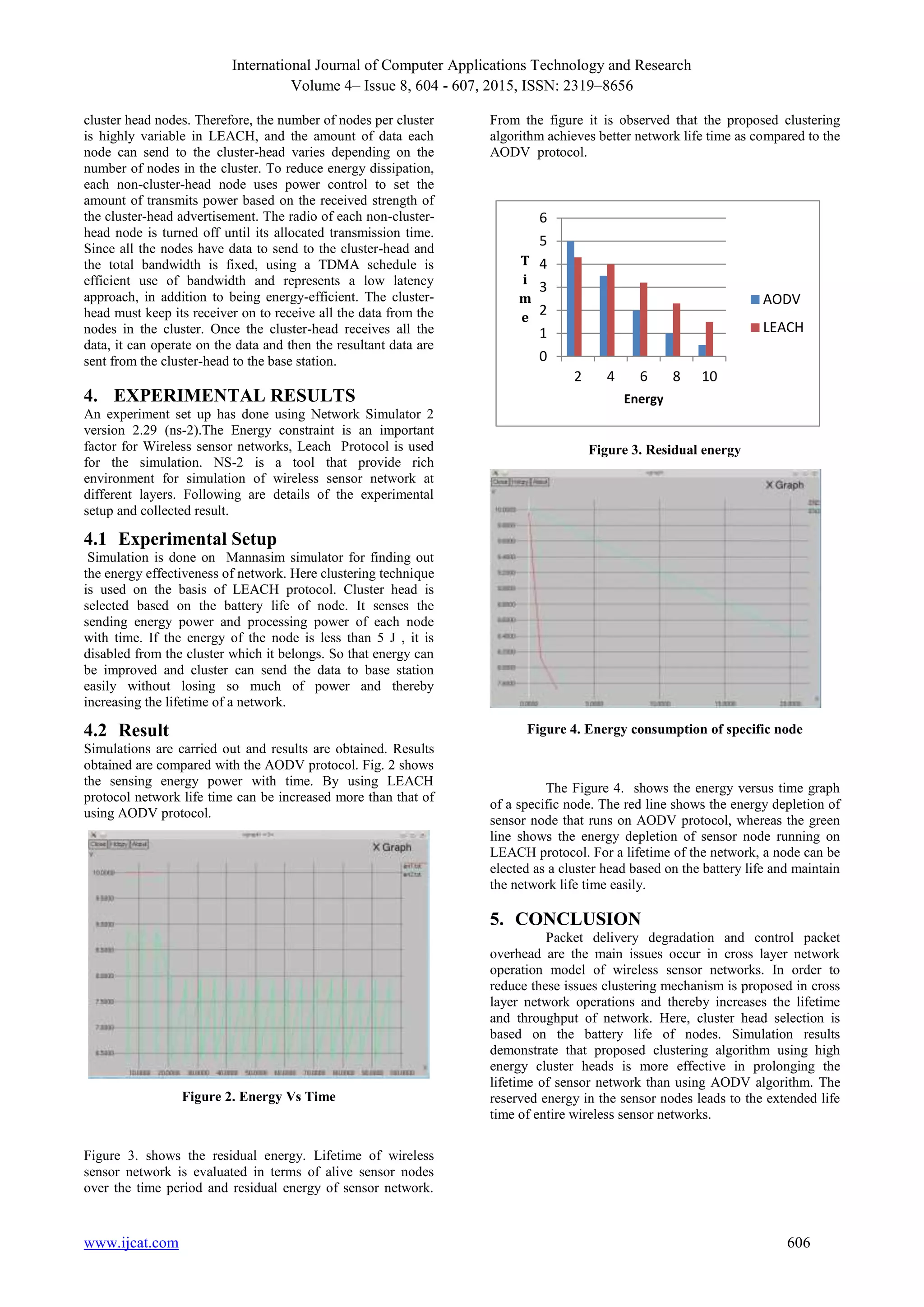
International Journal of Computer Applications Technology and Research Volume 4– Issue 8, 604 - 607, 2015, ISSN: 2319–8656 www.ijcat.com 606 cluster head nodes. Therefore, the number of nodes per cluster is highly variable in LEACH, and the amount of data each node can send to the cluster-head varies depending on the number of nodes in the cluster. To reduce energy dissipation, each non-cluster-head node uses power control to set the amount of transmits power based on the received strength of the cluster-head advertisement. The radio of each non-cluster- head node is turned off until its allocated transmission time. Since all the nodes have data to send to the cluster-head and the total bandwidth is fixed, using a TDMA schedule is efficient use of bandwidth and represents a low latency approach, in addition to being energy-efficient. The cluster- head must keep its receiver on to receive all the data from the nodes in the cluster. Once the cluster-head receives all the data, it can operate on the data and then the resultant data are sent from the cluster-head to the base station. 4. EXPERIMENTAL RESULTS An experiment set up has done using Network Simulator 2 version 2.29 (ns-2).The Energy constraint is an important factor for Wireless sensor networks, Leach Protocol is used for the simulation. NS-2 is a tool that provide rich environment for simulation of wireless sensor network at different layers. Following are details of the experimental setup and collected result. 4.1 Experimental Setup Simulation is done on Mannasim simulator for finding out the energy effectiveness of network. Here clustering technique is used on the basis of LEACH protocol. Cluster head is selected based on the battery life of node. It senses the sending energy power and processing power of each node with time. If the energy of the node is less than 5 J , it is disabled from the cluster which it belongs. So that energy can be improved and cluster can send the data to base station easily without losing so much of power and thereby increasing the lifetime of a network. 4.2 Result Simulations are carried out and results are obtained. Results obtained are compared with the AODV protocol. Fig. 2 shows the sensing energy power with time. By using LEACH protocol network life time can be increased more than that of using AODV protocol. Figure 2. Energy Vs Time Figure 3. shows the residual energy. Lifetime of wireless sensor network is evaluated in terms of alive sensor nodes over the time period and residual energy of sensor network. From the figure it is observed that the proposed clustering algorithm achieves better network life time as compared to the AODV protocol. 0 1 2 3 4 5 6 2 4 6 8 10 T i m e Energy AODV LEACH Figure 3. Residual energy Figure 4. Energy consumption of specific node The Figure 4. shows the energy versus time graph of a specific node. The red line shows the energy depletion of sensor node that runs on AODV protocol, whereas the green line shows the energy depletion of sensor node running on LEACH protocol. For a lifetime of the network, a node can be elected as a cluster head based on the battery life and maintain the network life time easily. 5. CONCLUSION Packet delivery degradation and control packet overhead are the main issues occur in cross layer network operation model of wireless sensor networks. In order to reduce these issues clustering mechanism is proposed in cross layer network operations and thereby increases the lifetime and throughput of network. Here, cluster head selection is based on the battery life of nodes. Simulation results demonstrate that proposed clustering algorithm using high energy cluster heads is more effective in prolonging the lifetime of sensor network than using AODV algorithm. The reserved energy in the sensor nodes leads to the extended life time of entire wireless sensor networks.
International Journal of Computer Applications Technology and Research Volume 4– Issue 8, 604 - 607, 2015, ISSN: 2319–8656 www.ijcat.com 607 6. FUTURE WORK In future, algorithm can enhanced to incorporate load balancing among the cluster heads based on the parameter like traffic. More energy preservation could be done by studying the placement of sensor nodes in network which opens us a scope for future research. 7. REFERENCES [1] Marwan -Jemeli, Fawnizu A. Hussin, Marwan Al- Jemeli, and Fawnizu A. Hussin,” An Energy Efficient Cross- Layer Network Operation Model for IEEE 802.15.4- Based Mobile Wireless Sensor Networks,” ,” IEEE SENSORS JOURNAL, VOL. 15, NO. 2, FEBRUARY 2015. [2] ] B. Meenakshi, P. Anandhakumar, “Lifetime extension of wireless sensor network by selecting two cluster heads and hierarchical routing”, IEEE International Conference on Advances in Computing, Communications and Informatics, 2012. [3] ] H.-W. Tseng, S.-C. Yang, P.-C. Yeh, and A.-C. Pang, “A cross-layer scheme for solving hidden device problem in IEEE 802.15.4 wireless sensor networks,” IEEE Sensors J., vol. 11, no. 2, pp. 493– 504, Feb. 2011. [4] Mao YE, Cengafa LI, Guihai Chen, Jie WU, “Energy Efficient Clustering Scheme in Wireless Sensor Networks”, IEEE International Conference on Performance, Computing and Communications, 2005. [5] S. He, J. Chen, D. K. Y. Yau, and Y. Sun, “Cross- layer optimization of correlated data gathering in wireless sensor networks,” in Proc. 7th Annu. IEEE Commun. Soc.Conf. Sensor Mesh Ad Hoc Commun. Network( SECON), Jun. 2010, pp. 1–9. [6] J. Ben-Othman and B. Yahya, “Energy efficient and QoS based routing protocol for wireless sensor networks,” J.Parallel Distrib. Comput.vol. 70, no. 8, pp. 849–857, Aug. 2010 [7] Seema Bandyopadhyay, Edward J. Coyle, “An Energy Efficient Hierarchical Clustering Algorithm for Wireless Sensor Networks”, Twenty-Second Annual Joint Conference of the IEEE Computer and Communications, 2003. [8] Gaurav Gupta, Mohamed Younis, “Performance Evaluation of Load- Balanced Clustering of Wireless Sensor Networks”, IEEE International Conference on Telecommunications, 2003. [9] J. Ben-Othman and B. Yahya, “Energy efficient and QoS based routing protocol for wireless sensor networks,” J. Parallel Distrib. Comput. vol. 70, no. 8, pp. 849–857, Aug. 2010.

An Improved Energy Efficient Wireless Sensor Networks Through Clustering In Cross Layer Network Operations

  • 1.
    International Journal ofComputer Applications Technology and Research Volume 4– Issue 8, 604 - 607, 2015, ISSN: 2319–8656 www.ijcat.com 604 An Improved Energy Efficient Wireless Sensor Networks Through Clustering In Cross Layer Network Operations Neethu Krishna Department of CSE Mangalam College of Engineering Kottayam, Kerala, India-686631 Vinodh P Vijayan Department of CSE Mangalam College of Engineering Kottayam, Kerala, India-686631 Abstract: One of the major reason for performance degradation in Wireless sensor network is the overhead due to control packet and packet delivery degradation. Clustering in cross layer network operation is an efficient way manage control packet overhead and which ultimately improve the lifetime of a network. All these overheads are crucial in a scalable networks. But the clustering always suffer from the cluster head failure which need to be solved effectively in a large network. As the focus is to improve the average lifetime of sensor network the cluster head is selected based on the battery life of nodes. The cross-layer operation model optimize the overheads in multiple layer and ultimately the use of clustering will reduce the major overheads identified and their by the energy consumption and throughput of wireless sensor network is improved. The proposed model operates on two layers of network ie., Network Layer and Transport Layer and Clustering is applied in the network layer . The simulation result shows that the integration of two layers reduces the energy consumption and increases the throughput of the wireless sensor networks. Keywords: Cross layer design, energy efficiency, wireless sensor networks, clustering 1. INTRODUCTION Wireless sensor network consists of spatially distributed autonomous sensors to monitor environmental conditions such as sound, temperature, pressure etc. Sensor nodes can sense and detect events in the region and communicate data back to the Base Station (BS). Wireless Sensor Network have become most interesting area of research. Sensor nodes are equipped with small batteries that can store at most I J. Limiting the transmission range and power consumption are the important constraints offered for communication, and hence it is advantageous to put in order the sensors into clusters. Clustering in cross layer networks is one of the important mechanism to improve the energy consumption of sensor network and thereby increase the network lifetime. In clustering, whole sensor network is divided into group of clusters. Cluster head is selected based on the battery life of a node. Cluster head gather and aggregate the data and send it back to the BS. Figure 1. Clusters with single cluster head Some of the clustering goals in wireless sensor networks are as follows;  Data aggregation and limits data transmission  Facilitating the reusability of the resources  CHs and gateway nodes can form a virtual backbone for inter-cluster communications  Cluster structure gives the impression of a smaller and more stable network  Improve network lifetime: reducing network traffic and the contention for the channel  Grouping of similar objects or sensors  Topology control by load balancing and network scalability The advantage of cluster is to collect data from neighboring node is operationally more convenient then observing units spread over a region. Clustering technique is done in the network layer. In transport layer, nodes are scheduled on the basis of how much time they are active. The remainder of this paper is organized as follows. Section 2 describes related work on cross layer network operations. Section 3 describes about proposed work and implementation. Section 4 describes experimental evaluation. Section 5 concludes this paper with a discussion of future approach. 2. RELATED WORK Lifetime extension of wireless sensor network [2] uses two cluster heads and hierarchical routing. In this paper an algorithm Two Cluster Head Energy efficient Wireless Sensor Network (TCHE-WSN) is proposed to improve the lifetime. The use of two cluster heads analogy reduces the overhead of single cluster head, avoids packet collision and improves reliable data transmission.
  • 2.
    International Journal ofComputer Applications Technology and Research Volume 4– Issue 8, 604 - 607, 2015, ISSN: 2319–8656 www.ijcat.com 605 A clustering based routing protocol called base station controlled dynamic clustering protocol, utilizes a high energy base station o setup cluster heads and perform other energy efficient tasks and thereby increasing the lifetime of a network. A cross layer network operation mechanism [5] which considers the physical and MAC layers to maximize the lifetime of a network. The model assumes that the problem of network is convex where G (P, h(ni )) is the network graph , P is the set of nodes deployed and h(ni ) is the amount of data needed from node i to indicate the sensed event in the deployment area. The deployed nodes are static and this model has not been tested for wireless sensor networks with mobility characteristics. Load balancing and clustering in Hybrid Sensor network with mobile Cluster Nodes [8] proposed an algorithm which works on the position of mobile cluster heads balancing of traffic load in sensor network that consist of mobile and static nodes. Low-energy adaptive clustering hierarchy (LEACH) [9] is a clustering-based protocol which utilizes randomized rotation of local CHs to evenly distribute the energy load across the network. Compared with other ordinary routing protocols like DD, it can prolong the network lifetime up to 8 times. However, the 5% of CHs are randomly selected and CHs transmit data directly to SN. Reference [3] proposed an Energy Efficient and QoS aware multipath routing protocol (EQSR) has been proposed for WSNs. This protocol is mainly used to find out the best path from the multiple path from source to destination. This protocol chooses its routing path based on the physical layer elements of the next hop. Those elements are the nodes residual energy interface buffer availability and the connection signal-to-noise ratio between two neighbour nodes. This protocol is an example of the tight cross layer of information between the physical layer and the network layer. In Energy Efficient Hierarchical Clustering Algorithm [7] a distributed, randomized clustering algorithm is proposed. The algorithm generates hierarchy of cluster heads. It has been observed that the energy savings increases with the number of levels in the hierarchy and thereby increases the lifetime of a network. SPEED [11] is another QoS based routing protocol that provides soft real-time end-to-end guarantees. Each sensor node maintains information about its neighbors and exploits geographic forwarding to find the paths. To ensure packet delivery within the required time limits, SPEED enables the application to compute the end-to-end delay by dividing the distance to the sink by the speed of packet delivery before making any admission decision. In addition to that, SPEED can provide congestion avoidance when the network is congested. In order to suit the periodical data gathering applications an Energy Efficient Clustering scheme [4] a novel scheme (EECS) for single-hop wireless sensor networks. This paper dealt with an approach to elect cluster heads with more residual energy in an autonomous manner using local radio communication. It produce good cluster head distribution and balances the load among cluster heads using this novel scheme. 3. PROPOSED APPROACH In this paper, Cross layer network operation is done in two layers which are Network Layer and Transport Layer .In Network Layer clustering technique(LEACH) is used and in the Transport layer energy can be improved by sensing the distance of nodes in which how long they are far from the antenna. We can analyze the performance by adjusting the antenna range. One of the important factors to improve lifetime of wireless sensor network is the design of network. LEACH(Low-Energy Adaptive Clustering Hierarchy) protocol is used for clustering. 3.1 Set-up phase In LEACH, nodes take autonomous decisions to form clusters by using a distributed algorithm with out any centralized control. Here no long-distance communication with the base station is required and distributed cluster formation can be done without knowing the exact location of any of the nodes in the network. In addition, no global communication is needed to set up the clusters. The cluster formation algorithm should be designed such that nodes are cluster-heads approximately the same number of time, assuming all the nodes start with the same amount of energy. Finally, the cluster-head nodes should be spread throughout the network, as this will minimize the distance the non- cluster-head nodes need to send their data. A sensor node chooses a random number, r, between 0 and 1. Let a threshold value be T(n) T(n)= p/1-p ×( r mod p-1 ) If this random number is less than a threshold value, T(n), the node becomes a cluster-head for the current round. The threshold value is calculated based on the above given equation that incorporates the desired percentage to become a cluster-head, the current round, and the set of nodes that have not been selected as a cluster-head in the last (1/P) rounds, p is cluster head probability. After the nodes have elected themselves to be cluster-heads, it broadcasts an advertisement message (ADV). This message is a small message containing the node's ID and a header that distinguishes this message as an announcement message. Cluster head is selected based on the battery life. First sense the energy of whole network and then select each node’s sensing power and processing power in which node has high battery life, it would be the cluster head. the energy of node which has less than 5J it is disabled from the cluster.. The cluster-heads in LEACH act as local control centers to co-ordinate the data transmissions in their cluster [9]. The cluster-head node sets up a TDMA schedule and transmits this schedule to the nodes in the cluster. This ensures that there are no collisions among data messages and also allows the radio components of each non cluster-head node to be turned off at all times except during their transmit time, thus minimizing the energy dissipated by the individual. 3.2 Steady-State Phase The steady-state operation is broken into frames where nodes send their data to the cluster-head at most once per frame during their allocated transmission slot. The set-up phase does not guarantee that nodes are evenly distributed among the
  • 3.
    International Journal ofComputer Applications Technology and Research Volume 4– Issue 8, 604 - 607, 2015, ISSN: 2319–8656 www.ijcat.com 606 cluster head nodes. Therefore, the number of nodes per cluster is highly variable in LEACH, and the amount of data each node can send to the cluster-head varies depending on the number of nodes in the cluster. To reduce energy dissipation, each non-cluster-head node uses power control to set the amount of transmits power based on the received strength of the cluster-head advertisement. The radio of each non-cluster- head node is turned off until its allocated transmission time. Since all the nodes have data to send to the cluster-head and the total bandwidth is fixed, using a TDMA schedule is efficient use of bandwidth and represents a low latency approach, in addition to being energy-efficient. The cluster- head must keep its receiver on to receive all the data from the nodes in the cluster. Once the cluster-head receives all the data, it can operate on the data and then the resultant data are sent from the cluster-head to the base station. 4. EXPERIMENTAL RESULTS An experiment set up has done using Network Simulator 2 version 2.29 (ns-2).The Energy constraint is an important factor for Wireless sensor networks, Leach Protocol is used for the simulation. NS-2 is a tool that provide rich environment for simulation of wireless sensor network at different layers. Following are details of the experimental setup and collected result. 4.1 Experimental Setup Simulation is done on Mannasim simulator for finding out the energy effectiveness of network. Here clustering technique is used on the basis of LEACH protocol. Cluster head is selected based on the battery life of node. It senses the sending energy power and processing power of each node with time. If the energy of the node is less than 5 J , it is disabled from the cluster which it belongs. So that energy can be improved and cluster can send the data to base station easily without losing so much of power and thereby increasing the lifetime of a network. 4.2 Result Simulations are carried out and results are obtained. Results obtained are compared with the AODV protocol. Fig. 2 shows the sensing energy power with time. By using LEACH protocol network life time can be increased more than that of using AODV protocol. Figure 2. Energy Vs Time Figure 3. shows the residual energy. Lifetime of wireless sensor network is evaluated in terms of alive sensor nodes over the time period and residual energy of sensor network. From the figure it is observed that the proposed clustering algorithm achieves better network life time as compared to the AODV protocol. 0 1 2 3 4 5 6 2 4 6 8 10 T i m e Energy AODV LEACH Figure 3. Residual energy Figure 4. Energy consumption of specific node The Figure 4. shows the energy versus time graph of a specific node. The red line shows the energy depletion of sensor node that runs on AODV protocol, whereas the green line shows the energy depletion of sensor node running on LEACH protocol. For a lifetime of the network, a node can be elected as a cluster head based on the battery life and maintain the network life time easily. 5. CONCLUSION Packet delivery degradation and control packet overhead are the main issues occur in cross layer network operation model of wireless sensor networks. In order to reduce these issues clustering mechanism is proposed in cross layer network operations and thereby increases the lifetime and throughput of network. Here, cluster head selection is based on the battery life of nodes. Simulation results demonstrate that proposed clustering algorithm using high energy cluster heads is more effective in prolonging the lifetime of sensor network than using AODV algorithm. The reserved energy in the sensor nodes leads to the extended life time of entire wireless sensor networks.
  • 4.
    International Journal ofComputer Applications Technology and Research Volume 4– Issue 8, 604 - 607, 2015, ISSN: 2319–8656 www.ijcat.com 607 6. FUTURE WORK In future, algorithm can enhanced to incorporate load balancing among the cluster heads based on the parameter like traffic. More energy preservation could be done by studying the placement of sensor nodes in network which opens us a scope for future research. 7. REFERENCES [1] Marwan -Jemeli, Fawnizu A. Hussin, Marwan Al- Jemeli, and Fawnizu A. Hussin,” An Energy Efficient Cross- Layer Network Operation Model for IEEE 802.15.4- Based Mobile Wireless Sensor Networks,” ,” IEEE SENSORS JOURNAL, VOL. 15, NO. 2, FEBRUARY 2015. [2] ] B. Meenakshi, P. Anandhakumar, “Lifetime extension of wireless sensor network by selecting two cluster heads and hierarchical routing”, IEEE International Conference on Advances in Computing, Communications and Informatics, 2012. [3] ] H.-W. Tseng, S.-C. Yang, P.-C. Yeh, and A.-C. Pang, “A cross-layer scheme for solving hidden device problem in IEEE 802.15.4 wireless sensor networks,” IEEE Sensors J., vol. 11, no. 2, pp. 493– 504, Feb. 2011. [4] Mao YE, Cengafa LI, Guihai Chen, Jie WU, “Energy Efficient Clustering Scheme in Wireless Sensor Networks”, IEEE International Conference on Performance, Computing and Communications, 2005. [5] S. He, J. Chen, D. K. Y. Yau, and Y. Sun, “Cross- layer optimization of correlated data gathering in wireless sensor networks,” in Proc. 7th Annu. IEEE Commun. Soc.Conf. Sensor Mesh Ad Hoc Commun. Network( SECON), Jun. 2010, pp. 1–9. [6] J. Ben-Othman and B. Yahya, “Energy efficient and QoS based routing protocol for wireless sensor networks,” J.Parallel Distrib. Comput.vol. 70, no. 8, pp. 849–857, Aug. 2010 [7] Seema Bandyopadhyay, Edward J. Coyle, “An Energy Efficient Hierarchical Clustering Algorithm for Wireless Sensor Networks”, Twenty-Second Annual Joint Conference of the IEEE Computer and Communications, 2003. [8] Gaurav Gupta, Mohamed Younis, “Performance Evaluation of Load- Balanced Clustering of Wireless Sensor Networks”, IEEE International Conference on Telecommunications, 2003. [9] J. Ben-Othman and B. Yahya, “Energy efficient and QoS based routing protocol for wireless sensor networks,” J. Parallel Distrib. Comput. vol. 70, no. 8, pp. 849–857, Aug. 2010.