Introduction toIntroduction to ARM Micro-controllersARM Micro-controllers Ravikumar Tiwari Assistant Professor Dept. of Electronics, GHRCE ravikumar.tiwari@raisoni.net www.facebook.com/rravik www.twitter.com/Ravi6096
ARM family of micro-controllersARM family of micro-controllers “ARM” architecture: designed by Advance RISC Machines Ltd., U.K. (www.arm.com) Designs the ARM range of RISC processor cores Many versions exist with backward compatibility. ARM does not fabricate silicon itself ARM7TDMI is one popular ARM version. Several manufacturers.
ARM Powered Products
ARM architecture basicsARM architecture basics  Reduced Instruction Set Computer (RISC).  32 bit architecture  Optional 16 bit THUMB mode in ARM7TDMI  Pipeline architecture  Data-processing operations only on registers.  “Accumulator” register not provided and not required.  32 bit arithmetic operations in 1 instruction (except division).  Various modes of operation: user, supervisor …  Exceptions such as interrupt, memory abort …  Other special features to support Operating Systems.
ARM7TDMI architectureARM7TDMI architecture One of the most popular ARM variant architectures. Offers very good price/performance ratio. 2 Operating States: ◦ 32 bit ARM ◦ 16 bit THUMB. ARM state offers very high performance (speed). THUMB state offers tight code density (size). Operating State can be changed by software. Instruction length is 32 bit (ARM) or 16 bit (THUMB)
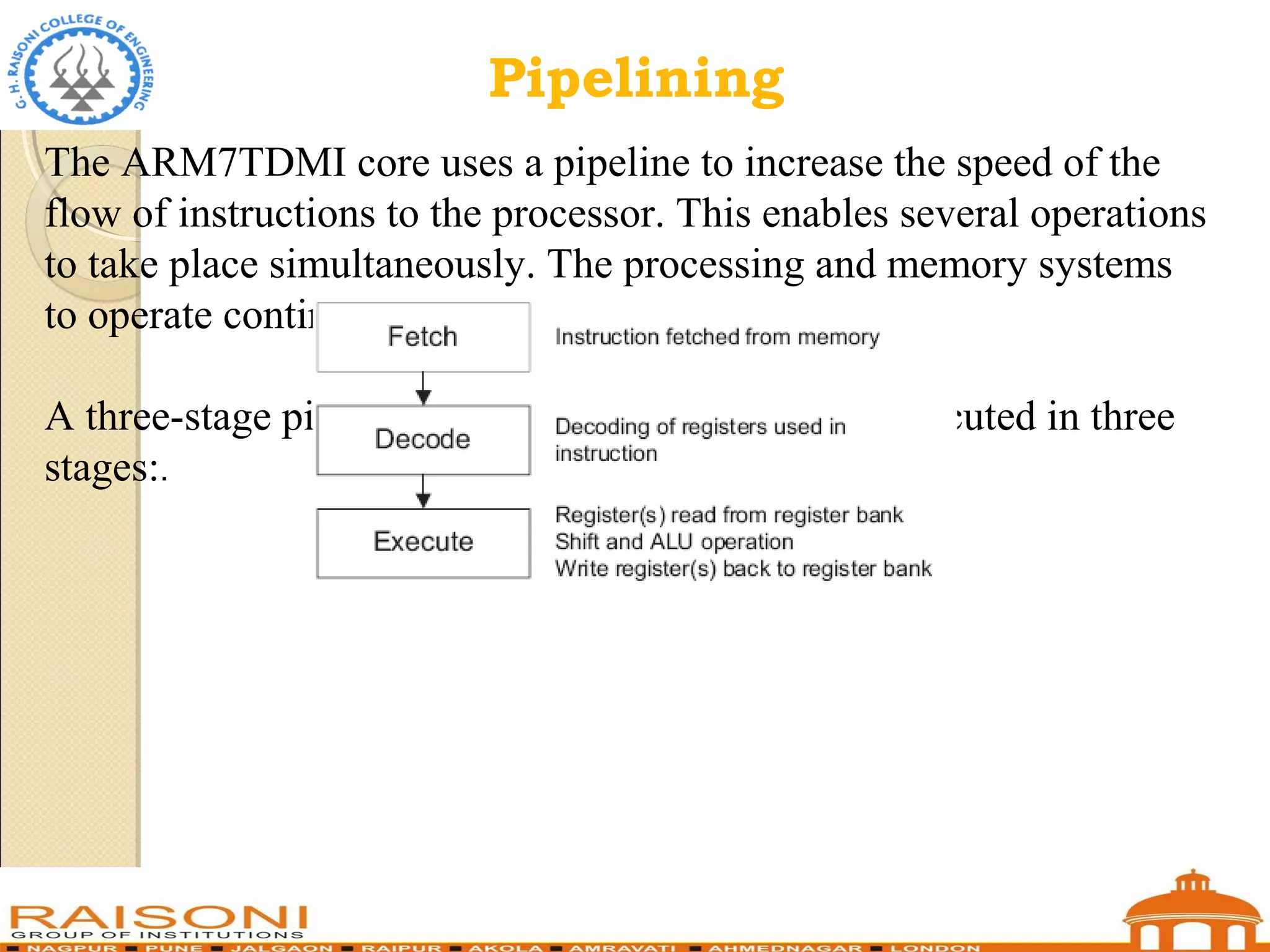
Pipelining The ARM7TDMI core uses a pipeline to increase the speed of the flow of instructions to the processor. This enables several operations to take place simultaneously. The processing and memory systems to operate continuously A three-stage pipeline is used, so instructions are executed in three stages:.
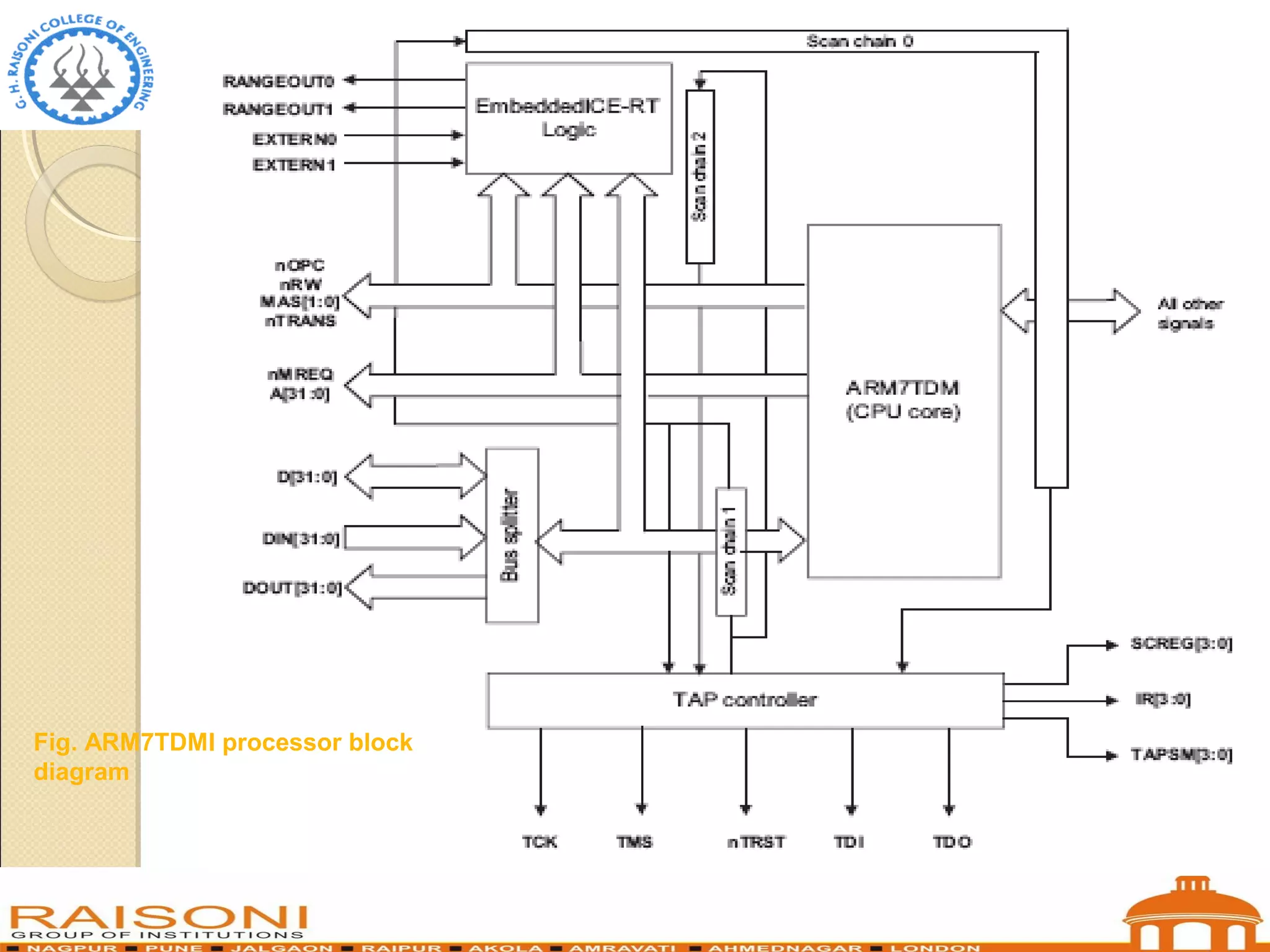
Fig. ARM7TDMI processor block diagram
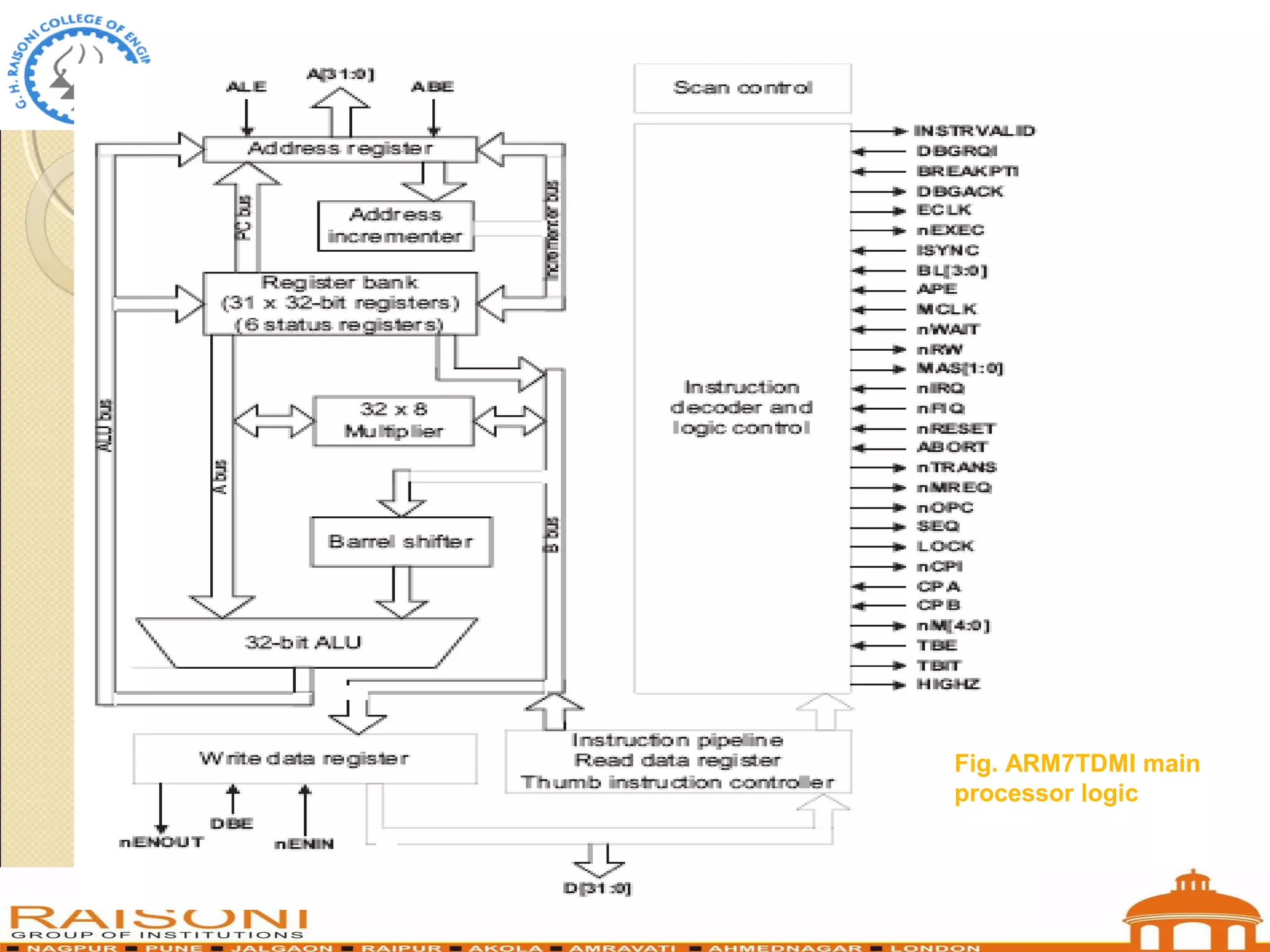
Fig. ARM7TDMI main processor logic
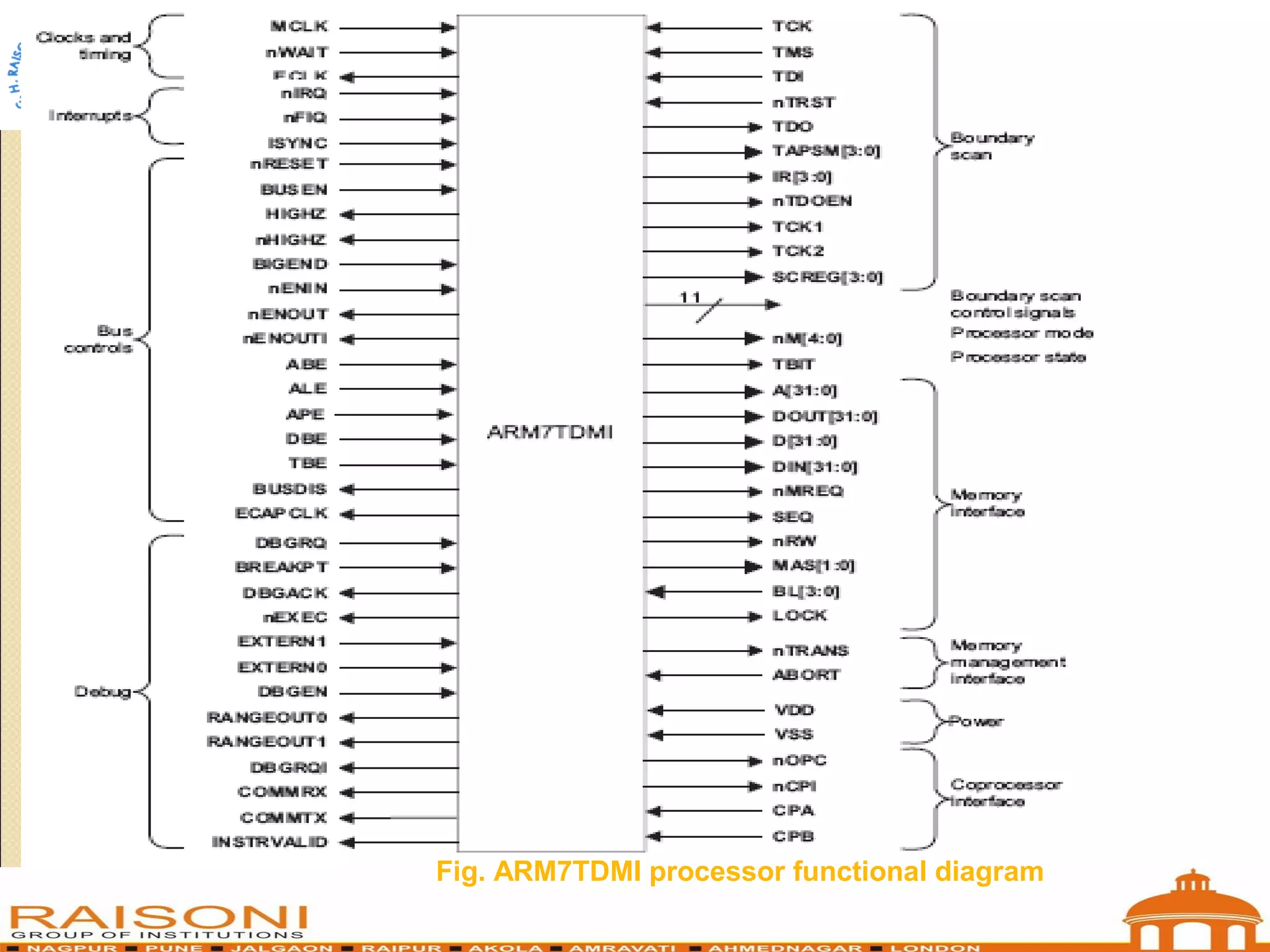
Fig. ARM7TDMI processor functional diagram
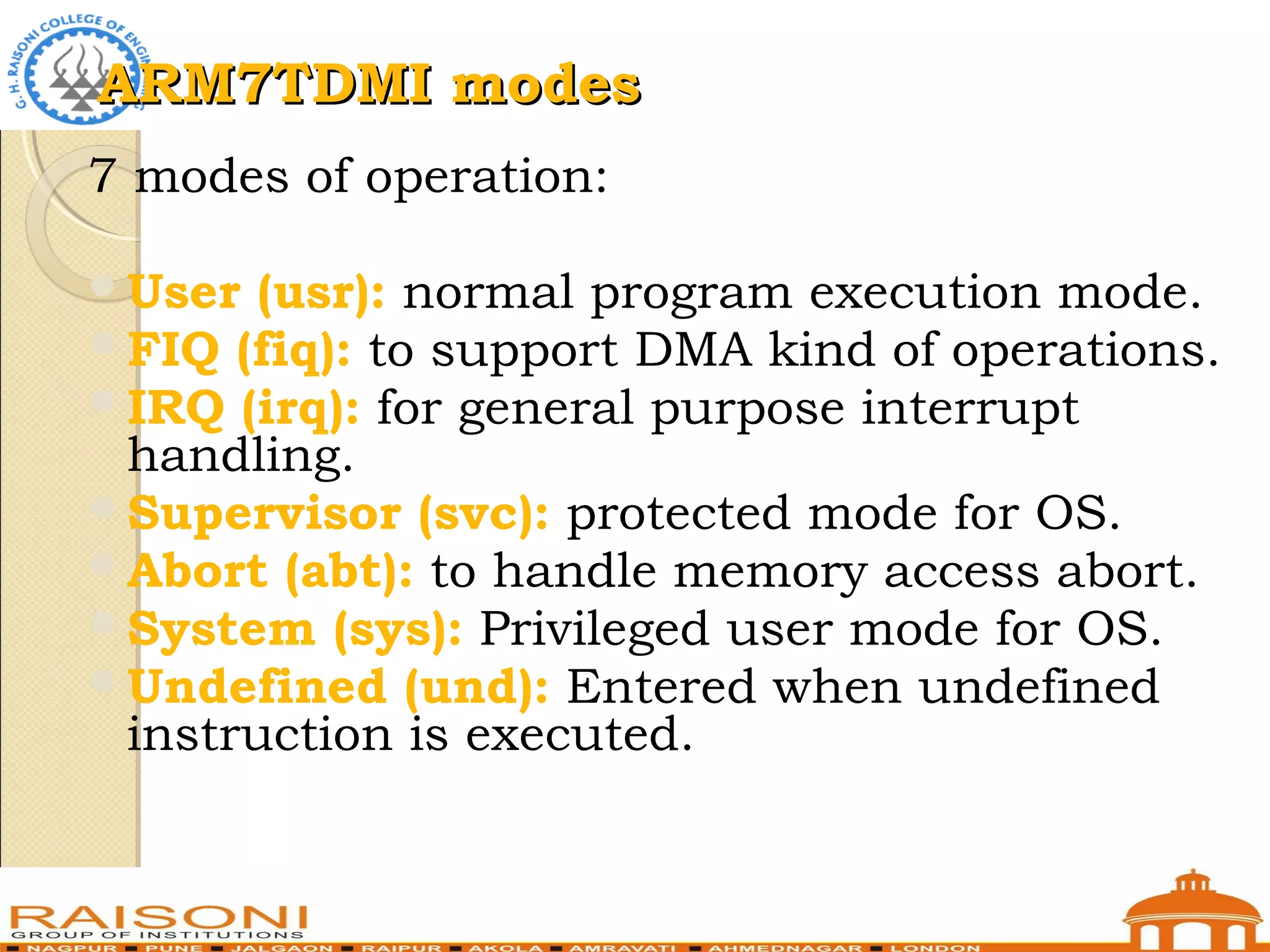
ARM7TDMI modesARM7TDMI modes 7 modes of operation: User (usr): normal program execution mode. FIQ (fiq): to support DMA kind of operations. IRQ (irq): for general purpose interrupt handling. Supervisor (svc): protected mode for OS. Abort (abt): to handle memory access abort. System (sys): Privileged user mode for OS. Undefined (und): Entered when undefined instruction is executed.
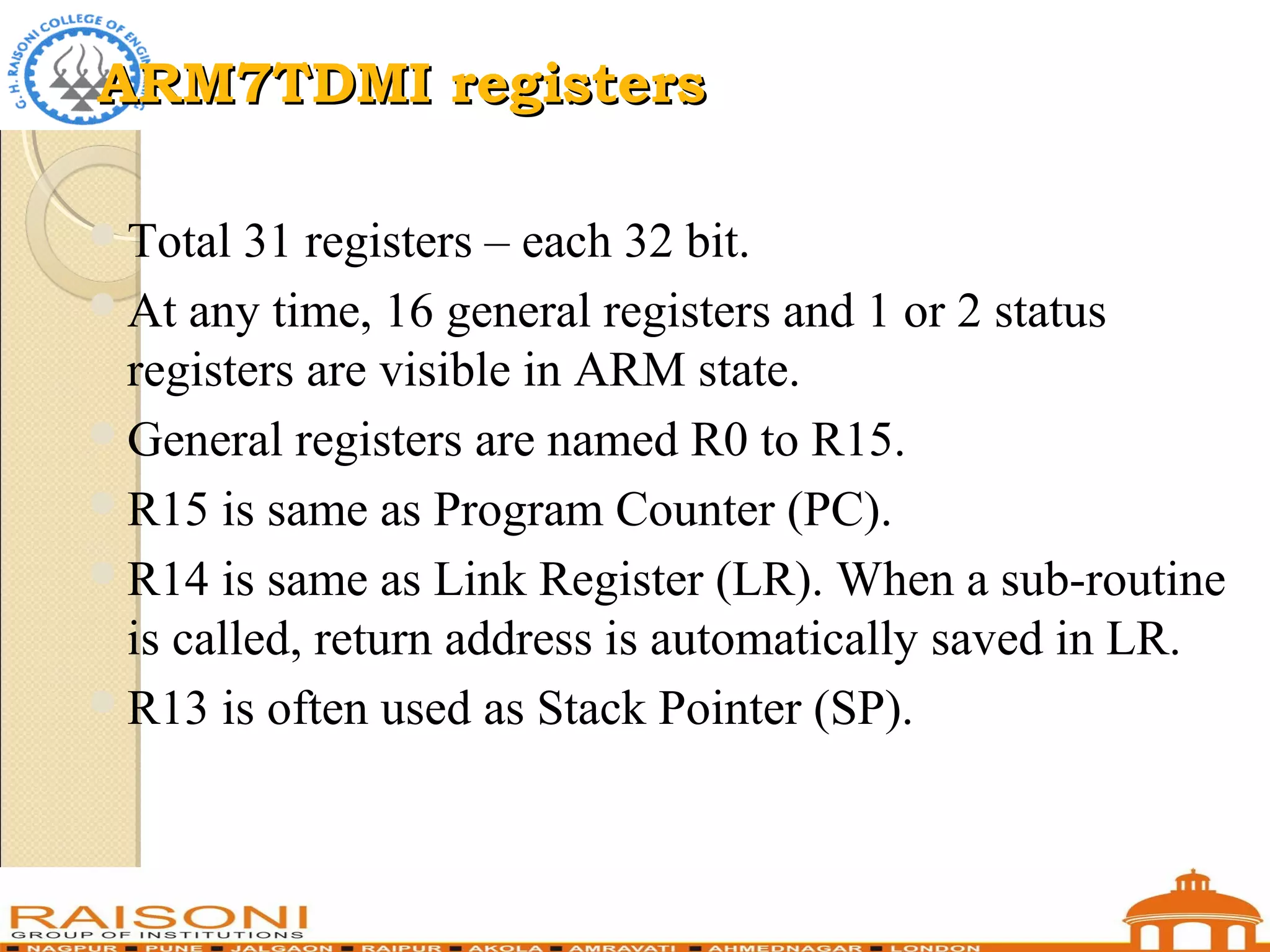
ARM7TDMI registersARM7TDMI registers Total 31 registers – each 32 bit. At any time, 16 general registers and 1 or 2 status registers are visible in ARM state. General registers are named R0 to R15. R15 is same as Program Counter (PC). R14 is same as Link Register (LR). When a sub-routine is called, return address is automatically saved in LR. R13 is often used as Stack Pointer (SP).
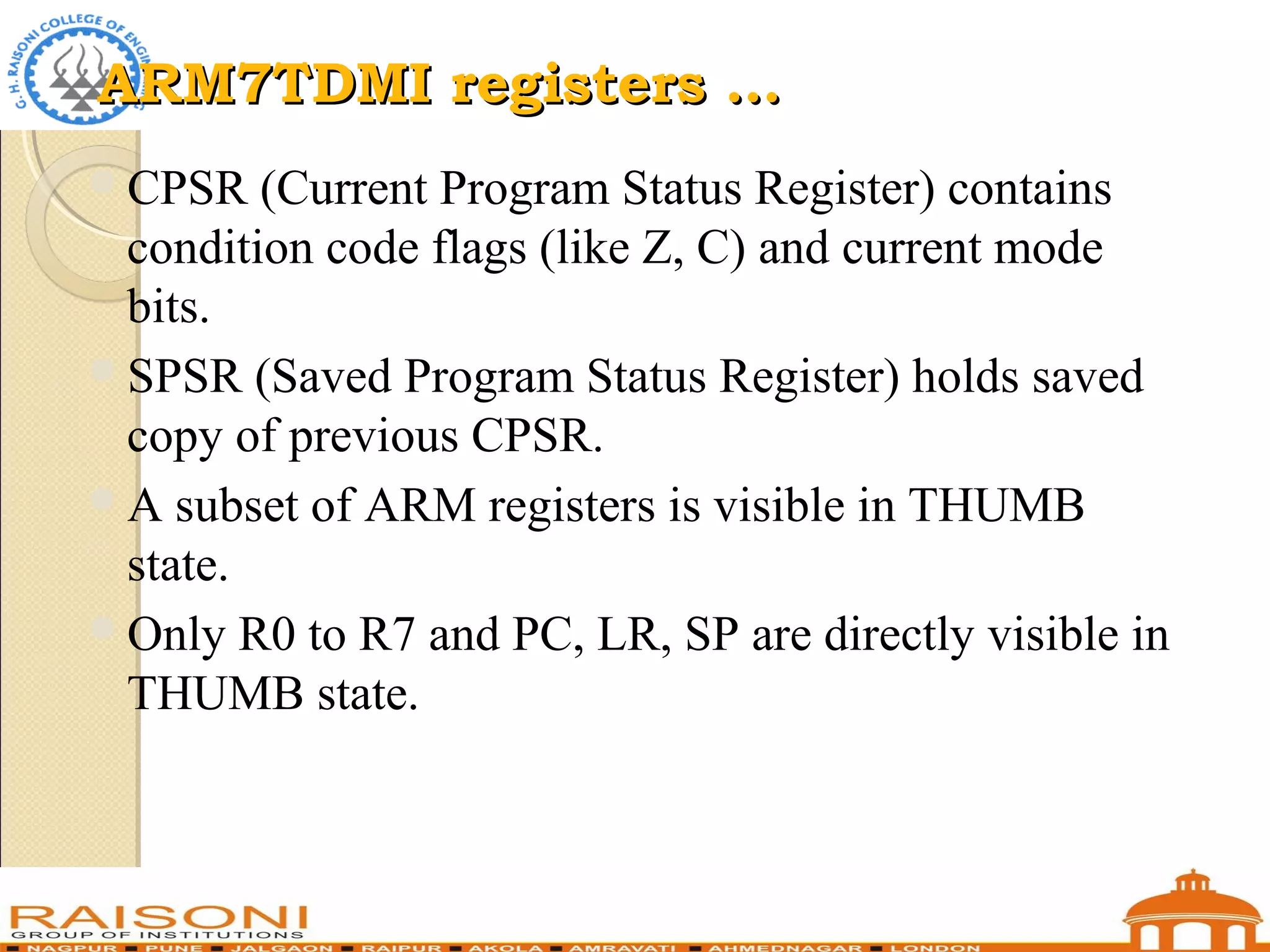
ARM7TDMI registers …ARM7TDMI registers … CPSR (Current Program Status Register) contains condition code flags (like Z, C) and current mode bits. SPSR (Saved Program Status Register) holds saved copy of previous CPSR. A subset of ARM registers is visible in THUMB state. Only R0 to R7 and PC, LR, SP are directly visible in THUMB state.
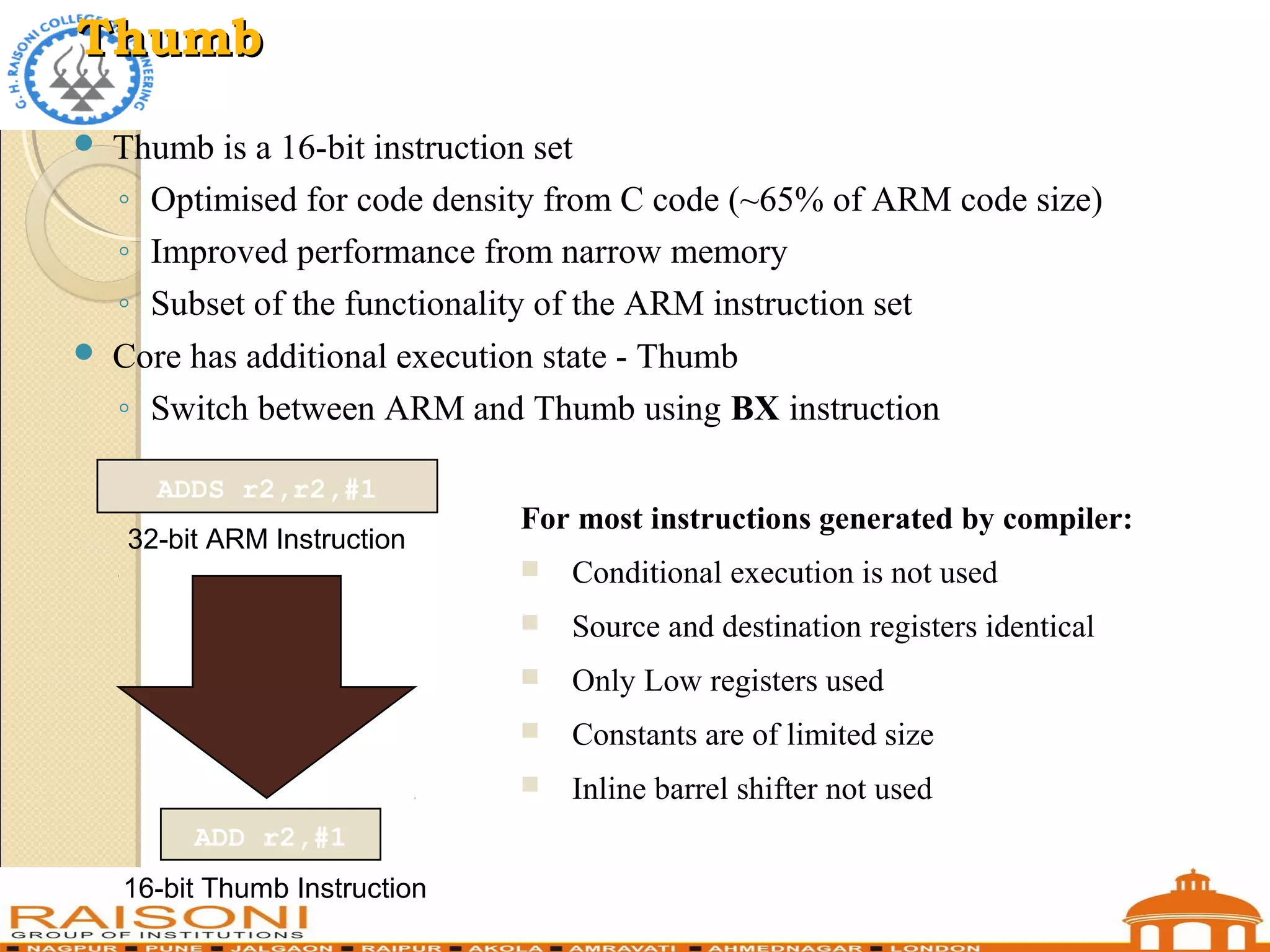
ThumbThumb  Thumb is a 16-bit instruction set ◦ Optimised for code density from C code (~65% of ARM code size) ◦ Improved performance from narrow memory ◦ Subset of the functionality of the ARM instruction set  Core has additional execution state - Thumb ◦ Switch between ARM and Thumb using BX instruction 015 31 0 ADDS r2,r2,#1 ADD r2,#1 32-bit ARM Instruction 16-bit Thumb Instruction For most instructions generated by compiler:  Conditional execution is not used  Source and destination registers identical  Only Low registers used  Constants are of limited size  Inline barrel shifter not used
ARM / THUMB advantageARM / THUMB advantage Many ARM operations can be done in 1 THUMB instruction; some need 2 or more THUMB instructions. Using THUMB instructions results in 30-40% reduction in code size. Using ARM instructions provides faster performance. Intermixing of ARM and THUMB code results in optimum solution in terms of code size and speed.
ARM Instruction SetARM Instruction Set All instructions are conditionally executed. Conditions can be “if Z flag set”, “if C flag clear” etc. “Always” is a valid condition. Many instructions are of the form: “ADD R1,R2,R3” – add contents of R2 with contents of R3 and store result in R1. Instructions to add, subtract, multiply 8/16/32 bit numbers. Instructions for logical operations AND, OR, EXOR…
ARM Instruction Set …ARM Instruction Set … Instructions for comparison of 32 bit numbers. MOV instructions to move contents of registers and constants. Immediate addressing mode supported, but not all values of constants are legal. Special Multiply-Accumulate instruction. Load / store instructions to move data between registers and memory.
ARM Instruction Set …ARM Instruction Set … Load / store instructions support various addressing modes like indexed, pre/post increment/decrement of base, write-back of base and so on. Special SWAP instruction to exchange contents of a register and a memory location. Branch (B) instruction to transfer control. Branch and Link (BL) instruction to call a sub-routine. BX instruction to branch and change state (ARM / THUMB).
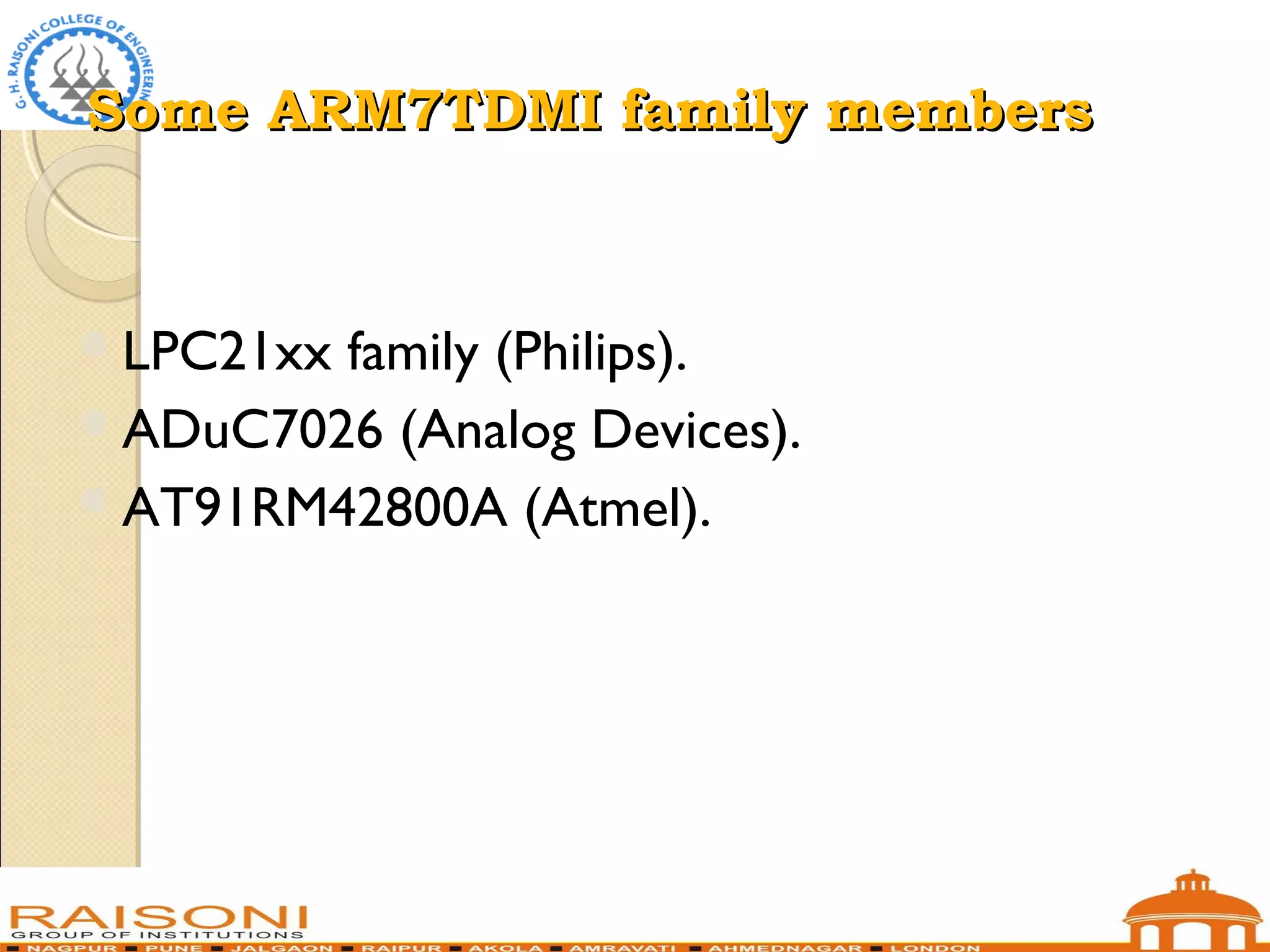
Applications of ARM Micro-controllersApplications of ARM Micro-controllers Any application desiring 32 bit performance. 3.3 V (or even lower voltage) ARM micro-controllers – suitable for battery operation. Applications requiring faster performance at lower power consumption. Applications requiring higher performance at not-so- high prices.
Some ARM7TDMI family membersSome ARM7TDMI family members LPC21xx family (Philips). ADuC7026 (Analog Devices). AT91RM42800A (Atmel).
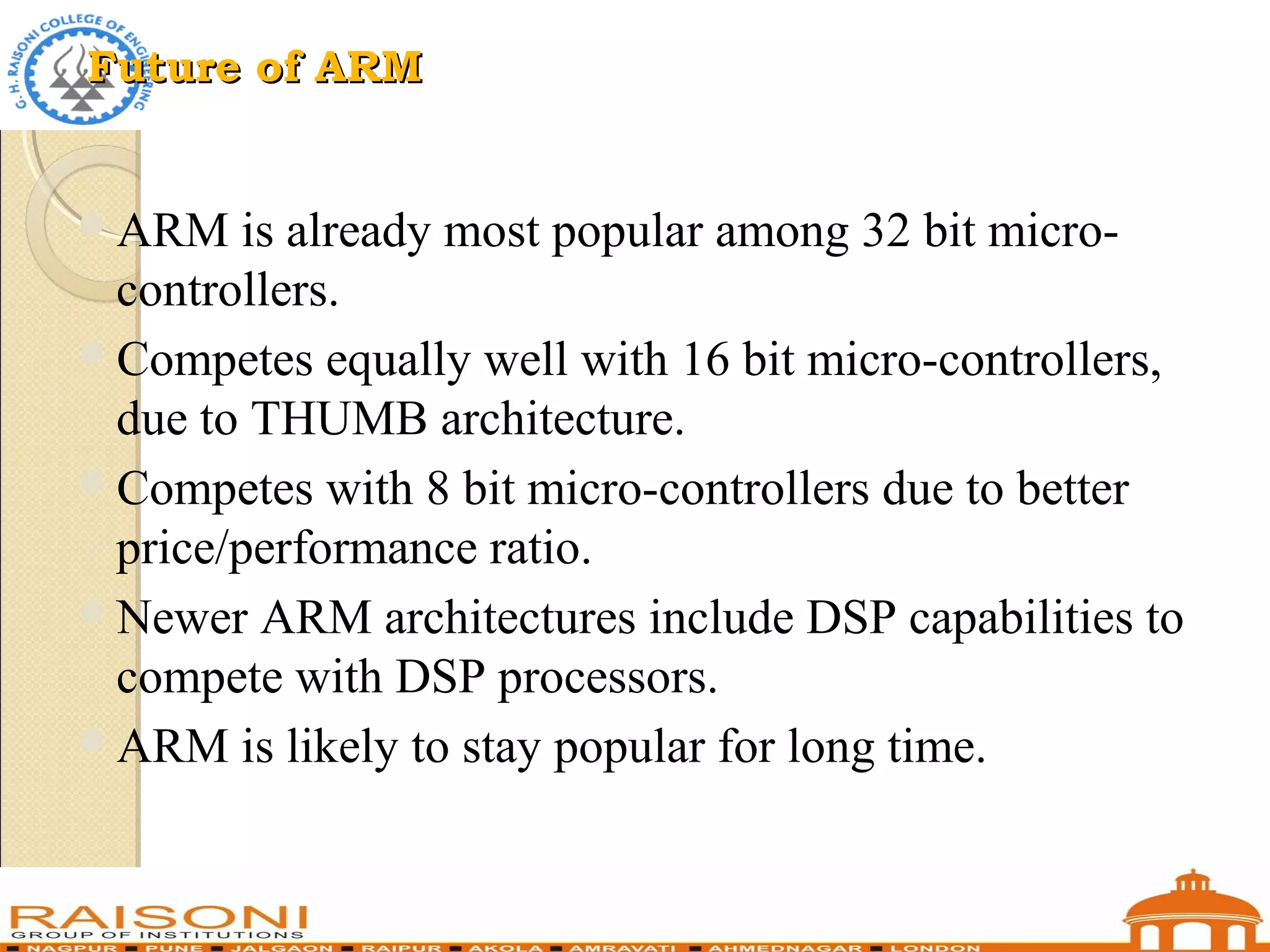
Future of ARMFuture of ARM ARM is already most popular among 32 bit micro- controllers. Competes equally well with 16 bit micro-controllers, due to THUMB architecture. Competes with 8 bit micro-controllers due to better price/performance ratio. Newer ARM architectures include DSP capabilities to compete with DSP processors. ARM is likely to stay popular for long time.
Links for more information:Links for more information: www.arm.com www.semiconductors.philips.com www.analogdevices.com www.atmel.com www.spjsystems.com/armboards.htm www.spjsystems.com/scarm.htm Thanks for your time!
?

ARM Micro-controller

  • 1.
    Introduction toIntroduction to ARMMicro-controllersARM Micro-controllers Ravikumar Tiwari Assistant Professor Dept. of Electronics, GHRCE ravikumar.tiwari@raisoni.net www.facebook.com/rravik www.twitter.com/Ravi6096
  • 2.
    ARM family ofmicro-controllersARM family of micro-controllers “ARM” architecture: designed by Advance RISC Machines Ltd., U.K. (www.arm.com) Designs the ARM range of RISC processor cores Many versions exist with backward compatibility. ARM does not fabricate silicon itself ARM7TDMI is one popular ARM version. Several manufacturers.
  • 3.
  • 4.
    ARM architecture basicsARMarchitecture basics  Reduced Instruction Set Computer (RISC).  32 bit architecture  Optional 16 bit THUMB mode in ARM7TDMI  Pipeline architecture  Data-processing operations only on registers.  “Accumulator” register not provided and not required.  32 bit arithmetic operations in 1 instruction (except division).  Various modes of operation: user, supervisor …  Exceptions such as interrupt, memory abort …  Other special features to support Operating Systems.
  • 5.
    ARM7TDMI architectureARM7TDMI architecture Oneof the most popular ARM variant architectures. Offers very good price/performance ratio. 2 Operating States: ◦ 32 bit ARM ◦ 16 bit THUMB. ARM state offers very high performance (speed). THUMB state offers tight code density (size). Operating State can be changed by software. Instruction length is 32 bit (ARM) or 16 bit (THUMB)
  • 6.
    Pipelining The ARM7TDMI coreuses a pipeline to increase the speed of the flow of instructions to the processor. This enables several operations to take place simultaneously. The processing and memory systems to operate continuously A three-stage pipeline is used, so instructions are executed in three stages:.
  • 7.
  • 8.
  • 9.
    Fig. ARM7TDMI processorfunctional diagram
  • 10.
    ARM7TDMI modesARM7TDMI modes 7modes of operation: User (usr): normal program execution mode. FIQ (fiq): to support DMA kind of operations. IRQ (irq): for general purpose interrupt handling. Supervisor (svc): protected mode for OS. Abort (abt): to handle memory access abort. System (sys): Privileged user mode for OS. Undefined (und): Entered when undefined instruction is executed.
  • 11.
    ARM7TDMI registersARM7TDMI registers Total31 registers – each 32 bit. At any time, 16 general registers and 1 or 2 status registers are visible in ARM state. General registers are named R0 to R15. R15 is same as Program Counter (PC). R14 is same as Link Register (LR). When a sub-routine is called, return address is automatically saved in LR. R13 is often used as Stack Pointer (SP).
  • 12.
    ARM7TDMI registers …ARM7TDMIregisters … CPSR (Current Program Status Register) contains condition code flags (like Z, C) and current mode bits. SPSR (Saved Program Status Register) holds saved copy of previous CPSR. A subset of ARM registers is visible in THUMB state. Only R0 to R7 and PC, LR, SP are directly visible in THUMB state.
  • 13.
    ThumbThumb  Thumb isa 16-bit instruction set ◦ Optimised for code density from C code (~65% of ARM code size) ◦ Improved performance from narrow memory ◦ Subset of the functionality of the ARM instruction set  Core has additional execution state - Thumb ◦ Switch between ARM and Thumb using BX instruction 015 31 0 ADDS r2,r2,#1 ADD r2,#1 32-bit ARM Instruction 16-bit Thumb Instruction For most instructions generated by compiler:  Conditional execution is not used  Source and destination registers identical  Only Low registers used  Constants are of limited size  Inline barrel shifter not used
  • 14.
    ARM / THUMBadvantageARM / THUMB advantage Many ARM operations can be done in 1 THUMB instruction; some need 2 or more THUMB instructions. Using THUMB instructions results in 30-40% reduction in code size. Using ARM instructions provides faster performance. Intermixing of ARM and THUMB code results in optimum solution in terms of code size and speed.
  • 15.
    ARM Instruction SetARMInstruction Set All instructions are conditionally executed. Conditions can be “if Z flag set”, “if C flag clear” etc. “Always” is a valid condition. Many instructions are of the form: “ADD R1,R2,R3” – add contents of R2 with contents of R3 and store result in R1. Instructions to add, subtract, multiply 8/16/32 bit numbers. Instructions for logical operations AND, OR, EXOR…
  • 16.
    ARM Instruction Set…ARM Instruction Set … Instructions for comparison of 32 bit numbers. MOV instructions to move contents of registers and constants. Immediate addressing mode supported, but not all values of constants are legal. Special Multiply-Accumulate instruction. Load / store instructions to move data between registers and memory.
  • 17.
    ARM Instruction Set…ARM Instruction Set … Load / store instructions support various addressing modes like indexed, pre/post increment/decrement of base, write-back of base and so on. Special SWAP instruction to exchange contents of a register and a memory location. Branch (B) instruction to transfer control. Branch and Link (BL) instruction to call a sub-routine. BX instruction to branch and change state (ARM / THUMB).
  • 18.
    Applications of ARMMicro-controllersApplications of ARM Micro-controllers Any application desiring 32 bit performance. 3.3 V (or even lower voltage) ARM micro-controllers – suitable for battery operation. Applications requiring faster performance at lower power consumption. Applications requiring higher performance at not-so- high prices.
  • 19.
    Some ARM7TDMI familymembersSome ARM7TDMI family members LPC21xx family (Philips). ADuC7026 (Analog Devices). AT91RM42800A (Atmel).
  • 20.
    Future of ARMFutureof ARM ARM is already most popular among 32 bit micro- controllers. Competes equally well with 16 bit micro-controllers, due to THUMB architecture. Competes with 8 bit micro-controllers due to better price/performance ratio. Newer ARM architectures include DSP capabilities to compete with DSP processors. ARM is likely to stay popular for long time.
  • 21.
    Links for moreinformation:Links for more information: www.arm.com www.semiconductors.philips.com www.analogdevices.com www.atmel.com www.spjsystems.com/armboards.htm www.spjsystems.com/scarm.htm Thanks for your time!
  • 22.

Editor's Notes

  • #14 The Thumb instruction set was designed by looking at the instructions produced by the ARM C compiler from real application code to see which instructions were most often used. This subset of instructions was then compressed into 16-bit opcodes to give better code density and better performance from narrow memory A Thumb compatible processor is still a 32-bit processor, but it has the ability to execute either sections of ARM code or sections of Thumb code. The two instruction sets cannot be interleaved though, a special form of branch has to be used to change “state”. The diagram then shows the way that a typical 32-bit ARM instruction might be “compressed” into a 16-bit Thumb one.