http://www.iaeme.com/IJCET/index.asp 36 editor@iaeme.com International Journal of Computer Engineering & Technology (IJCET) Volume 7, Issue 2, March-April 2016, pp. 36–43, Article ID: IJCET_07_02_005 Available online at http://www.iaeme.com/IJCET/issues.asp?JType=IJCET&VType=7&IType=2 Journal Impact Factor (2016): 9.3590 (Calculated by GISI) www.jifactor.com ISSN Print: 0976-6367 and ISSN Online: 0976–6375 © IAEME Publication ARTIFICIAL NEURAL CRYPTOGRAPHY DATAGRAM HIDING TECHNIQUES FOR COMPUTER SECURITY OBJECTS REGISTER Dr. R. Mala Assistant Professor, Department of Computer Science, Alagappa University, Karaikudi, Tamilnadu K. Karthikeyan Research Scholar, Department of Computer Science Marudupandiyar College, Vallam, Thanjavur, Tamilnadu ABSTRACT Cryptography is the scientific study of mathematical and algorithmic techniques relating to information security. Cryptographic techniques will help to protect information in cases where an attacker can have physical access to the bits representing the information, ex. When the information has to be sent over a communication channel that can be eaves dropped on by an attacker. Cryptographic primitives are the basic building blocks for constructing cryptographic solutions to information protection problems. A cryptographic primitive consists of one or more algorithms that achieve a number of protection goals. There is no well-agreed upon complete list of cryptographic primitives, nor are all cryptographic primitives independent, it is often possible to realize one primitive using a combination of other primitives. Key words: Cryptography, Datagram Protocol, Cipher, Decipher, AES, CSOR Cite this Article: Dr. R. Mala and K. Karthikeyan. Artificial Neural Cryptography Datagram Hiding Techniques For Computer Security Objects Register, International Journal of Computer Engineering and Technology, 7(2), 2016, pp. 36–43. http://www.iaeme.com/IJCET/issues.asp?JType=IJCET&VType=7&IType=1
Artificial Neural Cryptography Datagram Hiding Techniques For Computer Security Objects Register http://www.iaeme.com/IJCET/index.asp 37 editor@iaeme.com 1. INTRODUCTION Cryptography is the art or science of keeping messages secret suppose that someone wants to send a message to a receiver, and wants to be sure that no-one else can read the message. However, there is the possibility that someone else opens the letter or hears the electronic communication. In cryptographic terminology, the message is called plaintext or cipher text. Encoding the contents of the message in such a way that hides its contents from outsiders is called encryption. The encrypted message is called the cipher text. The process of retrieving the plaintext from the cipher text is called decryption. Encryption and decryption usually make use of a key, and the coding method is such that decryption can be performed only by knowing the proper key. A method of encryption and decryption is called a cipher. Some cryptographic methods rely on the secrecy of the algorithms; such algorithms are only of historical interest and are not adequate for real-world needs. All modern algorithms use a key to control encryption and decryption; a message can be decrypted only if the key matches the encryption key. There are two classes of key-based encryption algorithms, symmetric (or secret-key) and asymmetric (or public-key) algorithms. The difference is that symmetric algorithms use the same key for encryption and decryption (or the decryption key is easily derived from the encryption key). The Advanced Encryption Standard (AES) specifies a FIPS-approved Cryptographic algorithm that can be used to protect electronic data. The AES algorithm is a symmetric block cipher that can encrypt (encipher) and decrypt (decipher) information. Encryption converts data to an unintelligible form called cipher text; decrypting the cipher text converts the data back into its original form, called plaintext. The AES algorithm is capable of using cryptographic keys of 128, 192, and 256 bits to encrypt and decrypt data in blocks of 128 bits. The algorithm specified in this standard may be implemented in Software, firmware, hardware, or any combination thereof. The specific implementation may depend on several factors such as the application, the environment, the technology used, etc. The algorithm shall be used in conjunction with a FIPS approved or NIST recommended mode of operation. Object Identifiers (OIDs) and any associated parameters for AES used in these modes are available at the Computer Security Objects Register (CSOR), located at Implementations of the algorithm that are tested by an accredited laboratory and validated will be considered as complying with this standard. Since cryptographic security depends on many factors besides the correct implementation of an encryption algorithm, Federal Government employees, and others, should also refer to NIST Special Publication 800-21 for additional information and guidance 2. DESIGN AND ANALYSIS Encryption is the process in which we can enjoy security by hiding the secret codes without worrying about any one reading the contents. This process will normally be used in Army Defense Forces. The objectives to the problems are 1. It gives good results 2. Data security is fulfillment through Logical means. 3. To avoid physical security. That is used to communication channel.
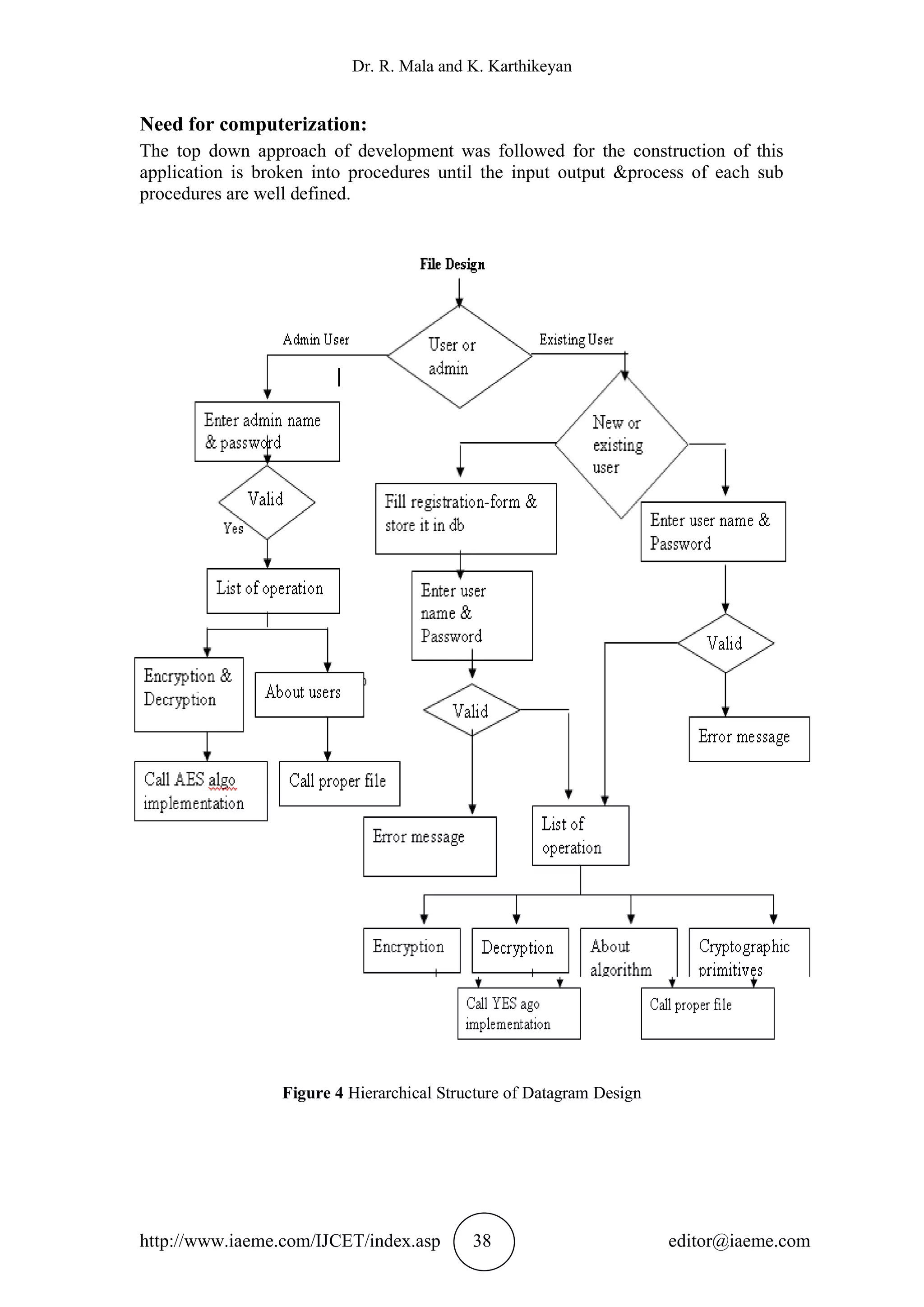
Dr. R. Mala and K. Karthikeyan http://www.iaeme.com/IJCET/index.asp 38 editor@iaeme.com Need for computerization: The top down approach of development was followed for the construction of this application is broken into procedures until the input output &process of each sub procedures are well defined. Figure 4 Hierarchical Structure of Datagram Design
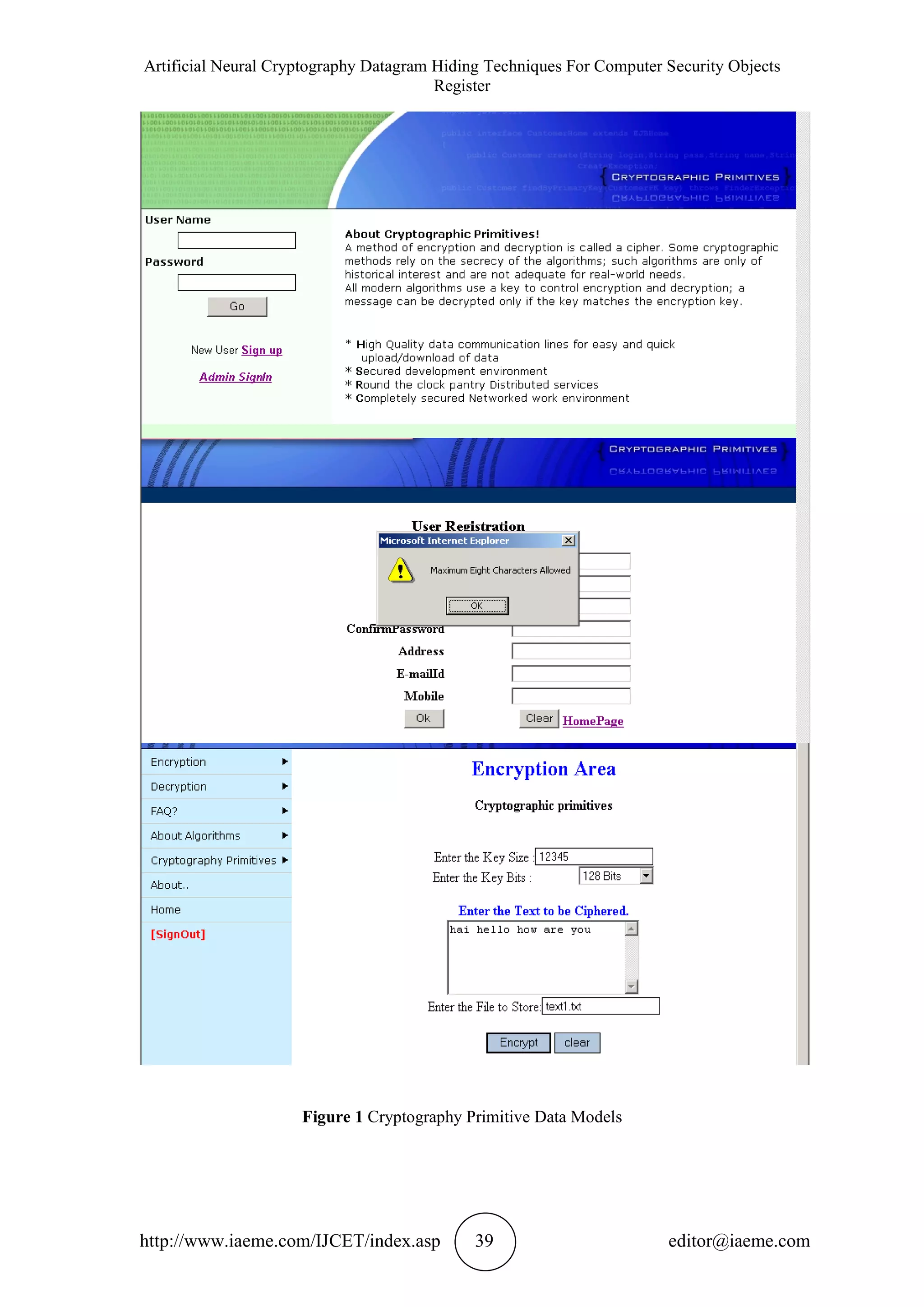
Artificial Neural Cryptography Datagram Hiding Techniques For Computer Security Objects Register http://www.iaeme.com/IJCET/index.asp 39 editor@iaeme.com Figure-1: Cryptographic Primitives Figure 1 Cryptography Primitive Data Models
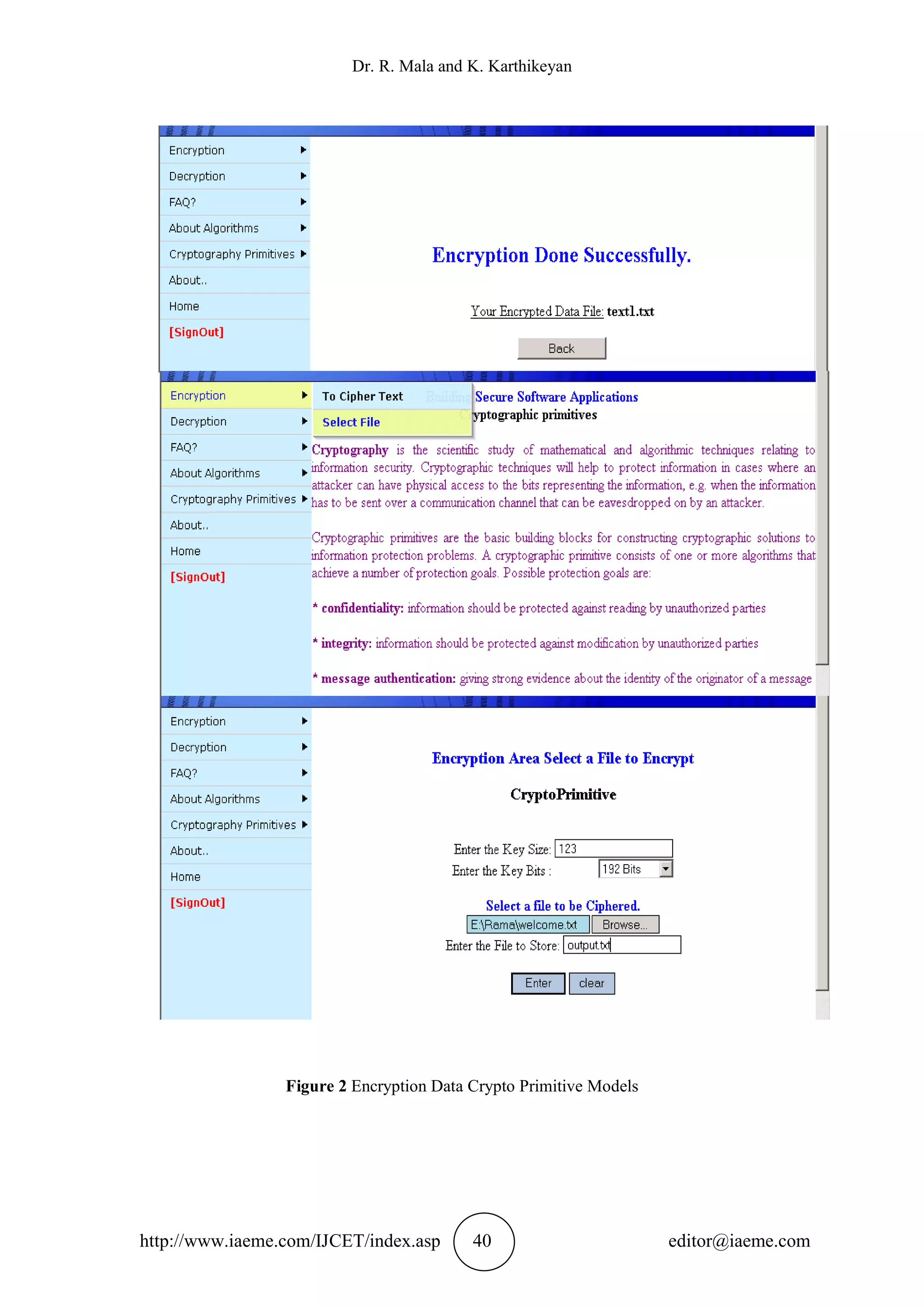
Dr. R. Mala and K. Karthikeyan http://www.iaeme.com/IJCET/index.asp 40 editor@iaeme.com Figure 2 Encryption Data Crypto Primitive Models
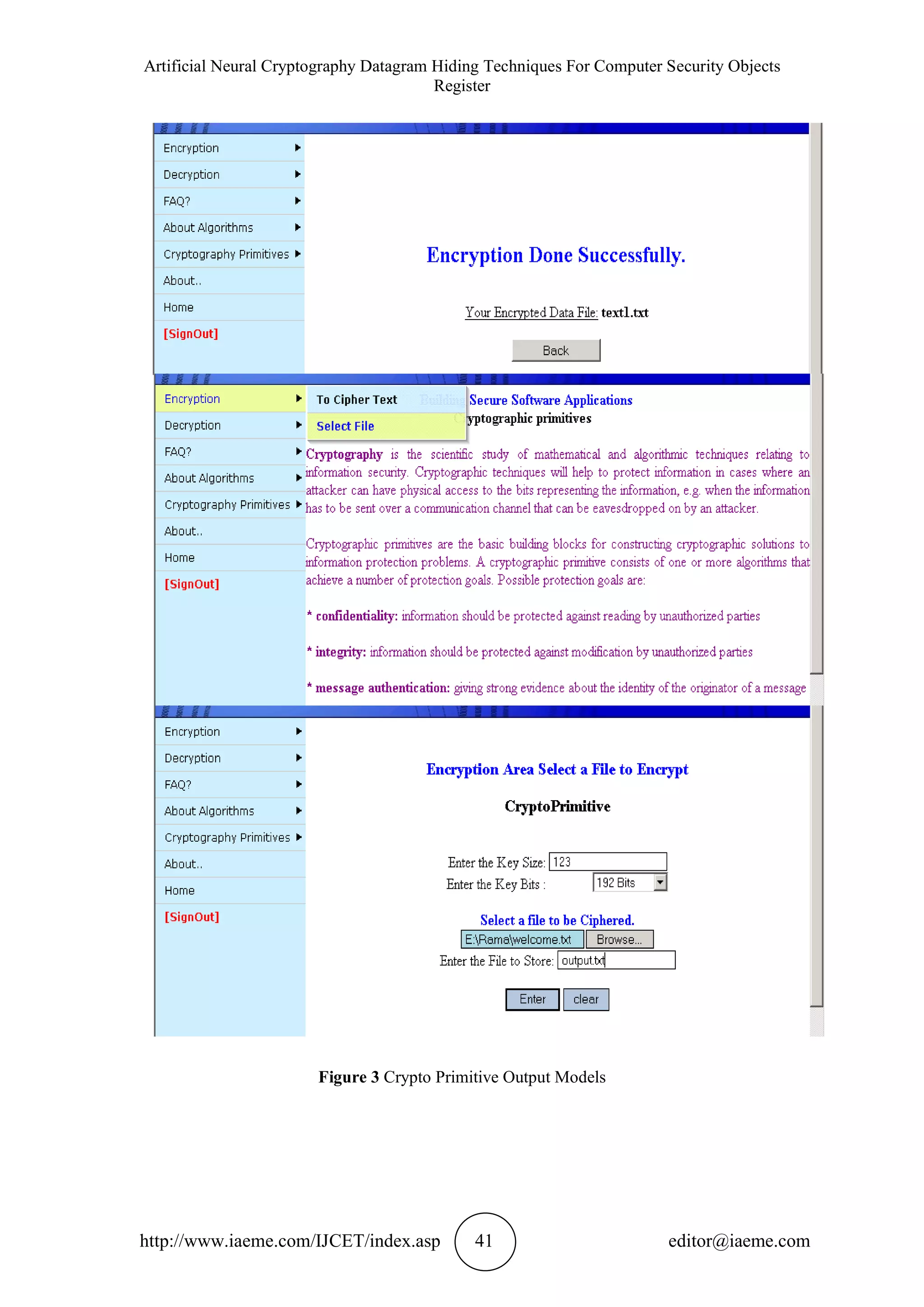
Artificial Neural Cryptography Datagram Hiding Techniques For Computer Security Objects Register http://www.iaeme.com/IJCET/index.asp 41 editor@iaeme.com Figure 3 Crypto Primitive Output Models
Dr. R. Mala and K. Karthikeyan http://www.iaeme.com/IJCET/index.asp 42 editor@iaeme.com 3. RESULT AND DISCUSSION Cryptographic algorithm that can be used to protect electronic data. The AES algorithm is a symmetric block cipher that can encrypt (encipher) and decrypt (decipher) information. Encryption converts data to an unintelligible form called cipher text; decrypting the cipher text converts the data back into its original form called plaintext. The AES algorithm is capable of using cryptographic keys of 128, 192, and 256 bits to encrypt and decrypt data in blocks of 128 bits. The algorithm specified in this standard may be implemented in software, firmware, hardware, or any combination thereof. The specific implementation may depend on several factors such as the application, the environment, the technology used, etc. The algorithm shall be used in conjunction with a FIPS approved or NIST recommended mode of operation. Object Identifiers (OIDs) and any associated parameters for AES used in these modes are available at the Computer Security Objects Register (CSOR), located at Implementations of the algorithm that are tested by an accredited laboratory and validated will be considered as complying with this standard. Since cryptographic security depends on many factors besides the correct implementation of an encryption algorithm, Federal Government employees, and others, should also refer to NIST Special Publication 800-21 for additional information and guidance. (NIST SP 800-21 is available) 4. CONCLUSION This “Cryptography Datagram Hiding Techniques Based on Computer Security Objects Register” research paper is very useful to keep the secret message safely without reading the content by the others. It maintains the logical security. These algorithms are only of historical interest and are not adequate for real-world needs of security by hiding the secret codes without worrying about any one reading of the contents. We conclude that this research work will be helpful for Army Defense forces and public commercial purposes. REFERENCES [1] H. Khan, Y. Javed, S. A. Khayam, F. Mirza. Embedding a Covert Channel in Active Network connections. In Proceedings of IEEE Global Communications Conference (GlobeCom), December 2004. [2] S. H. Sellke, C.-C. Wang, S. Bagchi, N. B. Shroff. Covert TCP/IP Timing Channels: Theory to Implementation. In Proceedings of the 28th Conference on Computer Communications (INFOCOM), April 2005 [3] S. Gianvecchio, H. Wang, D. Wijesekera, S. Jajodia. Model-Based Covert Timing Channels: Automated Modeling and Evasion. In Proceedings of Recent Advances in Intrusion Detection (RAID) Symposium, September 2008. [4] S. Zander, G. Armitage, P. Branch. Covert Channels and Countermeasures in Computer Network Protocols. IEEE Communications Magazine, 45(12):136- 142, December 2002 [5] S. Zander, G. Armitage, P. Branch. A Survey of Covert Channels and Countermeasures in Computer Network Protocols. IEEE Communications Surveys and Tutorials, 9(3):44-57, October 2007 [6] M. Van Horenbeeck. Deception on the Network: Thinking Differently About Covert Channels. In Proceedings of 7th Australian Information Warfare and Security Conference.
Artificial Neural Cryptography Datagram Hiding Techniques For Computer Security Objects Register http://www.iaeme.com/IJCET/index.asp 43 editor@iaeme.com [7] S. J. Murdoch. Hot or Not: Revealing Hidden Services by Their Clock Skew. In Proceedings of 13th ACM Conference on Computer and Communications Security (CCS), pages 27-36, November 2006. [8] W. Mazurczyk, Z. Kotulski. Covert Channel for Improving VoIP Security. In Proceedings of Multi conference on Advanced Computer Systems (ACS), pages 311-320, October 2006 [9] R. C. Chakinala, A. Kumarasubramanian, R. Manokaran, G. Noubir, C. Pandu Rangan, R. Sundaram. Steganographic Communication in Ordered Channels. In Proceedings of 8th International Workshop on Information Hiding, pages 42- 57, July 2009. [10] P. Singh. Whispers On The Wire - Network Based Covert Channels Exploitation & Detection. In Symposium on Security for Asia Network (SyScAN), September 2011. [11] S. Li, A. Ephremides. A Covert Channel in MAC Protocols based on Splitting Algorithms. In Proceedings of Wireless Communications and Networking Conference (WCNC), pages 1168-1173, March 2010. [12] Y. Liu, D. Ghosal, F. Armknecht, A.-R. Sadeghi, S. Schulz, S. Katzenbeisser. Hide and Seek in Time - Robust Covert Timing Channels. In Proceedings of 14th European Symposium on Research in Computer Security, September 2009. [13] Er. Abhijeet, Mr. Praveen Tripathi, Er.Anuja Priyam and Er.Vivek Kumar. Implementation of Public Key Cryptography In Kerberos with Prevention of Security Attacks, International Journal of Computer Engineering and Technology, 4(3), 2013, pp. 248–253. [14] Henry Navarro and Leonardo Bennun. Descriptive Examples of The Limitations of Artificial Neural Networks Applied To The Analysis of Independent Stochastic Data, International Journal of Computer Engineering and Technology, 5(5), 2014, pp. 40–42. [15] Ahmad Salameh Abusukhon. Block Cipher Encryption For Text-To-Image Algorithm, International Journal of Computer Engineering and Technology, 4(3), 2013, pp. 50–59.

ARTIFICIAL NEURAL CRYPTOGRAPHY DATAGRAM HIDING TECHNIQUES FOR COMPUTER SECURITY OBJECTS REGISTER

  • 1.
    http://www.iaeme.com/IJCET/index.asp 36 editor@iaeme.com InternationalJournal of Computer Engineering & Technology (IJCET) Volume 7, Issue 2, March-April 2016, pp. 36–43, Article ID: IJCET_07_02_005 Available online at http://www.iaeme.com/IJCET/issues.asp?JType=IJCET&VType=7&IType=2 Journal Impact Factor (2016): 9.3590 (Calculated by GISI) www.jifactor.com ISSN Print: 0976-6367 and ISSN Online: 0976–6375 © IAEME Publication ARTIFICIAL NEURAL CRYPTOGRAPHY DATAGRAM HIDING TECHNIQUES FOR COMPUTER SECURITY OBJECTS REGISTER Dr. R. Mala Assistant Professor, Department of Computer Science, Alagappa University, Karaikudi, Tamilnadu K. Karthikeyan Research Scholar, Department of Computer Science Marudupandiyar College, Vallam, Thanjavur, Tamilnadu ABSTRACT Cryptography is the scientific study of mathematical and algorithmic techniques relating to information security. Cryptographic techniques will help to protect information in cases where an attacker can have physical access to the bits representing the information, ex. When the information has to be sent over a communication channel that can be eaves dropped on by an attacker. Cryptographic primitives are the basic building blocks for constructing cryptographic solutions to information protection problems. A cryptographic primitive consists of one or more algorithms that achieve a number of protection goals. There is no well-agreed upon complete list of cryptographic primitives, nor are all cryptographic primitives independent, it is often possible to realize one primitive using a combination of other primitives. Key words: Cryptography, Datagram Protocol, Cipher, Decipher, AES, CSOR Cite this Article: Dr. R. Mala and K. Karthikeyan. Artificial Neural Cryptography Datagram Hiding Techniques For Computer Security Objects Register, International Journal of Computer Engineering and Technology, 7(2), 2016, pp. 36–43. http://www.iaeme.com/IJCET/issues.asp?JType=IJCET&VType=7&IType=1
  • 2.
    Artificial Neural CryptographyDatagram Hiding Techniques For Computer Security Objects Register http://www.iaeme.com/IJCET/index.asp 37 editor@iaeme.com 1. INTRODUCTION Cryptography is the art or science of keeping messages secret suppose that someone wants to send a message to a receiver, and wants to be sure that no-one else can read the message. However, there is the possibility that someone else opens the letter or hears the electronic communication. In cryptographic terminology, the message is called plaintext or cipher text. Encoding the contents of the message in such a way that hides its contents from outsiders is called encryption. The encrypted message is called the cipher text. The process of retrieving the plaintext from the cipher text is called decryption. Encryption and decryption usually make use of a key, and the coding method is such that decryption can be performed only by knowing the proper key. A method of encryption and decryption is called a cipher. Some cryptographic methods rely on the secrecy of the algorithms; such algorithms are only of historical interest and are not adequate for real-world needs. All modern algorithms use a key to control encryption and decryption; a message can be decrypted only if the key matches the encryption key. There are two classes of key-based encryption algorithms, symmetric (or secret-key) and asymmetric (or public-key) algorithms. The difference is that symmetric algorithms use the same key for encryption and decryption (or the decryption key is easily derived from the encryption key). The Advanced Encryption Standard (AES) specifies a FIPS-approved Cryptographic algorithm that can be used to protect electronic data. The AES algorithm is a symmetric block cipher that can encrypt (encipher) and decrypt (decipher) information. Encryption converts data to an unintelligible form called cipher text; decrypting the cipher text converts the data back into its original form, called plaintext. The AES algorithm is capable of using cryptographic keys of 128, 192, and 256 bits to encrypt and decrypt data in blocks of 128 bits. The algorithm specified in this standard may be implemented in Software, firmware, hardware, or any combination thereof. The specific implementation may depend on several factors such as the application, the environment, the technology used, etc. The algorithm shall be used in conjunction with a FIPS approved or NIST recommended mode of operation. Object Identifiers (OIDs) and any associated parameters for AES used in these modes are available at the Computer Security Objects Register (CSOR), located at Implementations of the algorithm that are tested by an accredited laboratory and validated will be considered as complying with this standard. Since cryptographic security depends on many factors besides the correct implementation of an encryption algorithm, Federal Government employees, and others, should also refer to NIST Special Publication 800-21 for additional information and guidance 2. DESIGN AND ANALYSIS Encryption is the process in which we can enjoy security by hiding the secret codes without worrying about any one reading the contents. This process will normally be used in Army Defense Forces. The objectives to the problems are 1. It gives good results 2. Data security is fulfillment through Logical means. 3. To avoid physical security. That is used to communication channel.
  • 3.
    Dr. R. Malaand K. Karthikeyan http://www.iaeme.com/IJCET/index.asp 38 editor@iaeme.com Need for computerization: The top down approach of development was followed for the construction of this application is broken into procedures until the input output &process of each sub procedures are well defined. Figure 4 Hierarchical Structure of Datagram Design
  • 4.
    Artificial Neural CryptographyDatagram Hiding Techniques For Computer Security Objects Register http://www.iaeme.com/IJCET/index.asp 39 editor@iaeme.com Figure-1: Cryptographic Primitives Figure 1 Cryptography Primitive Data Models
  • 5.
    Dr. R. Malaand K. Karthikeyan http://www.iaeme.com/IJCET/index.asp 40 editor@iaeme.com Figure 2 Encryption Data Crypto Primitive Models
  • 6.
    Artificial Neural CryptographyDatagram Hiding Techniques For Computer Security Objects Register http://www.iaeme.com/IJCET/index.asp 41 editor@iaeme.com Figure 3 Crypto Primitive Output Models
  • 7.
    Dr. R. Malaand K. Karthikeyan http://www.iaeme.com/IJCET/index.asp 42 editor@iaeme.com 3. RESULT AND DISCUSSION Cryptographic algorithm that can be used to protect electronic data. The AES algorithm is a symmetric block cipher that can encrypt (encipher) and decrypt (decipher) information. Encryption converts data to an unintelligible form called cipher text; decrypting the cipher text converts the data back into its original form called plaintext. The AES algorithm is capable of using cryptographic keys of 128, 192, and 256 bits to encrypt and decrypt data in blocks of 128 bits. The algorithm specified in this standard may be implemented in software, firmware, hardware, or any combination thereof. The specific implementation may depend on several factors such as the application, the environment, the technology used, etc. The algorithm shall be used in conjunction with a FIPS approved or NIST recommended mode of operation. Object Identifiers (OIDs) and any associated parameters for AES used in these modes are available at the Computer Security Objects Register (CSOR), located at Implementations of the algorithm that are tested by an accredited laboratory and validated will be considered as complying with this standard. Since cryptographic security depends on many factors besides the correct implementation of an encryption algorithm, Federal Government employees, and others, should also refer to NIST Special Publication 800-21 for additional information and guidance. (NIST SP 800-21 is available) 4. CONCLUSION This “Cryptography Datagram Hiding Techniques Based on Computer Security Objects Register” research paper is very useful to keep the secret message safely without reading the content by the others. It maintains the logical security. These algorithms are only of historical interest and are not adequate for real-world needs of security by hiding the secret codes without worrying about any one reading of the contents. We conclude that this research work will be helpful for Army Defense forces and public commercial purposes. REFERENCES [1] H. Khan, Y. Javed, S. A. Khayam, F. Mirza. Embedding a Covert Channel in Active Network connections. In Proceedings of IEEE Global Communications Conference (GlobeCom), December 2004. [2] S. H. Sellke, C.-C. Wang, S. Bagchi, N. B. Shroff. Covert TCP/IP Timing Channels: Theory to Implementation. In Proceedings of the 28th Conference on Computer Communications (INFOCOM), April 2005 [3] S. Gianvecchio, H. Wang, D. Wijesekera, S. Jajodia. Model-Based Covert Timing Channels: Automated Modeling and Evasion. In Proceedings of Recent Advances in Intrusion Detection (RAID) Symposium, September 2008. [4] S. Zander, G. Armitage, P. Branch. Covert Channels and Countermeasures in Computer Network Protocols. IEEE Communications Magazine, 45(12):136- 142, December 2002 [5] S. Zander, G. Armitage, P. Branch. A Survey of Covert Channels and Countermeasures in Computer Network Protocols. IEEE Communications Surveys and Tutorials, 9(3):44-57, October 2007 [6] M. Van Horenbeeck. Deception on the Network: Thinking Differently About Covert Channels. In Proceedings of 7th Australian Information Warfare and Security Conference.
  • 8.
    Artificial Neural CryptographyDatagram Hiding Techniques For Computer Security Objects Register http://www.iaeme.com/IJCET/index.asp 43 editor@iaeme.com [7] S. J. Murdoch. Hot or Not: Revealing Hidden Services by Their Clock Skew. In Proceedings of 13th ACM Conference on Computer and Communications Security (CCS), pages 27-36, November 2006. [8] W. Mazurczyk, Z. Kotulski. Covert Channel for Improving VoIP Security. In Proceedings of Multi conference on Advanced Computer Systems (ACS), pages 311-320, October 2006 [9] R. C. Chakinala, A. Kumarasubramanian, R. Manokaran, G. Noubir, C. Pandu Rangan, R. Sundaram. Steganographic Communication in Ordered Channels. In Proceedings of 8th International Workshop on Information Hiding, pages 42- 57, July 2009. [10] P. Singh. Whispers On The Wire - Network Based Covert Channels Exploitation & Detection. In Symposium on Security for Asia Network (SyScAN), September 2011. [11] S. Li, A. Ephremides. A Covert Channel in MAC Protocols based on Splitting Algorithms. In Proceedings of Wireless Communications and Networking Conference (WCNC), pages 1168-1173, March 2010. [12] Y. Liu, D. Ghosal, F. Armknecht, A.-R. Sadeghi, S. Schulz, S. Katzenbeisser. Hide and Seek in Time - Robust Covert Timing Channels. In Proceedings of 14th European Symposium on Research in Computer Security, September 2009. [13] Er. Abhijeet, Mr. Praveen Tripathi, Er.Anuja Priyam and Er.Vivek Kumar. Implementation of Public Key Cryptography In Kerberos with Prevention of Security Attacks, International Journal of Computer Engineering and Technology, 4(3), 2013, pp. 248–253. [14] Henry Navarro and Leonardo Bennun. Descriptive Examples of The Limitations of Artificial Neural Networks Applied To The Analysis of Independent Stochastic Data, International Journal of Computer Engineering and Technology, 5(5), 2014, pp. 40–42. [15] Ahmad Salameh Abusukhon. Block Cipher Encryption For Text-To-Image Algorithm, International Journal of Computer Engineering and Technology, 4(3), 2013, pp. 50–59.