AUTOMATION OF RAILWAY GATE CONTROL USING VERILOG By Ms. D.Vidya (14C35A0409) Ms. V.Pavanisujatha (13C31A04A1) Mr.P.Chendra shekar (13C31A0471) Under the guidance of Ms. M. Mounika Assistant professor BALAJI INSTITUTE OF TECHNOLOGY AND SCIENCE NARSAMPET, WARANGAL – 506 331 DEPARTMENT OF ELECTRONICS AND COMMUNICATION ENGINEERING
CONTENT  INTRODUCTION  ABSTRACT  SCHEMATIC DIAGRAM  IR SENSOR  INITIAL SIGNAL DISPLAY  FLOW CHART-1  TRAIN ARRIVAL DETECTION  FLOW CHART-2  TRAIN DEPARTURE DETECTION  ARCHITECTURE DIAGRAM
 APPLICATIONS  ADVANTAGES  CONCLUSION  REFERNCES
INTRODUCTION  The railway system is the most commonly used transportation mode in India.  Level crossings are managed by the gatekeeper and the gatekeeper is instructed by the means of telephone at most of the level cross from the control room.  Delay in the opening and closing of the gate could lead to railway accidents.  To avoid the human errors that could occur during the operation of gates, level crosses are controlled manually & the concept of automation is introduced.
ABSTRACT  The present work attempts to automate the opening and closing of gates at a railway level crossing.  The proposed system uses infrared sensors to detect the arrival and departure of trains at the railway level crossing.  The system uses two IR sensors to detect the arrival of the train and a third IR sensor to detect the departure of the train.
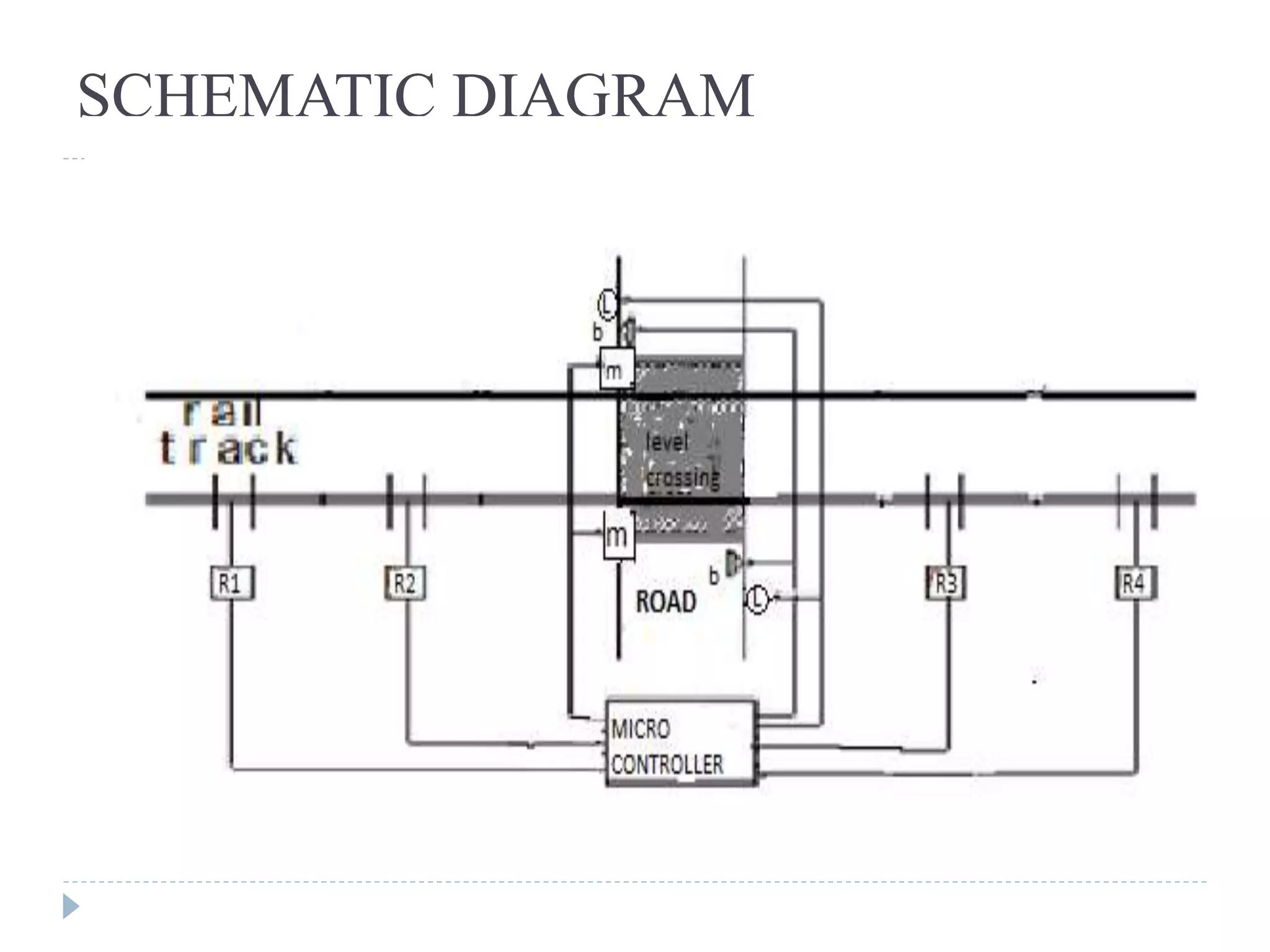
SCHEMATIC DIAGRAM
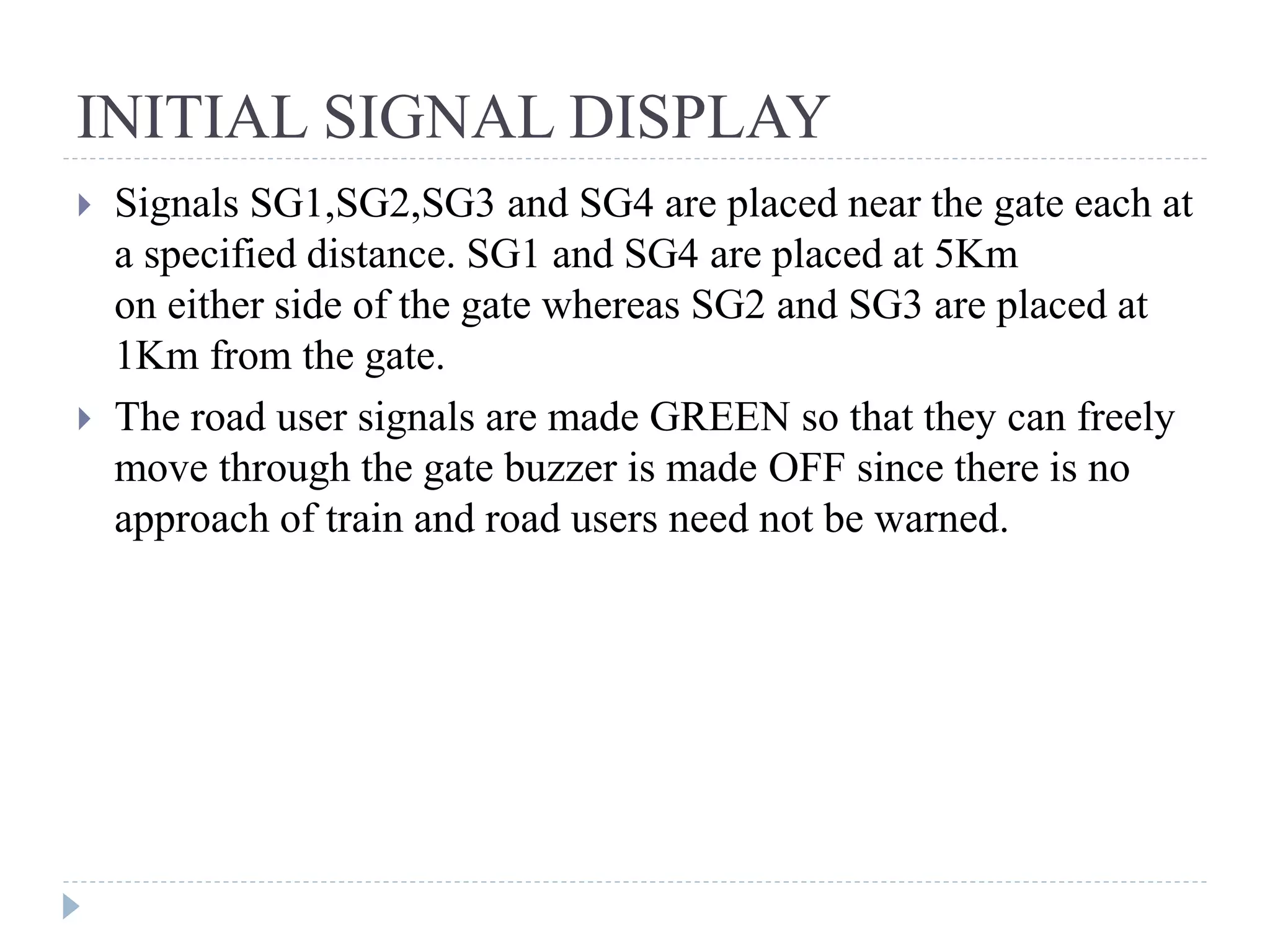
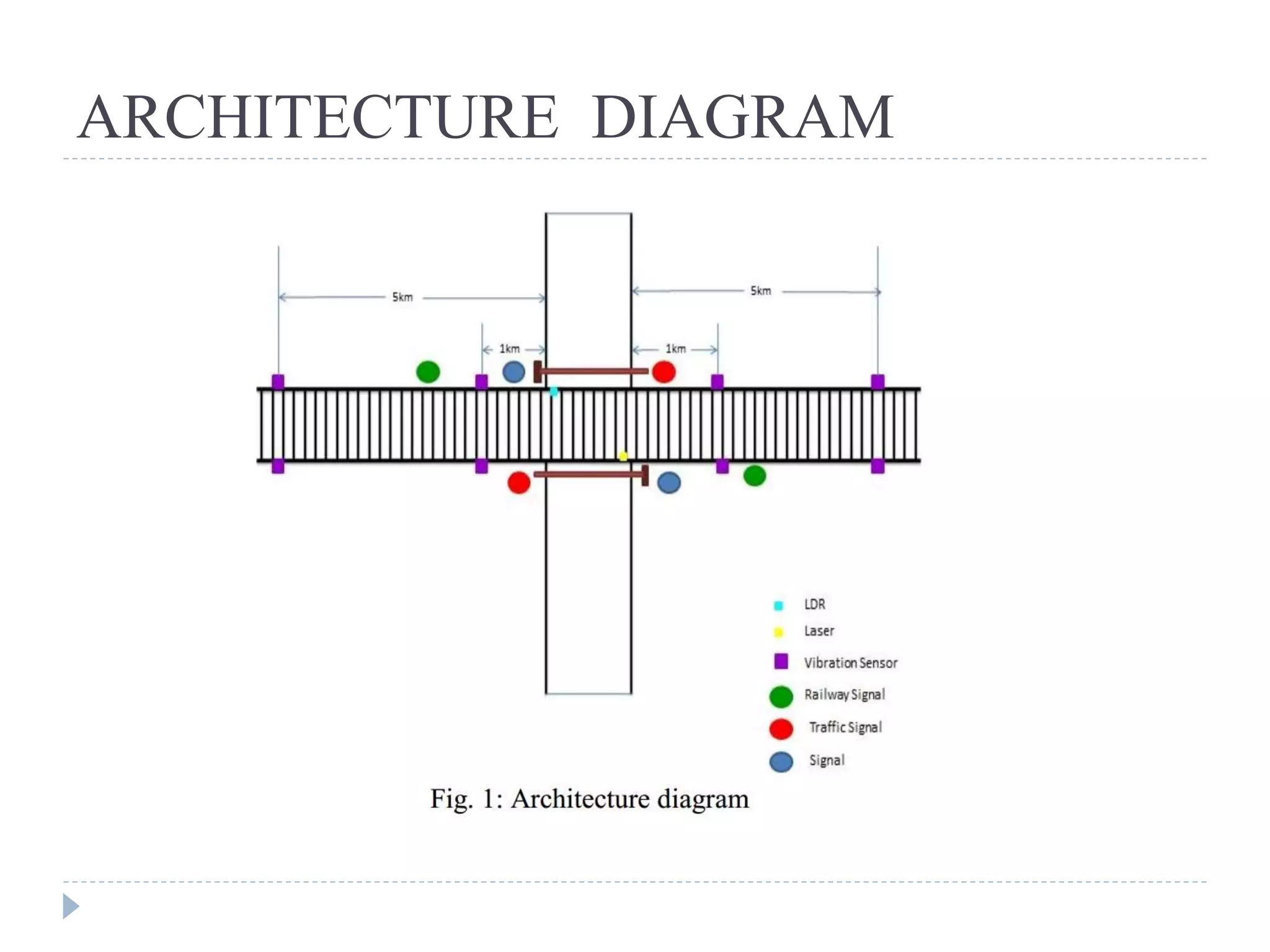
INITIAL SIGNAL DISPLAY  Signals SG1,SG2,SG3 and SG4 are placed near the gate each at a specified distance. SG1 and SG4 are placed at 5Km on either side of the gate whereas SG2 and SG3 are placed at 1Km from the gate.  The road user signals are made GREEN so that they can freely move through the gate buzzer is made OFF since there is no approach of train and road users need not be warned.
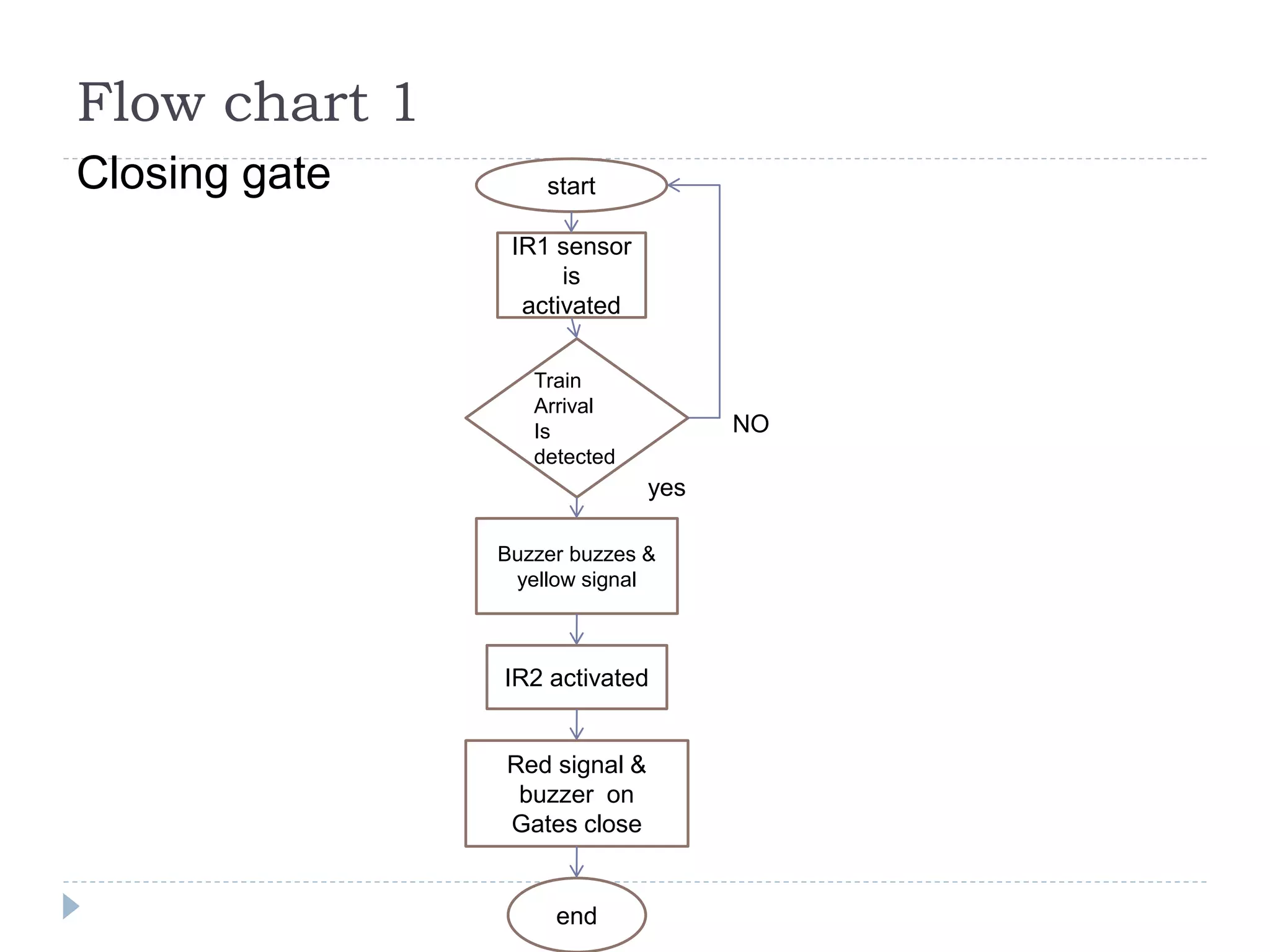
Flow chart 1 Closing gate start IR1 sensor is activated Train Arrival Is detected Buzzer buzzes & yellow signal IR2 activated Red signal & buzzer on Gates close end yes NO
TRAIN ARRIVAL DETECTION  Train arrival is sensing is done by sensors R1 and R4 respectively considering the directions of train approach.  When the train arrival is sensed by the sensors, the signal will be YELLOW.  After sensing next sensor the gate is closed and signal for road users are made RED so that the vehicles cannot pass through the gate.
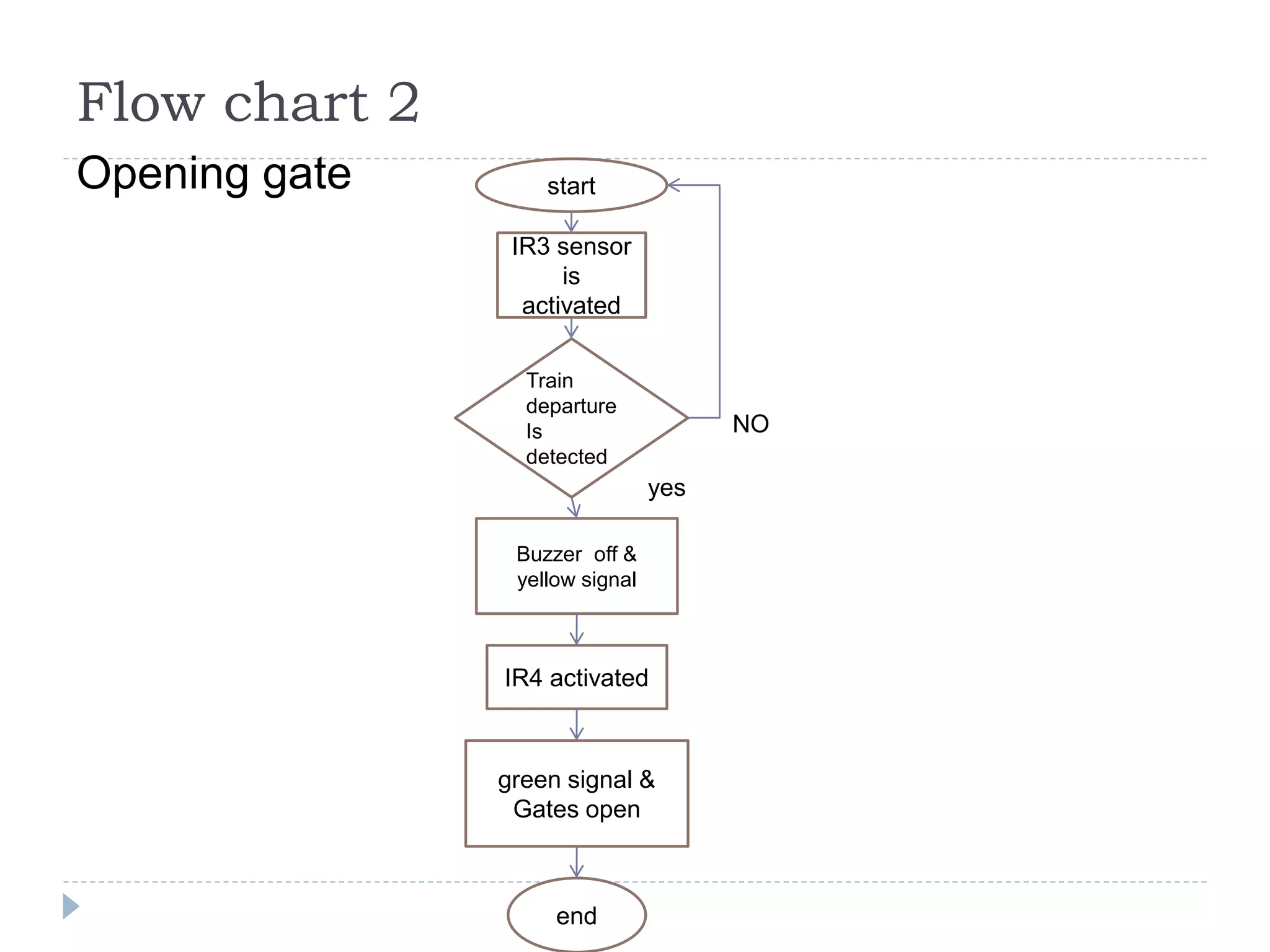
Flow chart 2 Opening gate start IR3 sensor is activated Train departure Is detected Buzzer off & yellow signal IR4 activated green signal & Gates open end yes NO
TRAIN DEPARTURE DETECTION  Train departure sensing is done by sensors R3 andR2 respectively considering the directions of train approach.  When the train departure is sensed by the sensors, the gates are opened.  Once the gate is opened signal for road users are made GREEN so that the vehicles can pass through the gate.
ARCHITECTURE DIAGRAM
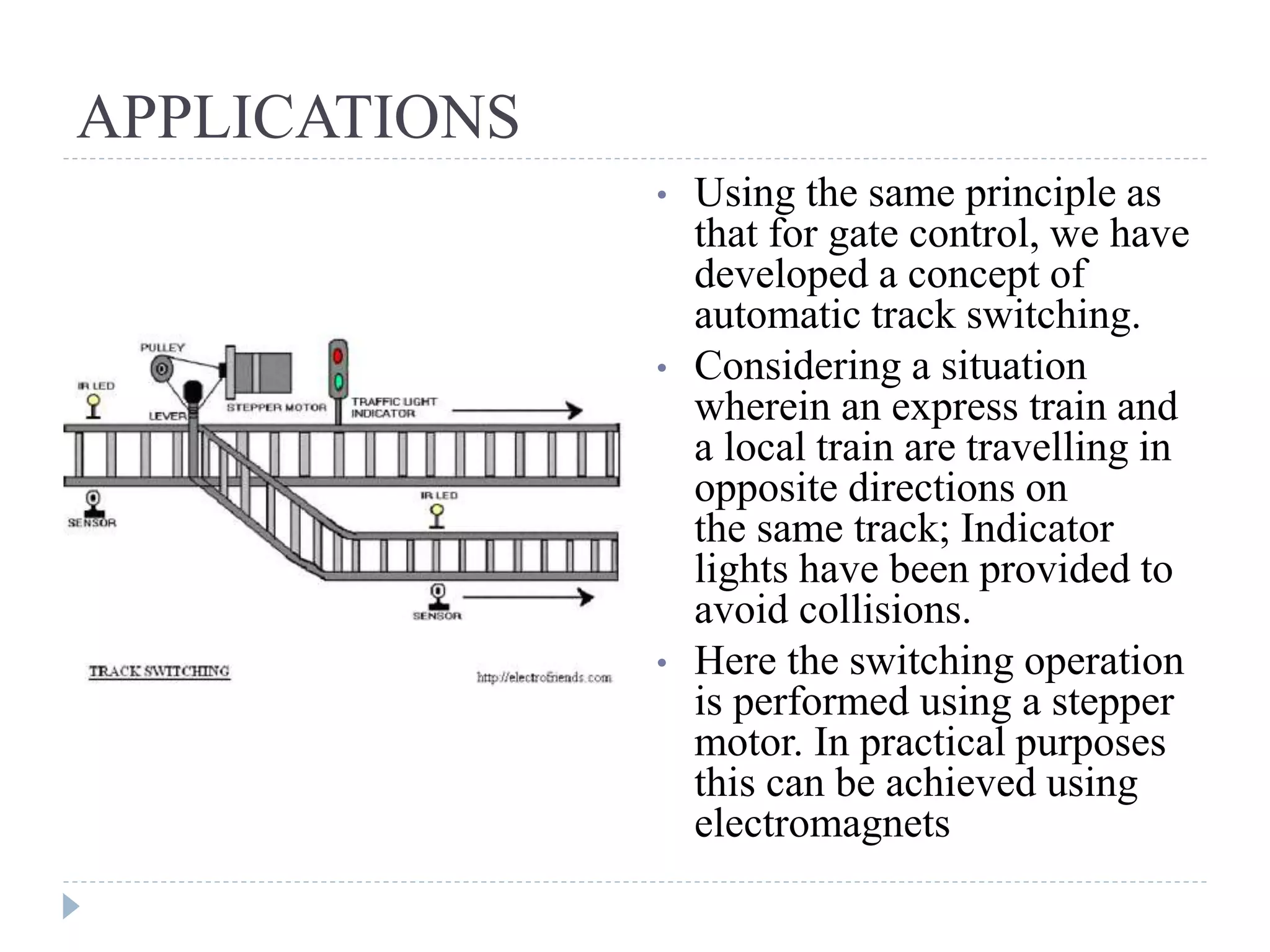
APPLICATIONS • Using the same principle as that for gate control, we have developed a concept of automatic track switching. • Considering a situation wherein an express train and a local train are travelling in opposite directions on the same track; Indicator lights have been provided to avoid collisions. • Here the switching operation is performed using a stepper motor. In practical purposes this can be achieved using electromagnets
ADVANTAGES  Management of road transport will be better.  It will also minimize the risk of deaths in accident with trains.  Reliable machine, which operates the railway gate even without gatekeeper which makes it useful for operation at unmanned crossings.  Less traffic jam will be there.  Management of Road transport will be better.  Management of Road transport will be better.
CONCLUSION  Avoids manual errors & provides ultimate safety to road users.  Gatekeeper not necessary and automatic operation of the gate through the motor.  The mechanism works on a simple principle.
Any Queries??????
Automation of railway gate using verilog presentation

Automation of railway gate using verilog presentation

  • 1.
    AUTOMATION OF RAILWAYGATE CONTROL USING VERILOG By Ms. D.Vidya (14C35A0409) Ms. V.Pavanisujatha (13C31A04A1) Mr.P.Chendra shekar (13C31A0471) Under the guidance of Ms. M. Mounika Assistant professor BALAJI INSTITUTE OF TECHNOLOGY AND SCIENCE NARSAMPET, WARANGAL – 506 331 DEPARTMENT OF ELECTRONICS AND COMMUNICATION ENGINEERING
  • 2.
    CONTENT  INTRODUCTION  ABSTRACT SCHEMATIC DIAGRAM  IR SENSOR  INITIAL SIGNAL DISPLAY  FLOW CHART-1  TRAIN ARRIVAL DETECTION  FLOW CHART-2  TRAIN DEPARTURE DETECTION  ARCHITECTURE DIAGRAM
  • 3.
     APPLICATIONS  ADVANTAGES CONCLUSION  REFERNCES
  • 4.
    INTRODUCTION  The railwaysystem is the most commonly used transportation mode in India.  Level crossings are managed by the gatekeeper and the gatekeeper is instructed by the means of telephone at most of the level cross from the control room.  Delay in the opening and closing of the gate could lead to railway accidents.  To avoid the human errors that could occur during the operation of gates, level crosses are controlled manually & the concept of automation is introduced.
  • 5.
    ABSTRACT  The presentwork attempts to automate the opening and closing of gates at a railway level crossing.  The proposed system uses infrared sensors to detect the arrival and departure of trains at the railway level crossing.  The system uses two IR sensors to detect the arrival of the train and a third IR sensor to detect the departure of the train.
  • 6.
  • 7.
    INITIAL SIGNAL DISPLAY Signals SG1,SG2,SG3 and SG4 are placed near the gate each at a specified distance. SG1 and SG4 are placed at 5Km on either side of the gate whereas SG2 and SG3 are placed at 1Km from the gate.  The road user signals are made GREEN so that they can freely move through the gate buzzer is made OFF since there is no approach of train and road users need not be warned.
  • 8.
    Flow chart 1 Closinggate start IR1 sensor is activated Train Arrival Is detected Buzzer buzzes & yellow signal IR2 activated Red signal & buzzer on Gates close end yes NO
  • 9.
    TRAIN ARRIVAL DETECTION Train arrival is sensing is done by sensors R1 and R4 respectively considering the directions of train approach.  When the train arrival is sensed by the sensors, the signal will be YELLOW.  After sensing next sensor the gate is closed and signal for road users are made RED so that the vehicles cannot pass through the gate.
  • 10.
    Flow chart 2 Openinggate start IR3 sensor is activated Train departure Is detected Buzzer off & yellow signal IR4 activated green signal & Gates open end yes NO
  • 11.
    TRAIN DEPARTURE DETECTION Train departure sensing is done by sensors R3 andR2 respectively considering the directions of train approach.  When the train departure is sensed by the sensors, the gates are opened.  Once the gate is opened signal for road users are made GREEN so that the vehicles can pass through the gate.
  • 12.
  • 13.
    APPLICATIONS • Using thesame principle as that for gate control, we have developed a concept of automatic track switching. • Considering a situation wherein an express train and a local train are travelling in opposite directions on the same track; Indicator lights have been provided to avoid collisions. • Here the switching operation is performed using a stepper motor. In practical purposes this can be achieved using electromagnets
  • 14.
    ADVANTAGES  Management ofroad transport will be better.  It will also minimize the risk of deaths in accident with trains.  Reliable machine, which operates the railway gate even without gatekeeper which makes it useful for operation at unmanned crossings.  Less traffic jam will be there.  Management of Road transport will be better.  Management of Road transport will be better.
  • 15.
    CONCLUSION  Avoids manualerrors & provides ultimate safety to road users.  Gatekeeper not necessary and automatic operation of the gate through the motor.  The mechanism works on a simple principle.
  • 16.