AWS Basics - VPC & Networking concepts By Abhinav Kumar
Agenda • Datacenter – Physical DC and concepts • IP – Division & classification • VPC & Subnets • AWS Basic Architecture • Route table • Internet Gateway • NAT instance & Nat Gateways • Security Groups & Network ACLs
Datacenter Team’s Contribution • Place where we have many Storage, compute and network devices. • Inter-connected with each other through high speed network connections • Are available on public or private network • It generally includes redundantor backup power supplies, redundant data communications connections, environmental controls (e.g. air conditioning, fire suppression) and various security devices. A large data center is an industrial-scale operation using as much electricity as a small town.
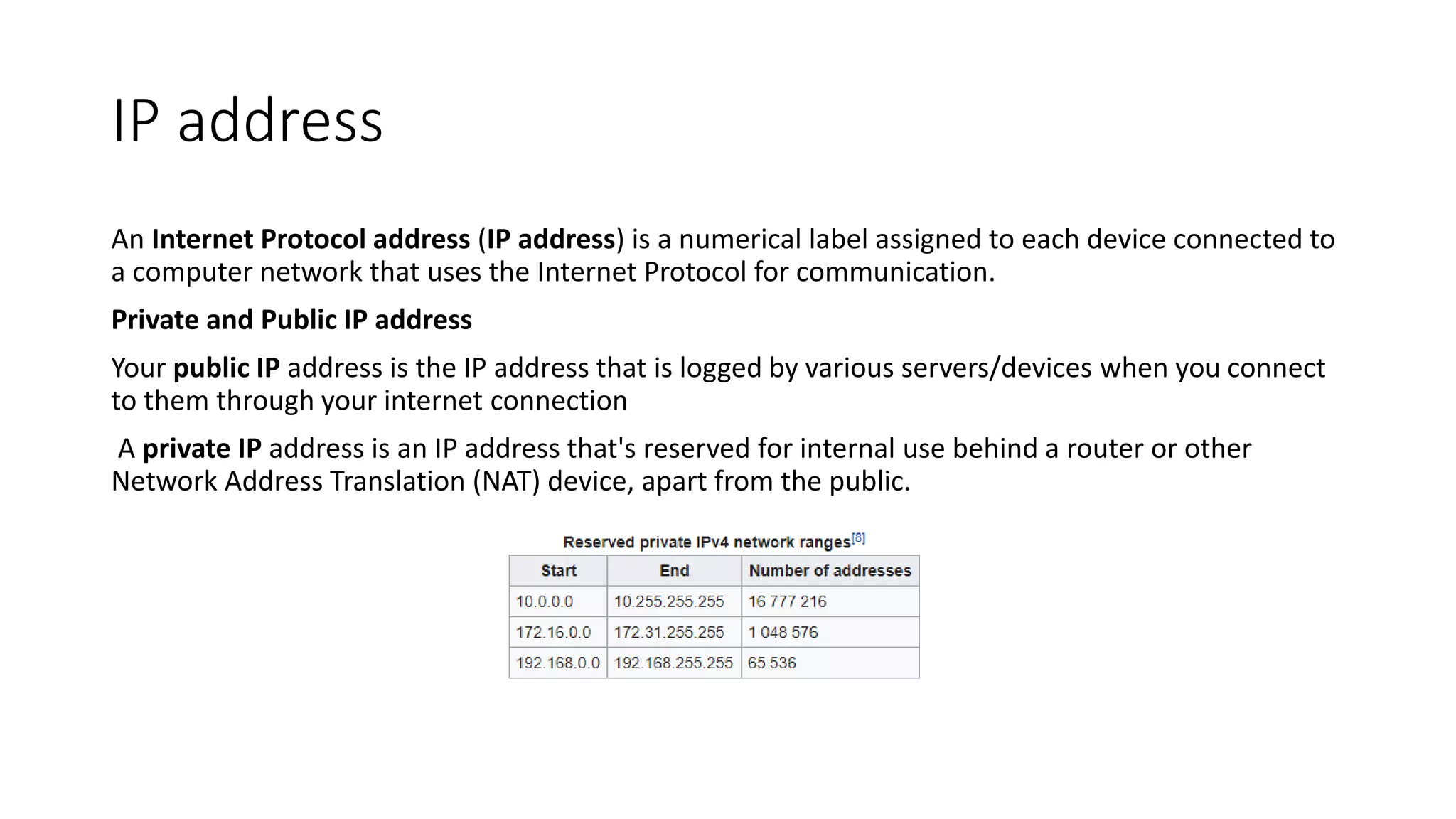
IP address An Internet Protocol address (IP address) is a numerical label assigned to each device connected to a computer network that uses the Internet Protocol for communication. Private and Public IP address Your public IP address is the IP address that is logged by various servers/devices when you connect to them through your internet connection A private IP address is an IP address that's reserved for internal use behind a router or other Network Address Translation (NAT) device, apart from the public.
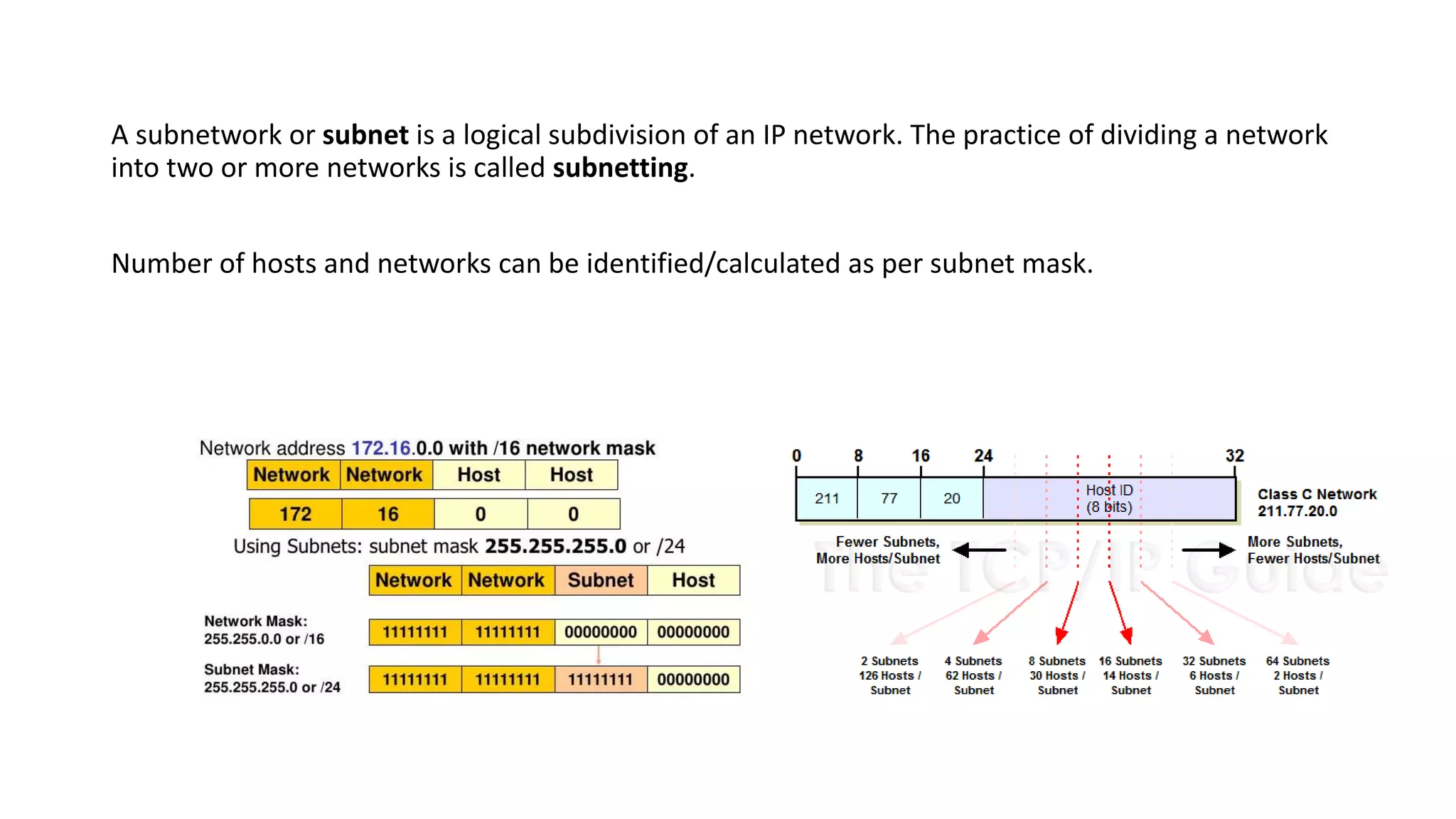
A subnetwork or subnet is a logical subdivision of an IP network. The practice of dividing a network into two or more networks is called subnetting. Number of hosts and networks can be identified/calculated as per subnet mask.
Virtual Private Cloud (VPC) Amazon Virtual Private Cloud (VPC) is a commercial cloud computing service that provides users a virtual private cloud, by provision a logically isolated section of Amazon Web Services (AWS) Cloud • Composed of large IP range • 5 VPC in one region of AWS • Contains subnets Subnets Subnets in VPCs are further division of network, which are created in specific availability zone of a region. Public Subnets – Subnet in which Instances are provided by Elastic IP(by default) can be overridden.
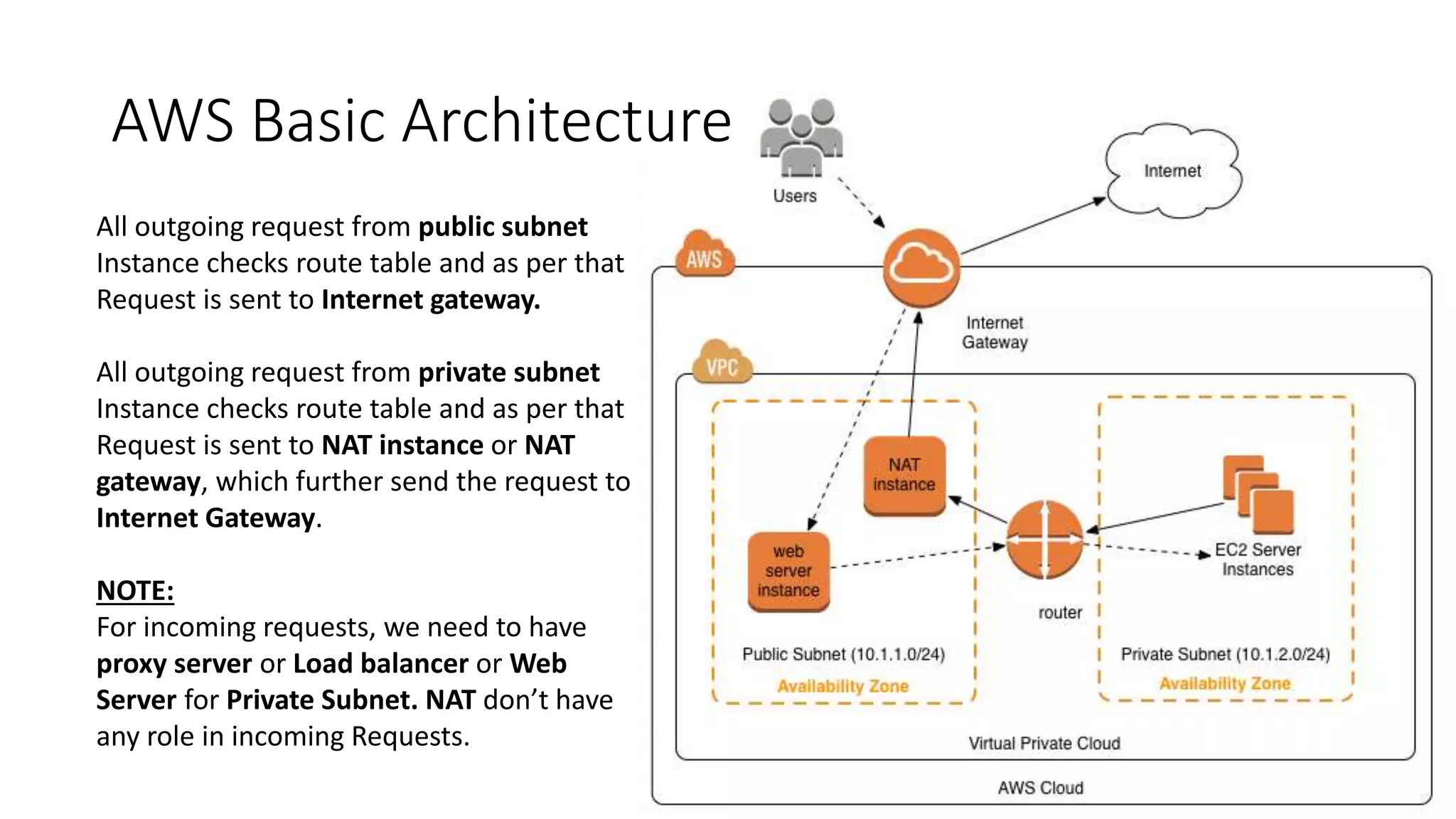
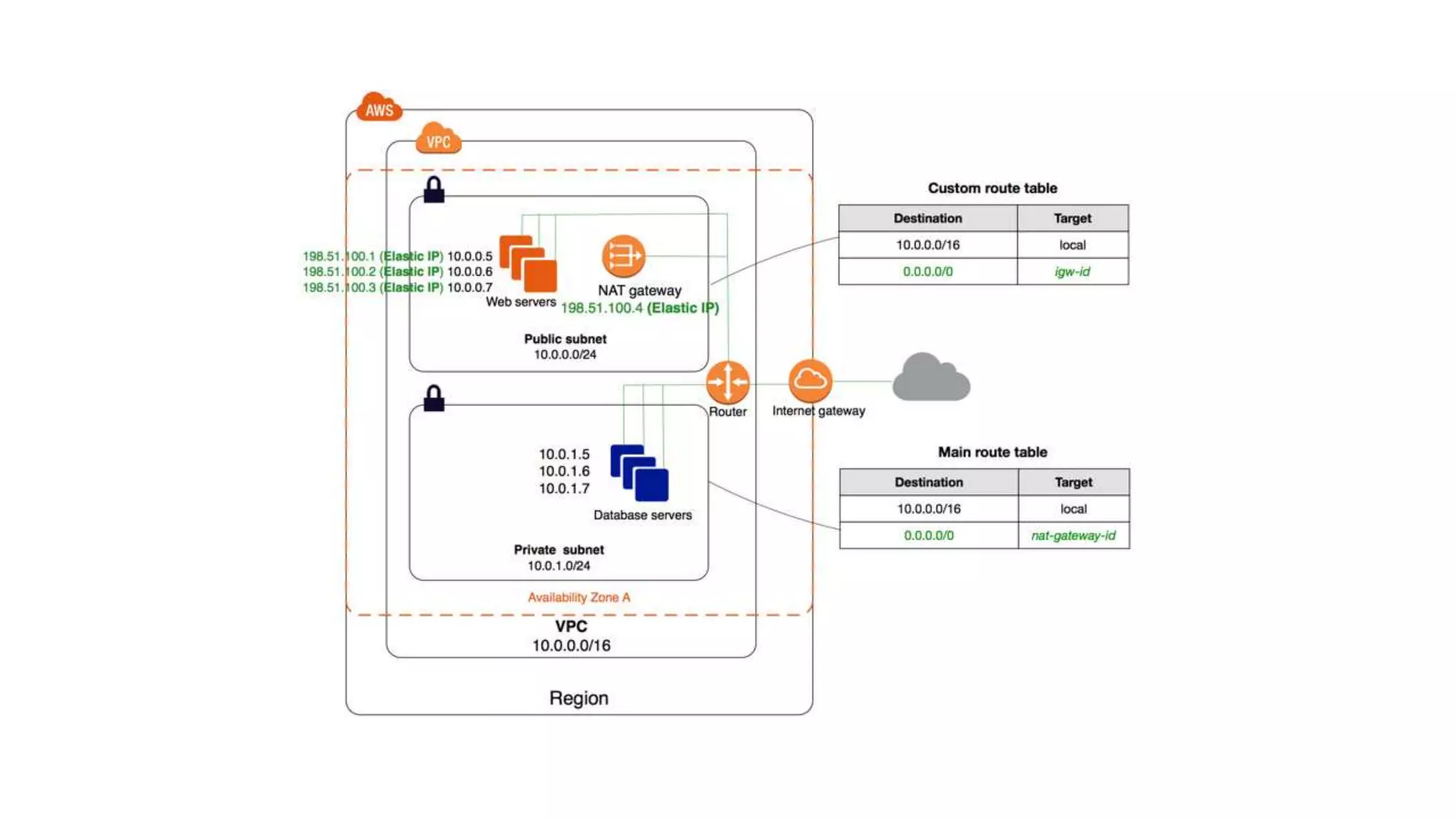
AWS Basic Architecture All outgoing request from public subnet Instance checks route table and as per that Request is sent to Internet gateway. All outgoing request from private subnet Instance checks route table and as per that Request is sent to NAT instance or NAT gateway, which further send the request to Internet Gateway. NOTE: For incoming requests, we need to have proxy server or Load balancer or Web Server for Private Subnet. NAT don’t have any role in incoming Requests.
Route Table A route table contains a set of rules, called routes, that are used to determine where network traffic is directed. Each subnet in your VPC must be associated with a route table; the table controls the routing for the subnet. A subnet can only be associated with one route table at a time, but you can associate multiple subnets with the same route table. Internet Gateway An Internet gateway is a horizontally scaled, redundant, and highly available VPC component that allows communication between instances in your VPC and the Internet. It therefore imposes no availability risks or bandwidth constraints on your network traffic. An Internet gateway serves two purposes: to provide a target in your VPC route tables for Internet- routable traffic, and to perform network address translation (NAT) for instances that have been assigned public IPv4 addresses.
NAT Instance & Nat Gateways You can use a network address translation (NAT) to enable instances in a private subnet to connect to the internet or other AWS services, but prevent the internet from initiating a connection with those instances. NAT instance is an instance with NAT configured and NAT gateway is a service provided by AWS
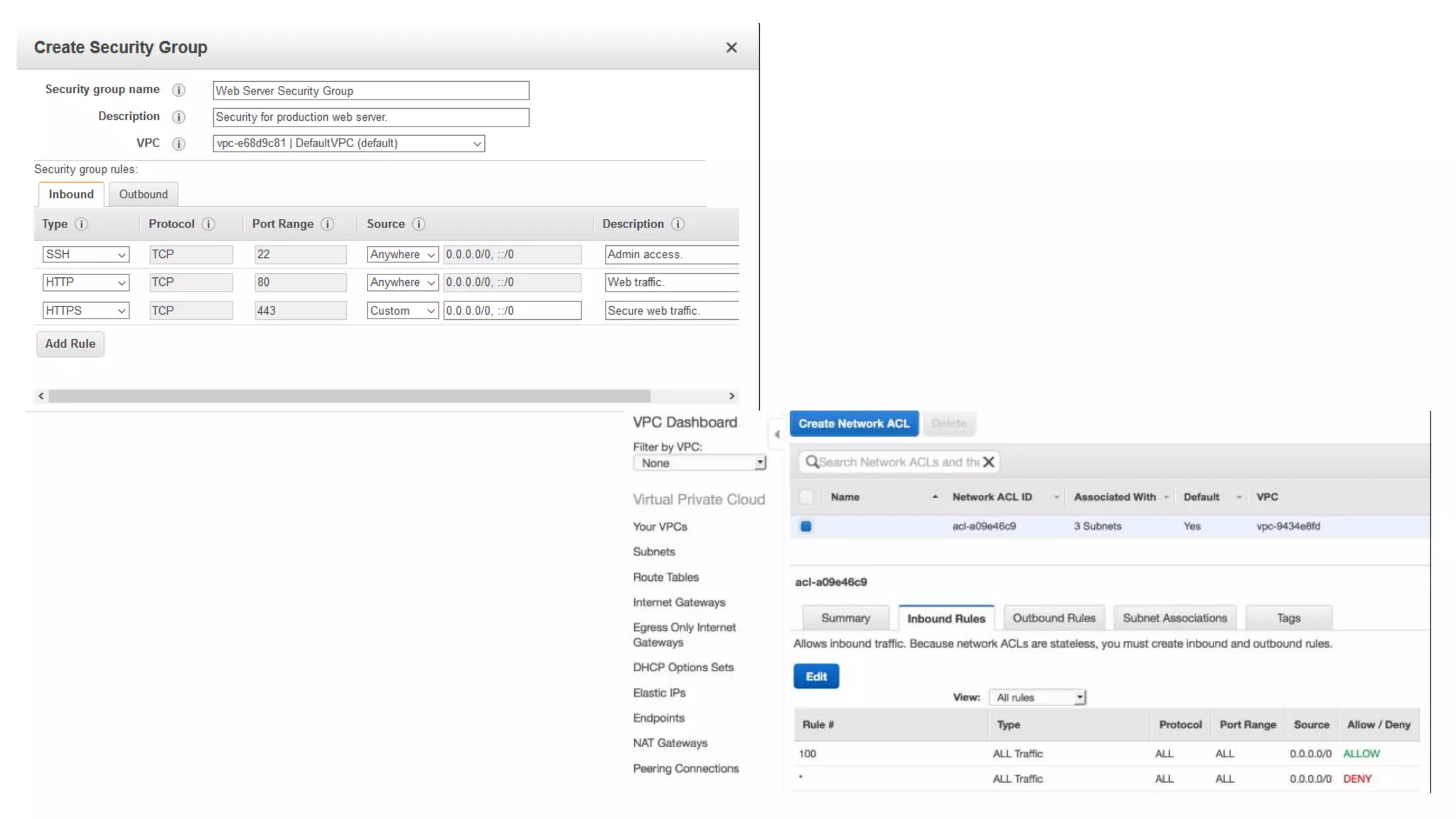
Security Group A security group acts as a virtual firewall that controls the traffic for one or more instances. When you launch an instance, you associate one or more security groups with the instance. You can modify the rules for a security group at any time; the new rules are automatically applied to all instances that are associated with the security group. When we decide whether to allow traffic to reach an instance, we evaluate all the rules from all the security groups that are associated with the instance. A network access control list (ACL) is an optional layer of security for your VPC that acts as a firewall for controlling traffic in and out of one or more subnets. You might set up network ACLs with rules similar to your security groups in order to add an additional layer of security to your VPC. Network ACL
References • https://docs.aws.amazon.com/ • https://en.wikipedia.org • https://www.google.co.in

AWS VPC & Networking basic concepts

  • 1.
    AWS Basics -VPC & Networking concepts By Abhinav Kumar
  • 2.
    Agenda • Datacenter –Physical DC and concepts • IP – Division & classification • VPC & Subnets • AWS Basic Architecture • Route table • Internet Gateway • NAT instance & Nat Gateways • Security Groups & Network ACLs
  • 3.
    Datacenter Team’s Contribution • Placewhere we have many Storage, compute and network devices. • Inter-connected with each other through high speed network connections • Are available on public or private network • It generally includes redundantor backup power supplies, redundant data communications connections, environmental controls (e.g. air conditioning, fire suppression) and various security devices. A large data center is an industrial-scale operation using as much electricity as a small town.
  • 4.
    IP address An InternetProtocol address (IP address) is a numerical label assigned to each device connected to a computer network that uses the Internet Protocol for communication. Private and Public IP address Your public IP address is the IP address that is logged by various servers/devices when you connect to them through your internet connection A private IP address is an IP address that's reserved for internal use behind a router or other Network Address Translation (NAT) device, apart from the public.
  • 5.
    A subnetwork orsubnet is a logical subdivision of an IP network. The practice of dividing a network into two or more networks is called subnetting. Number of hosts and networks can be identified/calculated as per subnet mask.
  • 6.
    Virtual Private Cloud(VPC) Amazon Virtual Private Cloud (VPC) is a commercial cloud computing service that provides users a virtual private cloud, by provision a logically isolated section of Amazon Web Services (AWS) Cloud • Composed of large IP range • 5 VPC in one region of AWS • Contains subnets Subnets Subnets in VPCs are further division of network, which are created in specific availability zone of a region. Public Subnets – Subnet in which Instances are provided by Elastic IP(by default) can be overridden.
  • 7.
    AWS Basic Architecture Alloutgoing request from public subnet Instance checks route table and as per that Request is sent to Internet gateway. All outgoing request from private subnet Instance checks route table and as per that Request is sent to NAT instance or NAT gateway, which further send the request to Internet Gateway. NOTE: For incoming requests, we need to have proxy server or Load balancer or Web Server for Private Subnet. NAT don’t have any role in incoming Requests.
  • 8.
    Route Table A routetable contains a set of rules, called routes, that are used to determine where network traffic is directed. Each subnet in your VPC must be associated with a route table; the table controls the routing for the subnet. A subnet can only be associated with one route table at a time, but you can associate multiple subnets with the same route table. Internet Gateway An Internet gateway is a horizontally scaled, redundant, and highly available VPC component that allows communication between instances in your VPC and the Internet. It therefore imposes no availability risks or bandwidth constraints on your network traffic. An Internet gateway serves two purposes: to provide a target in your VPC route tables for Internet- routable traffic, and to perform network address translation (NAT) for instances that have been assigned public IPv4 addresses.
  • 9.
    NAT Instance &Nat Gateways You can use a network address translation (NAT) to enable instances in a private subnet to connect to the internet or other AWS services, but prevent the internet from initiating a connection with those instances. NAT instance is an instance with NAT configured and NAT gateway is a service provided by AWS
  • 11.
    Security Group A securitygroup acts as a virtual firewall that controls the traffic for one or more instances. When you launch an instance, you associate one or more security groups with the instance. You can modify the rules for a security group at any time; the new rules are automatically applied to all instances that are associated with the security group. When we decide whether to allow traffic to reach an instance, we evaluate all the rules from all the security groups that are associated with the instance. A network access control list (ACL) is an optional layer of security for your VPC that acts as a firewall for controlling traffic in and out of one or more subnets. You might set up network ACLs with rules similar to your security groups in order to add an additional layer of security to your VPC. Network ACL
  • 13.