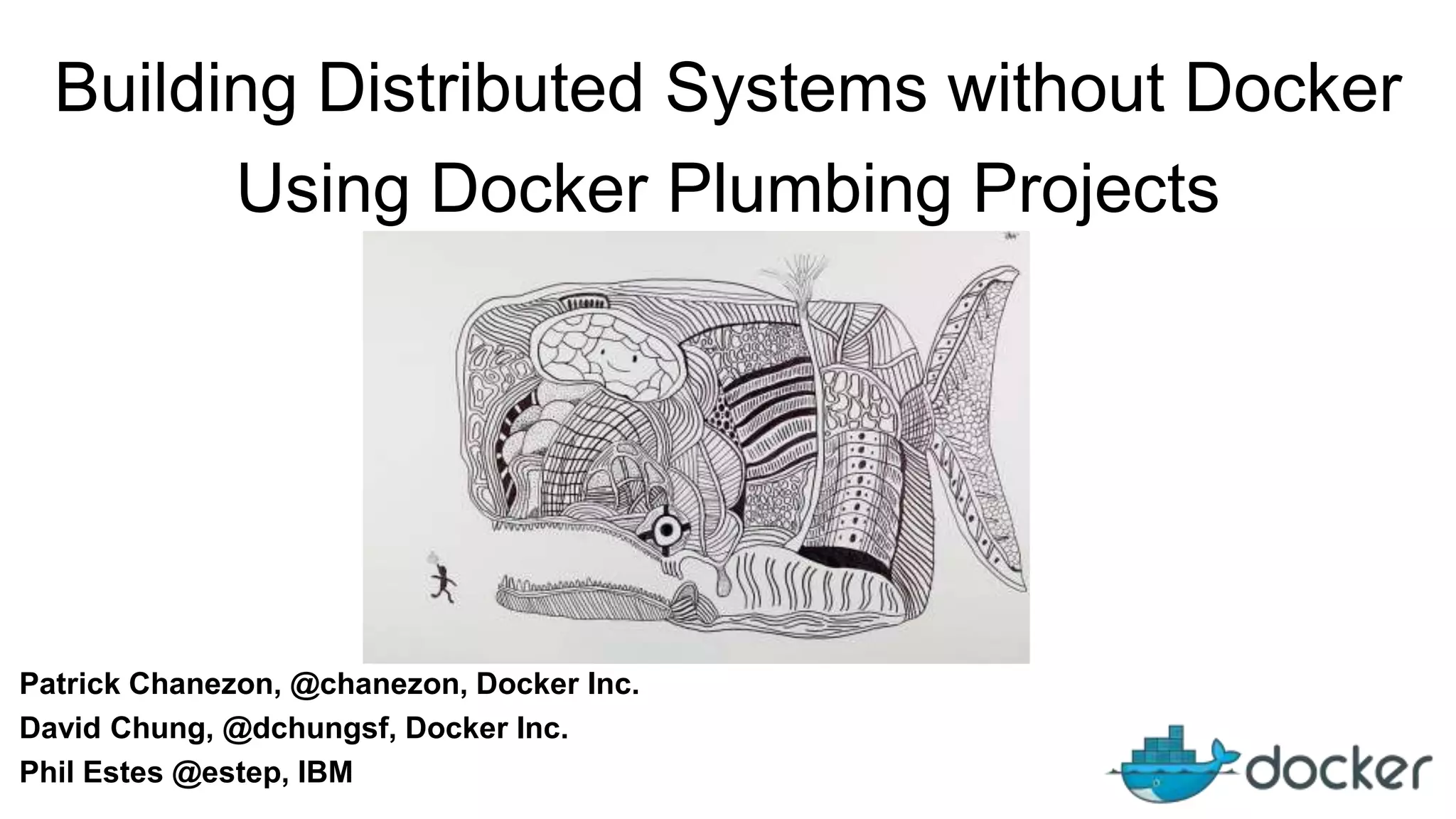



Patrick Chanezon, @chanezon, Docker Inc. Building Distributed Systems without Docker Using Docker Plumbing Projects David Chung, @dchungsf, Docker Inc. Phil Estes @estep, IBM
French Polyglot Platforms Software Plumber San Francisco Developer Relations @chanezon
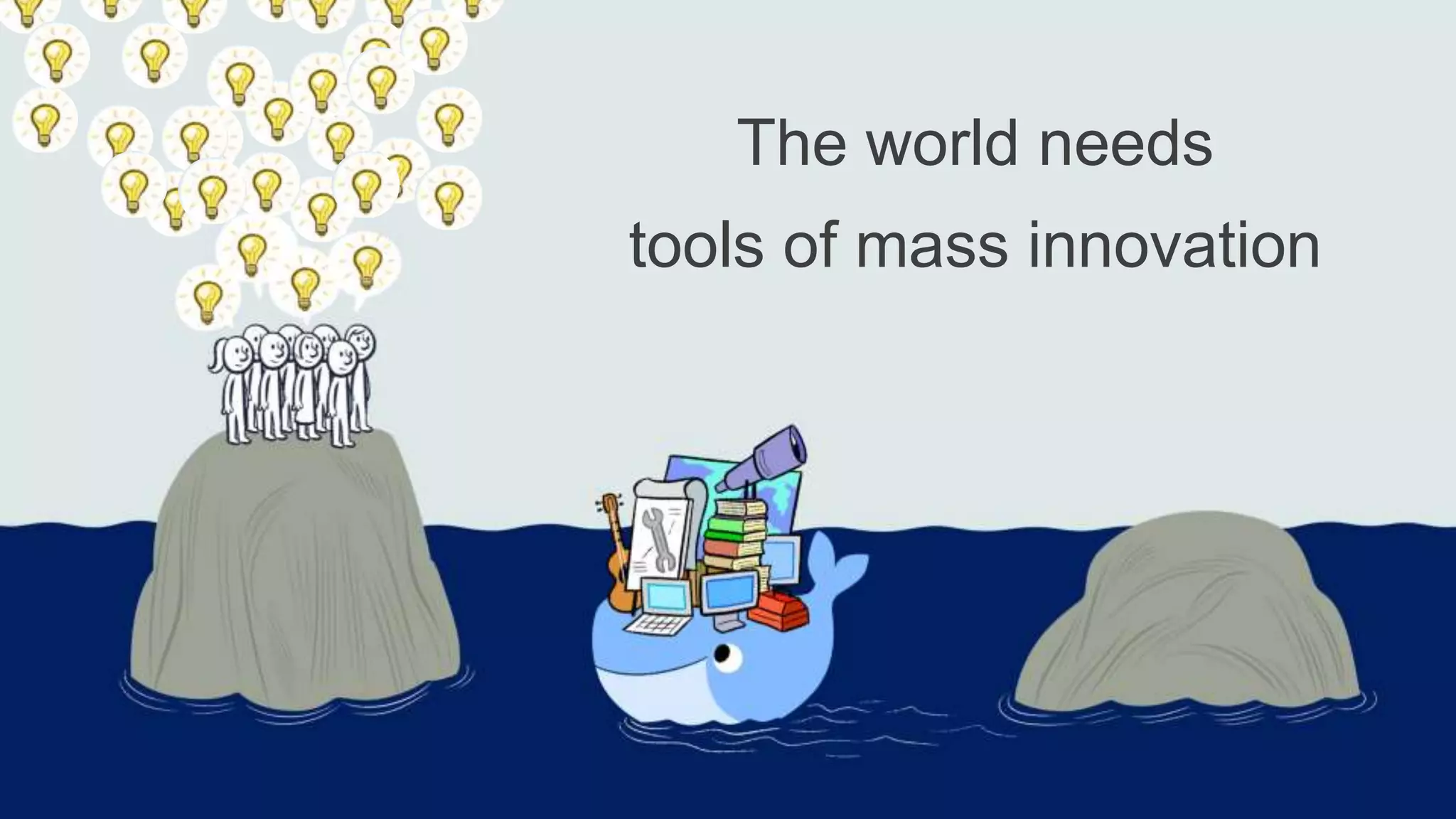
The world needs tools of mass innovation
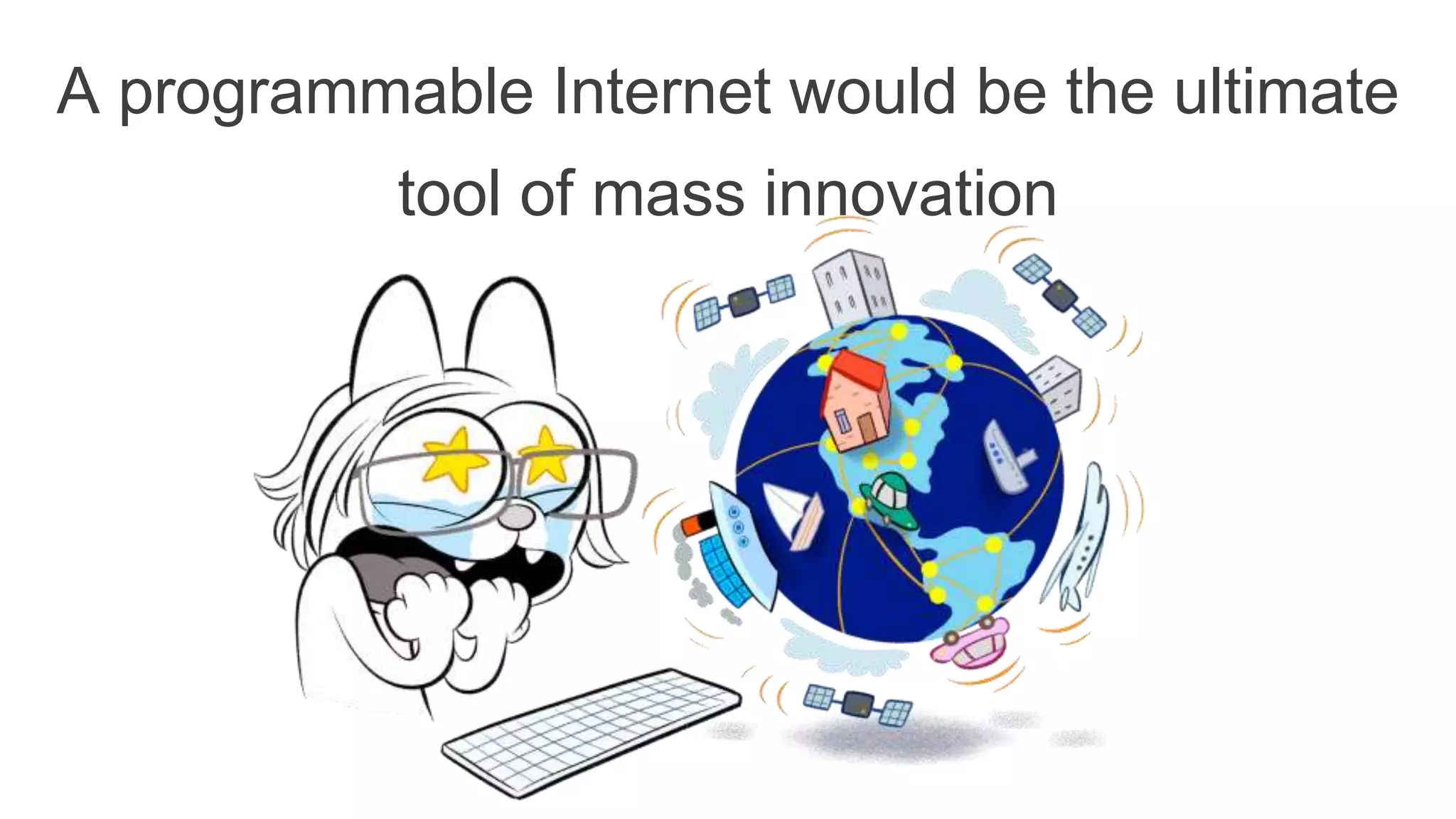
A programmable Internet would be the ultimate tool of mass innovation
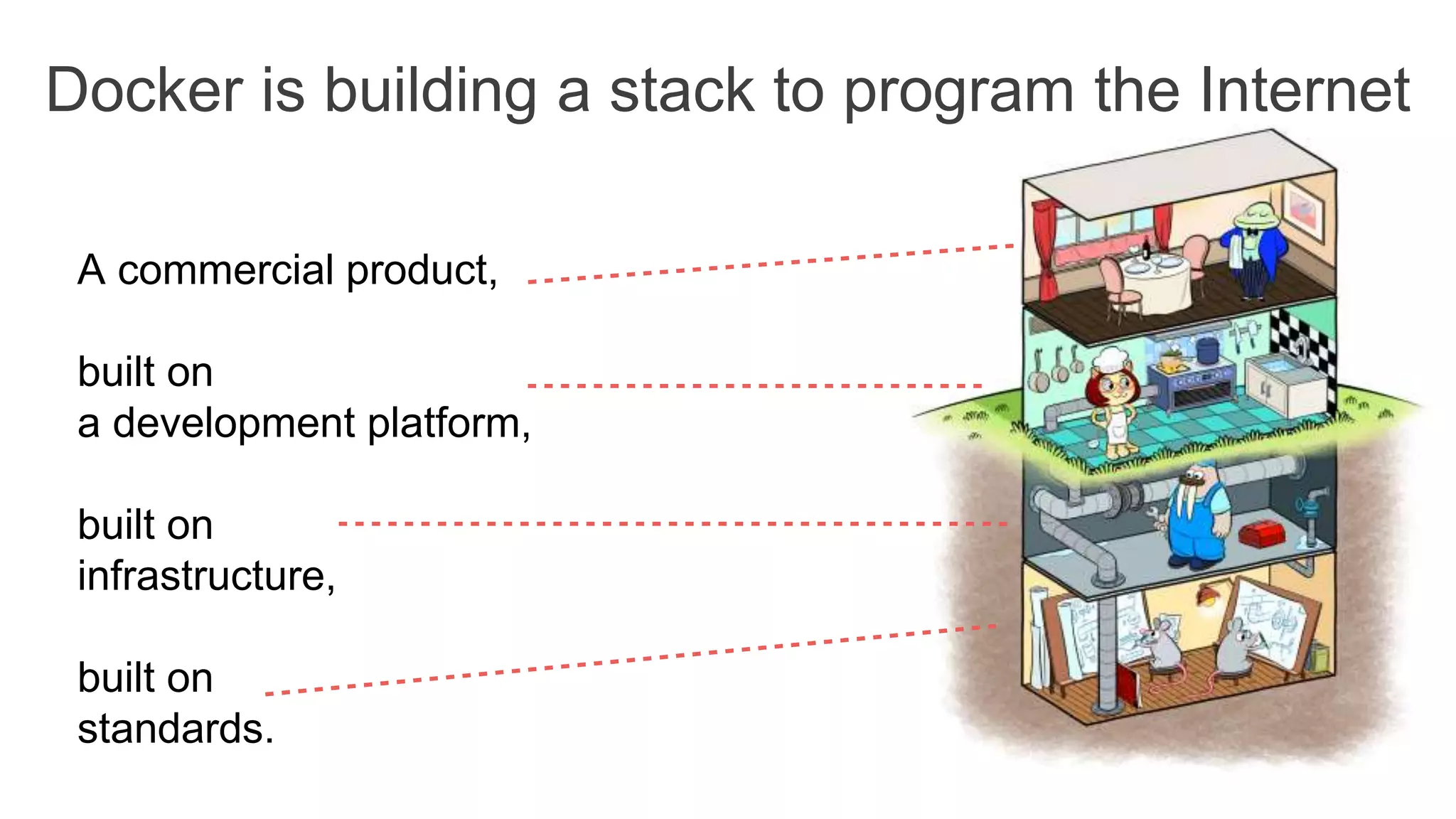
A commercial product, built on a development platform, built on infrastructure, built on standards. Docker is building a stack to program the Internet
Docker Platform
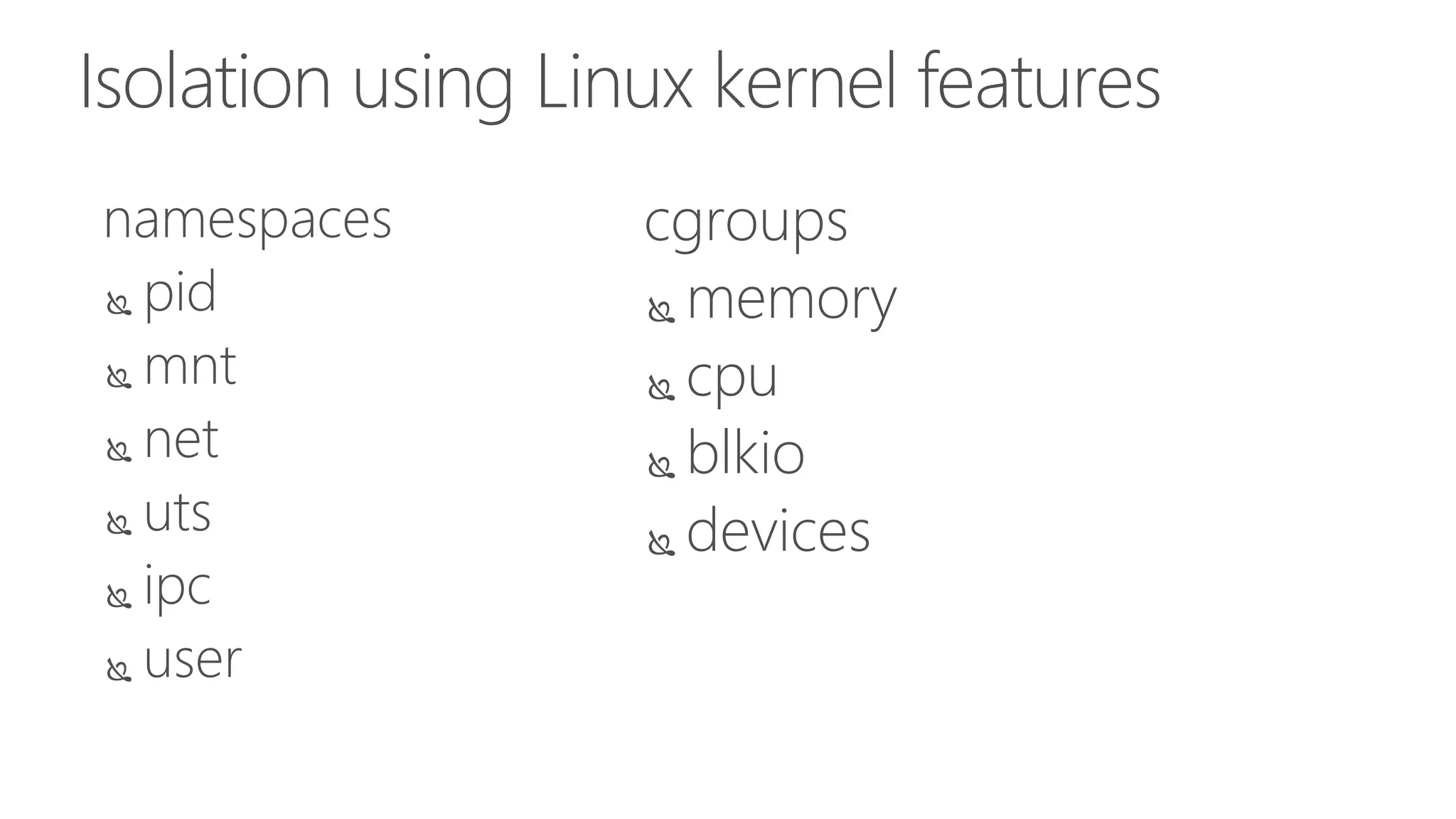
Isolation using Linux kernel features namespaces  pid  mnt  net  uts  ipc  user cgroups  memory  cpu  blkio  devices
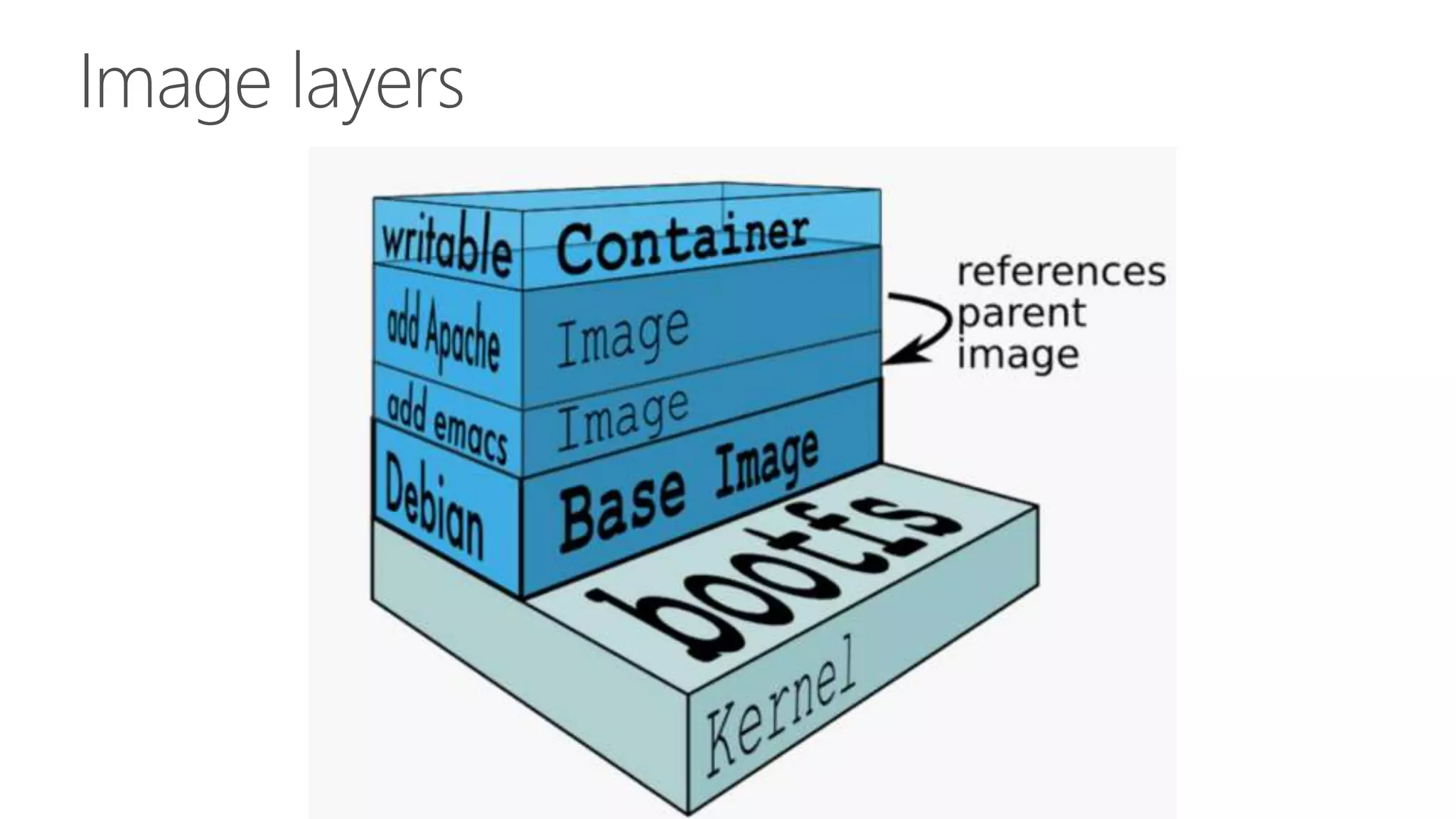
Image layers
1. Developer experience
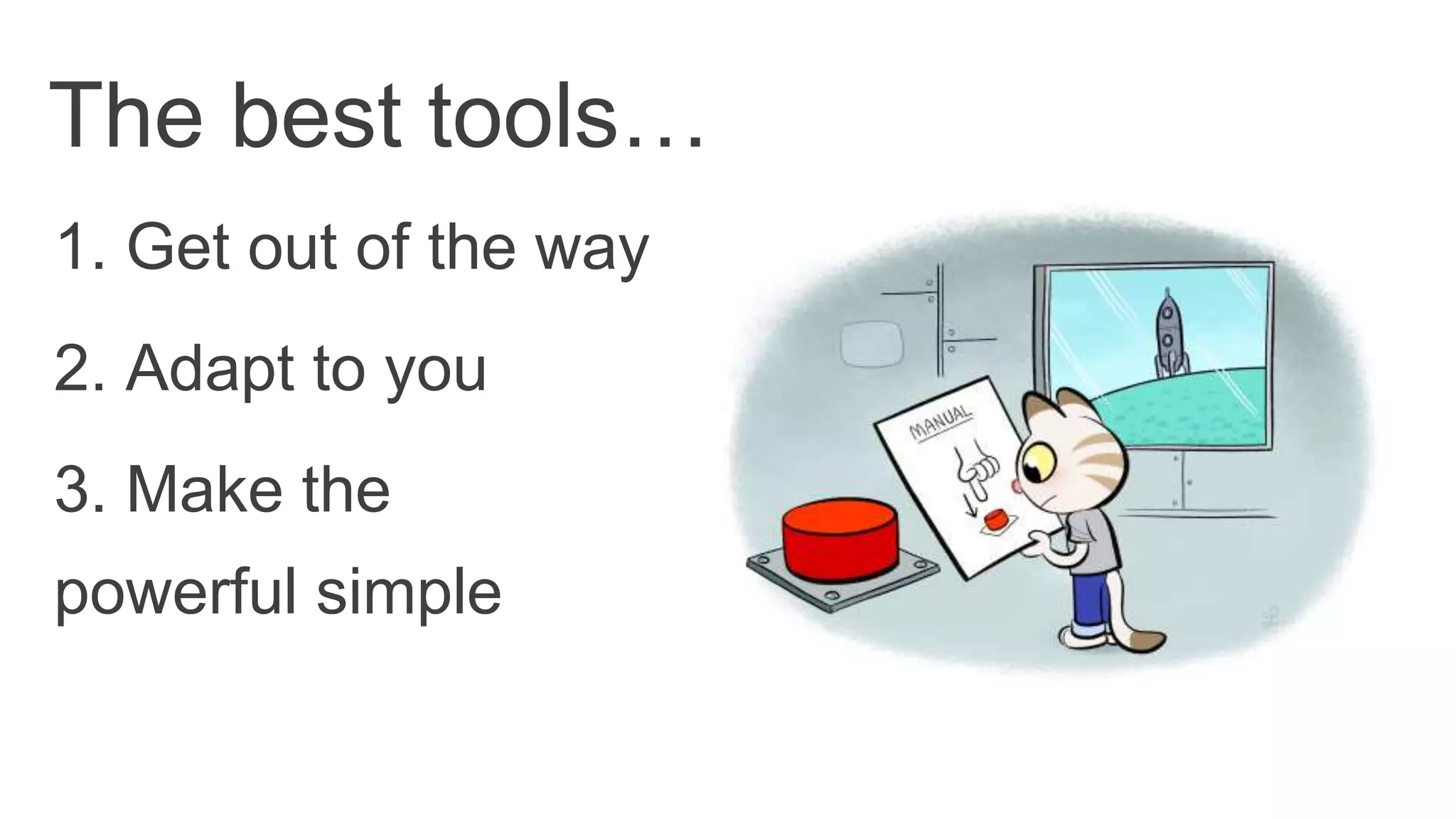
1. Get out of the way The best tools… 2. Adapt to you 3. Make the powerful simple
Docker for Mac Docker for Windows
2. Orchestration
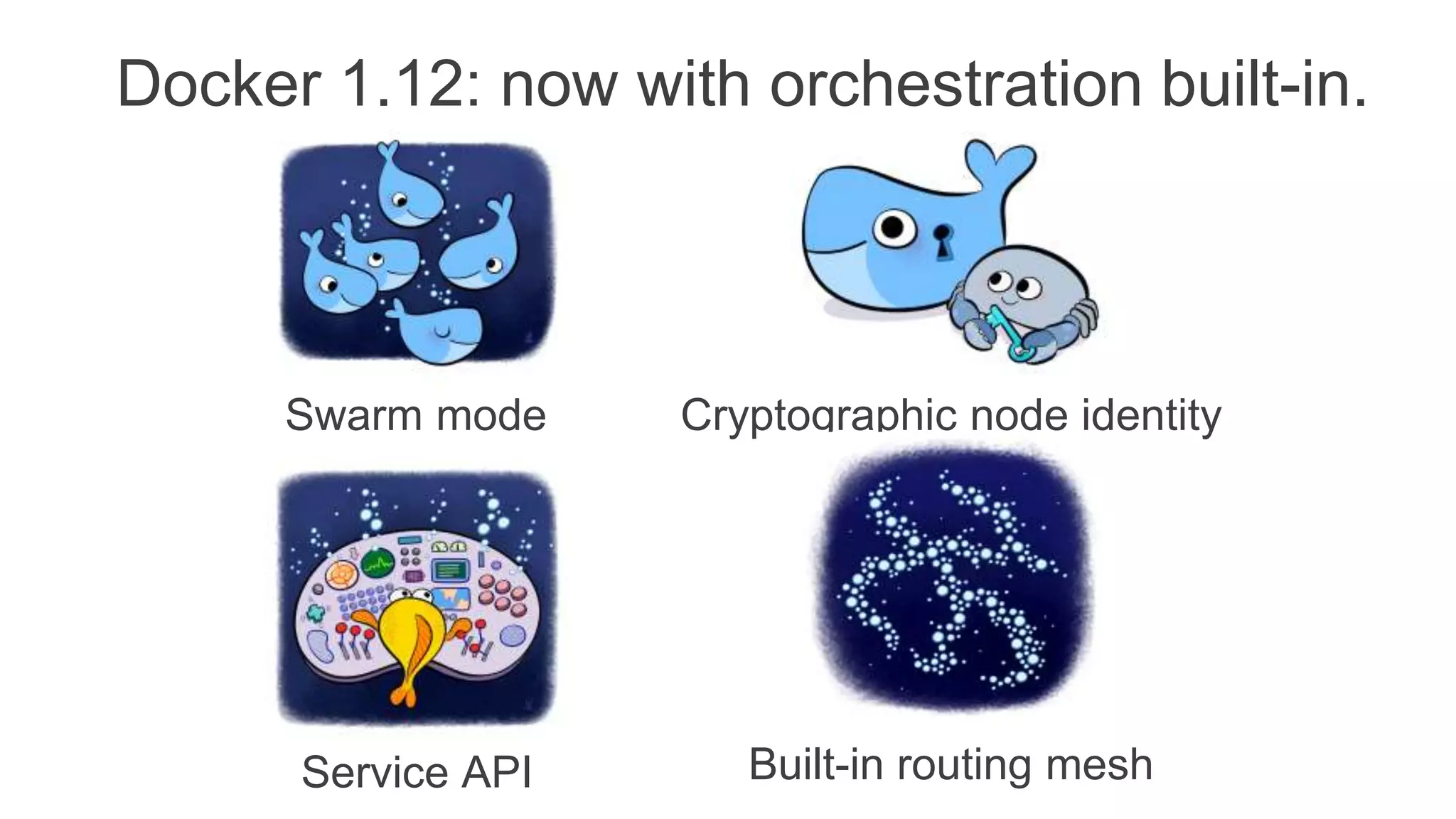
ng the best way to orchestrate Docke Docker 1.12: now with orchestration built-in.
Swarm mode Service API Cryptographic node identity Built-in routing mesh Docker 1.12: now with orchestration built-in.
Using the beta? You already have 1.12 installed. > docker swarm init > docker service create
3. Ops experience
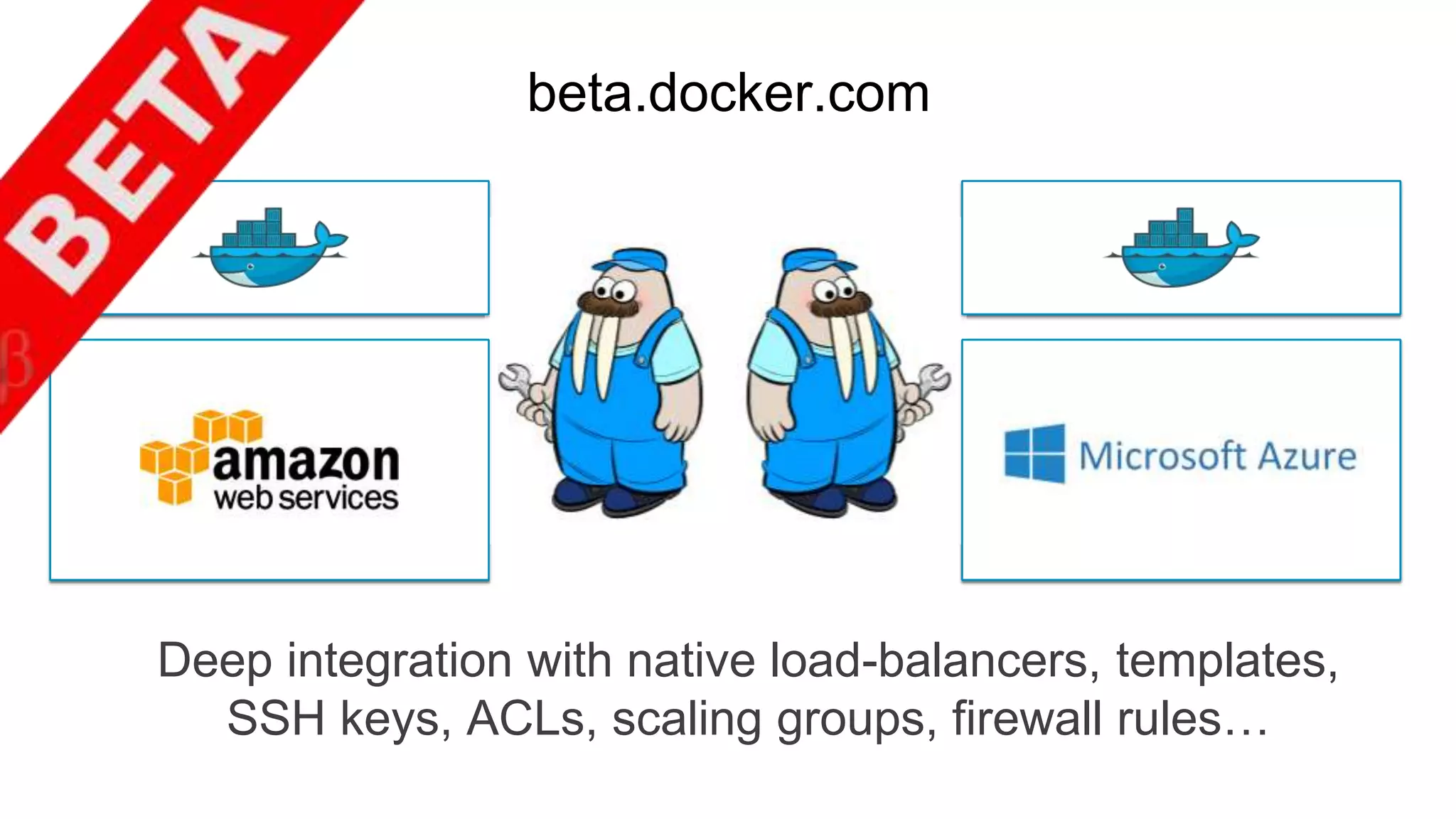
Deep integration with native load-balancers, templates, SSH keys, ACLs, scaling groups, firewall rules… beta.docker.com
Docker CaaS
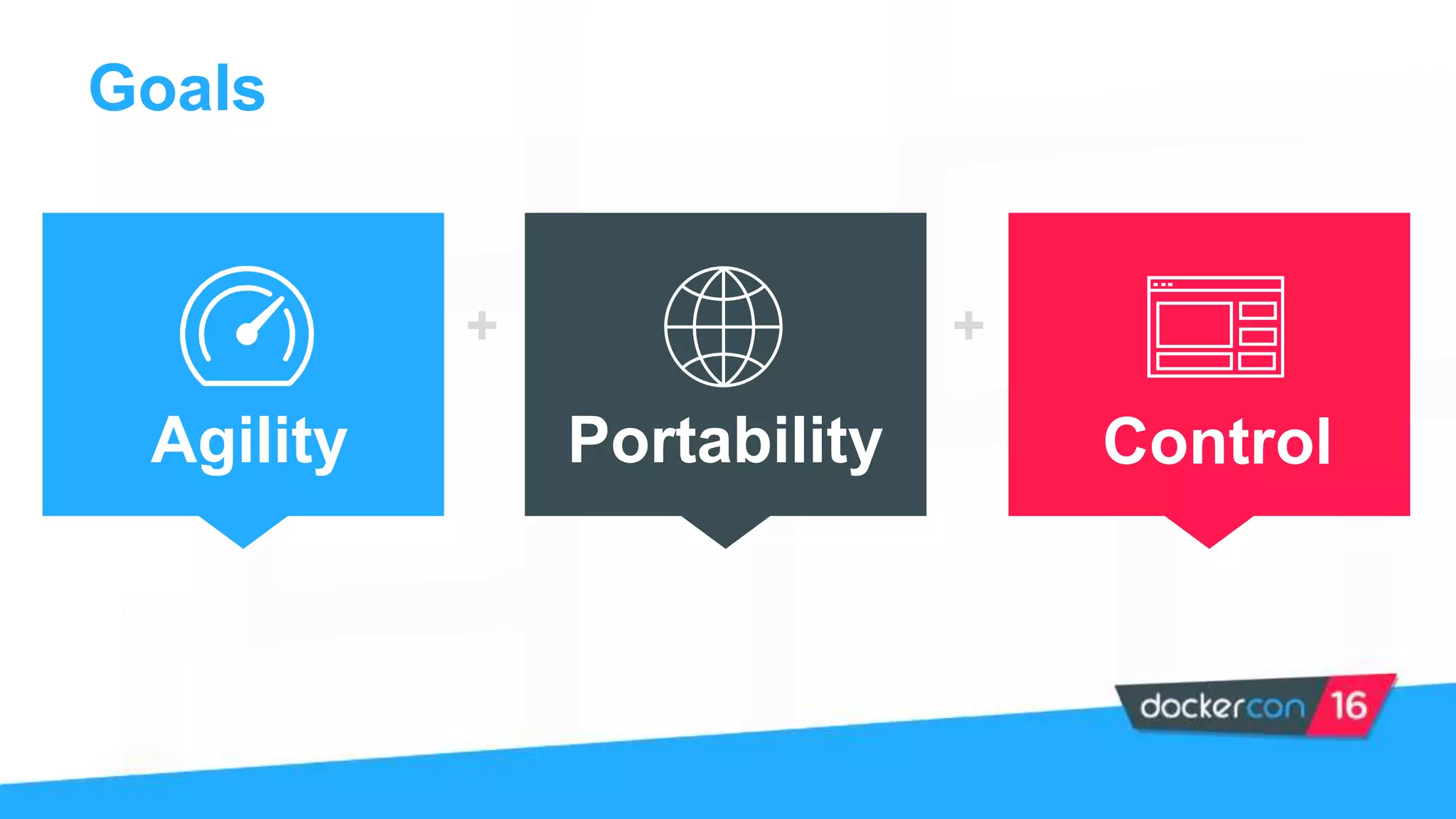
Goals + + Agility Portability Control
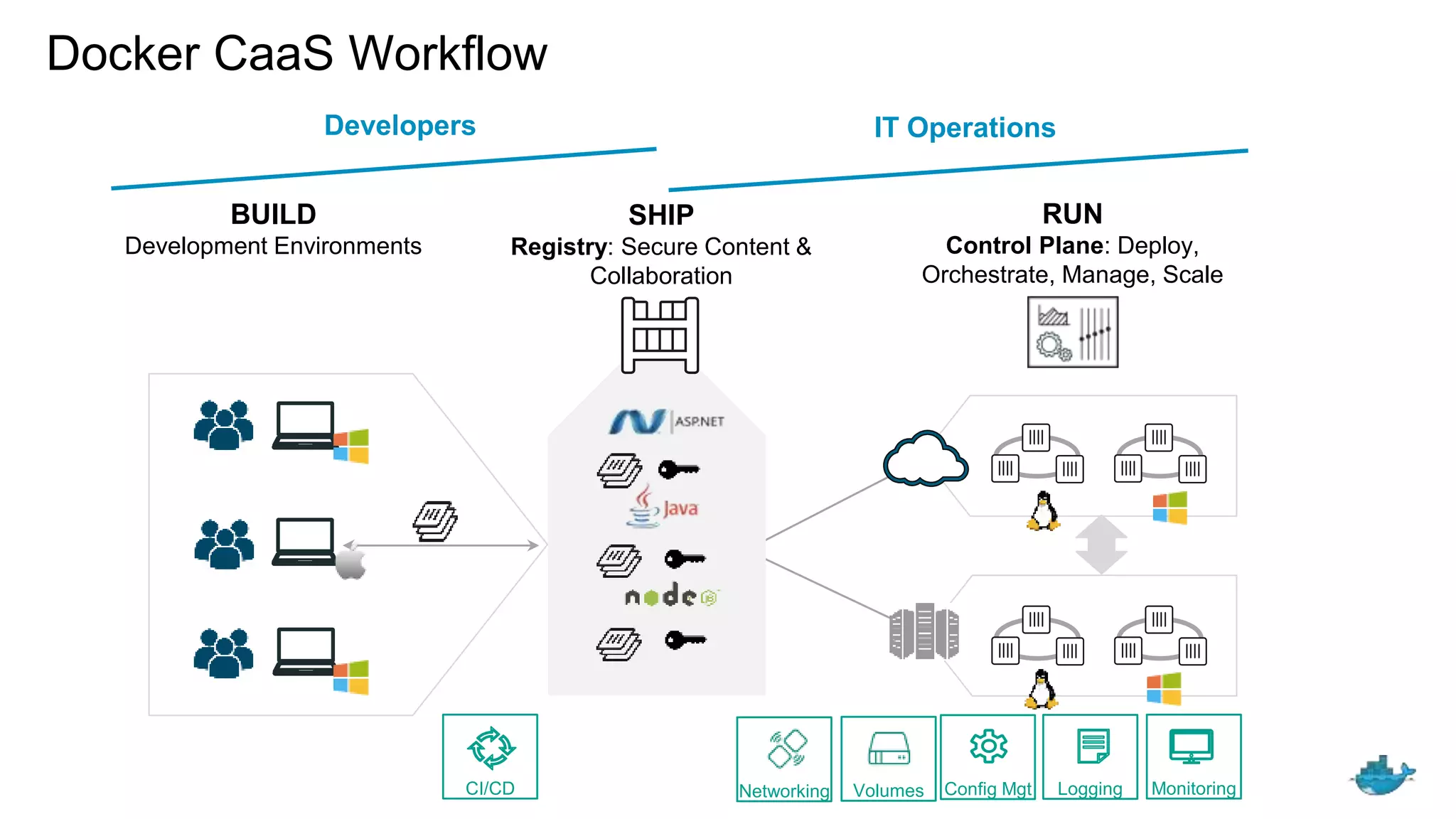
BUILD Development Environments SHIP Registry: Secure Content & Collaboration RUN Control Plane: Deploy, Orchestrate, Manage, Scale Networking Volumes MonitoringLoggingConfig MgtCI/CD IT Operations Developers IT Operations Docker CaaS Workflow
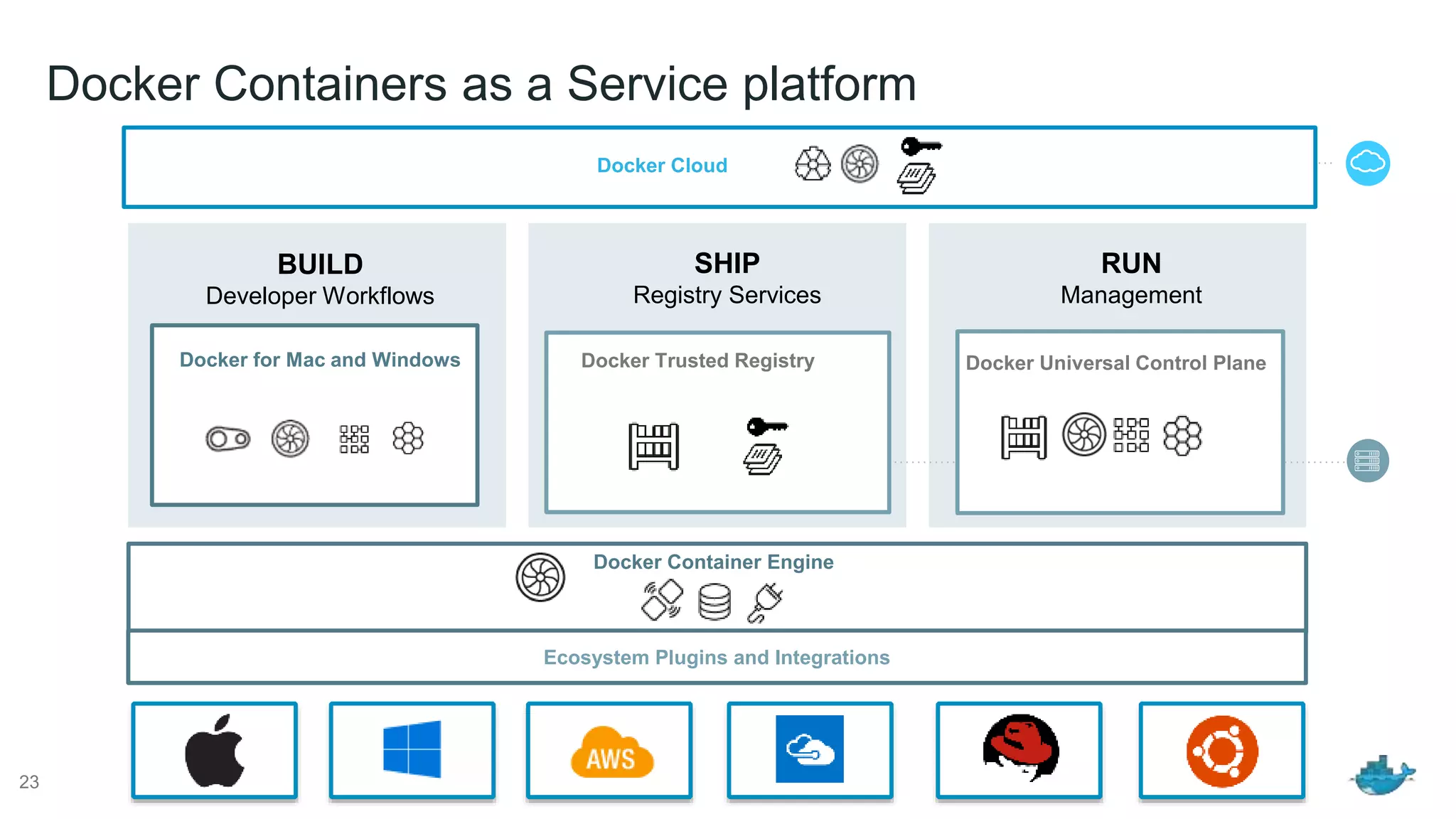
Docker Containers as a Service platform 23 BUILD Developer Workflows SHIP Registry Services RUN Management Docker for Mac and Windows Docker Trusted Registry Docker Universal Control Plane Docker Cloud Docker Container Engine Ecosystem Plugins and Integrations
Plumbing
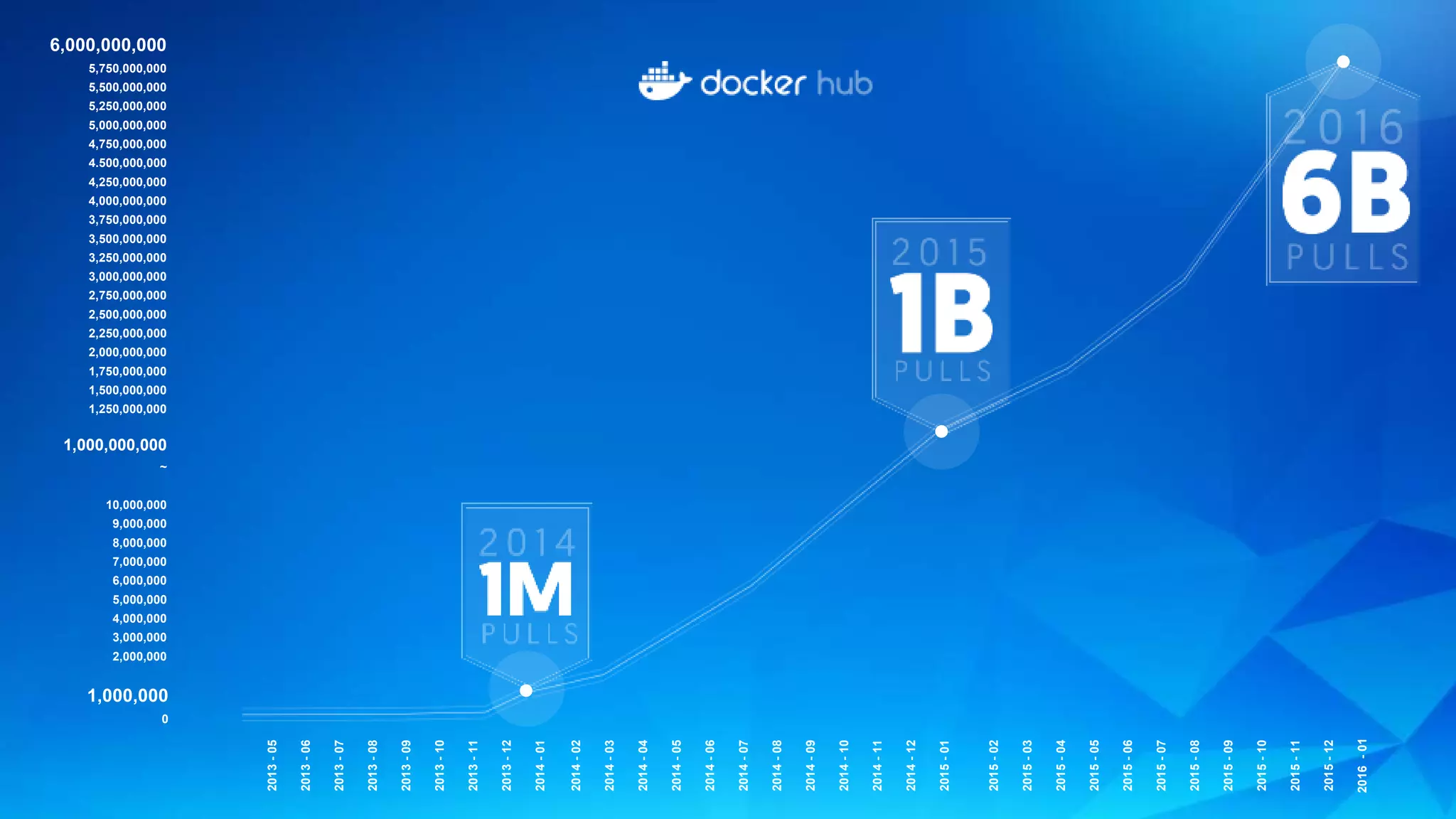
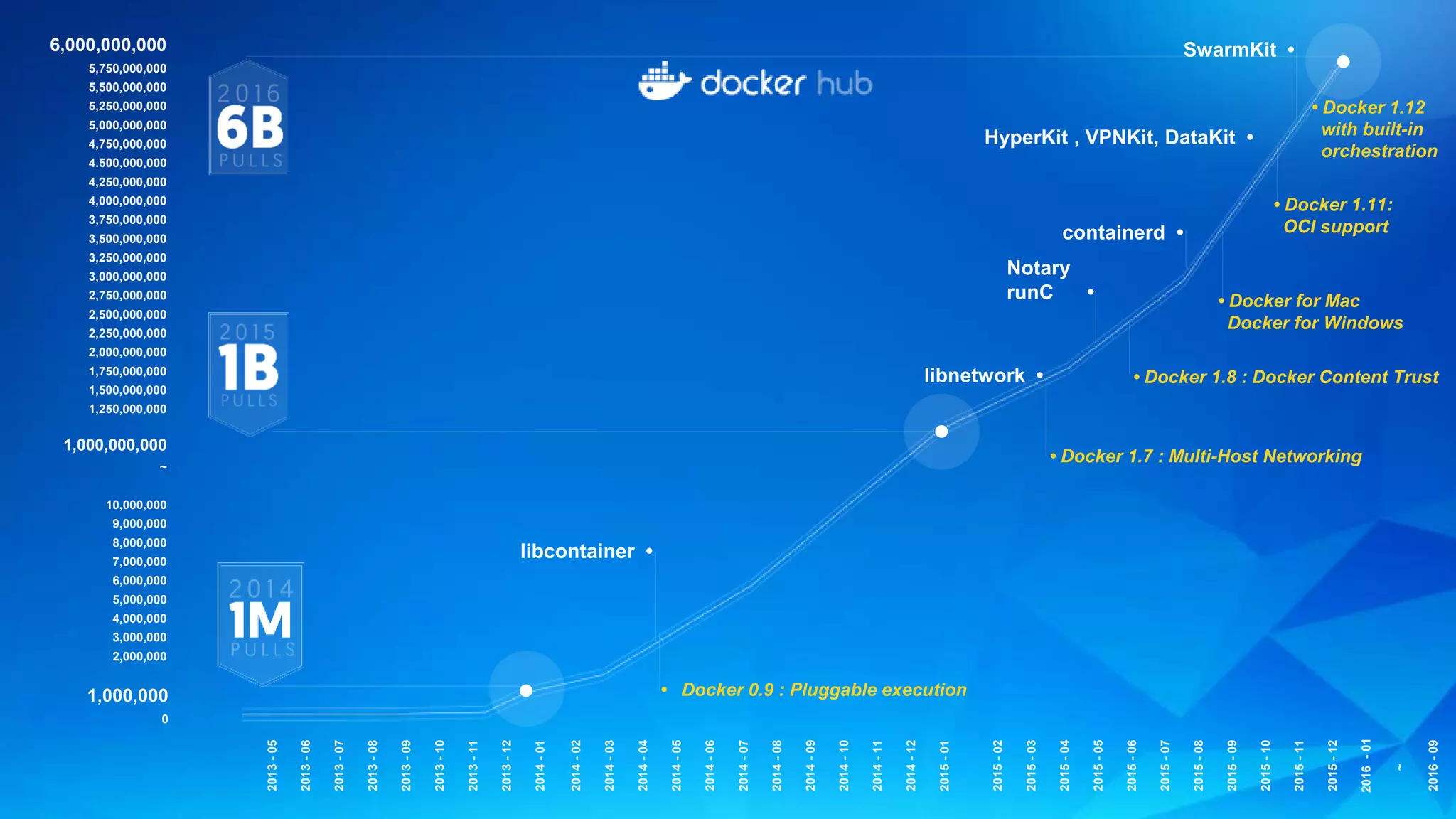
2013-05 2013-06 2013-07 2013-08 2013-09 2013-10 2013-11 2013-12 2014-01 1,000,000 0 2014-02 2014-03 2014-04 2014-05 2014-06 2014-07 2014-08 2014-09 2014-10 2014-11 2014-12 2015-01 2015-02 2015-03 2015-04 2015-05 2015-06 2015-07 2015-08 2015-09 2015-10 2015-11 2015-12 2016-01 1,000,000,000 ~ 10,000,000 9,000,000 8,000,000 7,000,000 6,000,000 5,000,000 4,000,000 3,000,000 2,000,000 6,000,000,000 5,750,000,000 5,500,000,000 5,250,000,000 5,000,000,000 4,750,000,000 4.500,000,000 4,250,000,000 4,000,000,000 3,750,000,000 3,500,000,000 3,250,000,000 3,000,000,000 2,750,000,000 2,500,000,000 2,250,000,000 2,000,000,000 1,750,000,000 1,500,000,000 1,250,000,000
2013-05 2013-06 2013-07 2013-08 2013-09 2013-10 2013-11 2013-12 2014-01 1,000,000 0 2014-02 2014-03 2014-04 2014-05 2014-06 2014-07 2014-08 2014-09 2014-10 2014-11 2014-12 2015-01 2015-02 2015-03 2015-04 2015-05 2015-06 2015-07 2015-08 2015-09 2015-10 2015-11 2015-12 2016-01 ~ 2016-09 1,000,000,000 ~ 10,000,000 9,000,000 8,000,000 7,000,000 6,000,000 5,000,000 4,000,000 3,000,000 2,000,000 6,000,000,000 5,750,000,000 5,500,000,000 5,250,000,000 5,000,000,000 4,750,000,000 4.500,000,000 4,250,000,000 4,000,000,000 3,750,000,000 3,500,000,000 3,250,000,000 3,000,000,000 2,750,000,000 2,500,000,000 2,250,000,000 2,000,000,000 1,750,000,000 1,500,000,000 1,250,000,000 Notary runC • containerd • HyperKit , VPNKit, DataKit • SwarmKit • libcontainer • libnetwork • • Docker 1.8 : Docker Content Trust • Docker for Mac Docker for Windows • Docker 1.12 with built-in orchestration • Docker 0.9 : Pluggable execution • Docker 1.7 : Multi-Host Networking • Docker 1.11: OCI support
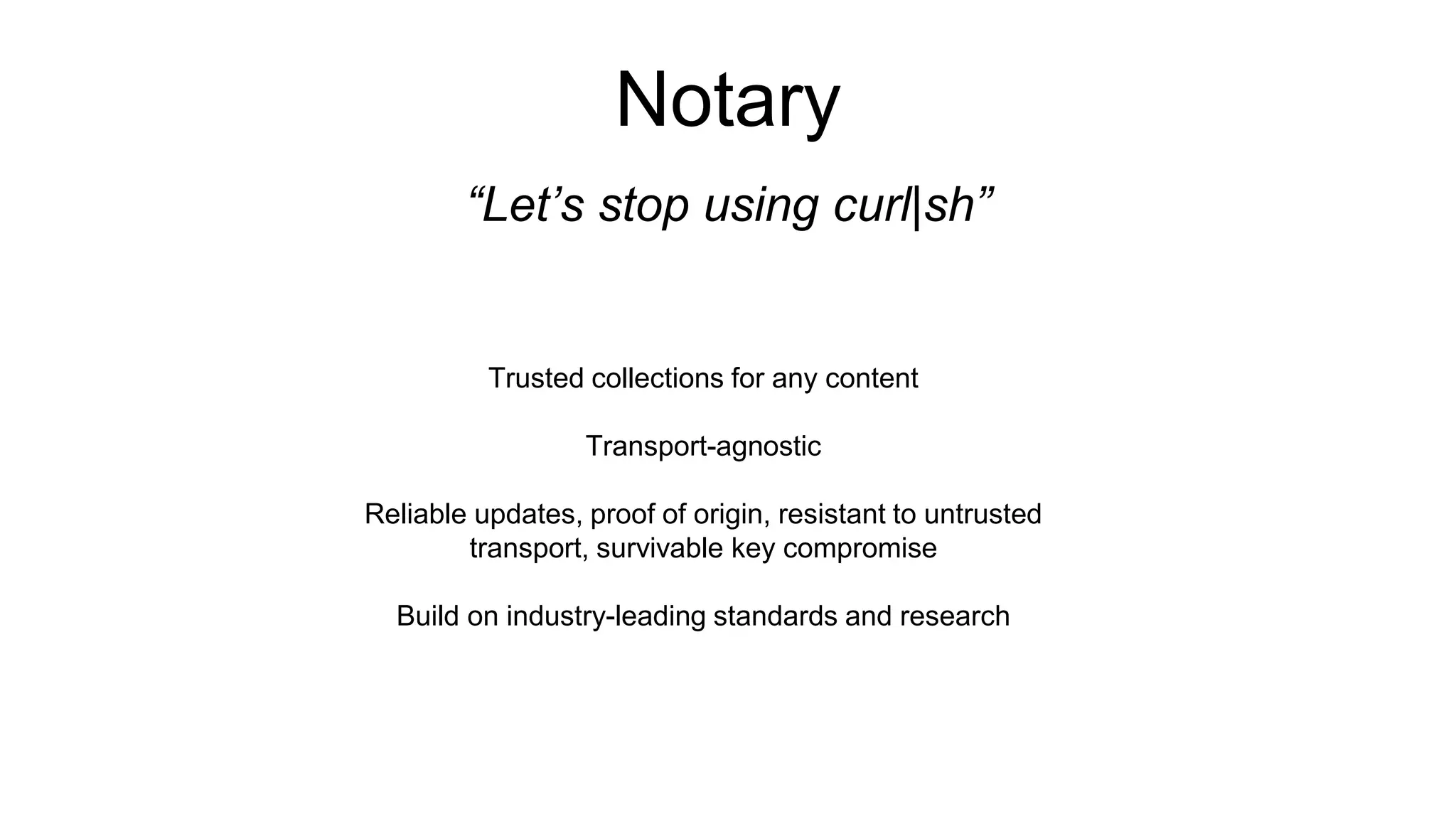
Notary “Let’s stop using curl|sh” Trusted collections for any content Transport-agnostic Reliable updates, proof of origin, resistant to untrusted transport, survivable key compromise Build on industry-leading standards and research
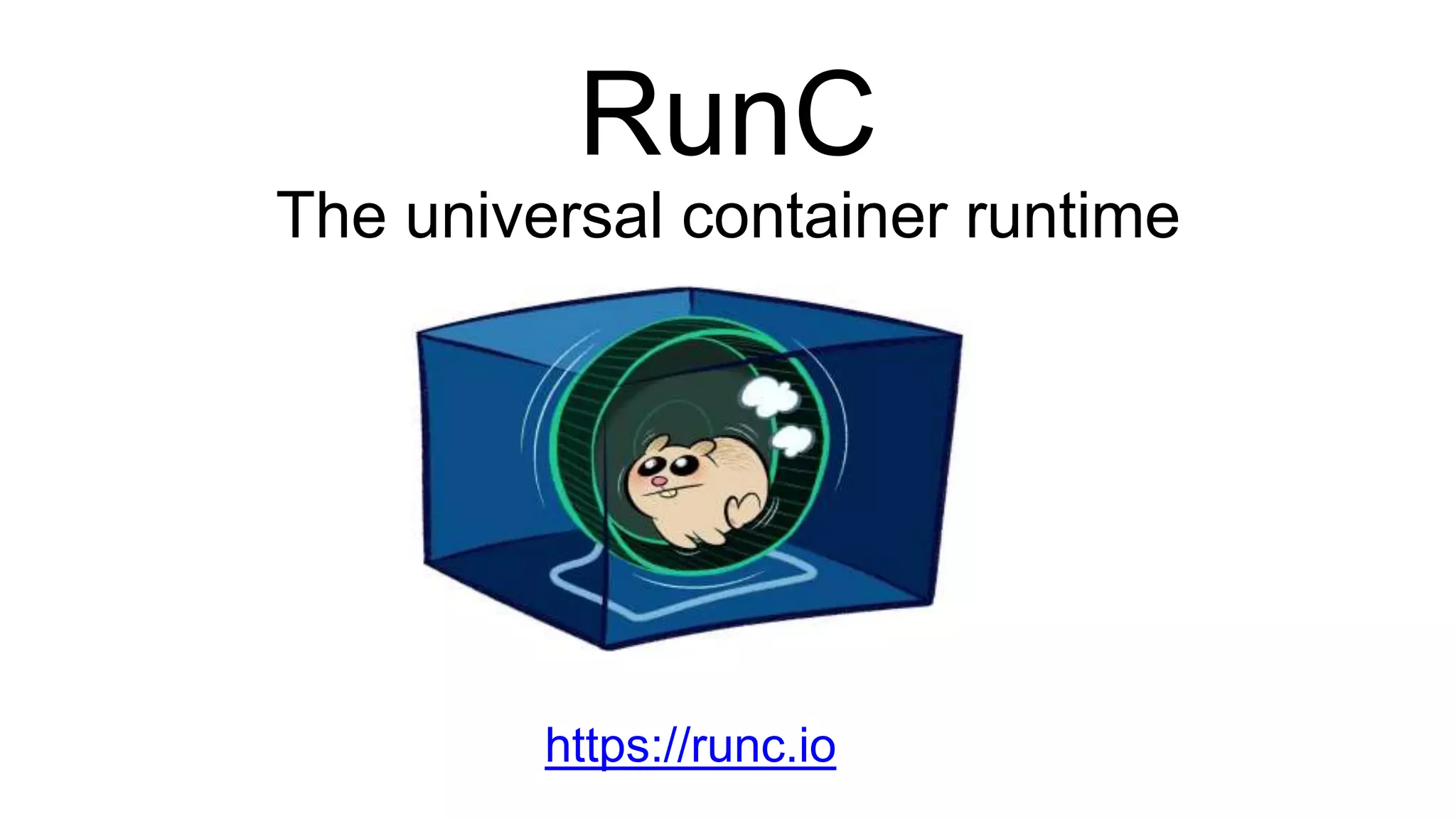
RunC The universal container runtime https://runc.io
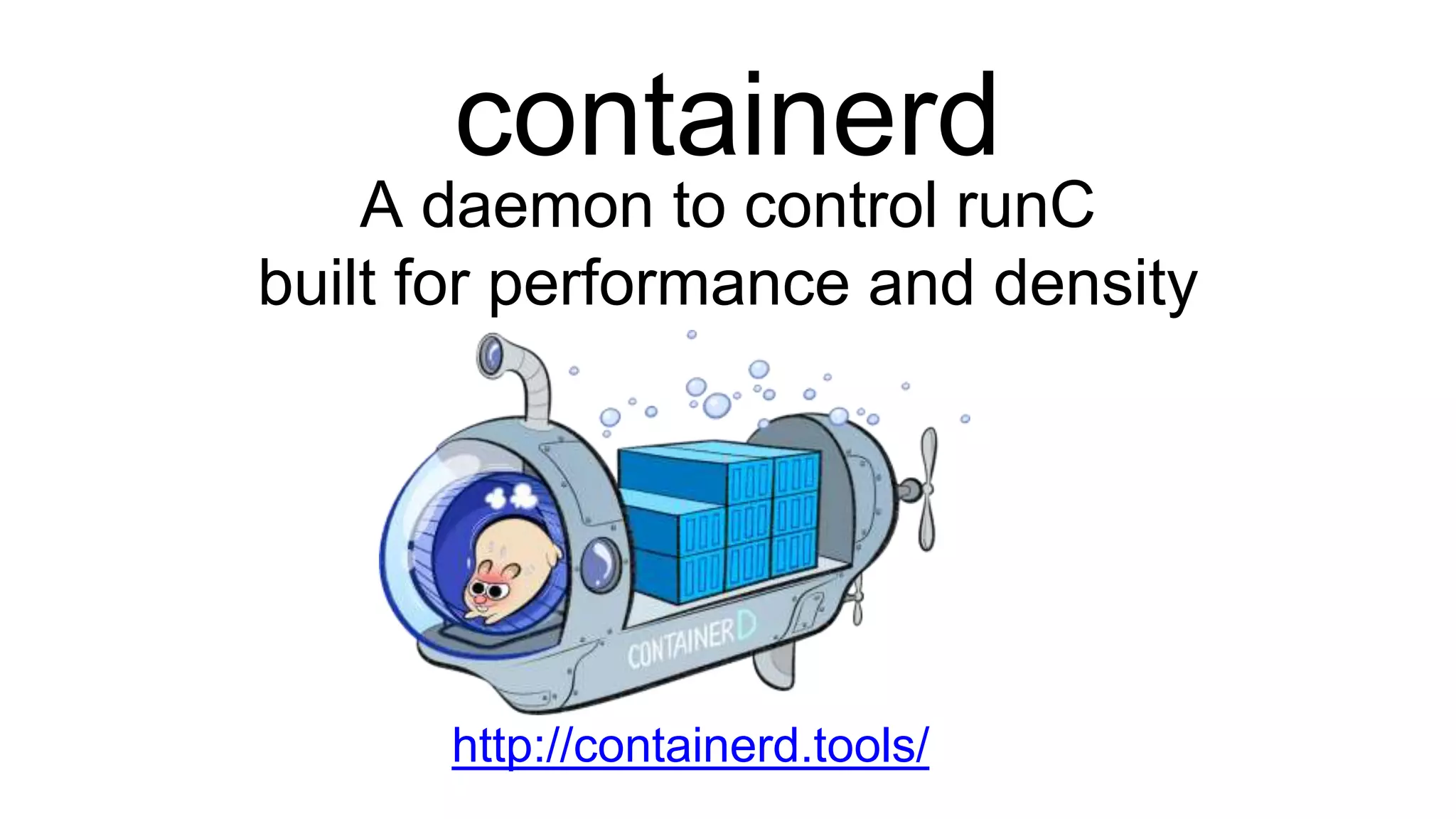
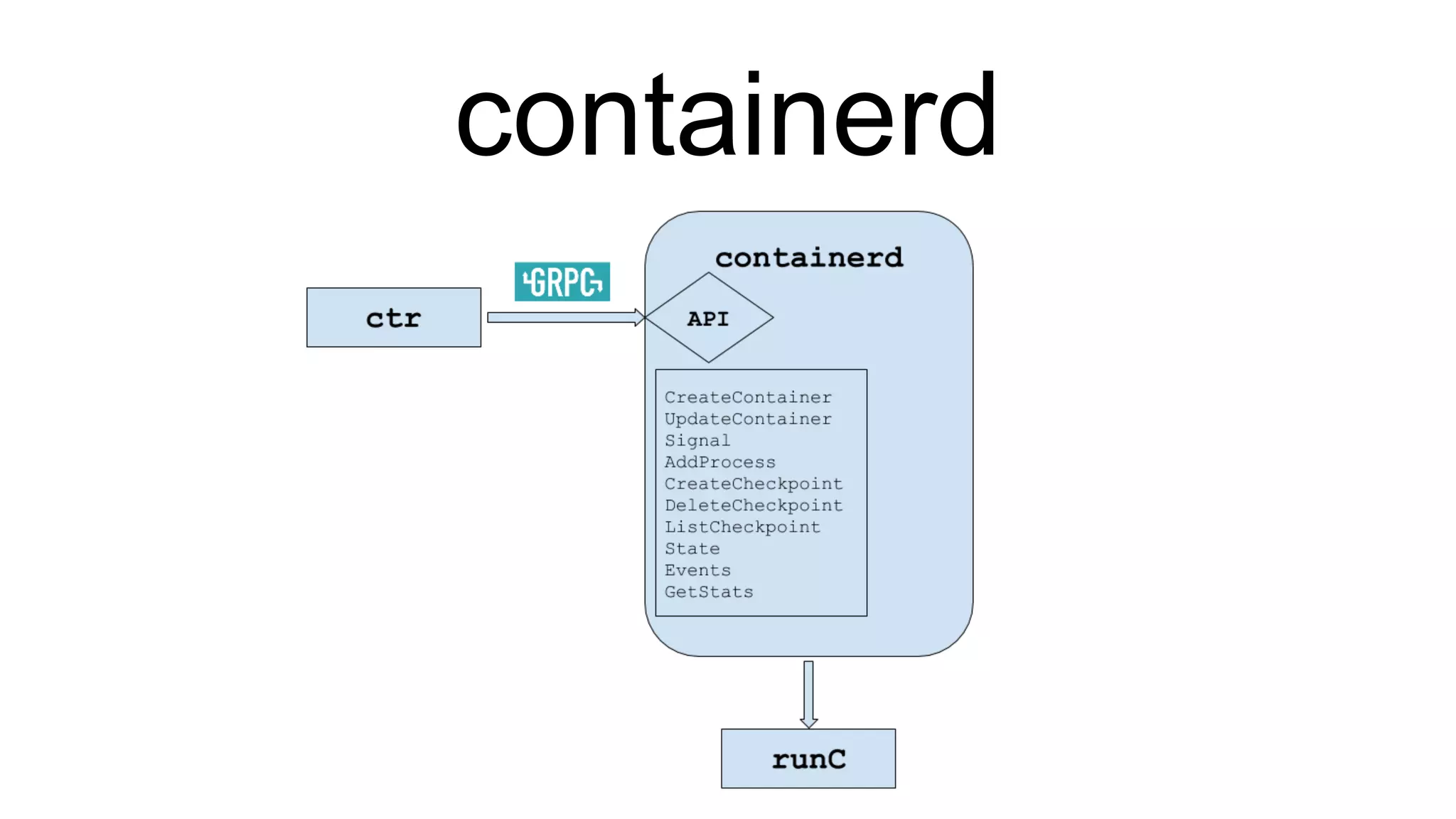
containerd A daemon to control runC built for performance and density http://containerd.tools/
containerd
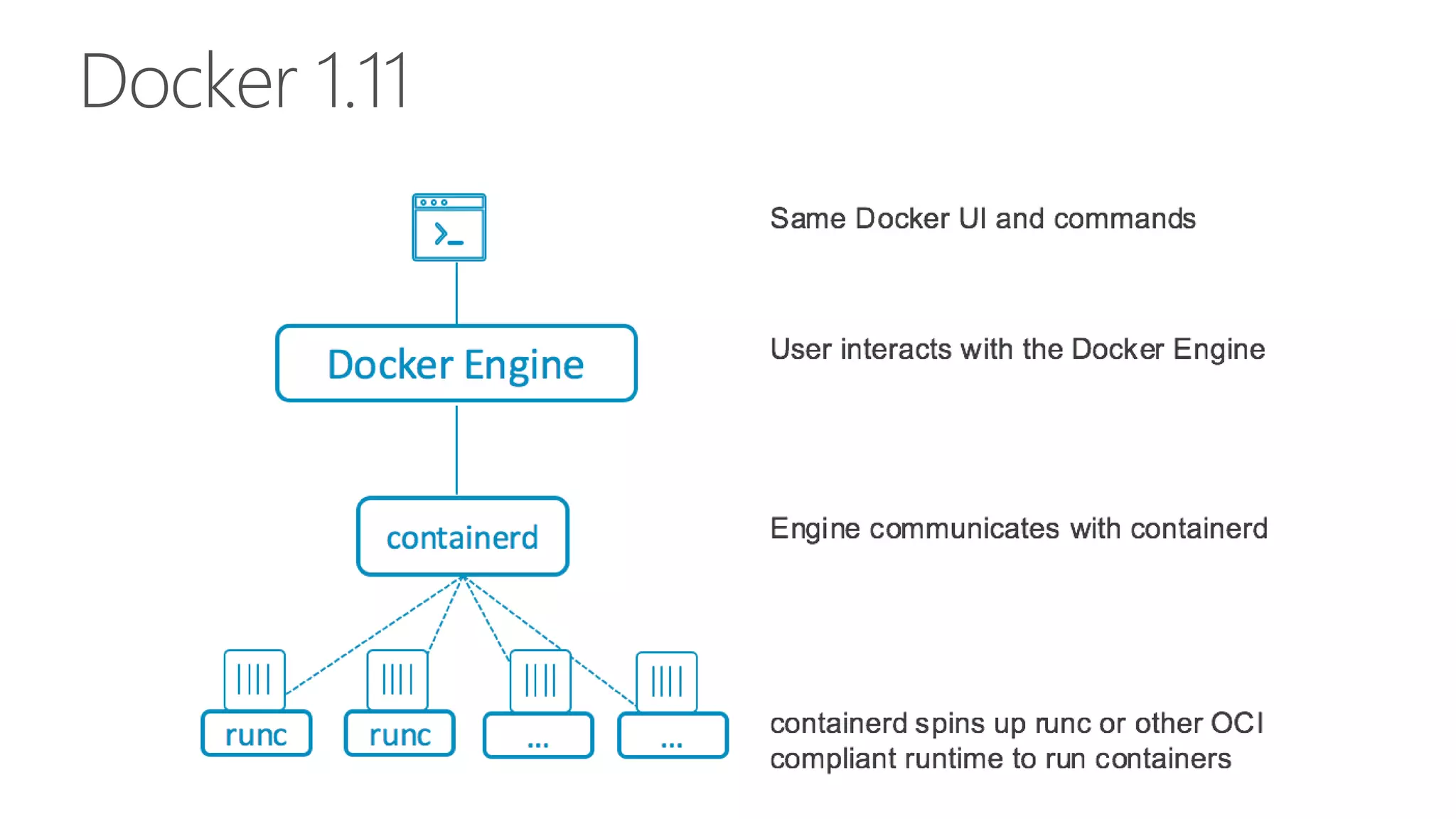
Docker 1.11
Docker for Mac architecture (simplified)
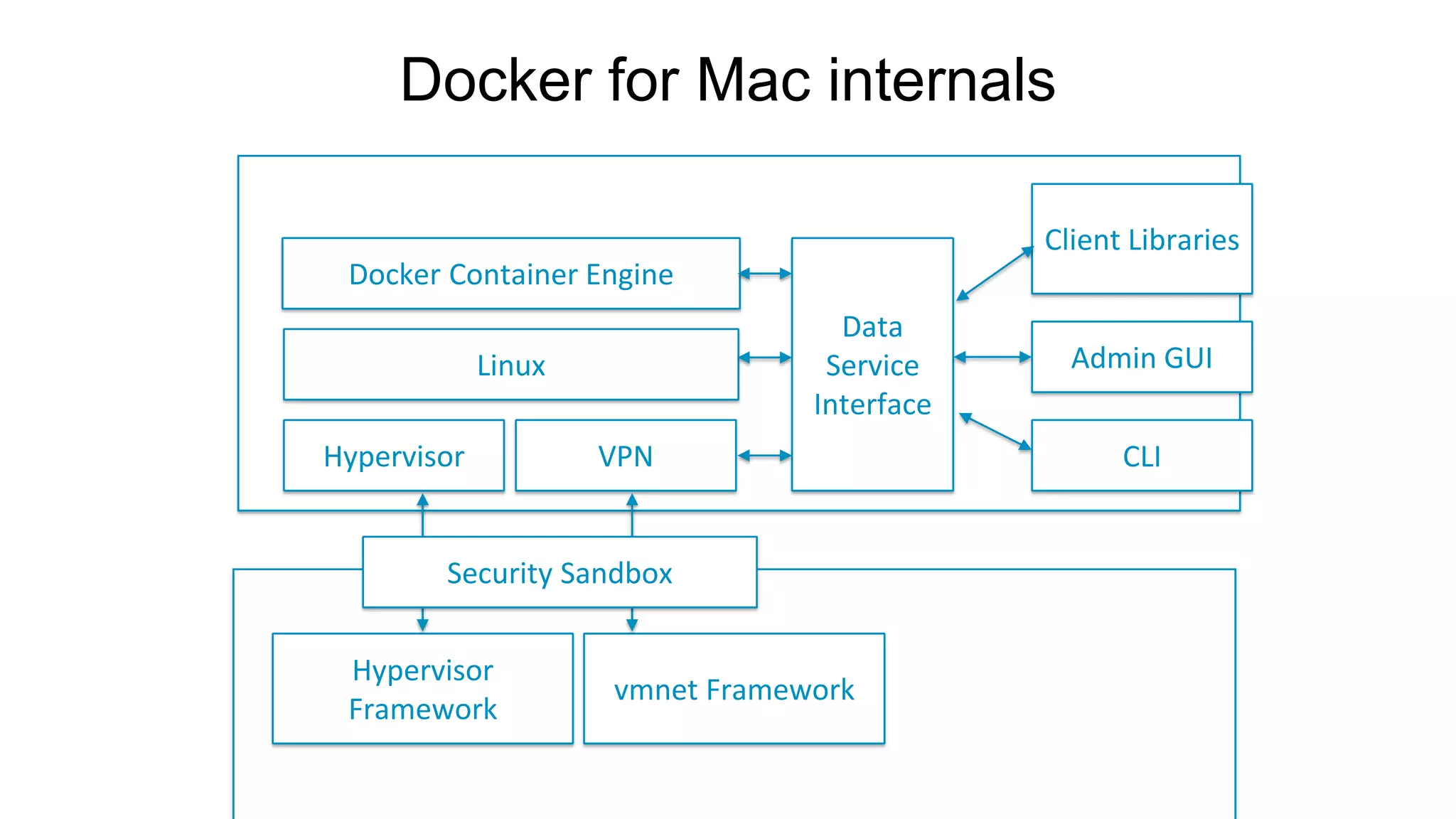
Hypervisor Framework vmnet Framework Docker Container Engine Hypervisor Linux VPN Data Service Interface Client Libraries Admin GUI CLI Security Sandbox Docker for Mac internals
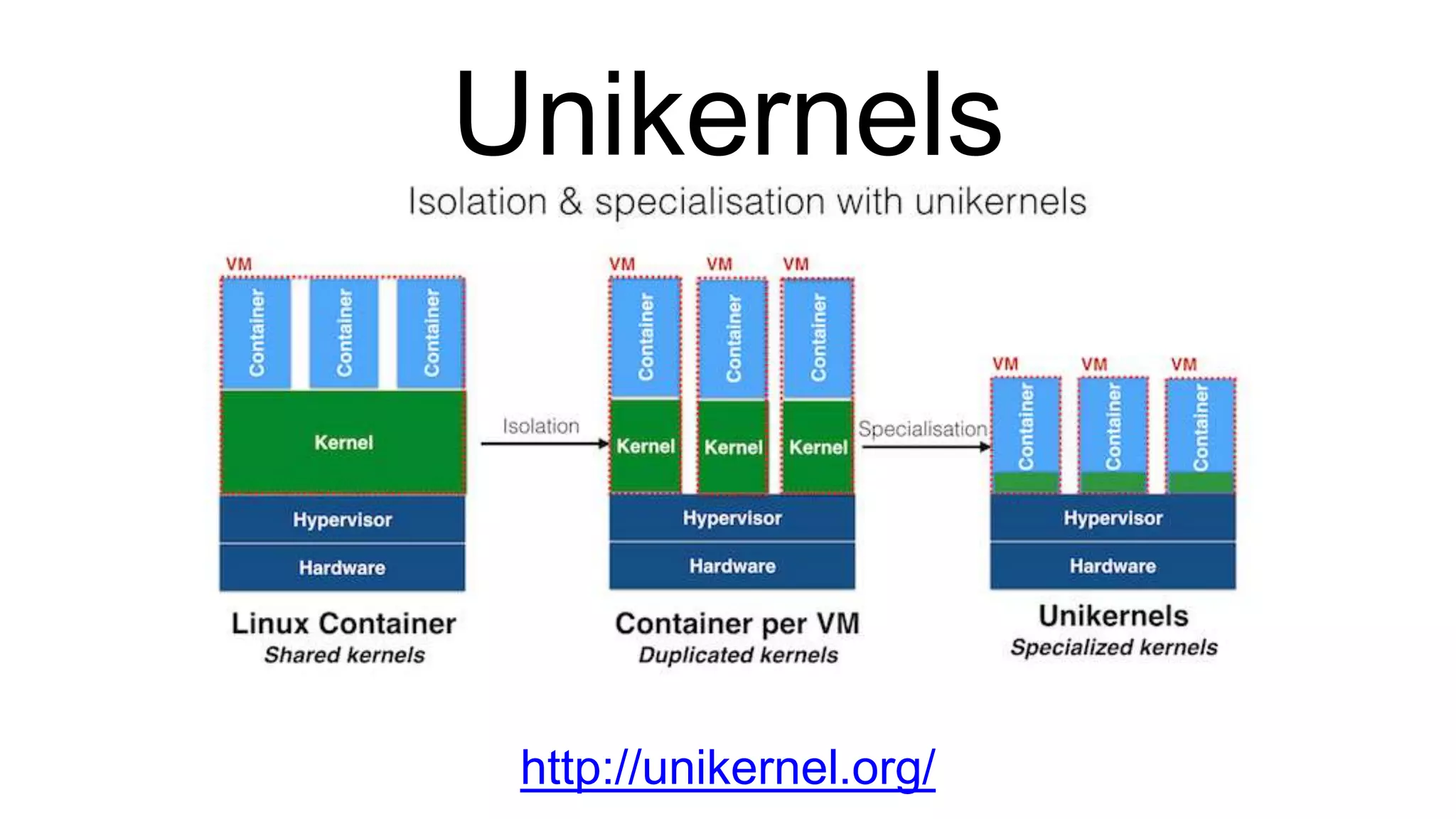
Unikernels http://unikernel.org/
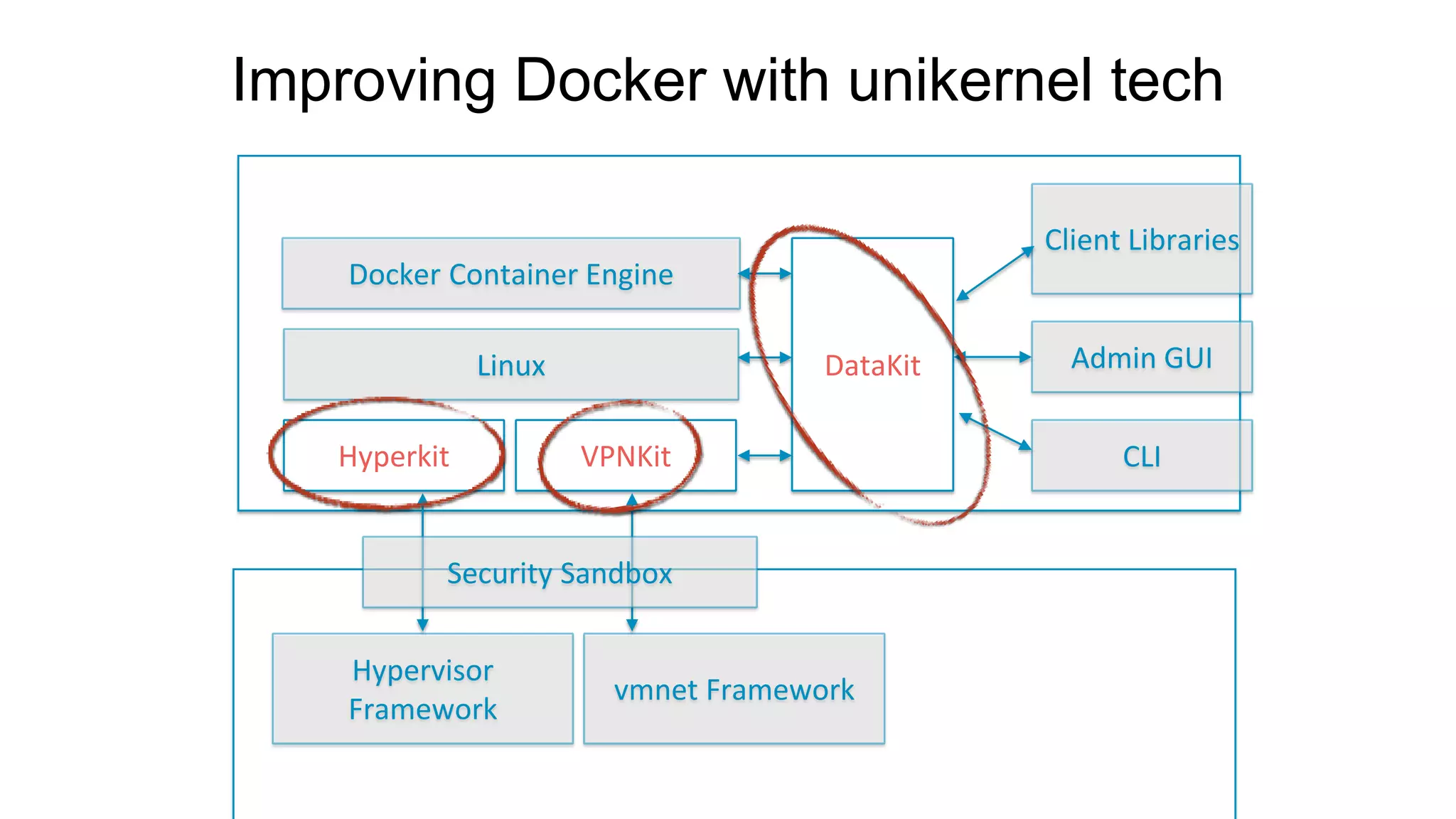
Hypervisor Framework vmnet Framework Docker Container Engine Hyperkit Linux VPNKit DataKit Client Libraries Admin GUI CLI Security Sandbox Improving Docker with unikernel tech
runC
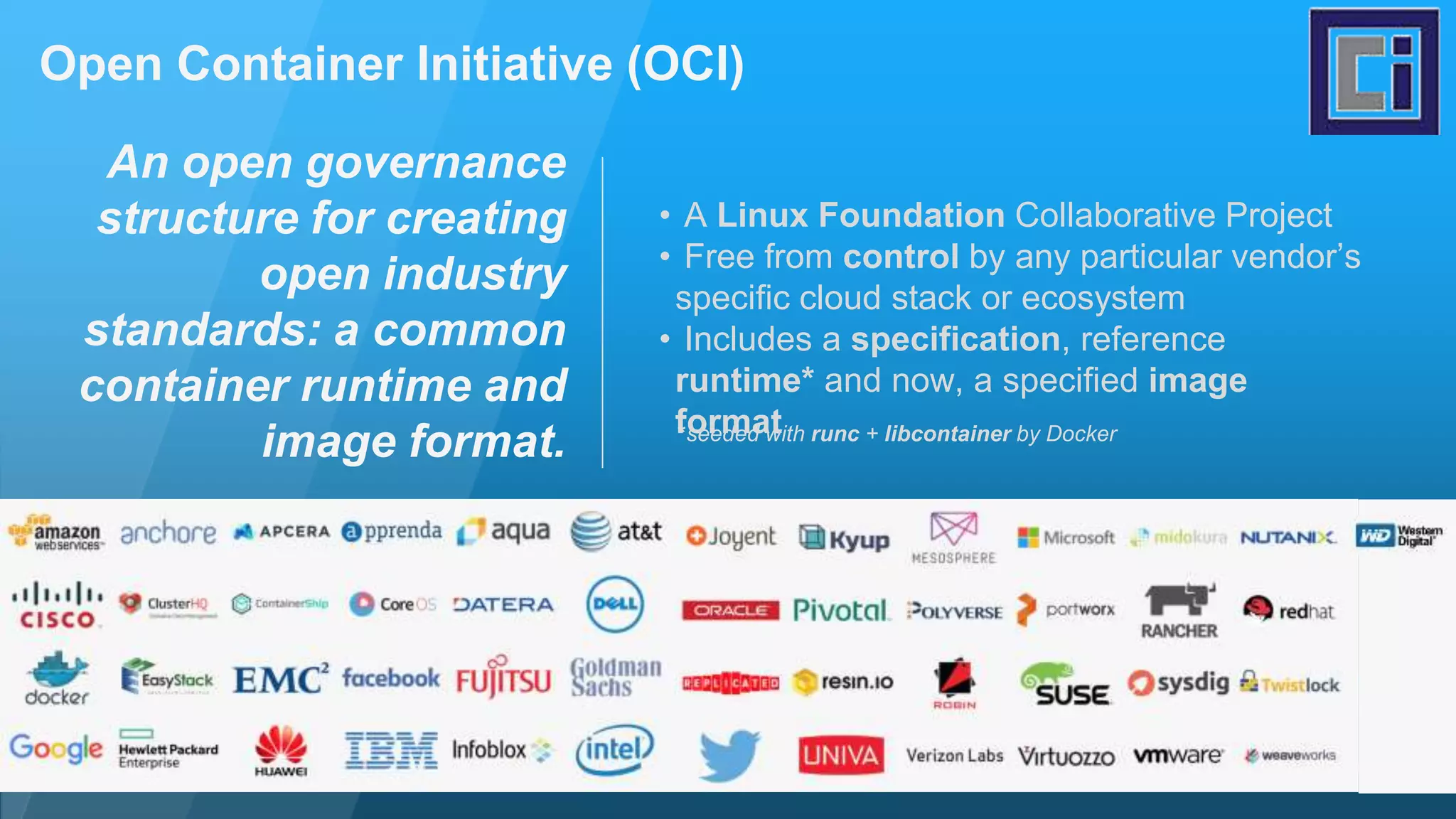
Open Container Initiative (OCI) An open governance structure for creating open industry standards: a common container runtime and image format. • A Linux Foundation Collaborative Project • Free from control by any particular vendor’s specific cloud stack or ecosystem • Includes a specification, reference runtime* and now, a specified image format*seeded with runc + libcontainer by Docker
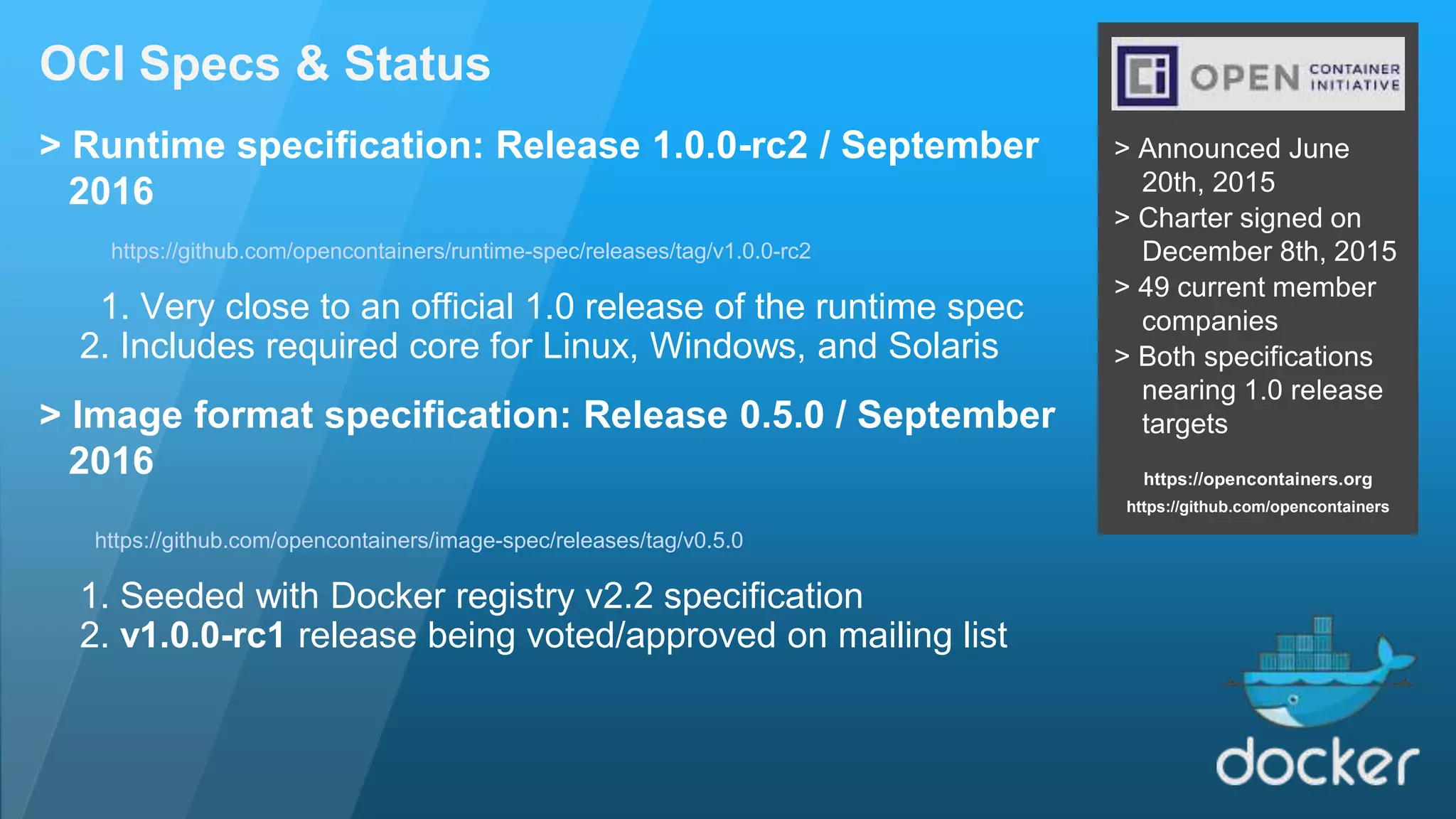
OCI Specs & Status > Announced June 20th, 2015 > Charter signed on December 8th, 2015 > 49 current member companies > Both specifications nearing 1.0 release targets https://opencontainers.org https://github.com/opencontainers > Runtime specification: Release 1.0.0-rc2 / September 2016 https://github.com/opencontainers/runtime-spec/releases/tag/v1.0.0-rc2 1. Very close to an official 1.0 release of the runtime spec 2. Includes required core for Linux, Windows, and Solaris > Image format specification: Release 0.5.0 / September 2016 https://github.com/opencontainers/image-spec/releases/tag/v0.5.0 1. Seeded with Docker registry v2.2 specification 2. v1.0.0-rc1 release being voted/approved on mailing list
Introduction to `runc` > runc is a client wrapper around libcontainer > Libcontainer is the OS level interface for containers Other platforms and architectures can implement the libcontainer API via their own primitives/system-level container concepts $ docker run -it --read-only -v /host:/hostpath alpine sh /# { "ociVersion": "0.6.0-dev", "platform": { "os": "linux", "arch": "amd64" }, "process": { "terminal": true, "args": [ "sh" ], "env": [ "PATH=/usr/local/sbin:/usr/local/bin:/bin” config.json
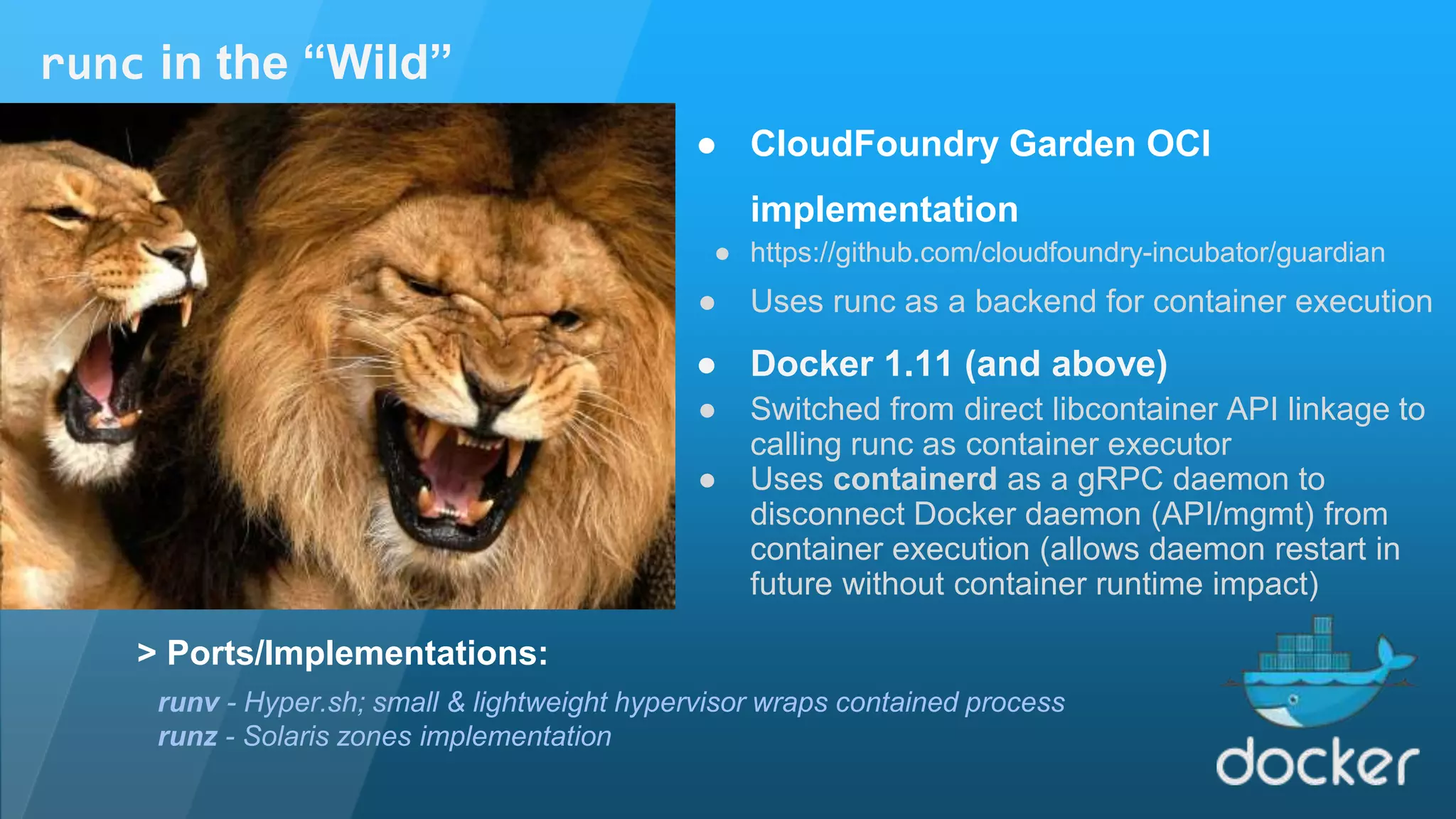
● CloudFoundry Garden OCI implementation ● https://github.com/cloudfoundry-incubator/guardian ● Uses runc as a backend for container execution ● Docker 1.11 (and above) ● Switched from direct libcontainer API linkage to calling runc as container executor ● Uses containerd as a gRPC daemon to disconnect Docker daemon (API/mgmt) from container execution (allows daemon restart in future without container runtime impact) runc in the “Wild” runv - Hyper.sh; small & lightweight hypervisor wraps contained process runz - Solaris zones implementation > Ports/Implementations:
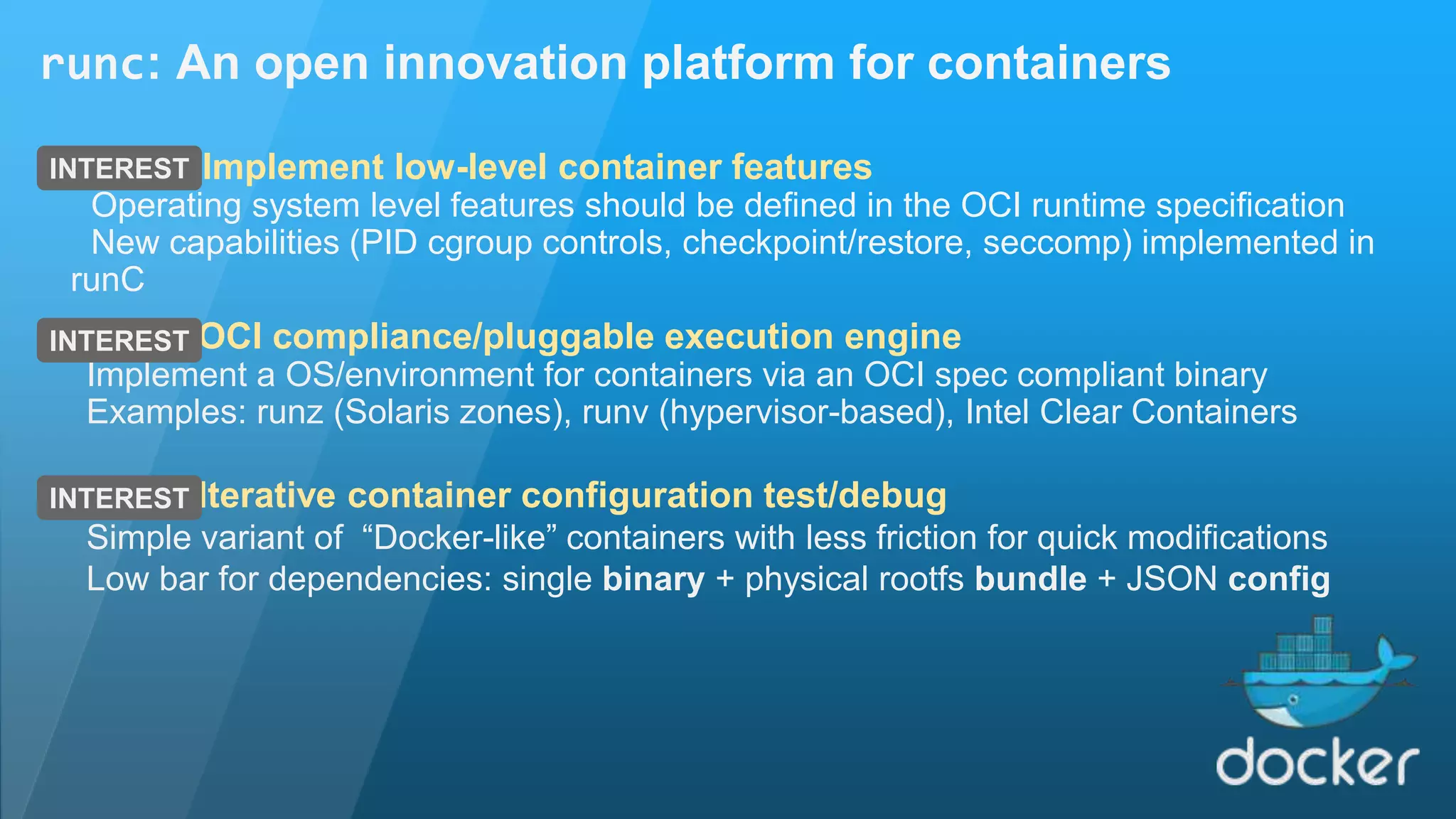
runc: An open innovation platform for containers Implement low-level container features Operating system level features should be defined in the OCI runtime specification New capabilities (PID cgroup controls, checkpoint/restore, seccomp) implemented in runC INTEREST OCI compliance/pluggable execution engine Implement a OS/environment for containers via an OCI spec compliant binary Examples: runz (Solaris zones), runv (hypervisor-based), Intel Clear Containers Iterative container configuration test/debug Simple variant of “Docker-like” containers with less friction for quick modifications Low bar for dependencies: single binary + physical rootfs bundle + JSON config INTEREST INTEREST
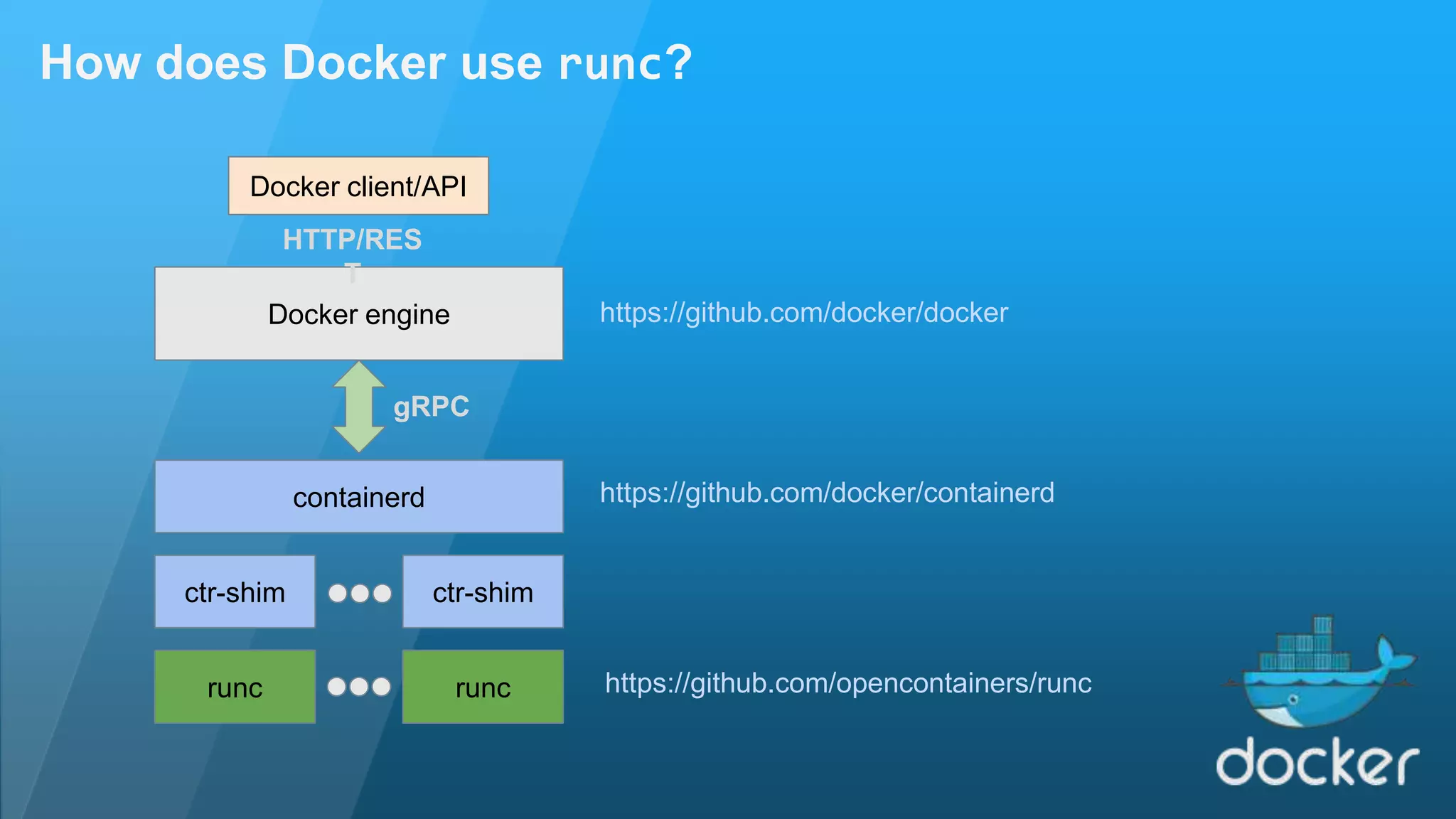
How does Docker use runc? Docker engine containerd gRPC ctr-shim ctr-shim runc runc https://github.com/docker/docker https://github.com/docker/containerd https://github.com/opencontainers/runc Docker client/API HTTP/RES T
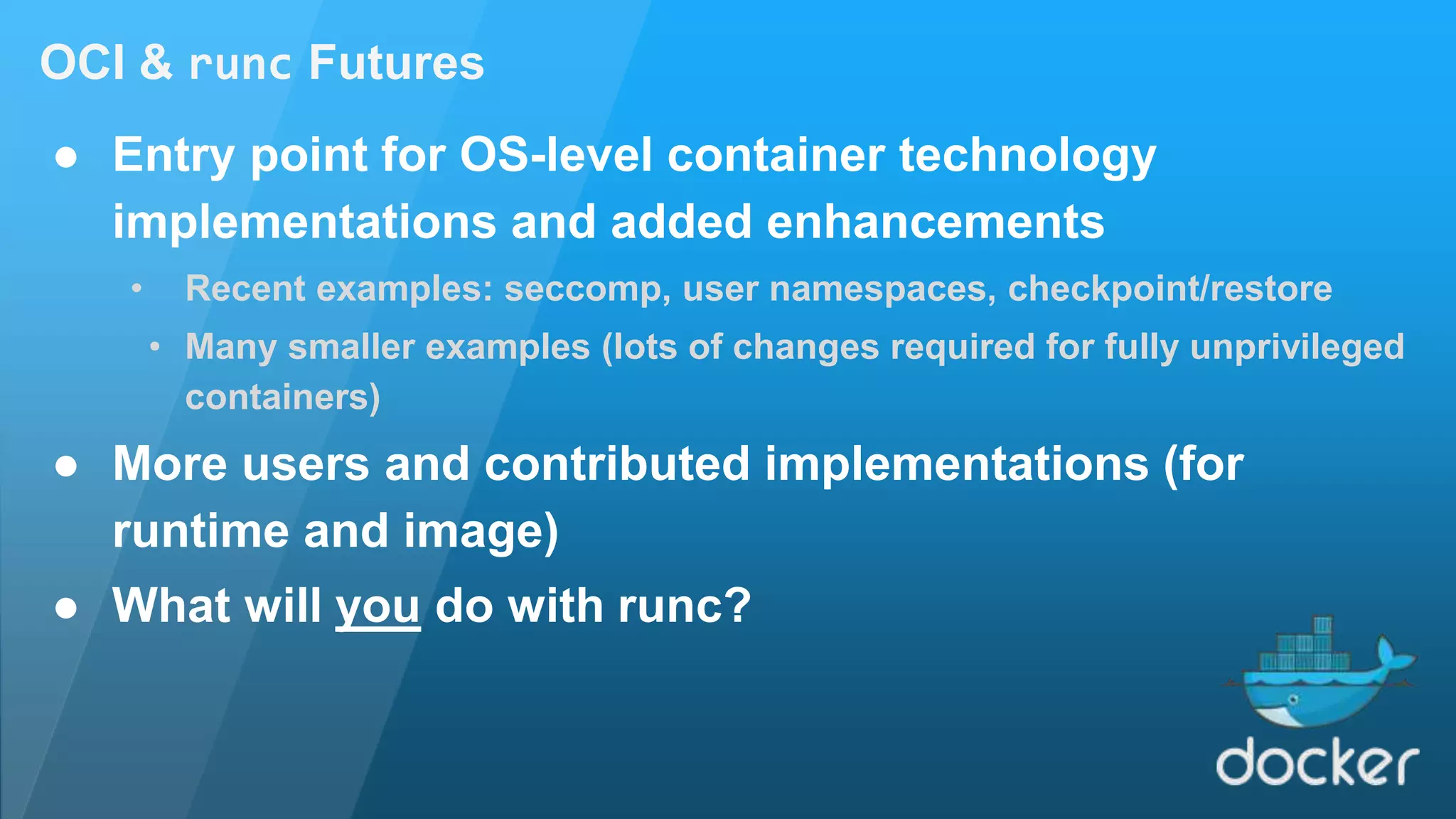
OCI & runc Futures ● Entry point for OS-level container technology implementations and added enhancements • Recent examples: seccomp, user namespaces, checkpoint/restore • Many smaller examples (lots of changes required for fully unprivileged containers) ● More users and contributed implementations (for runtime and image) ● What will you do with runc?
@estesp github.com/estesp estesp@gmail.com https://integratedcode.us IRC: estesp Phil Estes, IBM DEMO $ runc run alpine # /
InfraKit
Problem: Managing Docker on different infrastructure is difficult and not portable.
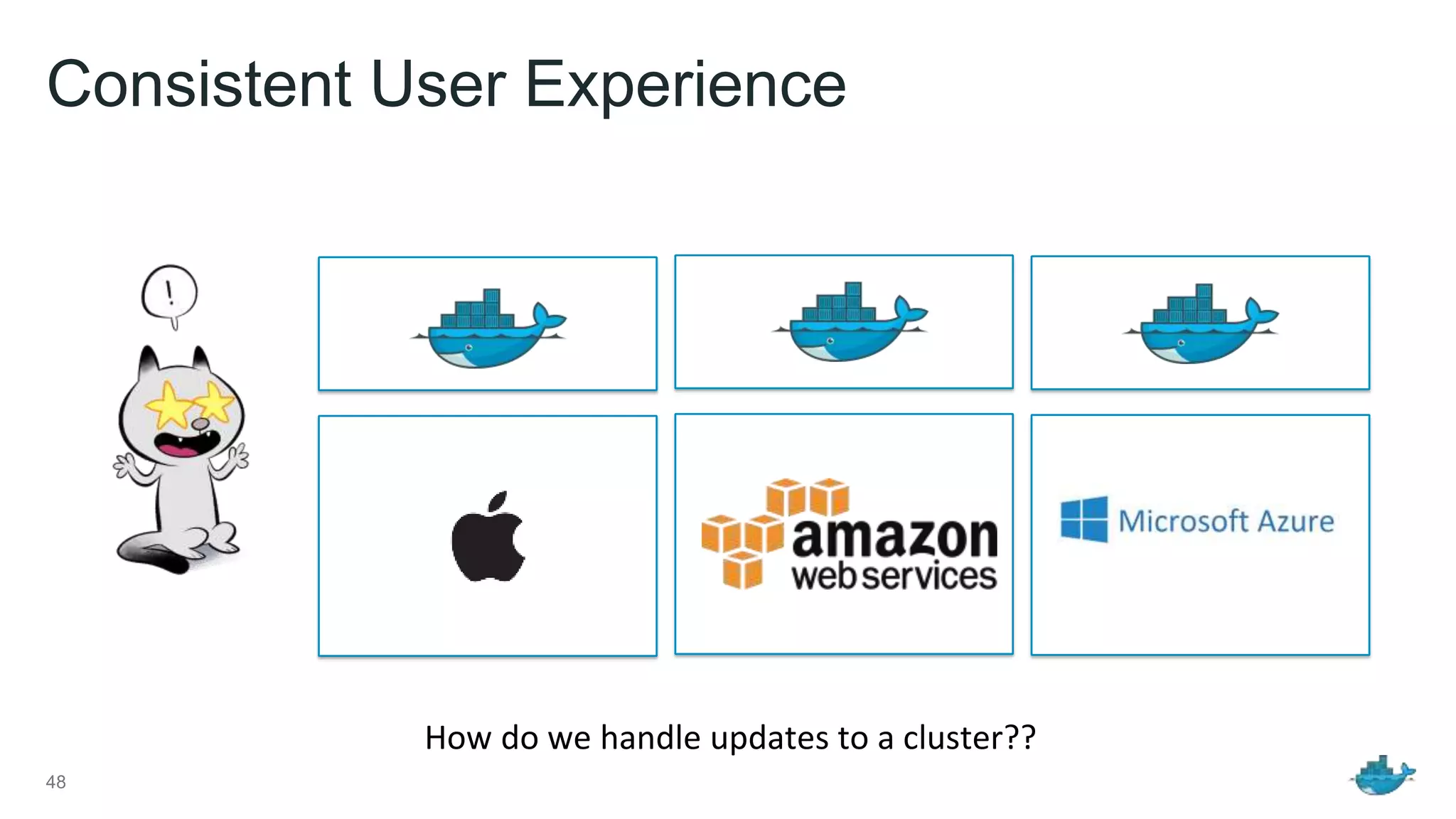
Consistent User Experience 48 How do we handle updates to a cluster??
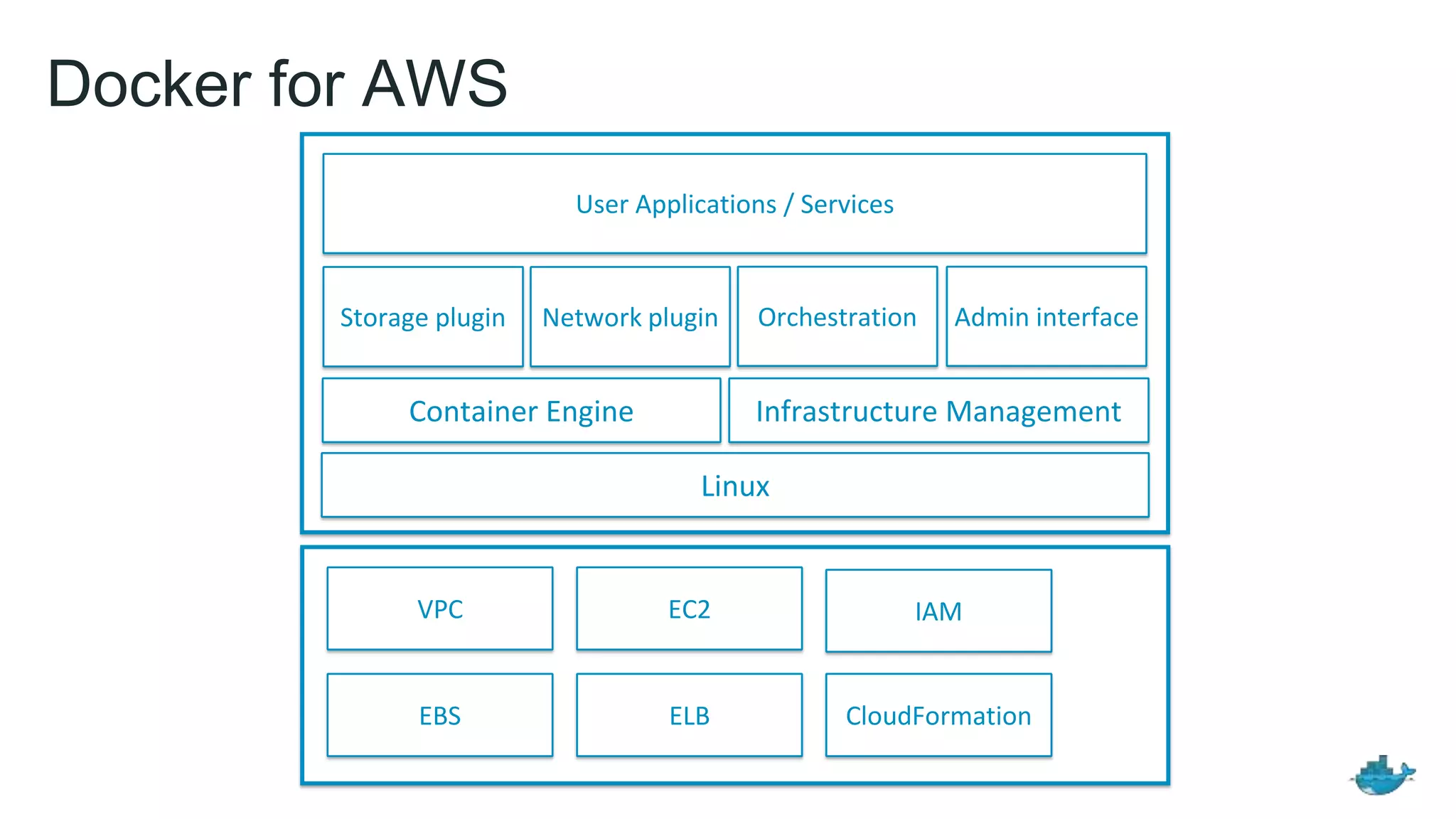
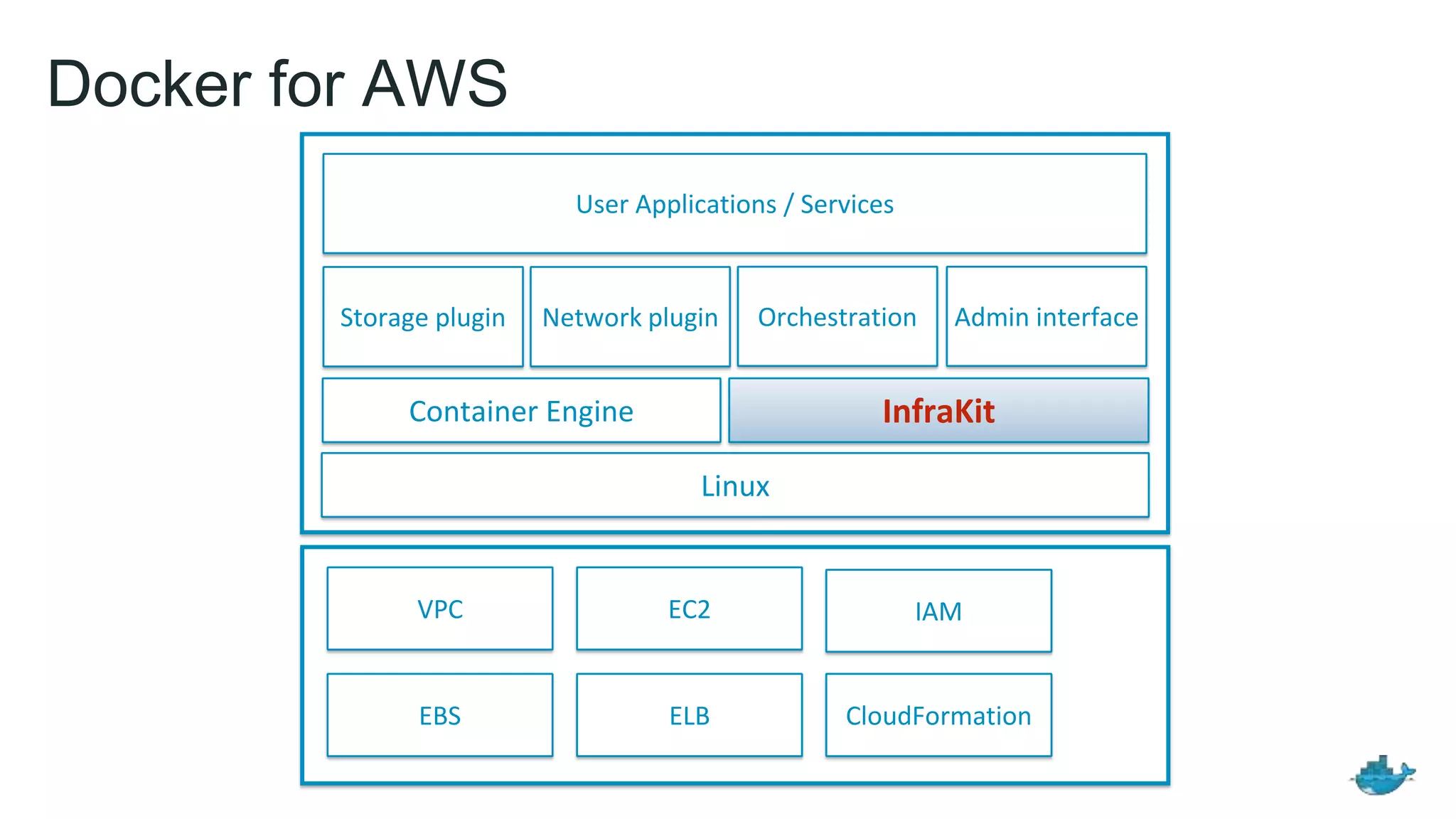
Docker for AWS EBS ELB Container Engine Storage plugin Infrastructure Management Network plugin Orchestration IAM CloudFormation EC2VPC Admin interface Linux User Applications / Services
Docker for AWS EBS ELB Container Engine Storage plugin InfraKit Network plugin Orchestration IAM CloudFormation EC2VPC Admin interface Linux User Applications / Services
InfraKit A toolkit for building declarative, self-healing infrastructure.
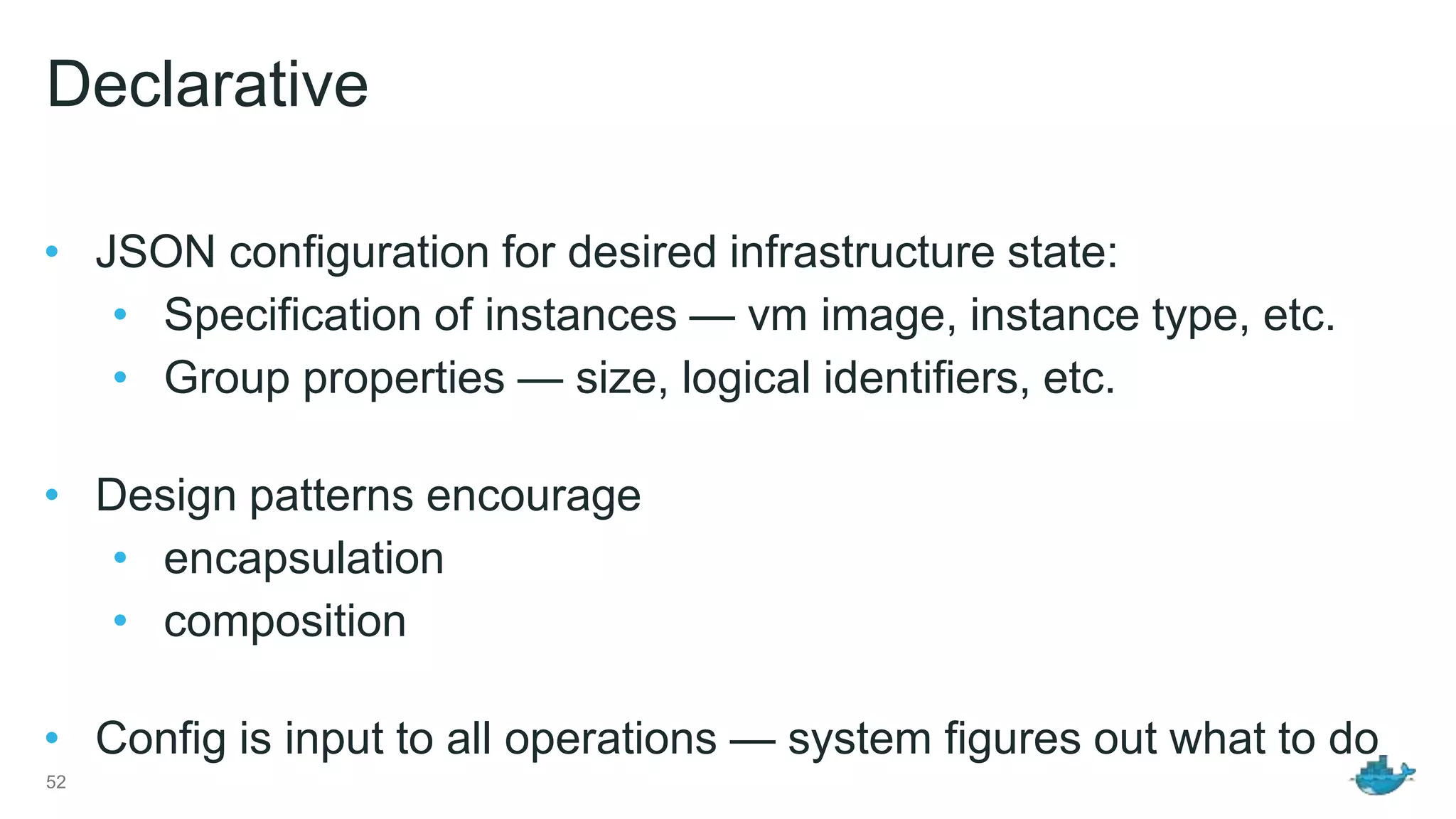
Declarative • JSON configuration for desired infrastructure state: • Specification of instances — vm image, instance type, etc. • Group properties — size, logical identifiers, etc. • Design patterns encourage • encapsulation • composition • Config is input to all operations — system figures out what to do 52
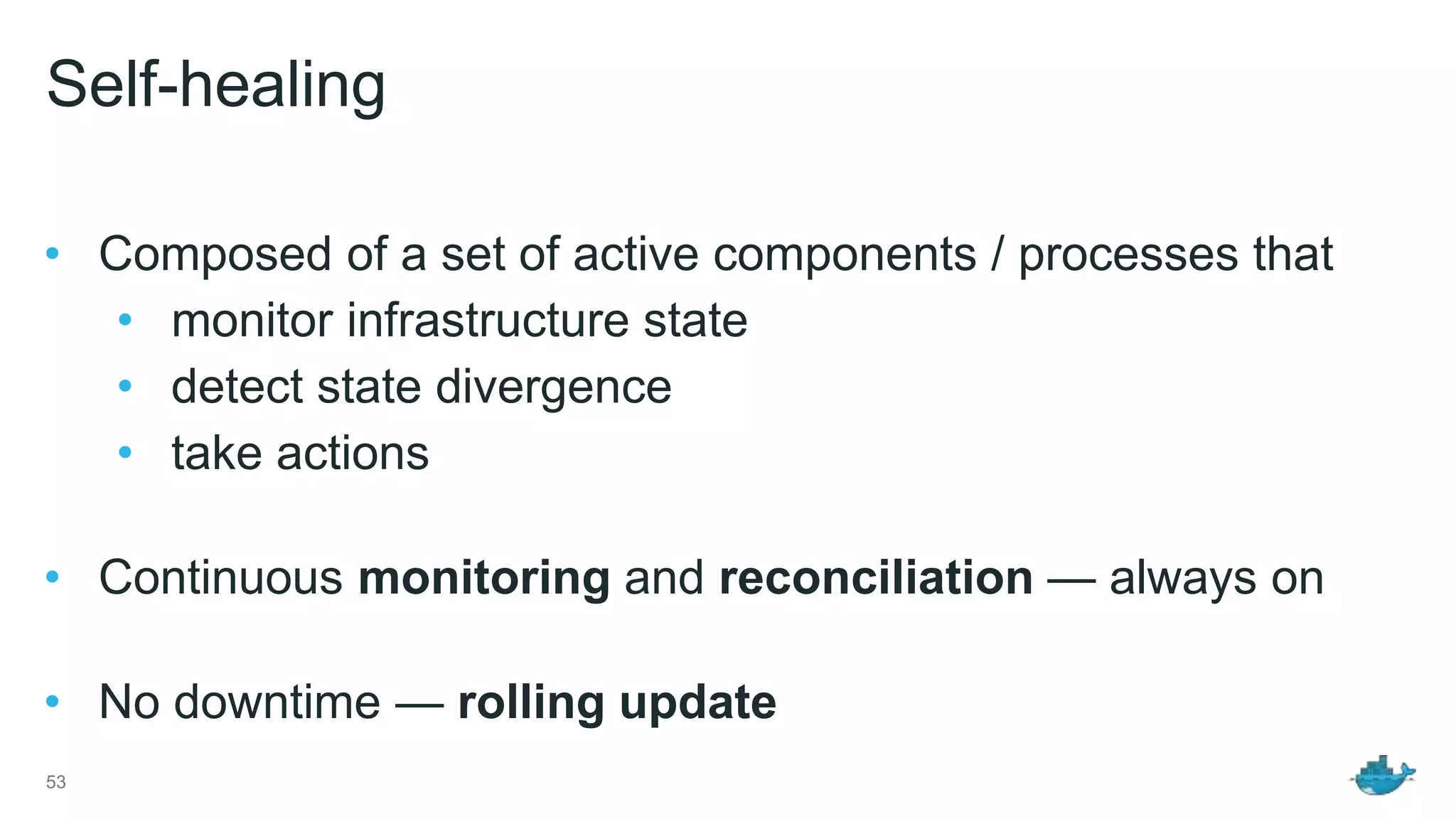
Self-healing • Composed of a set of active components / processes that • monitor infrastructure state • detect state divergence • take actions • Continuous monitoring and reconciliation — always on • No downtime — rolling update 53
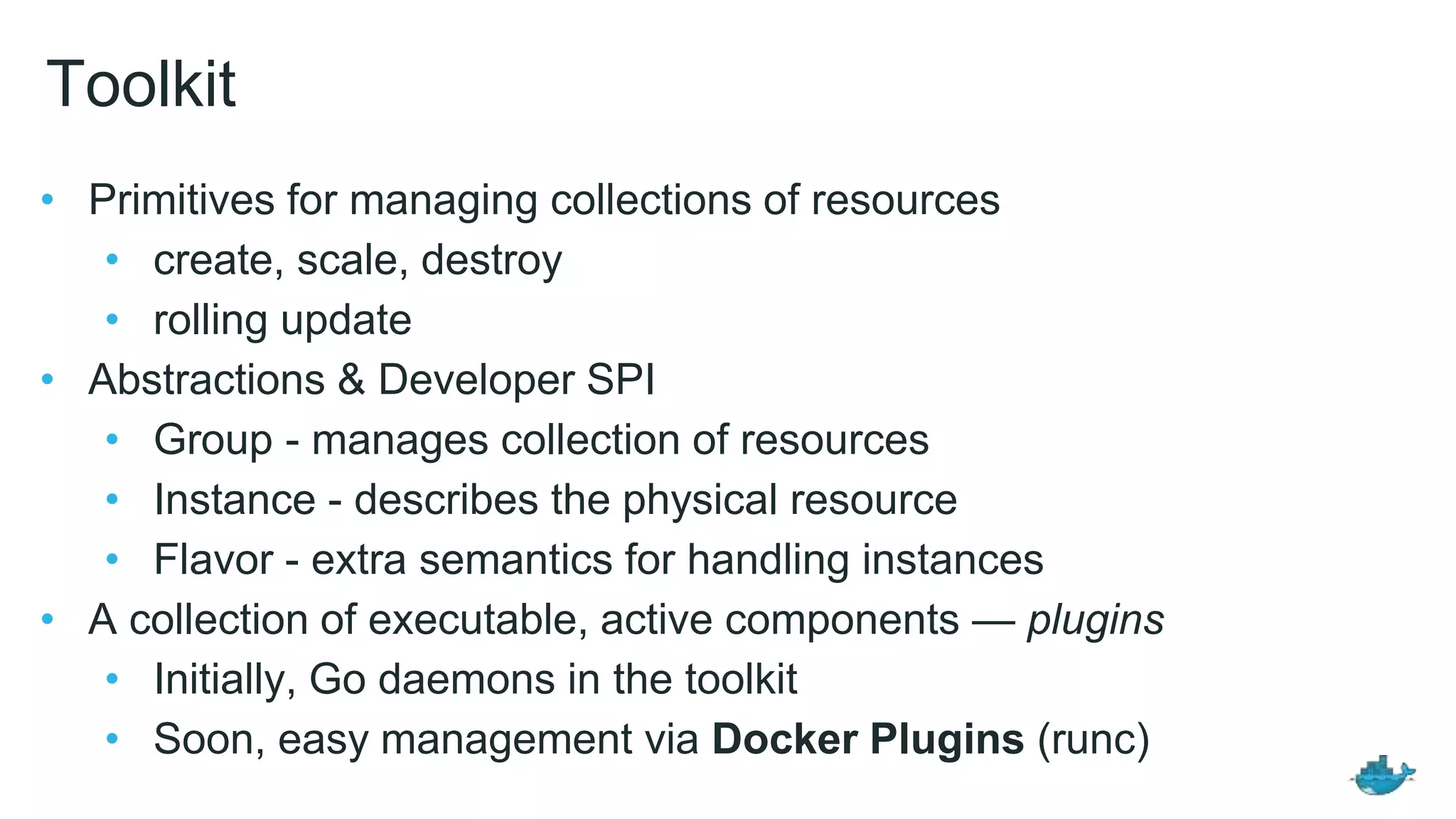
Toolkit • Primitives for managing collections of resources • create, scale, destroy • rolling update • Abstractions & Developer SPI • Group - manages collection of resources • Instance - describes the physical resource • Flavor - extra semantics for handling instances • A collection of executable, active components — plugins • Initially, Go daemons in the toolkit • Soon, easy management via Docker Plugins (runc)
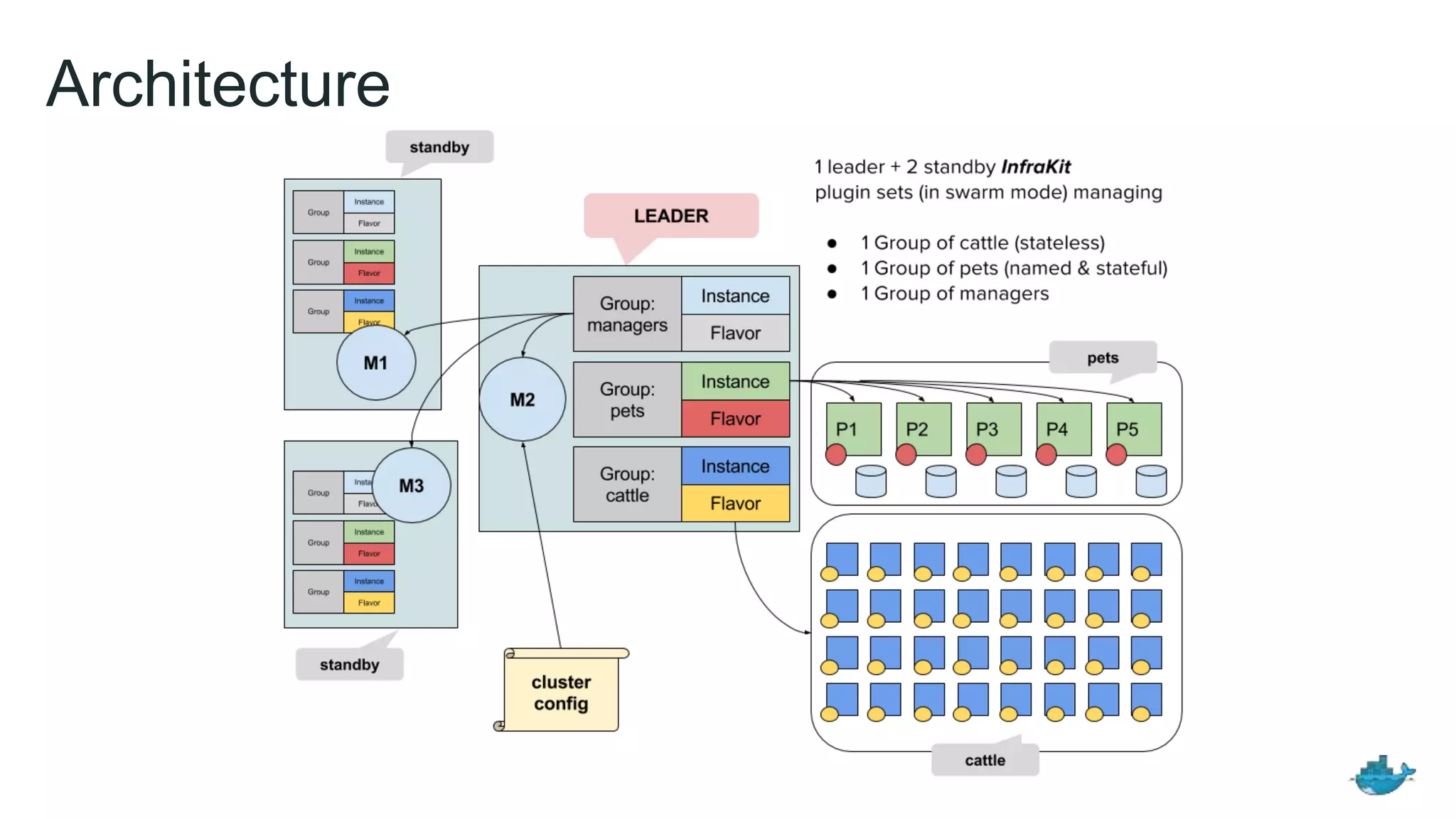
Architecture
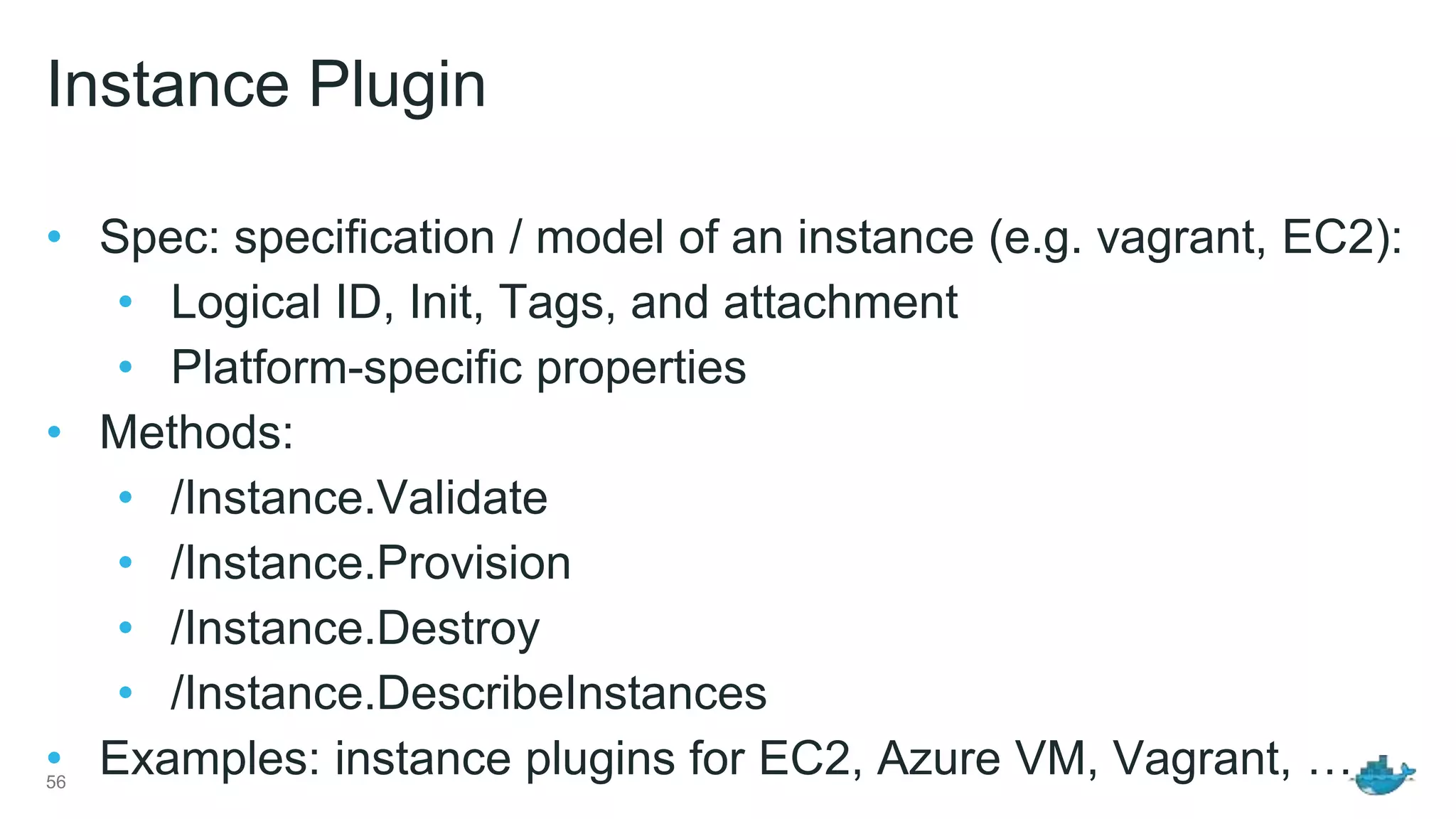
Instance Plugin • Spec: specification / model of an instance (e.g. vagrant, EC2): • Logical ID, Init, Tags, and attachment • Platform-specific properties • Methods: • /Instance.Validate • /Instance.Provision • /Instance.Destroy • /Instance.DescribeInstances • Examples: instance plugins for EC2, Azure VM, Vagrant, …56
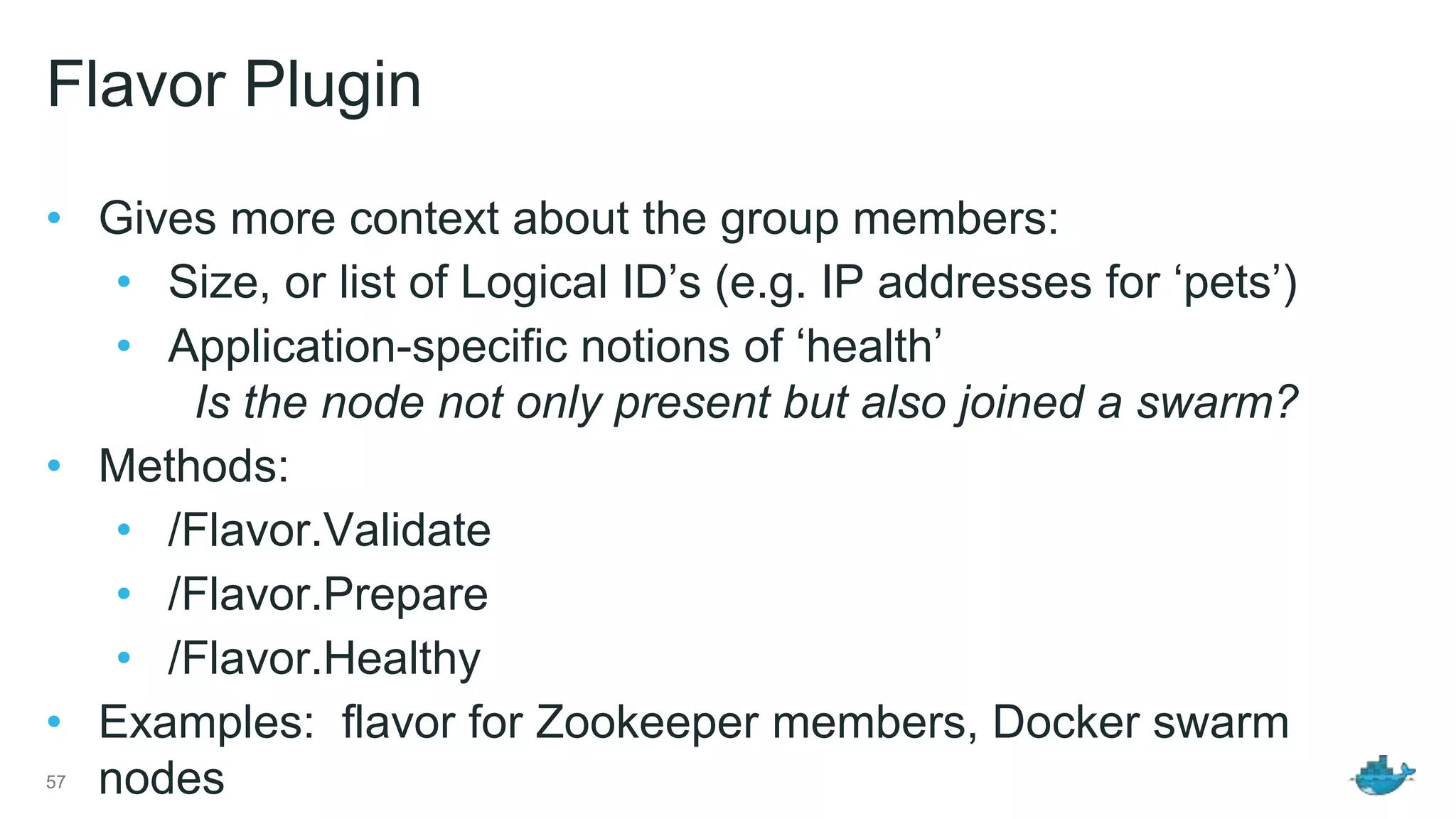
Flavor Plugin • Gives more context about the group members: • Size, or list of Logical ID’s (e.g. IP addresses for ‘pets’) • Application-specific notions of ‘health’ Is the node not only present but also joined a swarm? • Methods: • /Flavor.Validate • /Flavor.Prepare • /Flavor.Healthy • Examples: flavor for Zookeeper members, Docker swarm nodes57
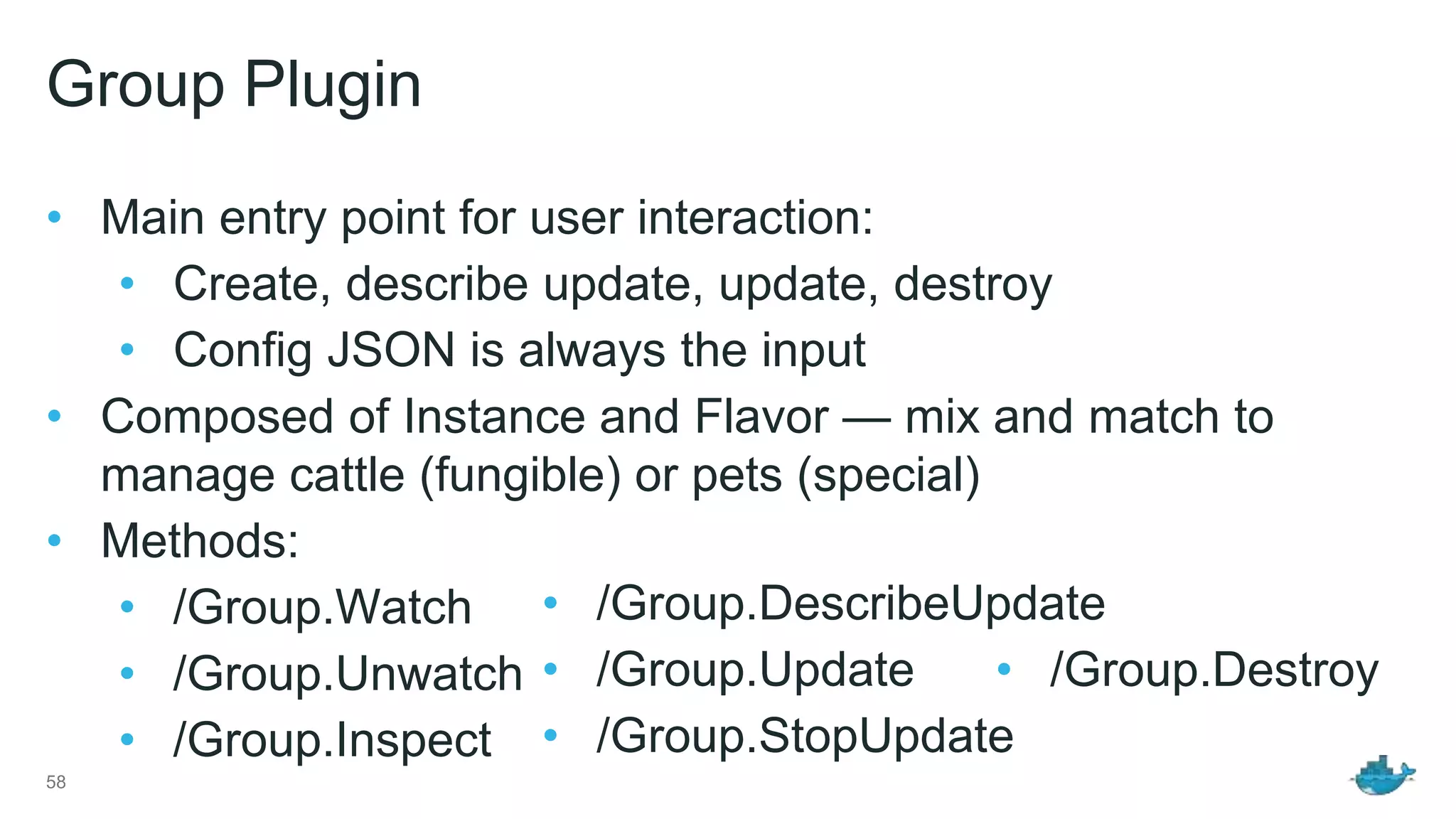
Group Plugin • Main entry point for user interaction: • Create, describe update, update, destroy • Config JSON is always the input • Composed of Instance and Flavor — mix and match to manage cattle (fungible) or pets (special) • Methods: • /Group.Watch • /Group.Unwatch • /Group.Inspect 58 • /Group.DescribeUpdate • /Group.Update • /Group.StopUpdate • /Group.Destroy
Configuration Example config file (zk.conf): Group configuration = Instance + Flavor { "Properties": { /* raw configuration */ } } { "groups" : { "my_zookeeper_nodes" : { "Properties" : { "Instance" : { "Plugin": "instance-vagrant", "Properties": { "Box": "bento/ubuntu-16.04" } }, "Flavor" : { "Plugin": "flavor-zookeeper", "Properties": { "type": "member", "IPs": ["192.168.1.200", "192.168.1.201", "192.168.1.202"] } } } } } }
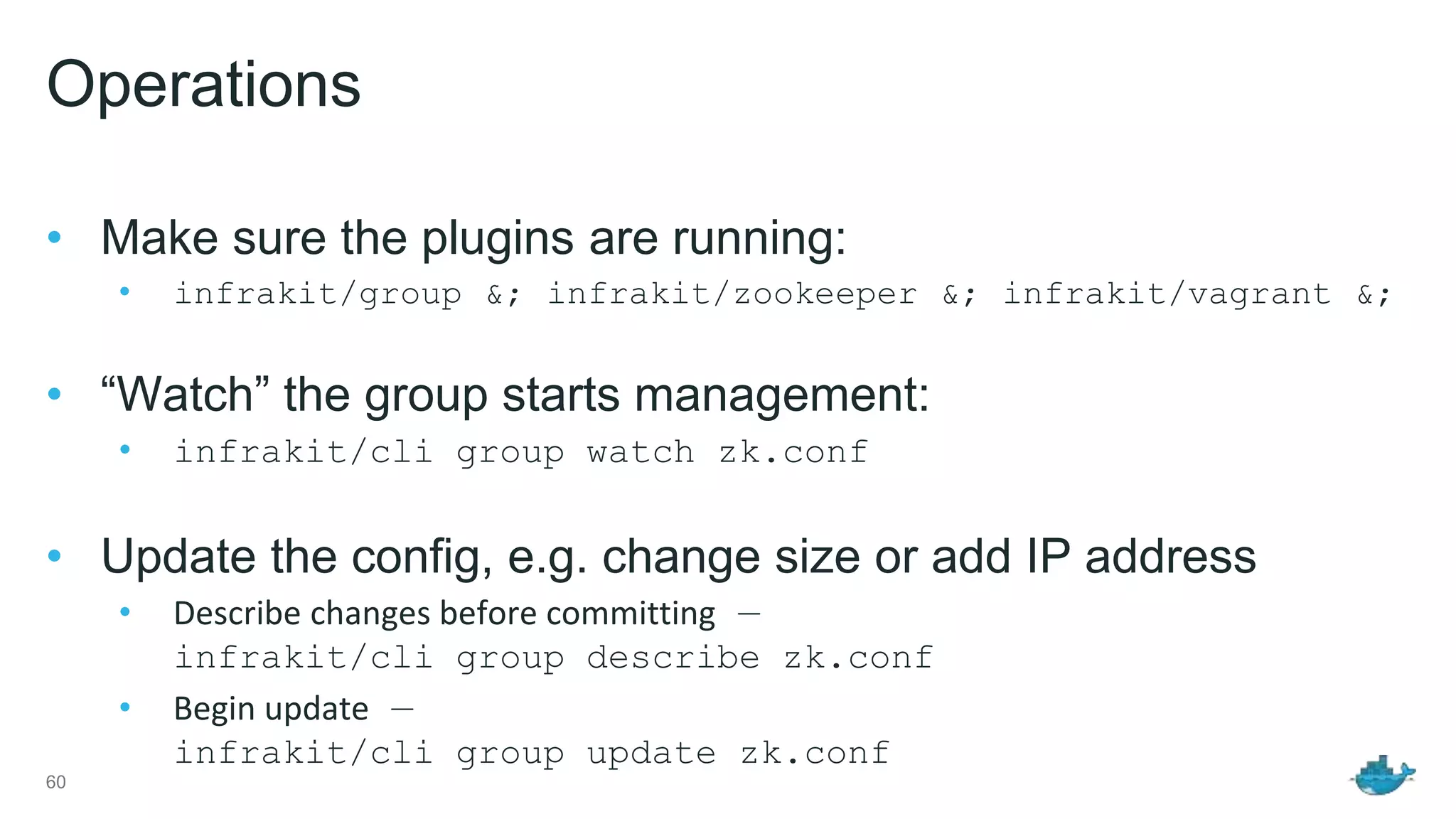
Operations • Make sure the plugins are running: • infrakit/group &; infrakit/zookeeper &; infrakit/vagrant &; • “Watch” the group starts management: • infrakit/cli group watch zk.conf • Update the config, e.g. change size or add IP address • Describe changes before committing — infrakit/cli group describe zk.conf • Begin update — infrakit/cli group update zk.conf 60
Demo 61
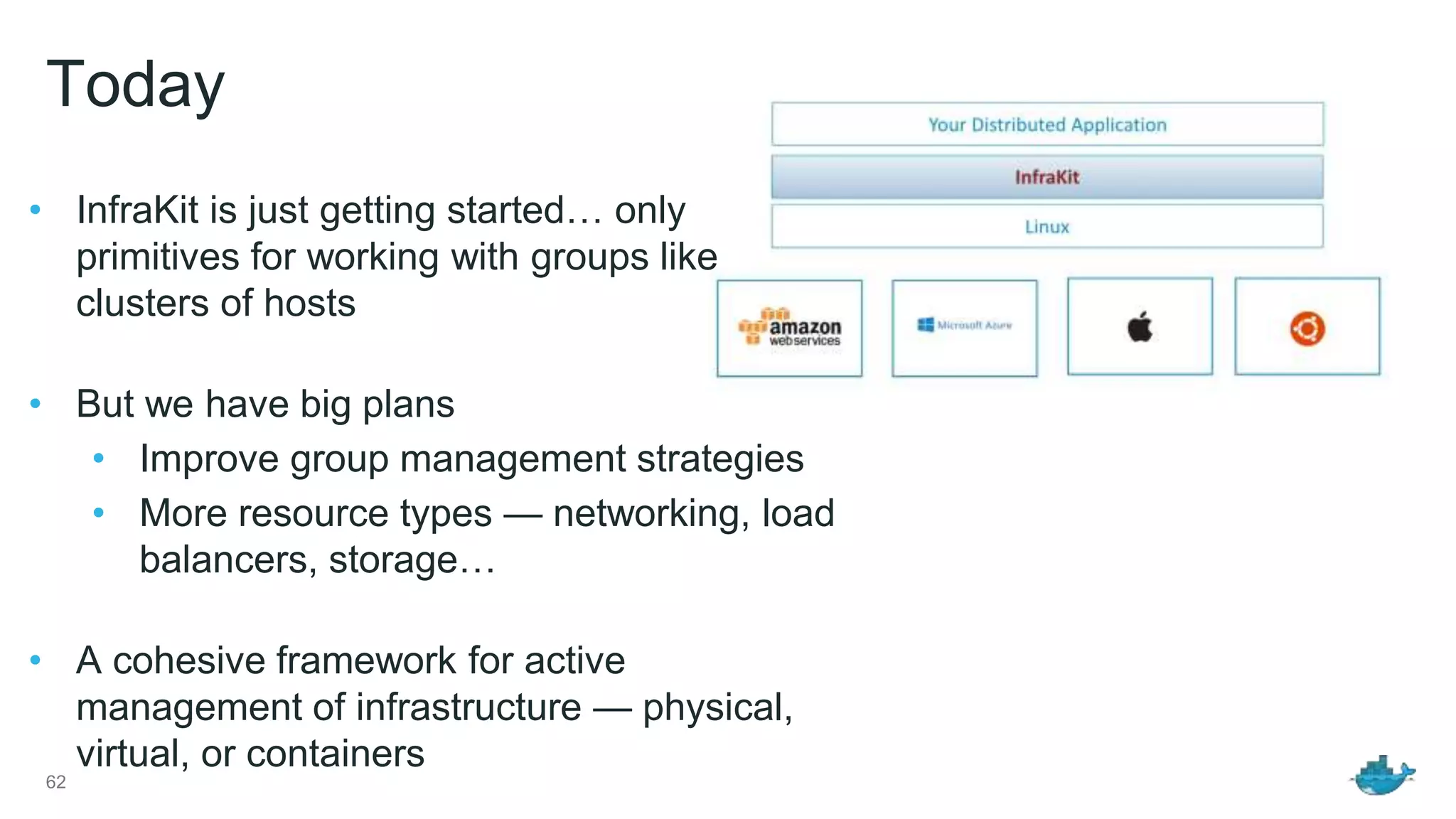
Today 62 • InfraKit is just getting started… only primitives for working with groups like clusters of hosts • But we have big plans • Improve group management strategies • More resource types — networking, load balancers, storage… • A cohesive framework for active management of infrastructure — physical, virtual, or containers
Get Involved • Help define and implement new and interesting plugins • Instance plugins for different infrastructure providers • Flavor plugins for systems like etcd or mysql clusters • Group controller plugins — metrics-driven auto scaling and more • Help define interfaces and implement new infrastructure resource types — load balancers, networks and storage volume provisioners 63
More Info • Github: https://github.com/docker/infrakit • A quick tutorial: https://github.com/docker/infrakit/blob/master/docs/tutorial.m d 64
Booth D38 @ LinuxCon + ContainerCon Tues Oct 4th • Build Distributed Systems without Docker, using Docker Plumbing Projects - Patrick Chanezon, David Chung and Captain Phil Estes • Getting Started with Docker Services - Mike Goelzer • Swarmkit: Docker’s Simplified Model for Complex Orchestration - Stephen Day • User Namespace and Seccomp Support in Docker Engine - Paul Novarese • Build Efficient Parallel Testing Systems with Docker - Docker Captain Laura Frank Wed Oct 5th • How Secure is your Container? A Docker Engine Security Update - Phil Estes • Docker Orchestration: Beyond the Basics - Aaron Lehmann • When the Going gets Tough, get TUF Going - Riyaz Faizullabhoy and Lily Guo Thurs Oct 6th • Orchestrating Linux Containers while Tolerating Failures - Drew Erny • Unikernels: When you Should and When you Shouldn’t - Amir Chaudhry • Berlin Docker Meetup Friday Oct 7th • Tutorial: Comparing Container Orchestration Tools - Neependra Khare • Tutorial: Orchestrate Containers in Production at Scale with Docker Swarm - Jerome Petazzoni
THANK YOU

Building Distributed Systems without Docker, Using Docker Plumbing Projects - LinuxCon Berlin 2016

Editor's Notes

  • #23 Local development environments Self service app images Build, Test, Deploy applications Define app behavior and infra needs Registry services for image storage, management and distribution IT Ops maintains library of secure base content Manage role based access to repos/images Management consoles Provision, manage infrastructure resources Monitor, manage, scale infrastructure and applications
  • #49 Docker for Mac is super easy to use. It self-updates. But how to do you do that for other platforms??
  • #50 Infrastructure management holds an interesting position — it has to prepare the environment for the container engine.
  • #51 Infrastructure management sets up the environment for the container engine. It then collaborates with it to service the user’s needs.
  • #55 integration in the future as Docker Plugins (as runc containers) goes back to initial goal of simplifying user experience through a common Docker plugin install experience
  • #56 InfraKit can be used set up to run with leader election (e.g. integrated with Docker swarm mode) to achieve high availability. Multiple plugin sets are running as hot standby but only one is active (the leader).
  • #57 no method to update !!— opinionated immutable infrastructure
  • #58 Prepare modifies the Spec for the instance. It can inject additional init scripts, tags. Healthy goes beyond just presence — is a node present AND part of a swarm?
  • #59 No operations to create: watching nodes that don’t exist —> will create them … declarative state explain cases for using each. why explicit is better than implicit (use unwatch / destroy example)
  • #60 Simple patterns Compose them into a large configuration. Group is made up of Instance and Flavor
  • #61 Note the config is used for all inputs. The system figures out what needs to be done. Only signals to system to start managing Docker plugins in a future implementation