2 Conditional operatorsin details Decision making structures like IF, IF-ELSE AND SWITCH Loop control structures like FOR, WHILE, DO- WHILE Implementation of break and continue. Nested structures. Unconditional branching (GOTO statement).
3.
3 INTRODUCTION:- Normally thestatement of a program are executed from first to last. Sometimes it is necessary to alter the sequence of execution of statements. Based on certain conditions or we may require some statements to be executed repeatedly until some condition is satisfied. This involves decision making and looping.
4.
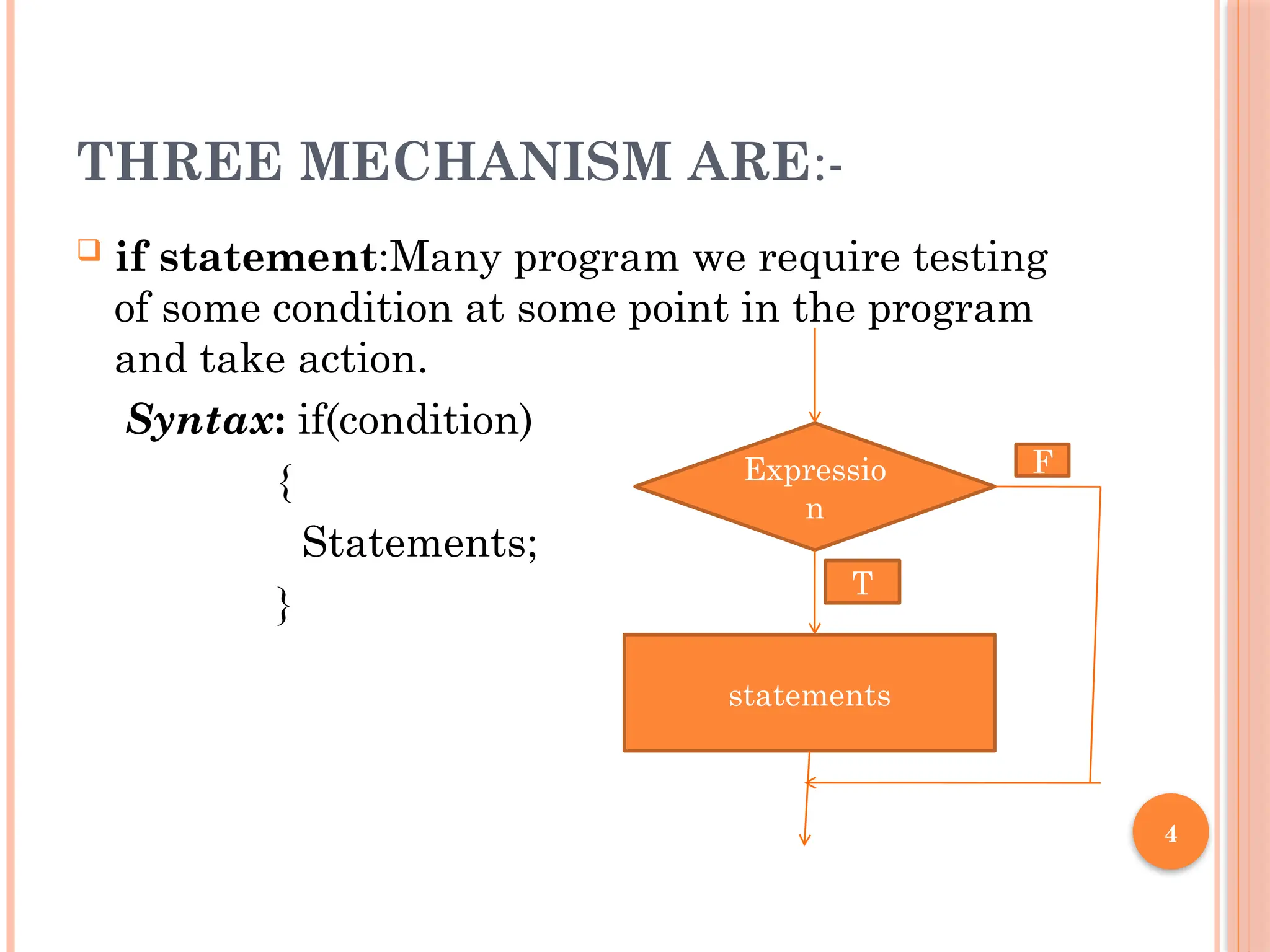
4 THREE MECHANISM ARE:- if statement:Many program we require testing of some condition at some point in the program and take action. Syntax: if(condition) { Statements; } Expressio n statements F T
5.
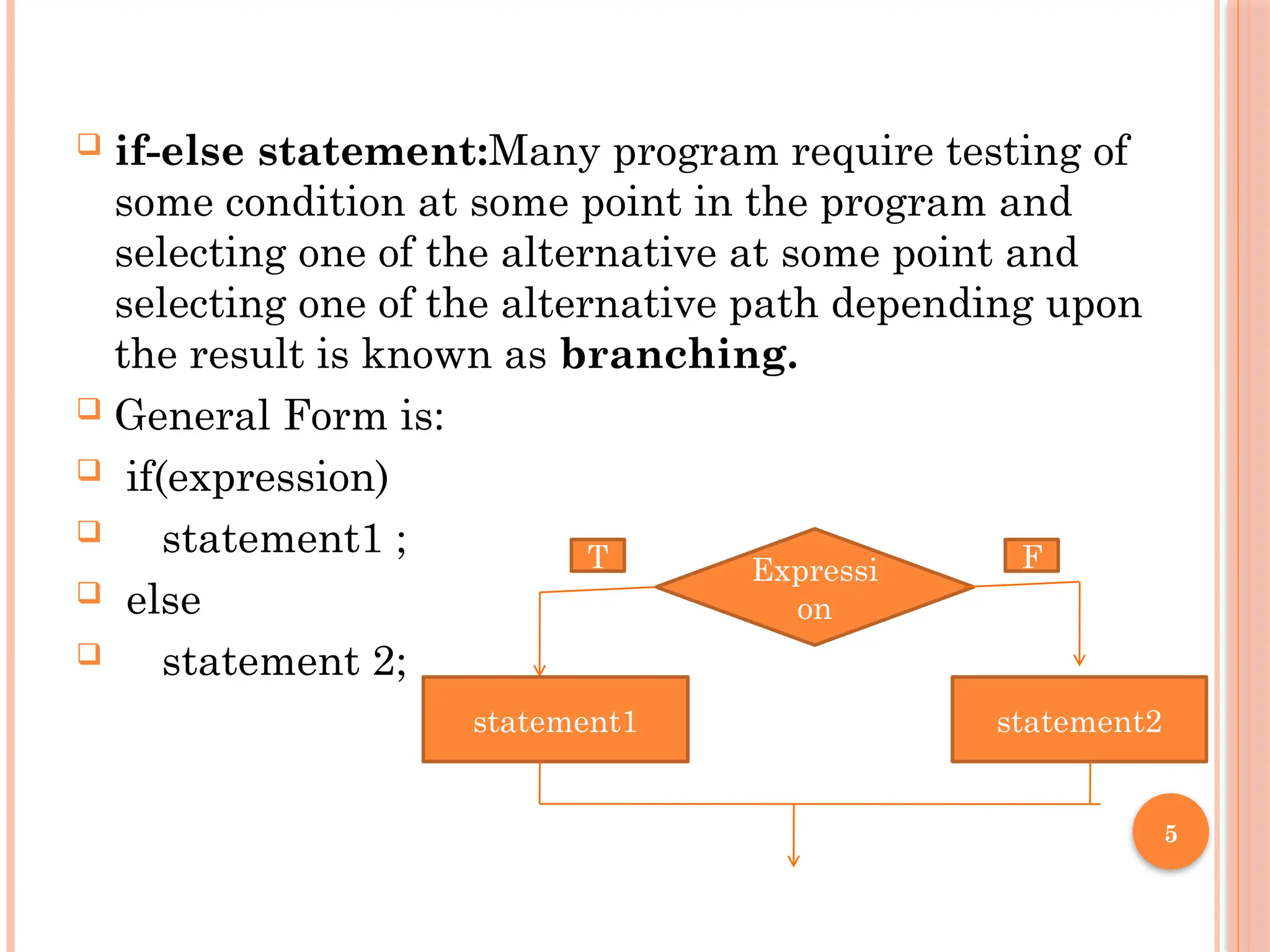
5 if-else statement:Manyprogram require testing of some condition at some point in the program and selecting one of the alternative at some point and selecting one of the alternative path depending upon the result is known as branching. General Form is: if(expression) statement1 ; else statement 2; Expressi on statement1 statement2 T F
6.
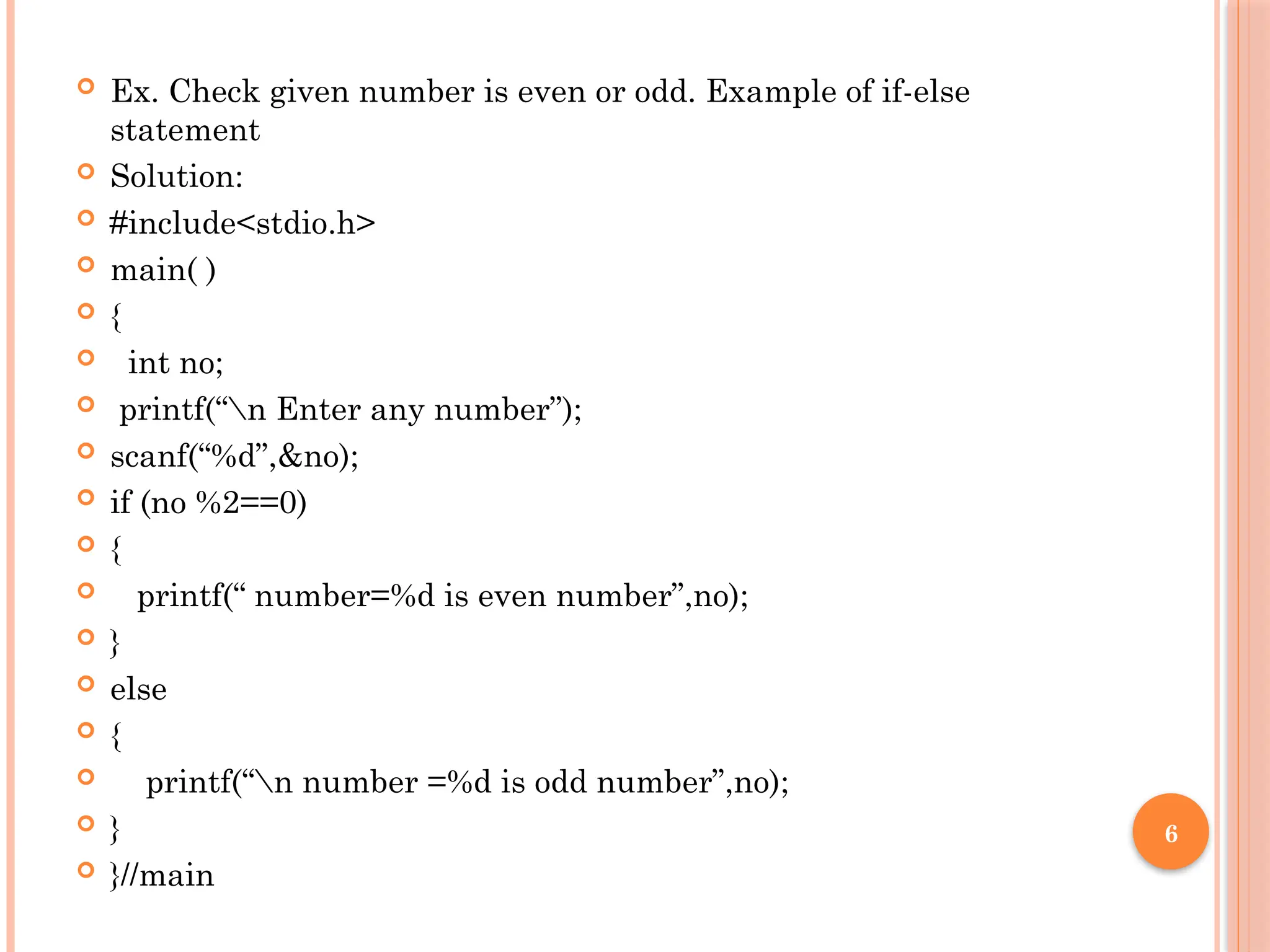
6 Ex. Checkgiven number is even or odd. Example of if-else statement Solution: #include<stdio.h> main( ) { int no; printf(“n Enter any number”); scanf(“%d”,&no); if (no %2==0) { printf(“ number=%d is even number”,no); } else { printf(“n number =%d is odd number”,no); } }//main
7.
7 NESTED IF–ELSE STATEMENT NESTED “IF-ELSE” STATEMENTS:- Nested “if-else” statements, the if or the else can contain another if or if-else statement. This provides a programmer with a lot of flexibility in programming. Nesting could take one of several form as illustrated as below: 1] if statement inside else:- Syntax: if(expression) Statement1; else if(expression2) Statement2;
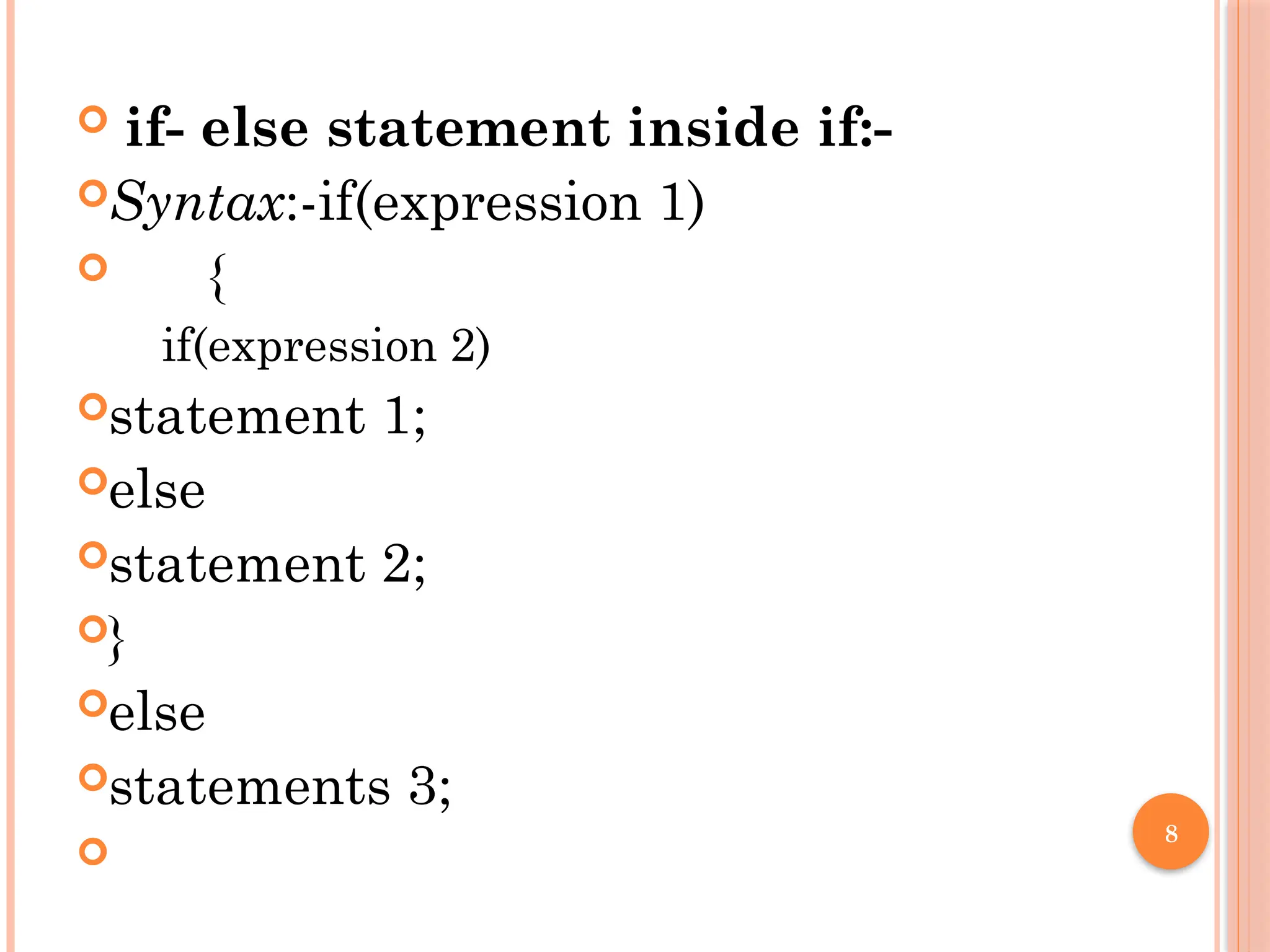
9 4] if-elsestatement inside if-else:- Syntax:-if(expression1) {if(expression2) statement1; else statement 2;} else if(expression3) statement3; else statement 4; Eg Write a c program to accept 3 no from user and check greater no. #include<stdio.h> #include<conio.h> void main() { int no1, no2, no3; clrscr(); printf(“n Ennter any 3 nos:”); scanf(“%d%d%d”,&no1,&no2,&no3); if(no1>no2) if(no1>no3) printf(“n no1 is greater number”);
10.
10 5]else-if ladder:- If there is if-else statement nested in each else of an if-else construct, that is called as else-if ladder. Syntax: if(expression1) statement 1; else if(expression 2) statement2; else if(expression3) statement 3; else statement 4;
11.
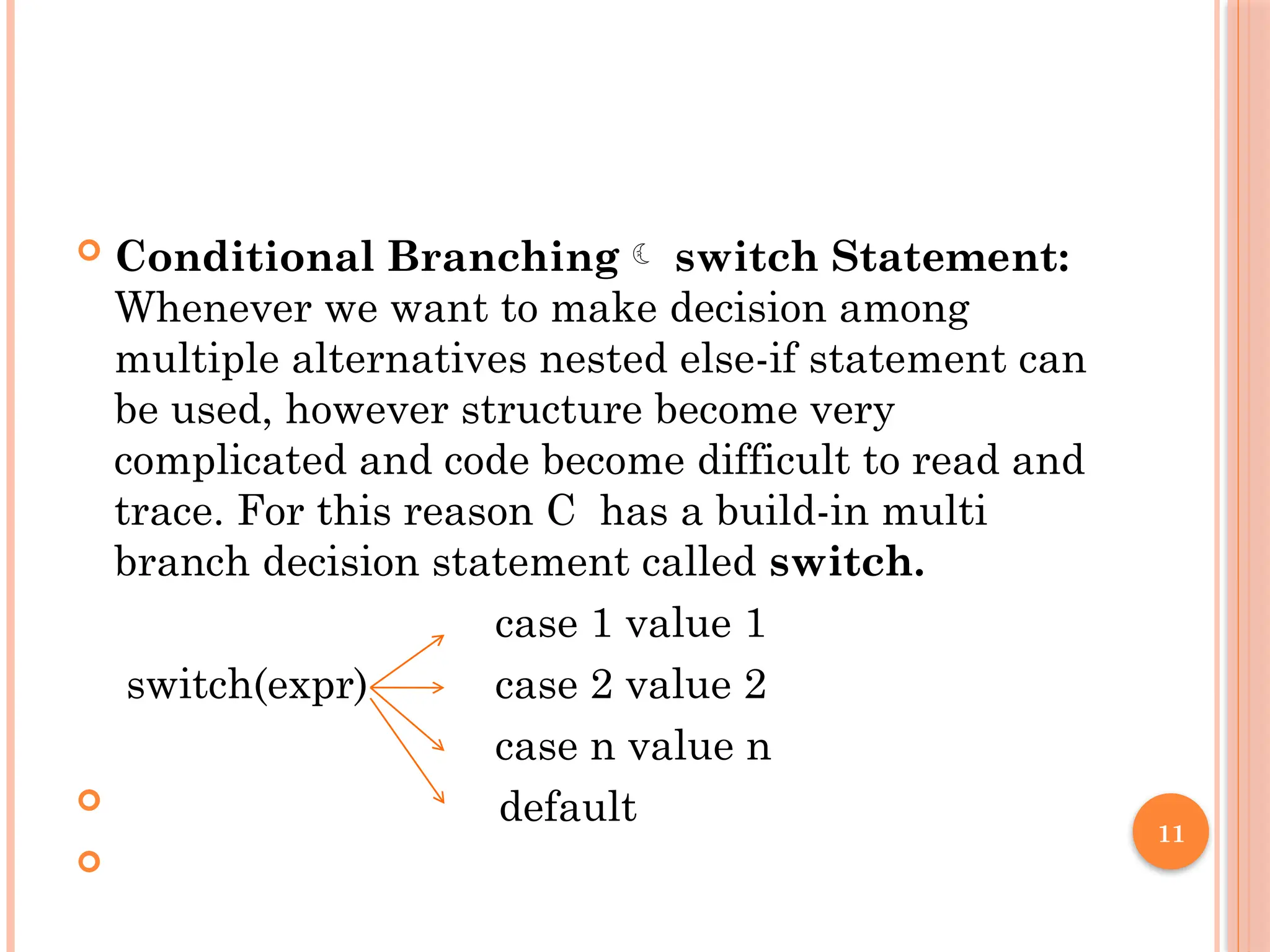
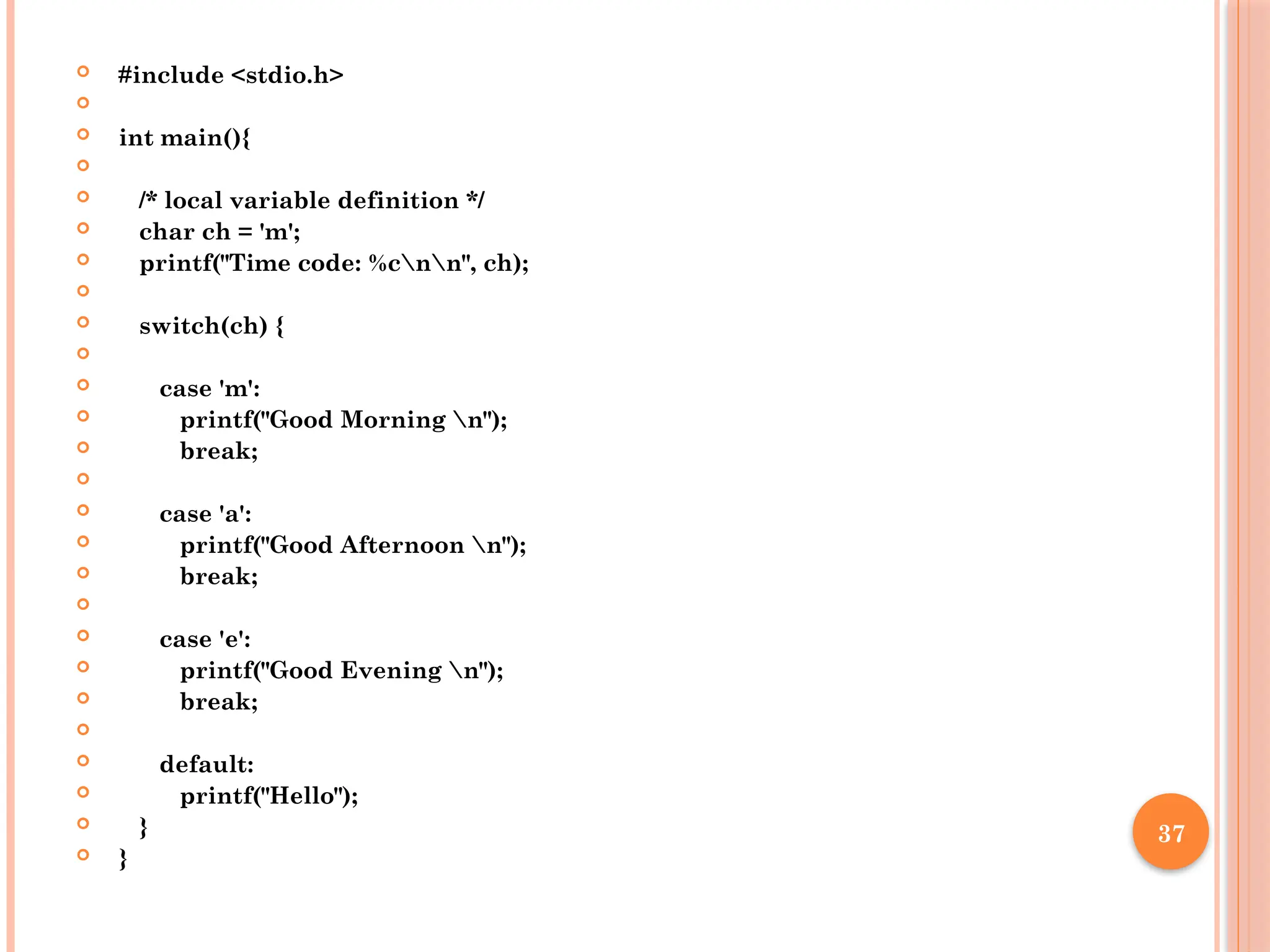
11 Conditional Branchingswitch Statement: Whenever we want to make decision among multiple alternatives nested else-if statement can be used, however structure become very complicated and code become difficult to read and trace. For this reason C has a build-in multi branch decision statement called switch. case 1 value 1 switch(expr) case 2 value 2 case n value n default
12.
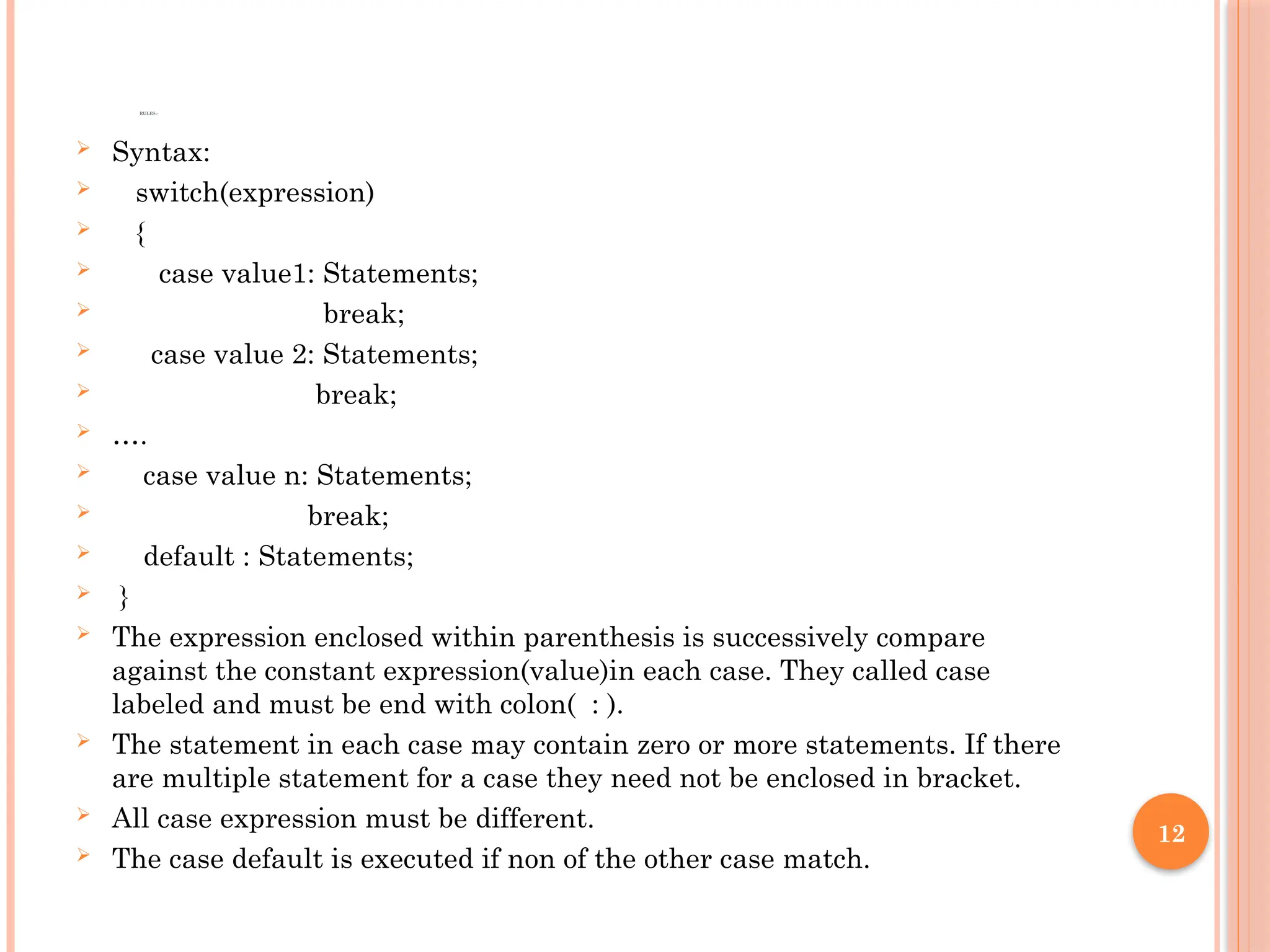
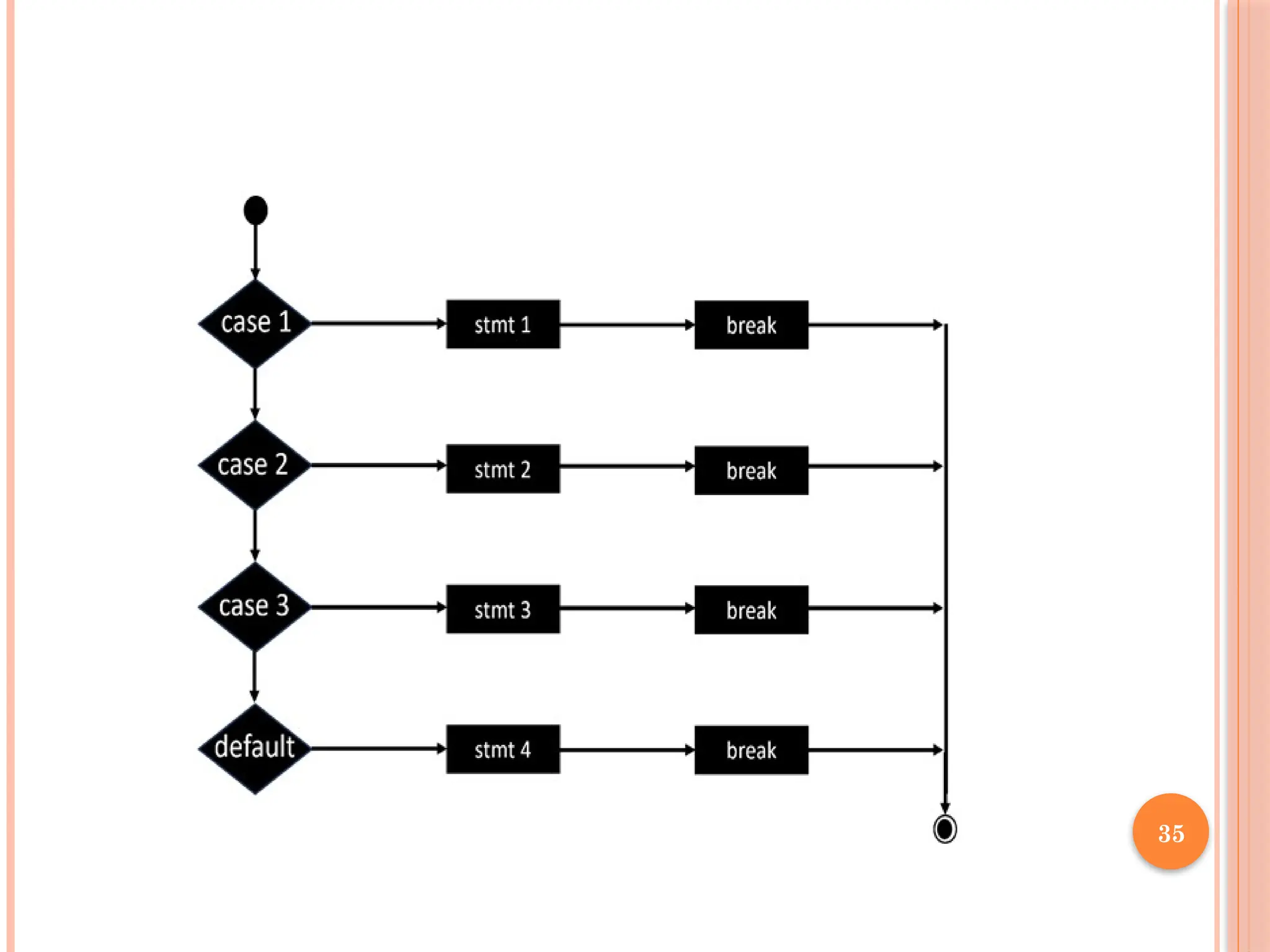
12 RULES:- Syntax: switch(expression) { case value1: Statements; break; case value 2: Statements; break; …. case value n: Statements; break; default : Statements; } The expression enclosed within parenthesis is successively compare against the constant expression(value)in each case. They called case labeled and must be end with colon( : ). The statement in each case may contain zero or more statements. If there are multiple statement for a case they need not be enclosed in bracket. All case expression must be different. The case default is executed if non of the other case match.
13.
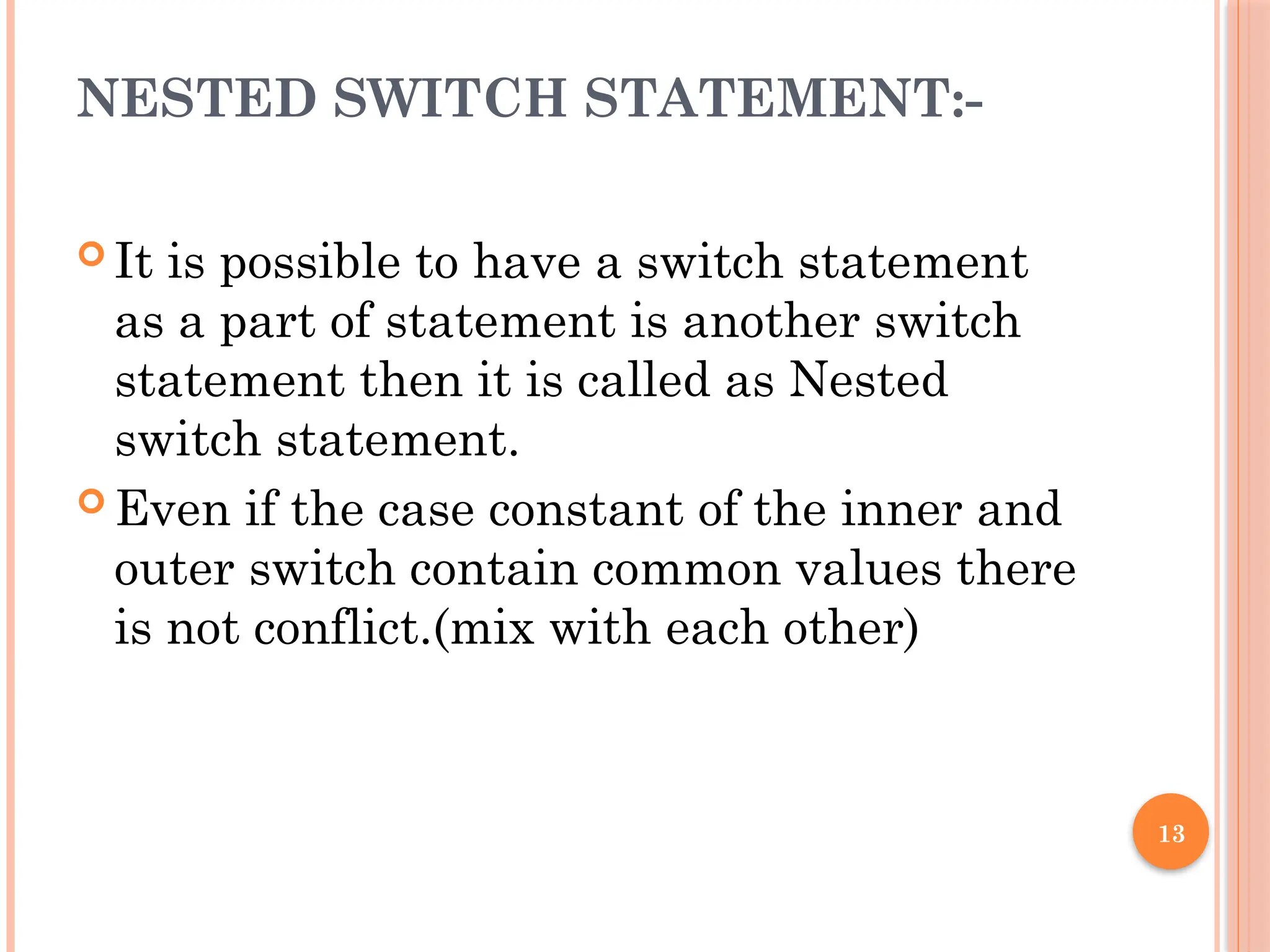
13 NESTED SWITCH STATEMENT:- It is possible to have a switch statement as a part of statement is another switch statement then it is called as Nested switch statement. Even if the case constant of the inner and outer switch contain common values there is not conflict.(mix with each other)
14.
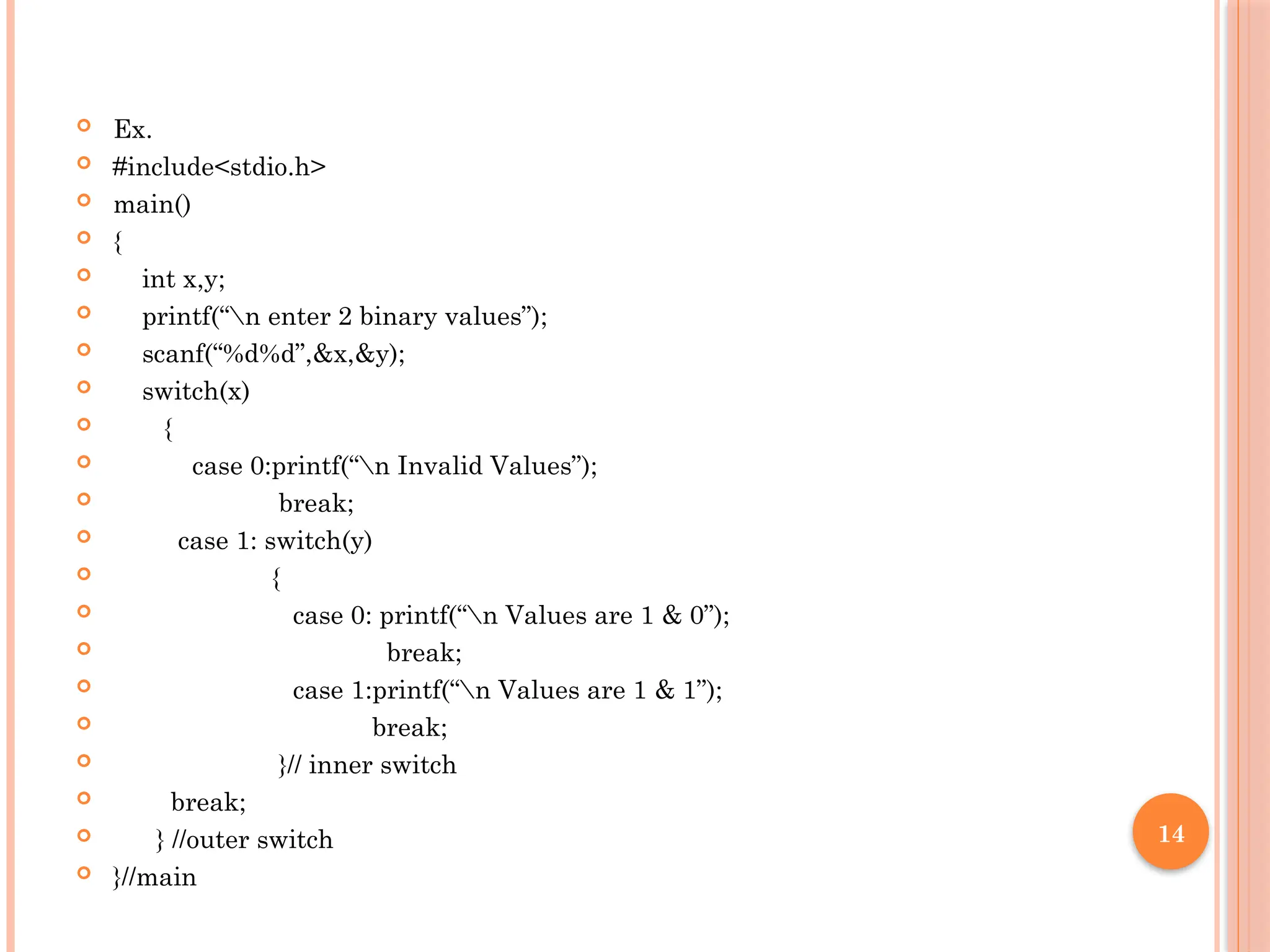
14 Ex. #include<stdio.h> main() { int x,y; printf(“n enter 2 binary values”); scanf(“%d%d”,&x,&y); switch(x) { case 0:printf(“n Invalid Values”); break; case 1: switch(y) { case 0: printf(“n Values are 1 & 0”); break; case 1:printf(“n Values are 1 & 1”); break; }// inner switch break; } //outer switch }//main
15.
15 LOOP CONTROL STRUCTURE:- A block of program statements that is executed repeatedly is called a loop. The repetition is done until some condition for termination of the loop is satisfied . A loop structure essentially contains a test condition. 1]A test condition determines the number of times the loop body is executed. 2]Loop statements- If the test condition evaluate to true then statement within the loop body get executed otherwise control transfer outside the loop i.e loop termination. initially contains a test condition.
16.
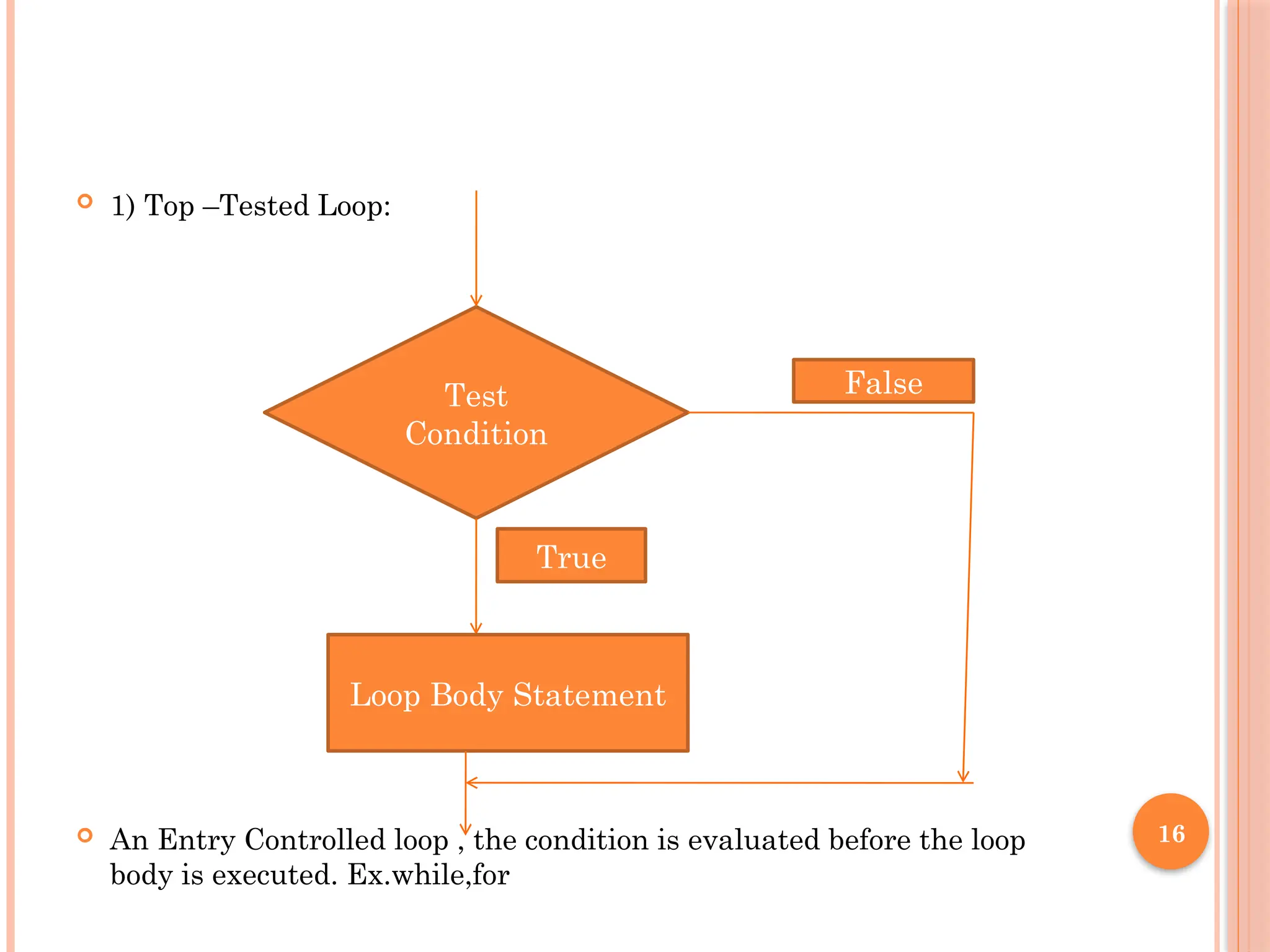
16 1) Top–Tested Loop: An Entry Controlled loop , the condition is evaluated before the loop body is executed. Ex.while,for Test Condition Loop Body Statement False True
17.
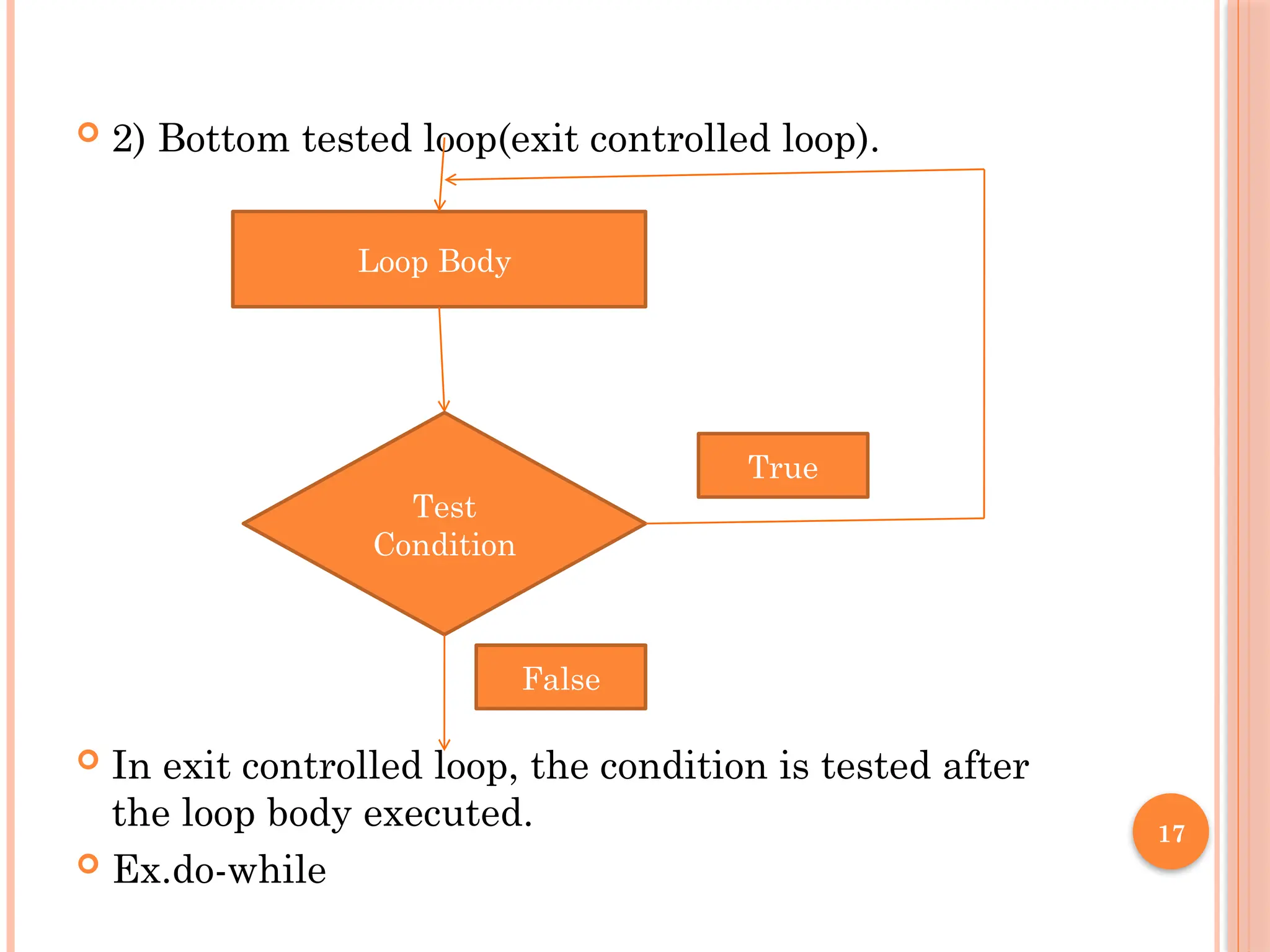
17 2) Bottomtested loop(exit controlled loop). In exit controlled loop, the condition is tested after the loop body executed. Ex.do-while Loop Body Test Condition True False
18.
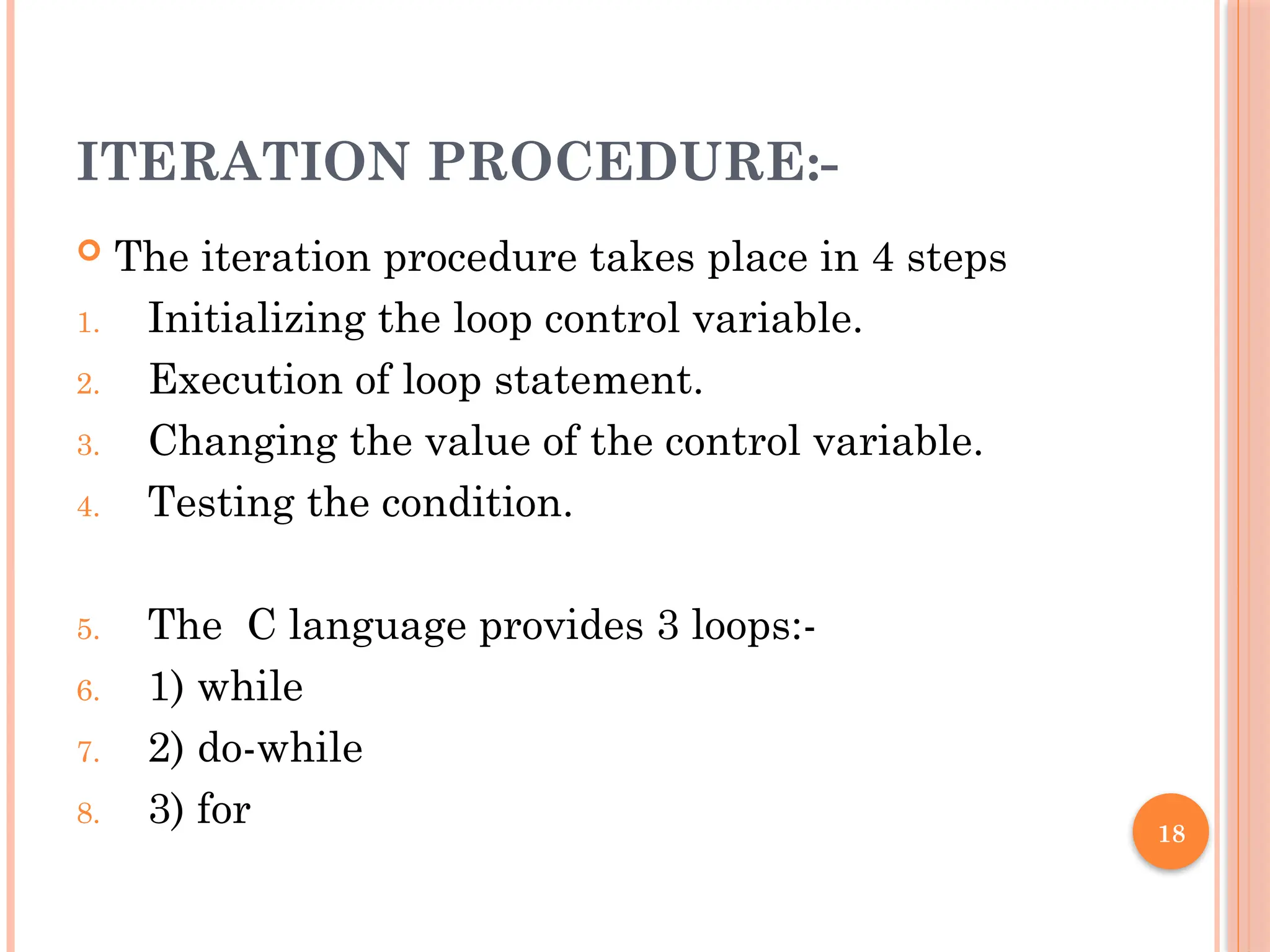
18 ITERATION PROCEDURE:- Theiteration procedure takes place in 4 steps 1. Initializing the loop control variable. 2. Execution of loop statement. 3. Changing the value of the control variable. 4. Testing the condition. 5. The C language provides 3 loops:- 6. 1) while 7. 2) do-while 8. 3) for
19.
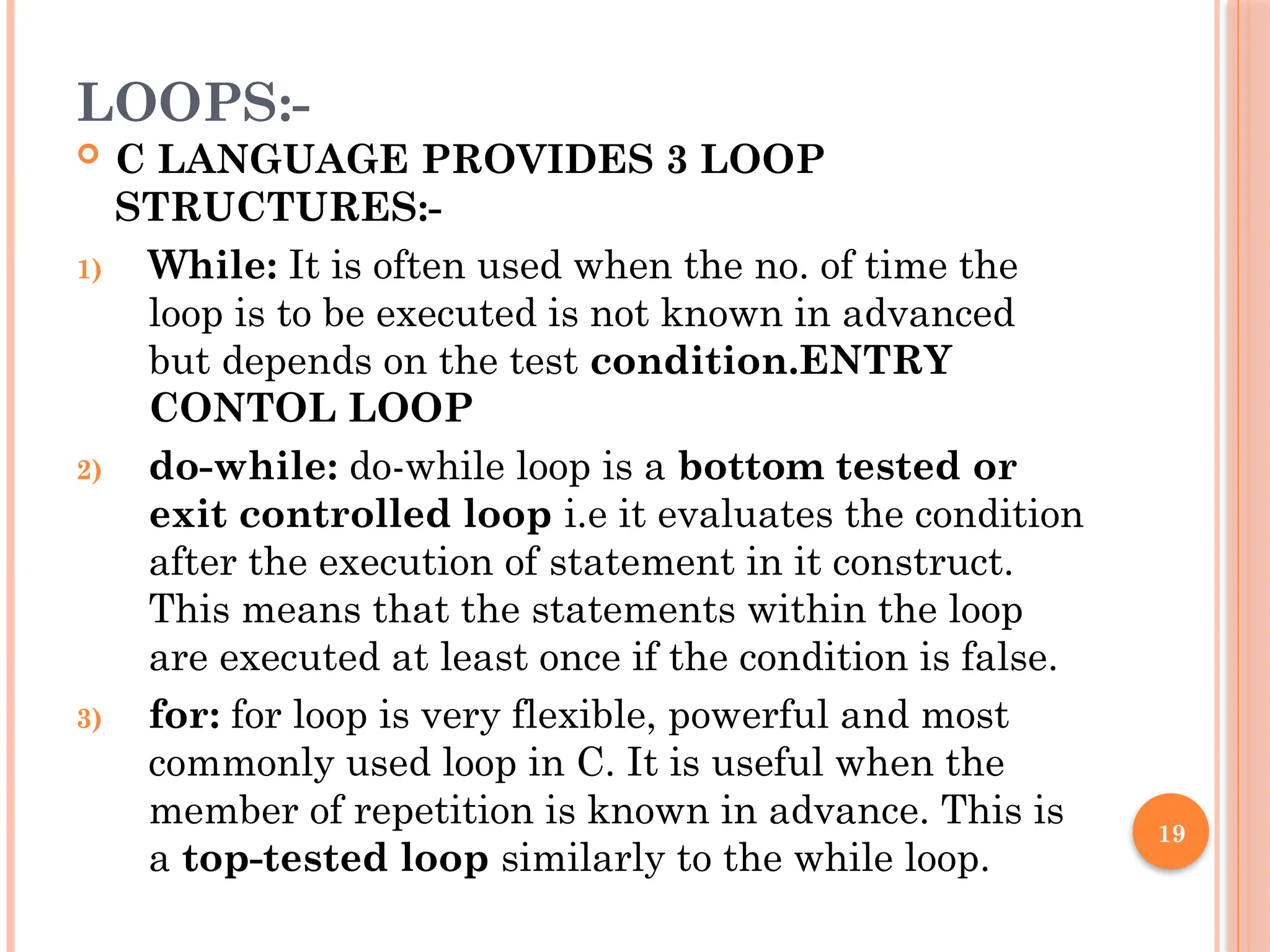
19 LOOPS:- C LANGUAGEPROVIDES 3 LOOP STRUCTURES:- 1) While: It is often used when the no. of time the loop is to be executed is not known in advanced but depends on the test condition.ENTRY CONTOL LOOP 2) do-while: do-while loop is a bottom tested or exit controlled loop i.e it evaluates the condition after the execution of statement in it construct. This means that the statements within the loop are executed at least once if the condition is false. 3) for: for loop is very flexible, powerful and most commonly used loop in C. It is useful when the member of repetition is known in advance. This is a top-tested loop similarly to the while loop.
20.
20 1] While:- Itis often used when the no. of time the loop is to be executed is not known in advanced but depends on the test condition. Syntax:- while(expression) { statements; } That expression is a test condition and can be any valid c expression. The statement can be a single or set of statement.
21.
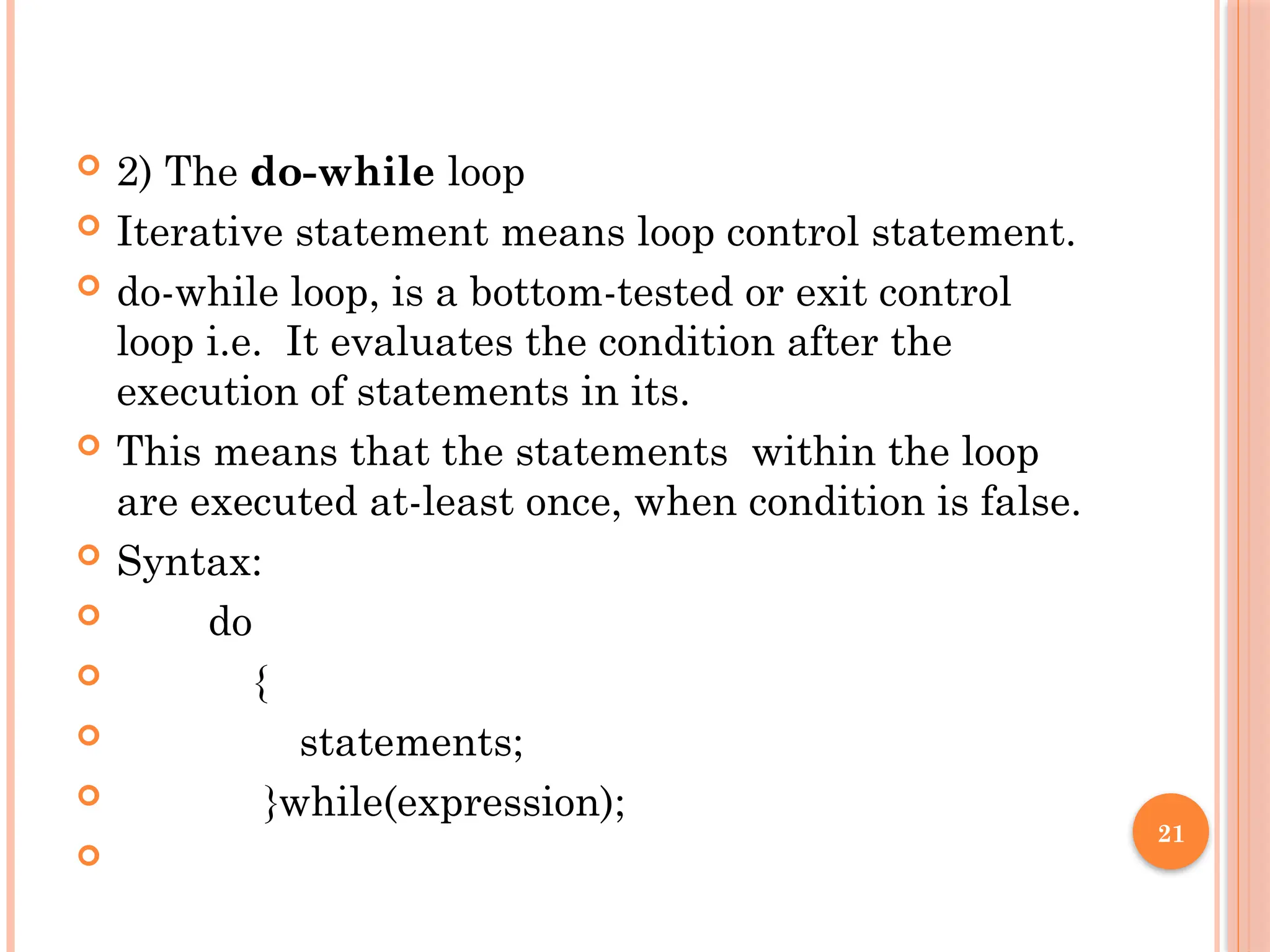
21 2) Thedo-while loop Iterative statement means loop control statement. do-while loop, is a bottom-tested or exit control loop i.e. It evaluates the condition after the execution of statements in its. This means that the statements within the loop are executed at-least once, when condition is false. Syntax: do { statements; }while(expression);
22.
22 3] forloop:- For loop is very flexible, powerful and most commonly used loop in C . It is useful when the member of repetition is known in advance. This is a top-tested loop similarly to the while loop. Syntax:- for(exp1;exp2;exp3) ex. for( i=1;i<=10;i++) { statement; } Where, expr1 is to used to initialization of expression. expr2 is used to test condition . expr3 is used to update expression. these 3 expression is separated by ‘ ; ’.
23.
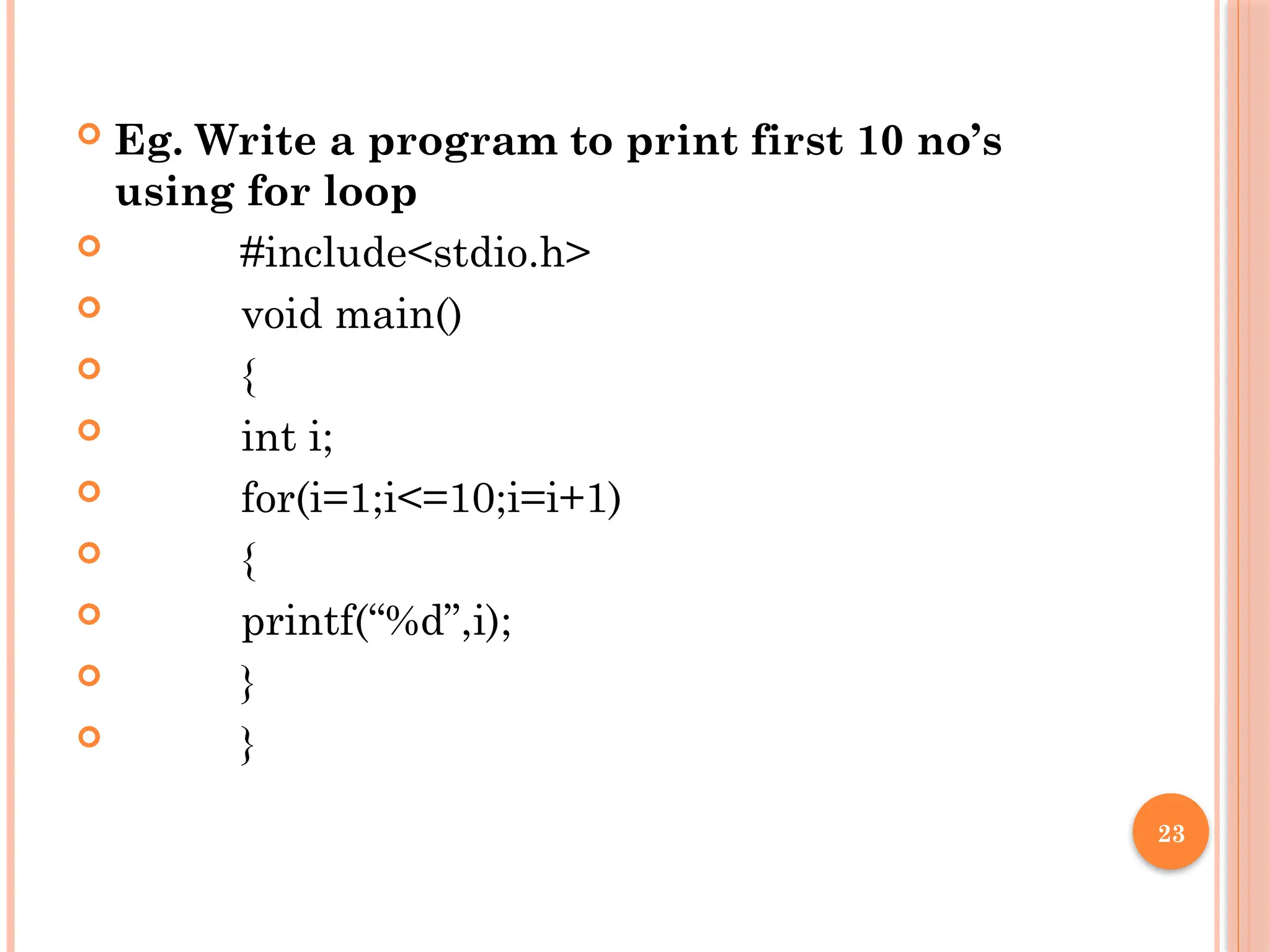
23 Eg. Writea program to print first 10 no’s using for loop #include<stdio.h> void main() { int i; for(i=1;i<=10;i=i+1) { printf(“%d”,i); } }
24.
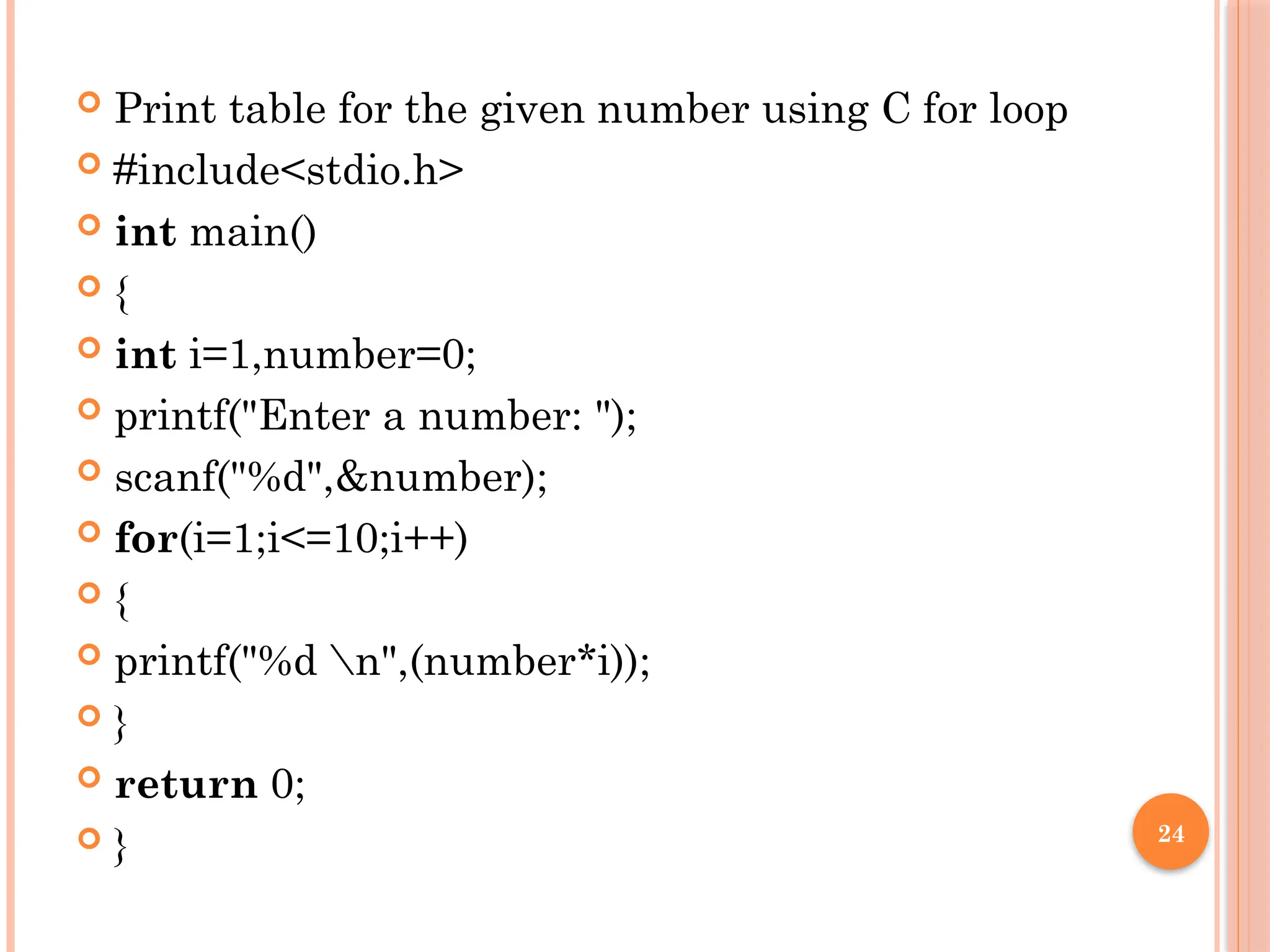
24 Print tablefor the given number using C for loop #include<stdio.h> int main() { int i=1,number=0; printf("Enter a number: "); scanf("%d",&number); for(i=1;i<=10;i++) { printf("%d n",(number*i)); } return 0; }
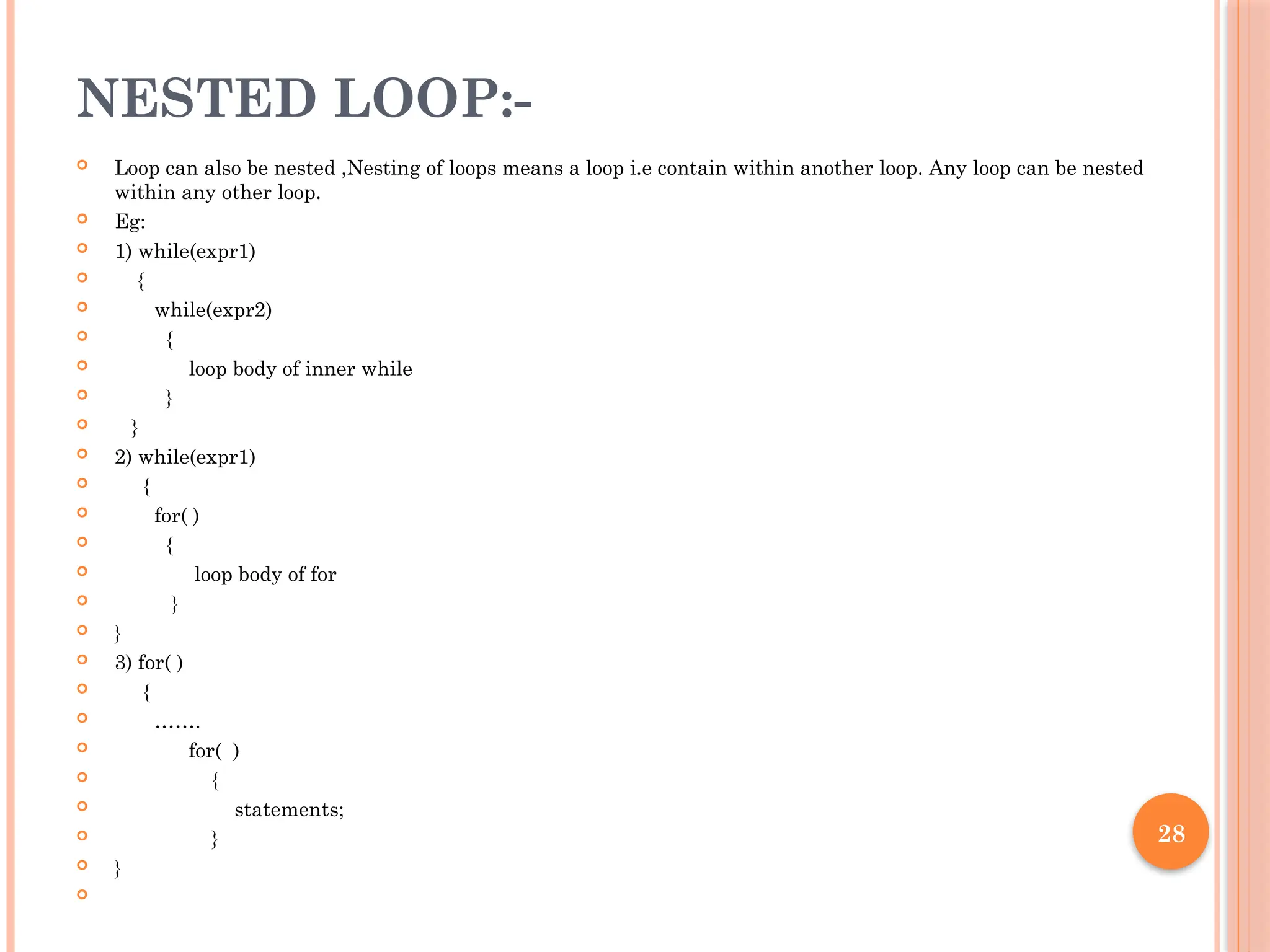
28 NESTED LOOP:- Loopcan also be nested ,Nesting of loops means a loop i.e contain within another loop. Any loop can be nested within any other loop. Eg: 1) while(expr1) { while(expr2) { loop body of inner while } } 2) while(expr1) { for( ) { loop body of for } } 3) for( ) { ……. for( ) { statements; } }
29.
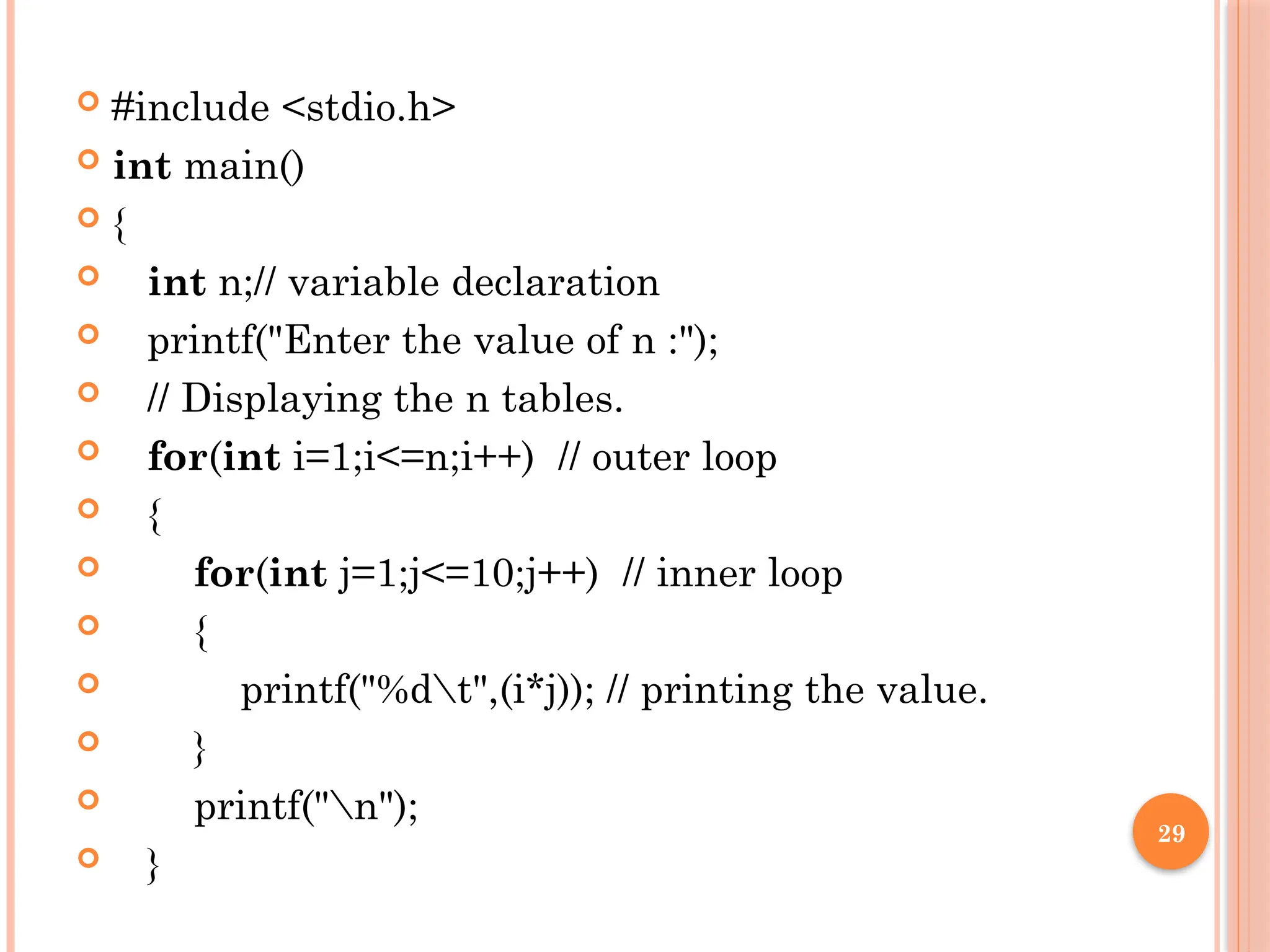
29 #include <stdio.h> int main() { int n;// variable declaration printf("Enter the value of n :"); // Displaying the n tables. for(int i=1;i<=n;i++) // outer loop { for(int j=1;j<=10;j++) // inner loop { printf("%dt",(i*j)); // printing the value. } printf("n"); }
30.
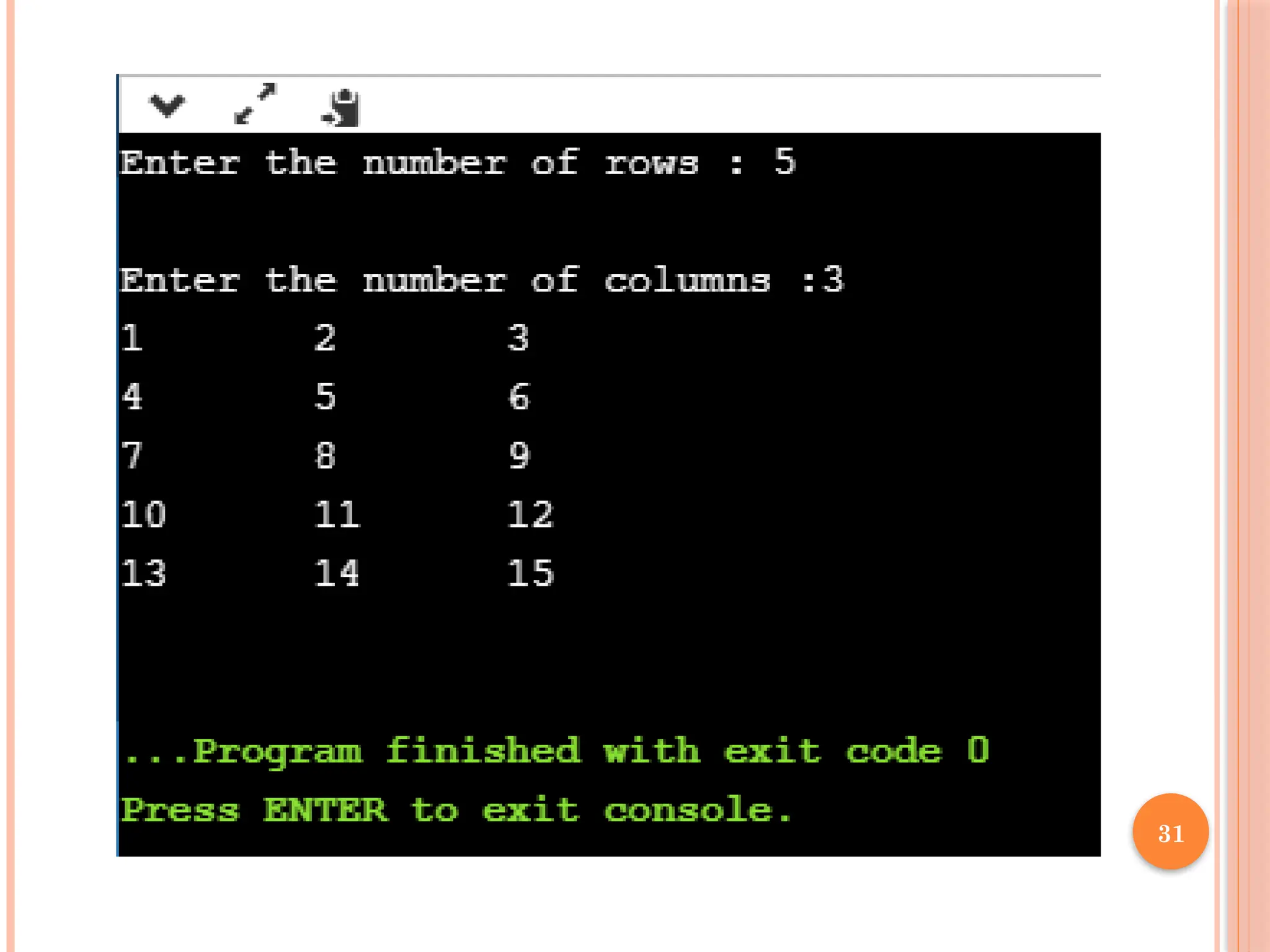
30 #include <stdio.h> int main() { int rows; // variable declaration int columns; // variable declaration int k=1; // variable initialization printf("Enter the number of rows :"); // input the number of rows. scanf("%d",&rows); printf("nEnter the number of columns :"); // input the number of columns. scanf("%d",&columns); int a[rows][columns]; //2d array declaration int i=1; while(i<=rows) // outer loop { int j=1; while(j<=columns) // inner loop { printf("%dt",k); // printing the value of k. k++; // increment counter j++; } i++; printf("n"); } }
32 JUMP STATEMENT:- Inmany cases we want to stop the execution loop before it ends or transfer the control to some other part of a program. This can be done using jump statement. C supports 4 jump statements 1. break 2. continue 3. return 4. Goto 5. exit
33.
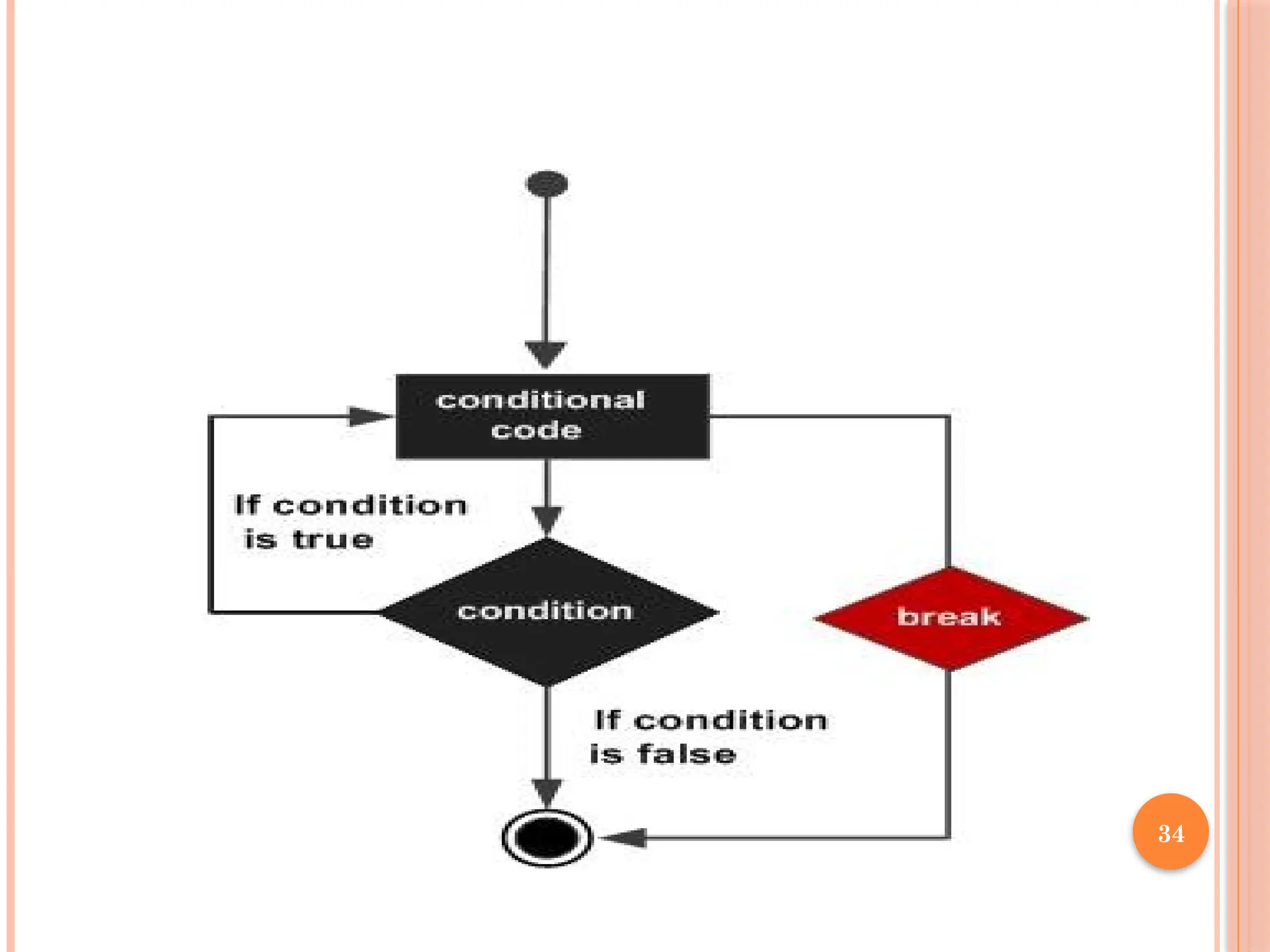
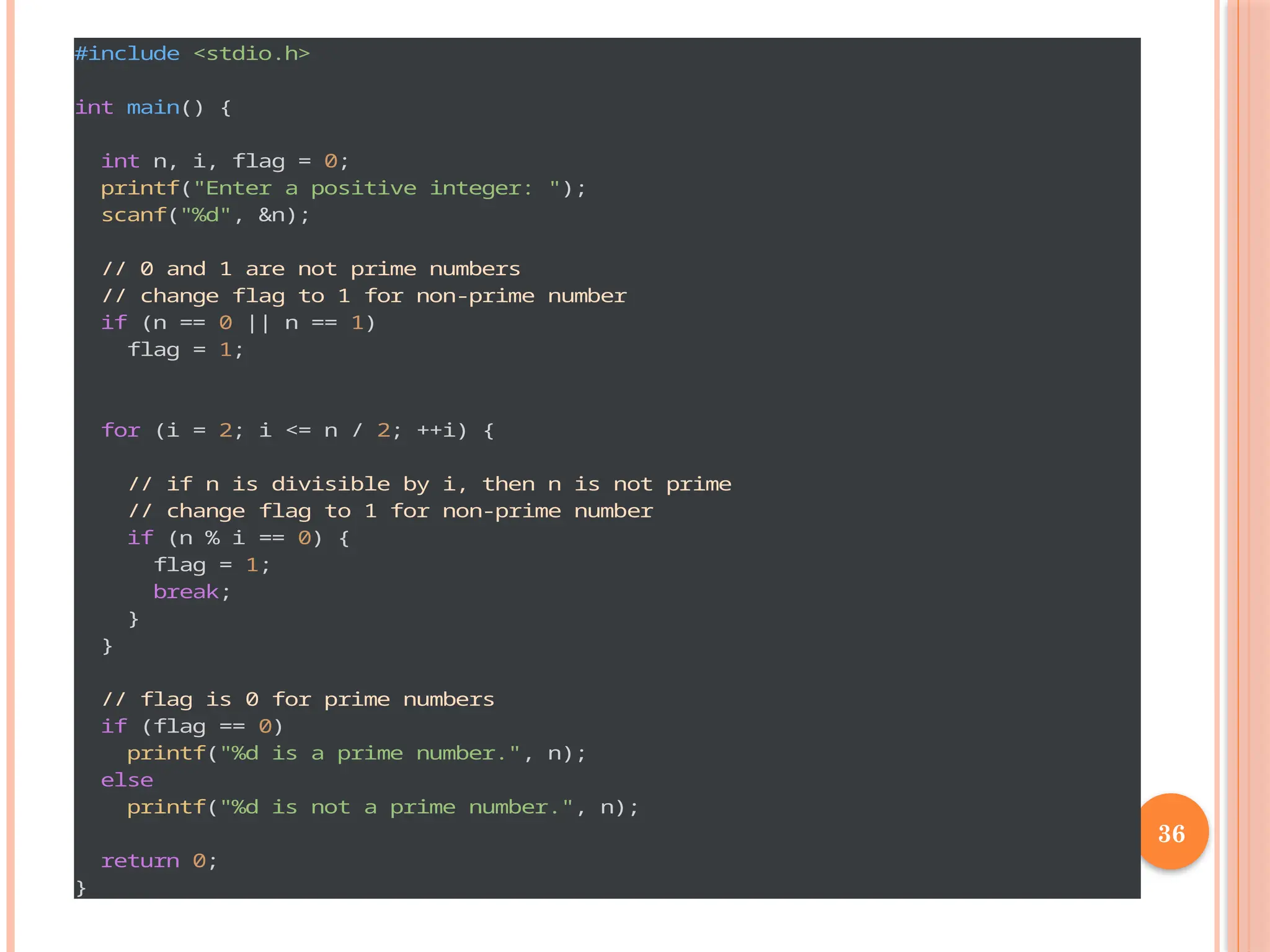
33 1] break:- Sometimeit is require to exit a loop as soon as a certain condition is made. To skip all subsequent statement of loop body and to come out of the loop. When the break statement is encounter inside a loop, the loop is immediately terminate subsequent statement are skipped and program control transfer at the next statement of the following loop.
36 #include <stdio.h> int main(){ int n, i, flag = 0; printf("Enter a positive integer: "); scanf("%d", &n); // 0 and 1 are not prime numbers // change flag to 1 for non-prime number if (n == 0 || n == 1) flag = 1; for (i = 2; i <= n / 2; ++i) { // if n is divisible by i, then n is not prime // change flag to 1 for non-prime number if (n % i == 0) { flag = 1; break; } } // flag is 0 for prime numbers if (flag == 0) printf("%d is a prime number.", n); else printf("%d is not a prime number.", n); return 0; }
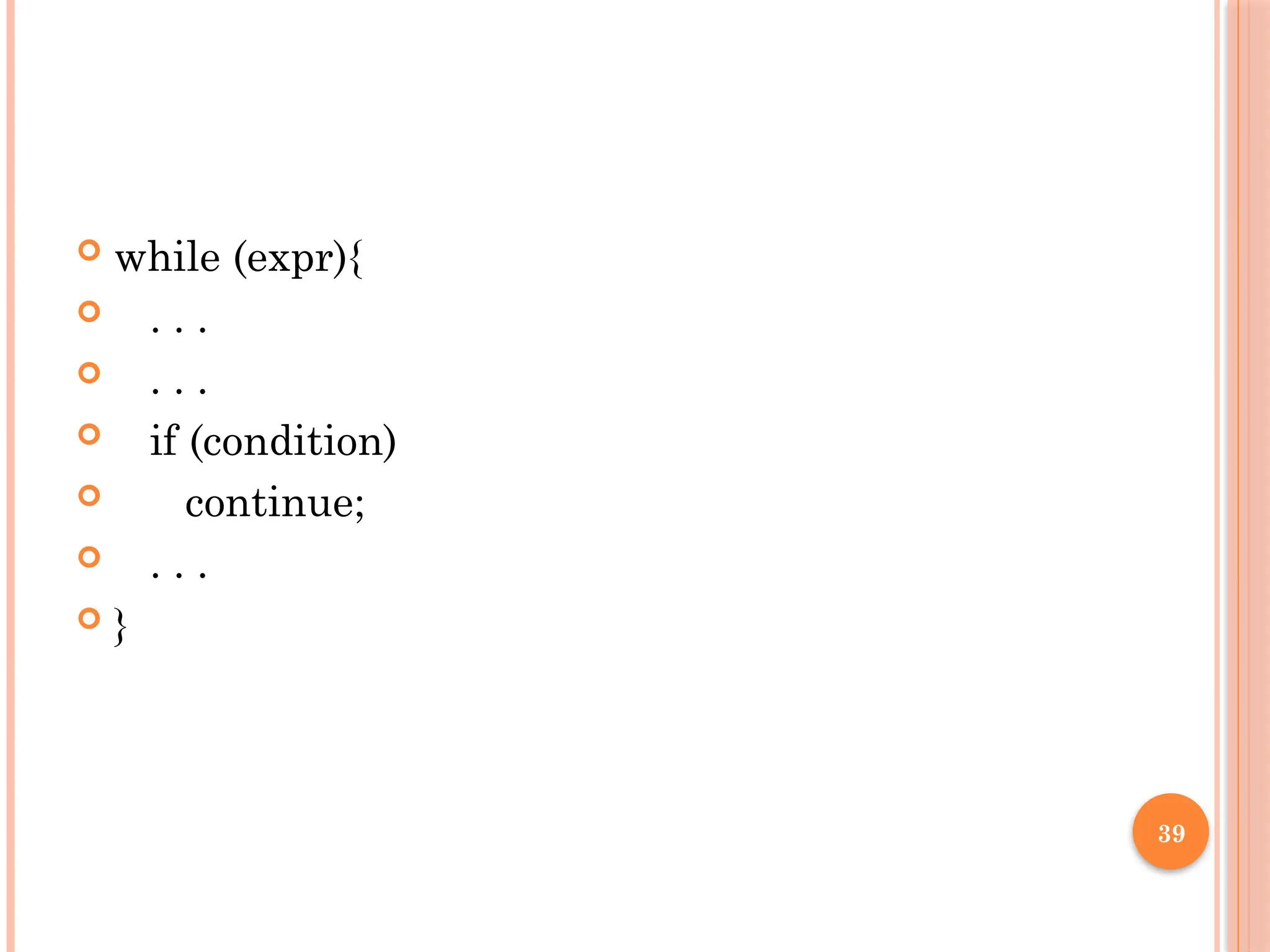
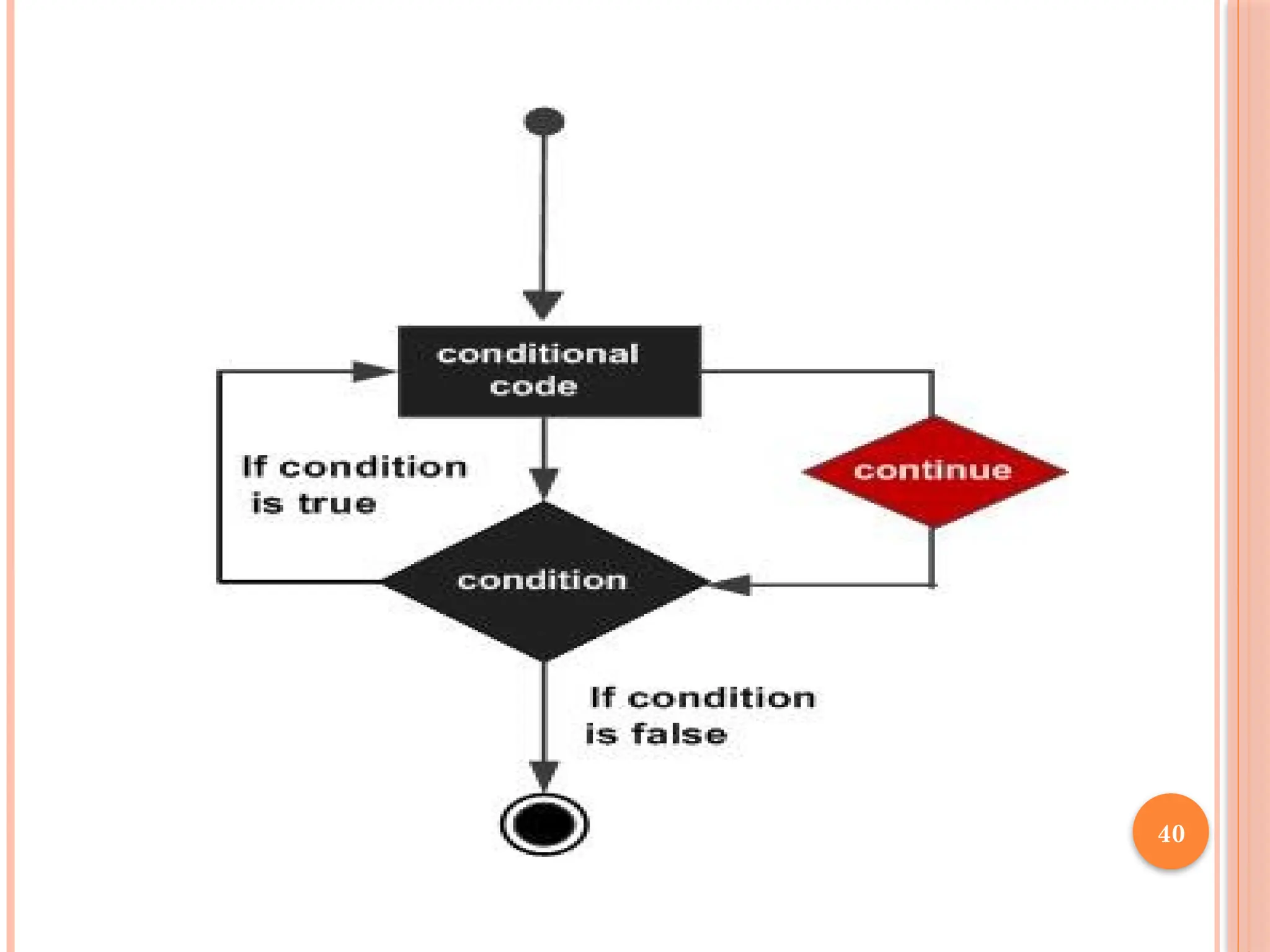
38 2]continue:- Continuestatement is used to transfer control to the beginning of the loop. It remaining statement and it forces the next interaction of the loop to takes place as usual. Syntax:- continue;
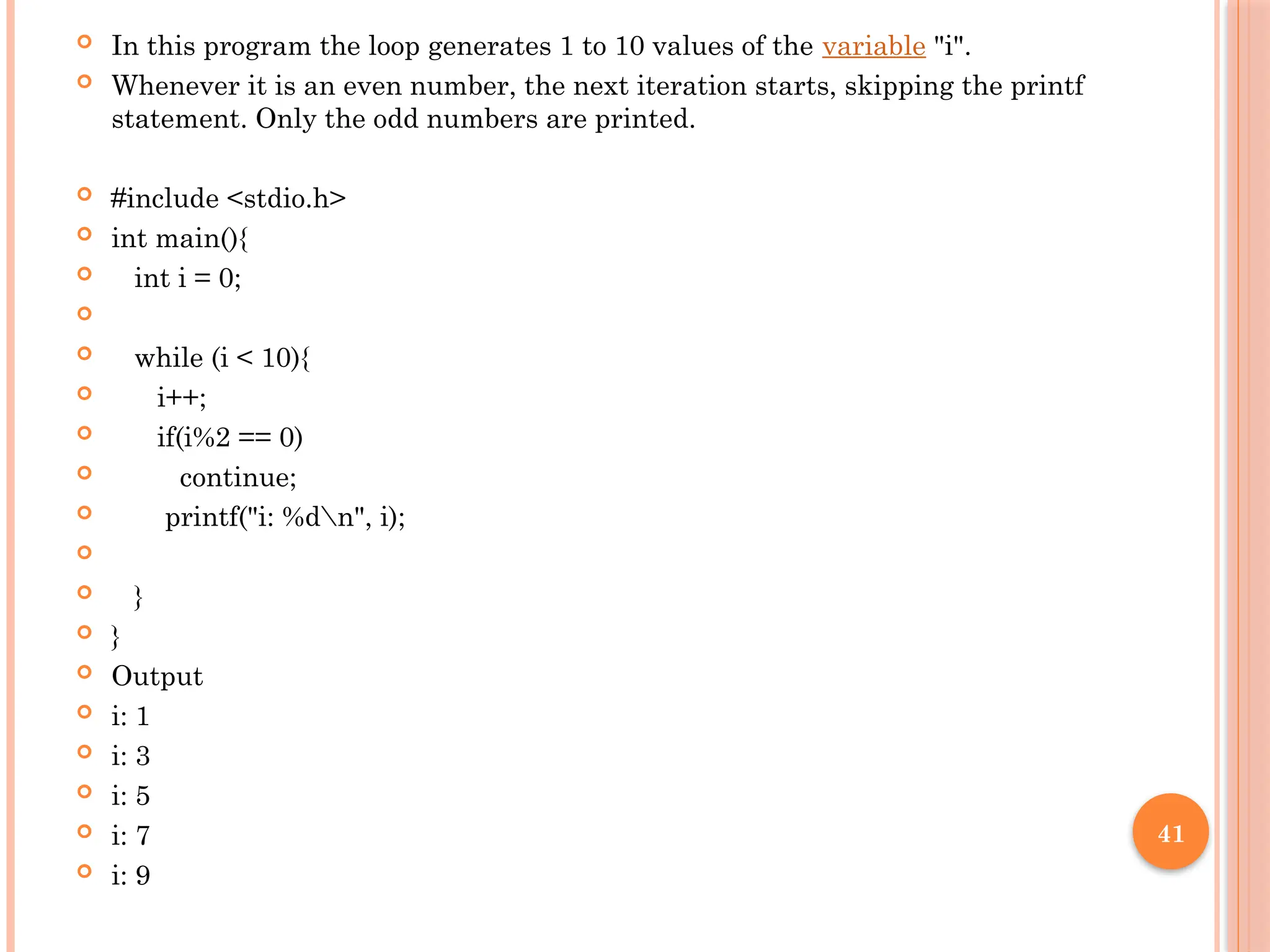
41 In thisprogram the loop generates 1 to 10 values of the variable "i". Whenever it is an even number, the next iteration starts, skipping the printf statement. Only the odd numbers are printed. #include <stdio.h> int main(){ int i = 0; while (i < 10){ i++; if(i%2 == 0) continue; printf("i: %dn", i); } } Output i: 1 i: 3 i: 5 i: 7 i: 9
42.
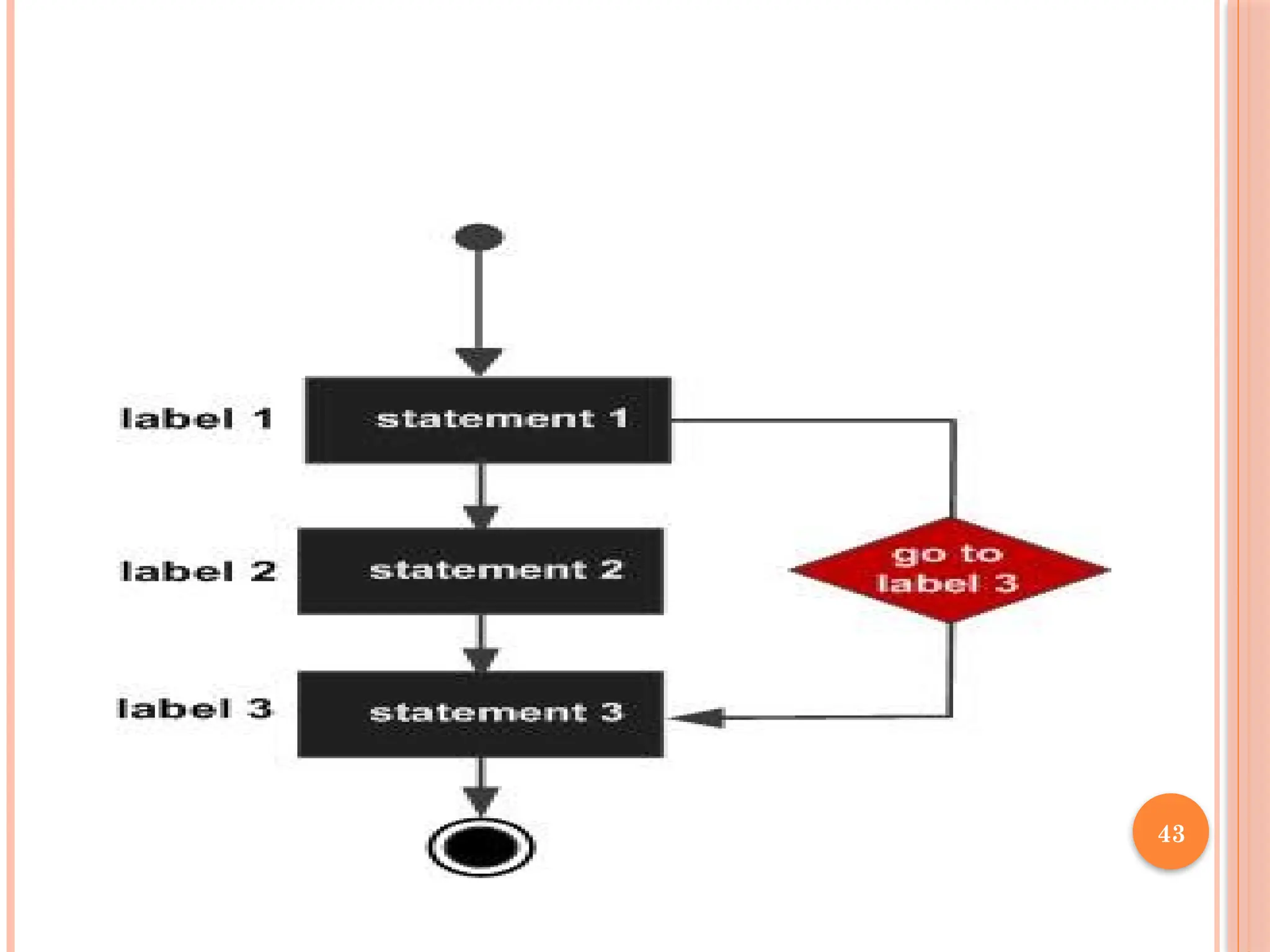
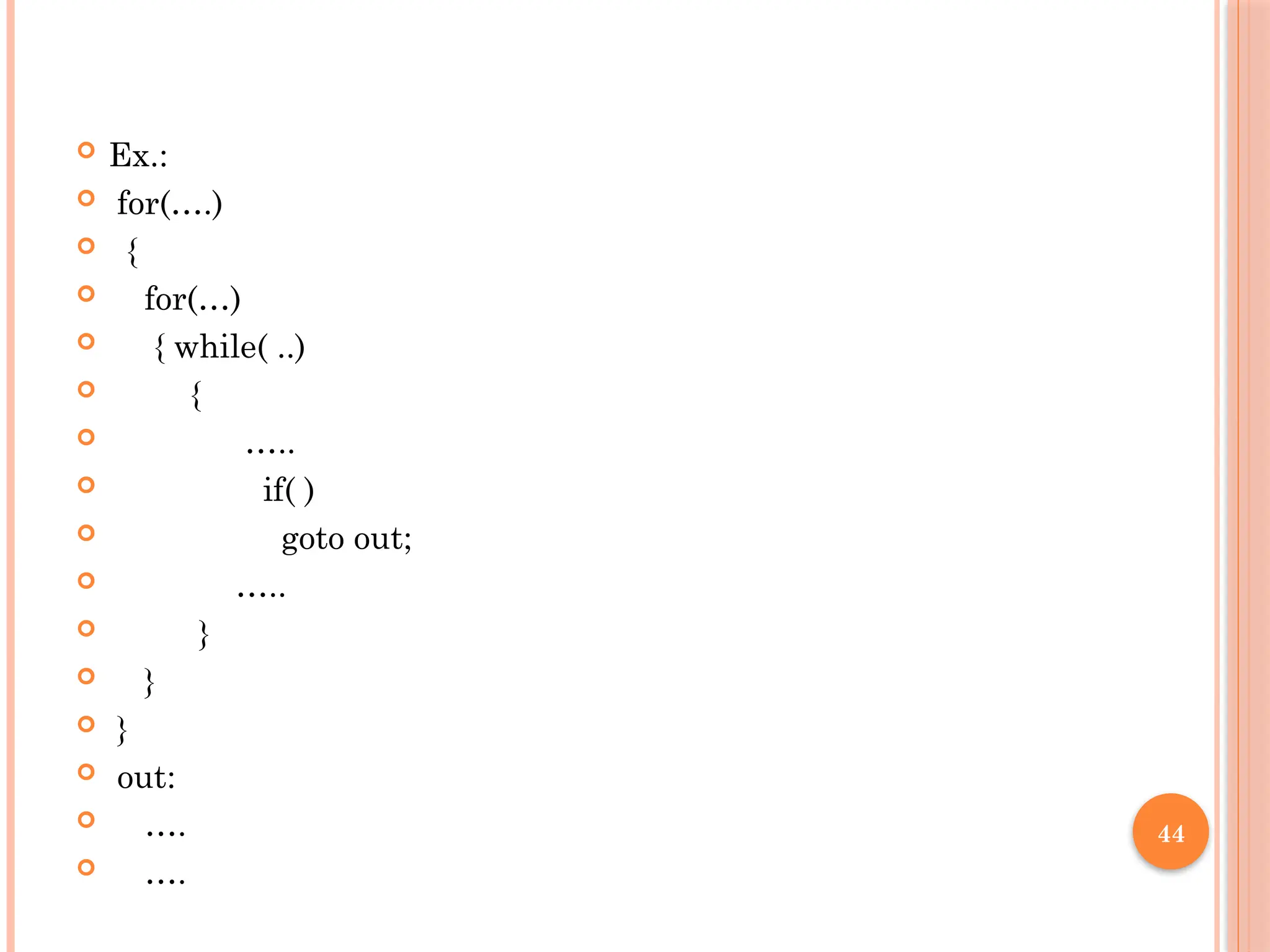
42 3] gotoStatement:- goto statement is an unconditional jump statement. Goto statement is use to alter the normal sequence of program execution by unconditionally transferring by control some other part of program. Syntax: goto label; The statement where control has to be transfer is identified by the label. A label is valid C identifier. The label followed by colon “:” . The label can attached to any statement in the same function as the goto. The label does not has to be declared like other identifier.
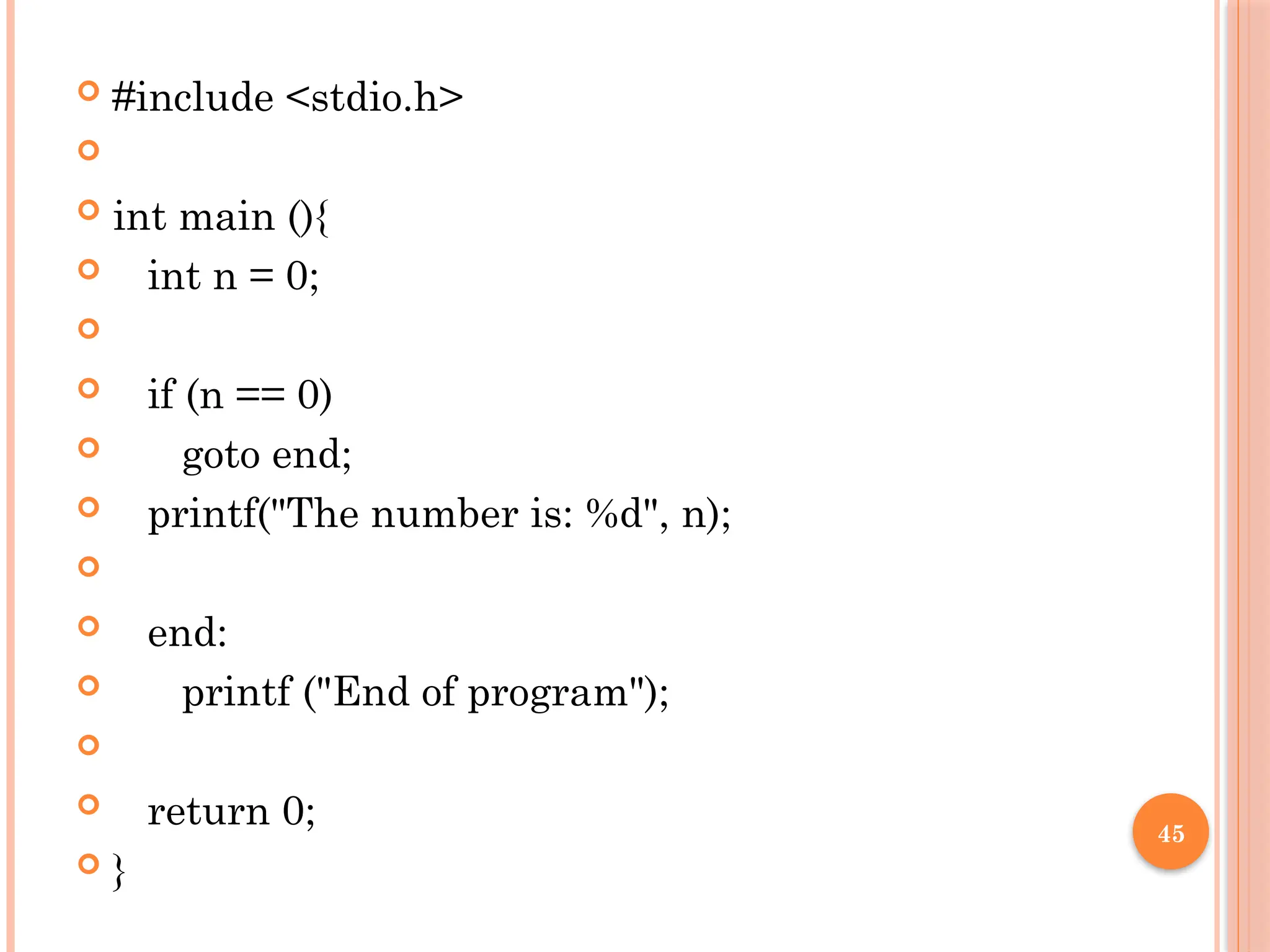
45 #include <stdio.h> int main (){ int n = 0; if (n == 0) goto end; printf("The number is: %d", n); end: printf ("End of program"); return 0; }
46.
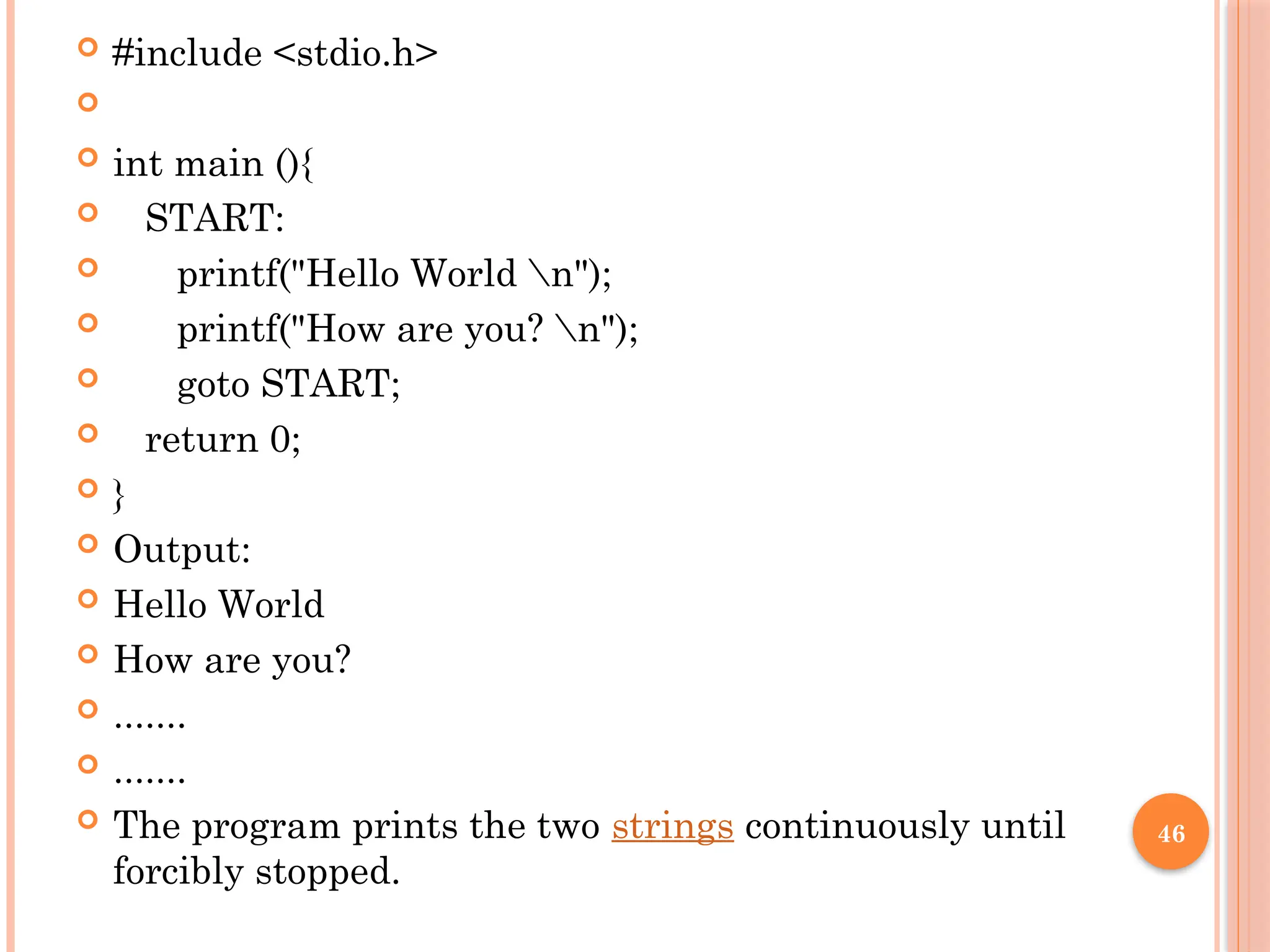
46 #include <stdio.h> int main (){ START: printf("Hello World n"); printf("How are you? n"); goto START; return 0; } Output: Hello World How are you? ....... ....... The program prints the two strings continuously until forcibly stopped.
47.
47 4] exit():- The exit(0) function causes indicate termination of the entire program .the exit function is called with an arguments’0’ to indicate that termination is normal. Eg. Invalid password enter that time use exit(0).
![7 NESTED IF–ELSE STATEMENT NESTED “IF-ELSE” STATEMENTS:- Nested “if-else” statements, the if or the else can contain another if or if-else statement. This provides a programmer with a lot of flexibility in programming. Nesting could take one of several form as illustrated as below: 1] if statement inside else:- Syntax: if(expression) Statement1; else if(expression2) Statement2;](https://image.slidesharecdn.com/cprogramming-controlstatement-250612102351-c069be83/75/C-PROGRAMMING-CONTROL-STATEMENT-IF-ELSE-SWITCH-7-2048.jpg)
![9 4] if-else statement inside if-else:- Syntax:-if(expression1) {if(expression2) statement1; else statement 2;} else if(expression3) statement3; else statement 4; Eg Write a c program to accept 3 no from user and check greater no. #include<stdio.h> #include<conio.h> void main() { int no1, no2, no3; clrscr(); printf(“n Ennter any 3 nos:”); scanf(“%d%d%d”,&no1,&no2,&no3); if(no1>no2) if(no1>no3) printf(“n no1 is greater number”); ](https://image.slidesharecdn.com/cprogramming-controlstatement-250612102351-c069be83/75/C-PROGRAMMING-CONTROL-STATEMENT-IF-ELSE-SWITCH-9-2048.jpg)
![10 5]else-if ladder:- If there is if-else statement nested in each else of an if-else construct, that is called as else-if ladder. Syntax: if(expression1) statement 1; else if(expression 2) statement2; else if(expression3) statement 3; else statement 4;](https://image.slidesharecdn.com/cprogramming-controlstatement-250612102351-c069be83/75/C-PROGRAMMING-CONTROL-STATEMENT-IF-ELSE-SWITCH-10-2048.jpg)
![15 LOOP CONTROL STRUCTURE:- A block of program statements that is executed repeatedly is called a loop. The repetition is done until some condition for termination of the loop is satisfied . A loop structure essentially contains a test condition. 1]A test condition determines the number of times the loop body is executed. 2]Loop statements- If the test condition evaluate to true then statement within the loop body get executed otherwise control transfer outside the loop i.e loop termination. initially contains a test condition.](https://image.slidesharecdn.com/cprogramming-controlstatement-250612102351-c069be83/75/C-PROGRAMMING-CONTROL-STATEMENT-IF-ELSE-SWITCH-15-2048.jpg)
![20 1] While:- It is often used when the no. of time the loop is to be executed is not known in advanced but depends on the test condition. Syntax:- while(expression) { statements; } That expression is a test condition and can be any valid c expression. The statement can be a single or set of statement.](https://image.slidesharecdn.com/cprogramming-controlstatement-250612102351-c069be83/75/C-PROGRAMMING-CONTROL-STATEMENT-IF-ELSE-SWITCH-20-2048.jpg)
![22 3] for loop:- For loop is very flexible, powerful and most commonly used loop in C . It is useful when the member of repetition is known in advance. This is a top-tested loop similarly to the while loop. Syntax:- for(exp1;exp2;exp3) ex. for( i=1;i<=10;i++) { statement; } Where, expr1 is to used to initialization of expression. expr2 is used to test condition . expr3 is used to update expression. these 3 expression is separated by ‘ ; ’.](https://image.slidesharecdn.com/cprogramming-controlstatement-250612102351-c069be83/75/C-PROGRAMMING-CONTROL-STATEMENT-IF-ELSE-SWITCH-22-2048.jpg)
![30 #include <stdio.h> int main() { int rows; // variable declaration int columns; // variable declaration int k=1; // variable initialization printf("Enter the number of rows :"); // input the number of rows. scanf("%d",&rows); printf("nEnter the number of columns :"); // input the number of columns. scanf("%d",&columns); int a[rows][columns]; //2d array declaration int i=1; while(i<=rows) // outer loop { int j=1; while(j<=columns) // inner loop { printf("%dt",k); // printing the value of k. k++; // increment counter j++; } i++; printf("n"); } }](https://image.slidesharecdn.com/cprogramming-controlstatement-250612102351-c069be83/75/C-PROGRAMMING-CONTROL-STATEMENT-IF-ELSE-SWITCH-30-2048.jpg)
![33 1] break:- Sometime it is require to exit a loop as soon as a certain condition is made. To skip all subsequent statement of loop body and to come out of the loop. When the break statement is encounter inside a loop, the loop is immediately terminate subsequent statement are skipped and program control transfer at the next statement of the following loop.](https://image.slidesharecdn.com/cprogramming-controlstatement-250612102351-c069be83/75/C-PROGRAMMING-CONTROL-STATEMENT-IF-ELSE-SWITCH-33-2048.jpg)
![38 2]continue:- Continue statement is used to transfer control to the beginning of the loop. It remaining statement and it forces the next interaction of the loop to takes place as usual. Syntax:- continue;](https://image.slidesharecdn.com/cprogramming-controlstatement-250612102351-c069be83/75/C-PROGRAMMING-CONTROL-STATEMENT-IF-ELSE-SWITCH-38-2048.jpg)
![42 3] goto Statement:- goto statement is an unconditional jump statement. Goto statement is use to alter the normal sequence of program execution by unconditionally transferring by control some other part of program. Syntax: goto label; The statement where control has to be transfer is identified by the label. A label is valid C identifier. The label followed by colon “:” . The label can attached to any statement in the same function as the goto. The label does not has to be declared like other identifier.](https://image.slidesharecdn.com/cprogramming-controlstatement-250612102351-c069be83/75/C-PROGRAMMING-CONTROL-STATEMENT-IF-ELSE-SWITCH-42-2048.jpg)
![47 4] exit():- The exit(0) function causes indicate termination of the entire program .the exit function is called with an arguments’0’ to indicate that termination is normal. Eg. Invalid password enter that time use exit(0).](https://image.slidesharecdn.com/cprogramming-controlstatement-250612102351-c069be83/75/C-PROGRAMMING-CONTROL-STATEMENT-IF-ELSE-SWITCH-47-2048.jpg)