Download to read offline

![Several Instances of a Resource Type Available : A vector of length m indicates the number of available resources of each type. Allocation: An n x m matrix defines the number of resources of each type currently allocated to each process. Request: An n x m matrix indicates the current request of each process. If Request[ij]=k, then process Pi is requesting k more instances of resource type Rj.](https://image.slidesharecdn.com/presentation-220708133411-f7929a74/75/Deadlock-Detection-Algorithm-11-2048.jpg)
![Detection Algorithm 1. Let Work and Finish be vectors of length m and n, respectively Initialize : (a) Work=Available (b) For i=1,2,…,n if Allocationi ≠ 0, then Finish[i]=false; otherwise, Finish[i]=true. 2. Find an index i such that both: (a) Finish[i]==false (b) Requesti≤ Work 3. Work = Work +Allocationi Finish[i]=true go to step 2. 4. If Finish[i]==false, for some i, 1 ≤i ≤n, then the system is in the deadlock state. Moreover, if Finish[i]==false, then Piis deadlocked. Algorithm requires an order of O(m x n2) operations to detect whether the system is in deadlocked state.](https://image.slidesharecdn.com/presentation-220708133411-f7929a74/75/Deadlock-Detection-Algorithm-12-2048.jpg)
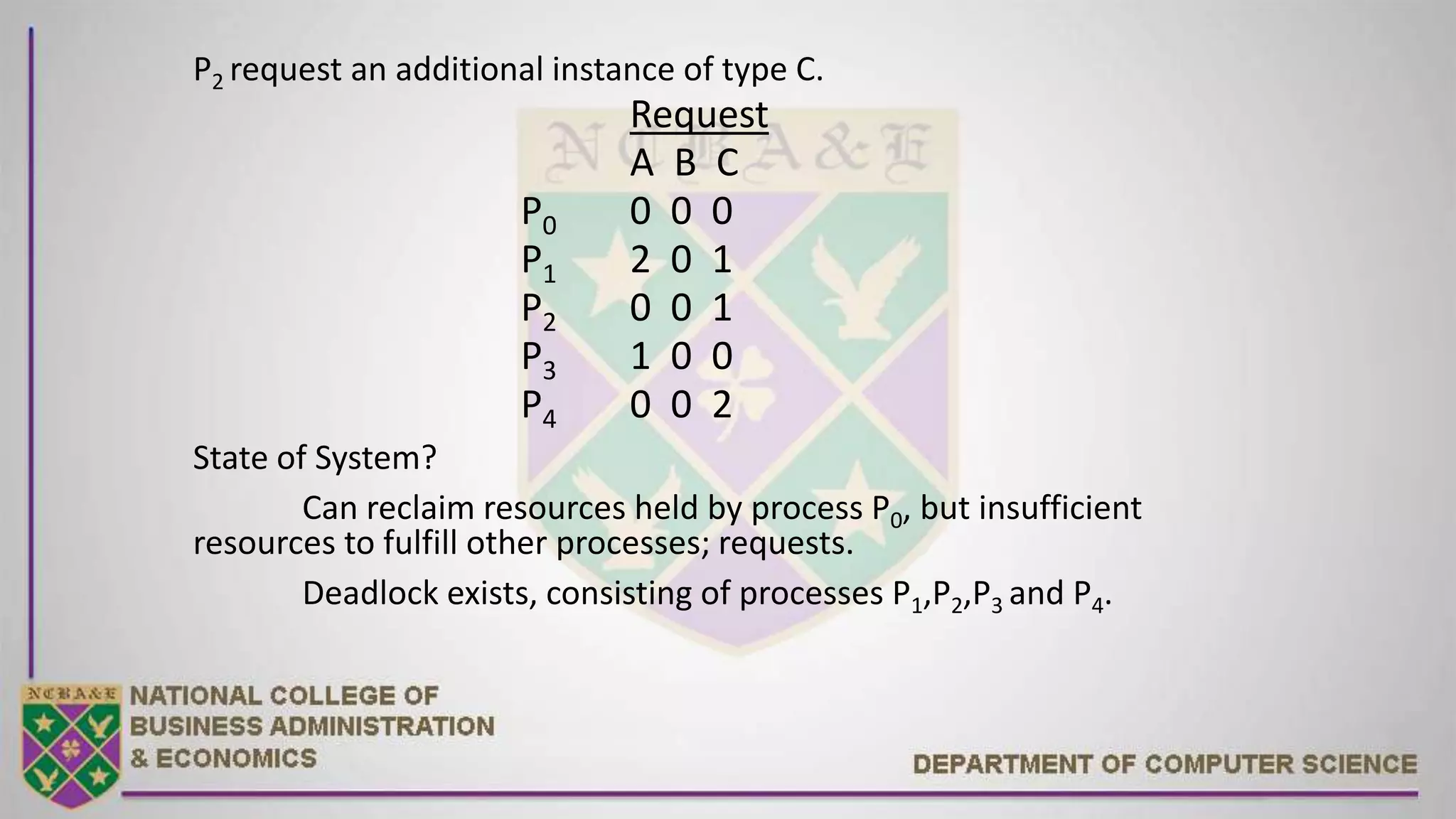
![Example of Detection Algorithm Five processes Po through P4; three resource types A(7 instances), B(2 instances), and C(6 instances). Snapshot at time T0: Allocation Request Available A B C A B C A B C P0 0 1 0 0 0 0 0 0 0 P1 2 0 0 2 0 2 P2 3 0 3 0 0 0 P3 2 1 1 1 0 0 P4 0 0 2 0 0 2 Sequence <P0,P1,P2,P3,P4>will result in Finish[i]=true for all i.](https://image.slidesharecdn.com/presentation-220708133411-f7929a74/75/Deadlock-Detection-Algorithm-13-2048.jpg)


Deadlocks occur in operating systems when processes are blocked waiting for resources held by other blocked processes, forming a circular wait. There are four conditions for deadlock: mutual exclusion, hold and wait, no preemption, and circular wait. Deadlocks can be modeled using a resource allocation graph (RAG) with processes and resources as nodes and request/assignment edges. A cycle in the RAG indicates a deadlock. Detection algorithms work by maintaining a wait-for graph (WFG) and periodically searching for cycles, while avoidance methods analyze resource requests to allow only safe sequences.
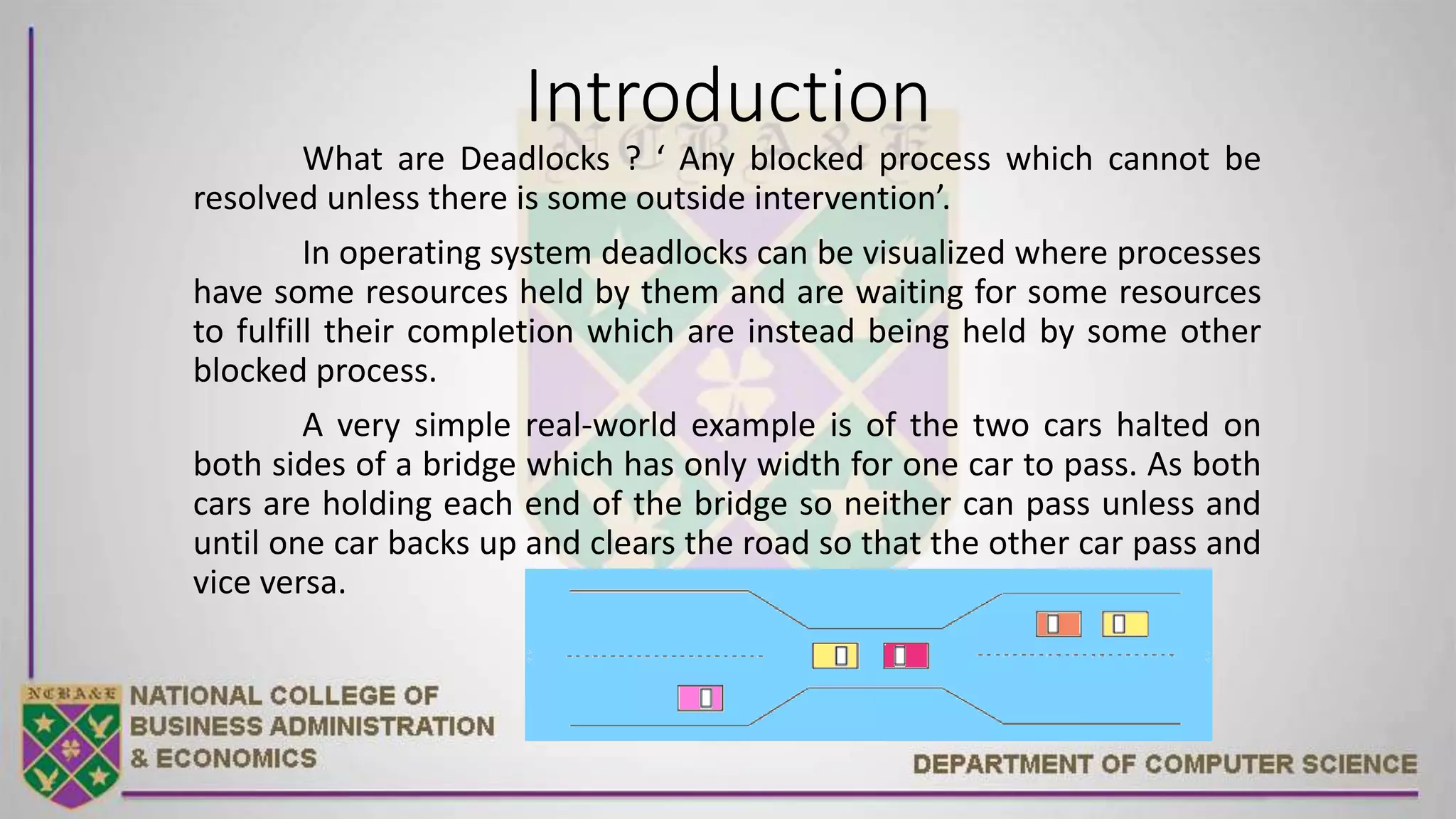
Definition of deadlocks, real-world analogy using a bridge example. Deadlocks refer to blocked processes needing external intervention.
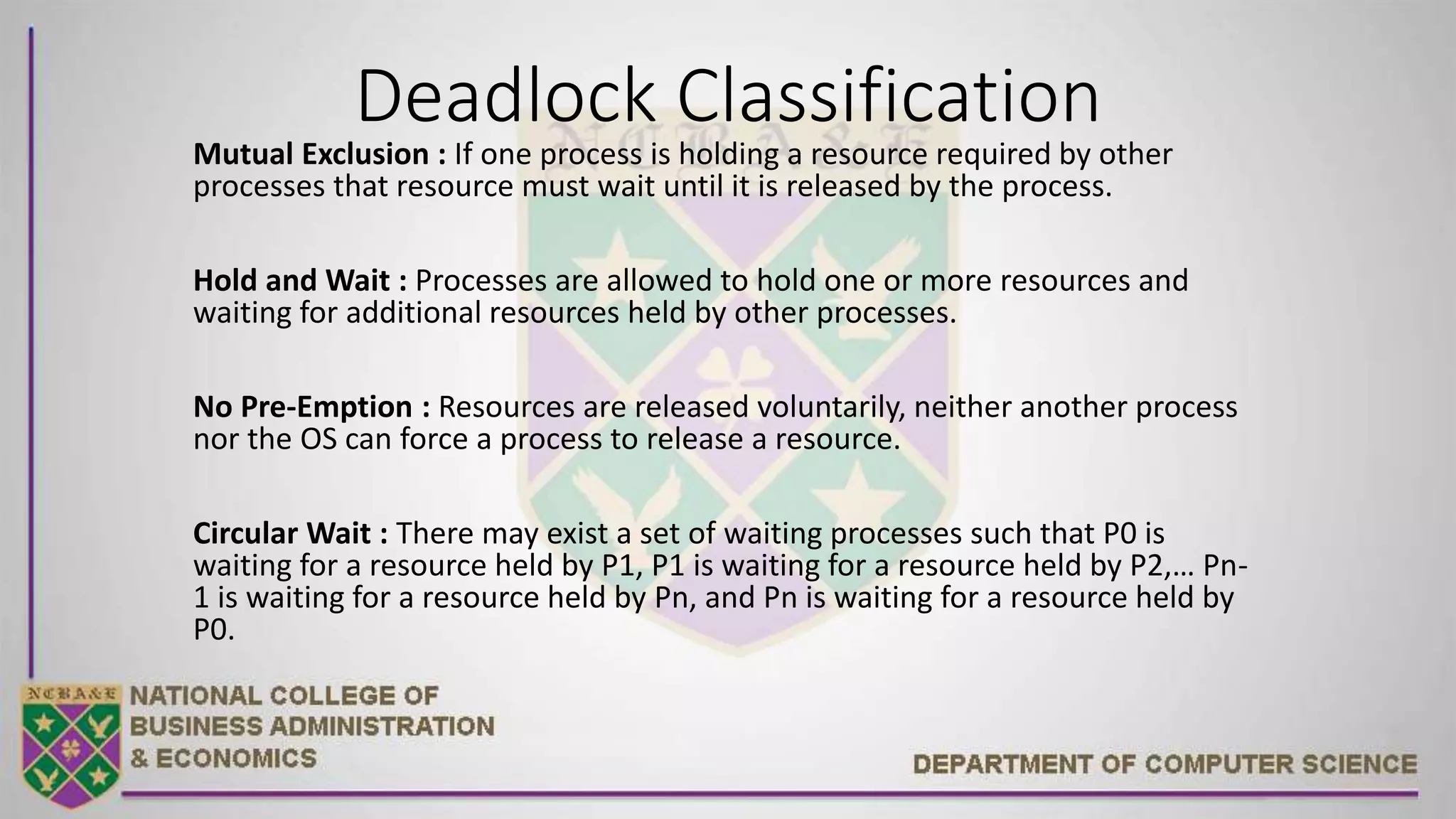
Four conditions of deadlocks: Mutual Exclusion, Hold and Wait, No Pre-Emption, and Circular Wait, crucial for recognizing deadlock situations.
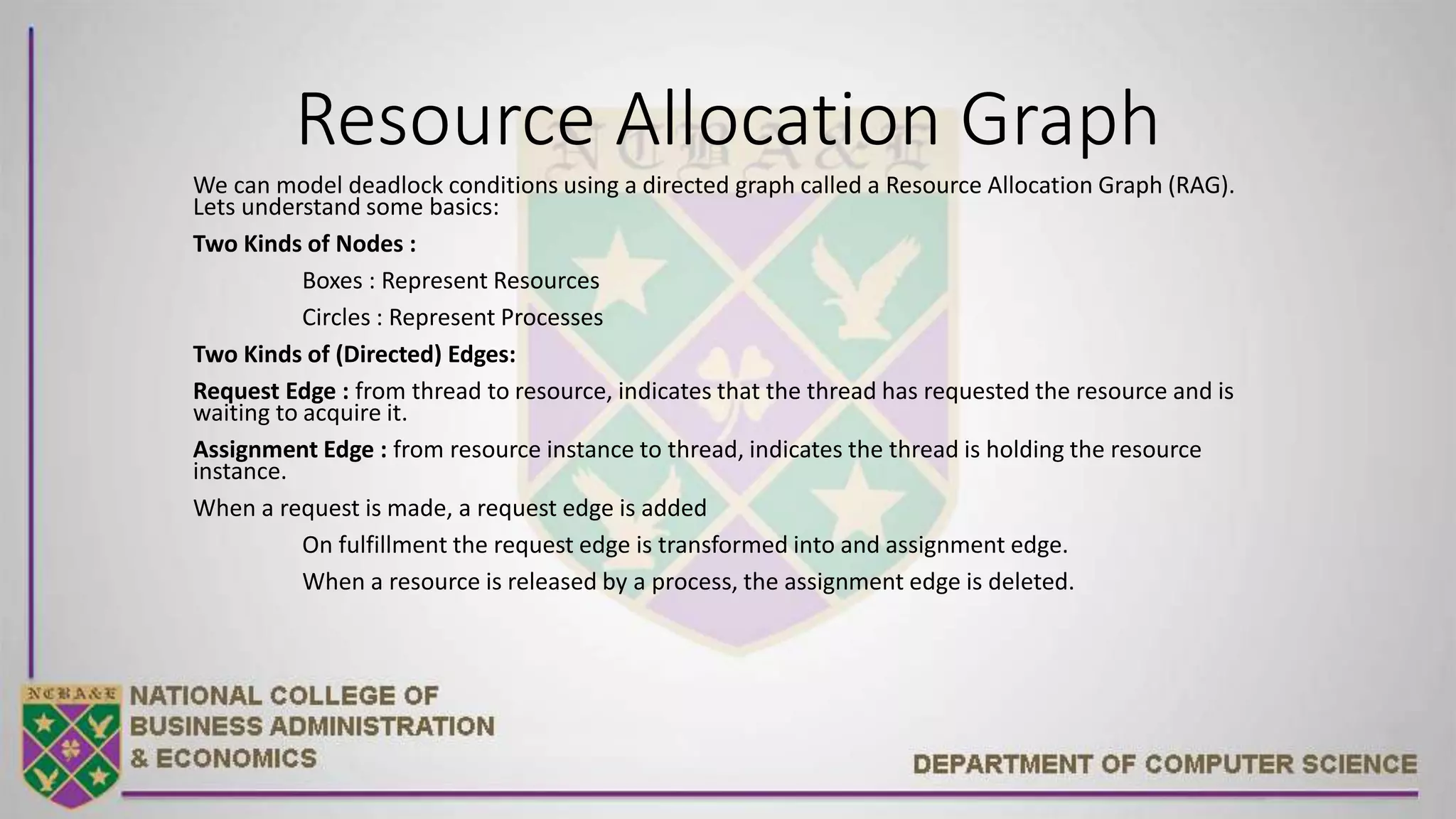
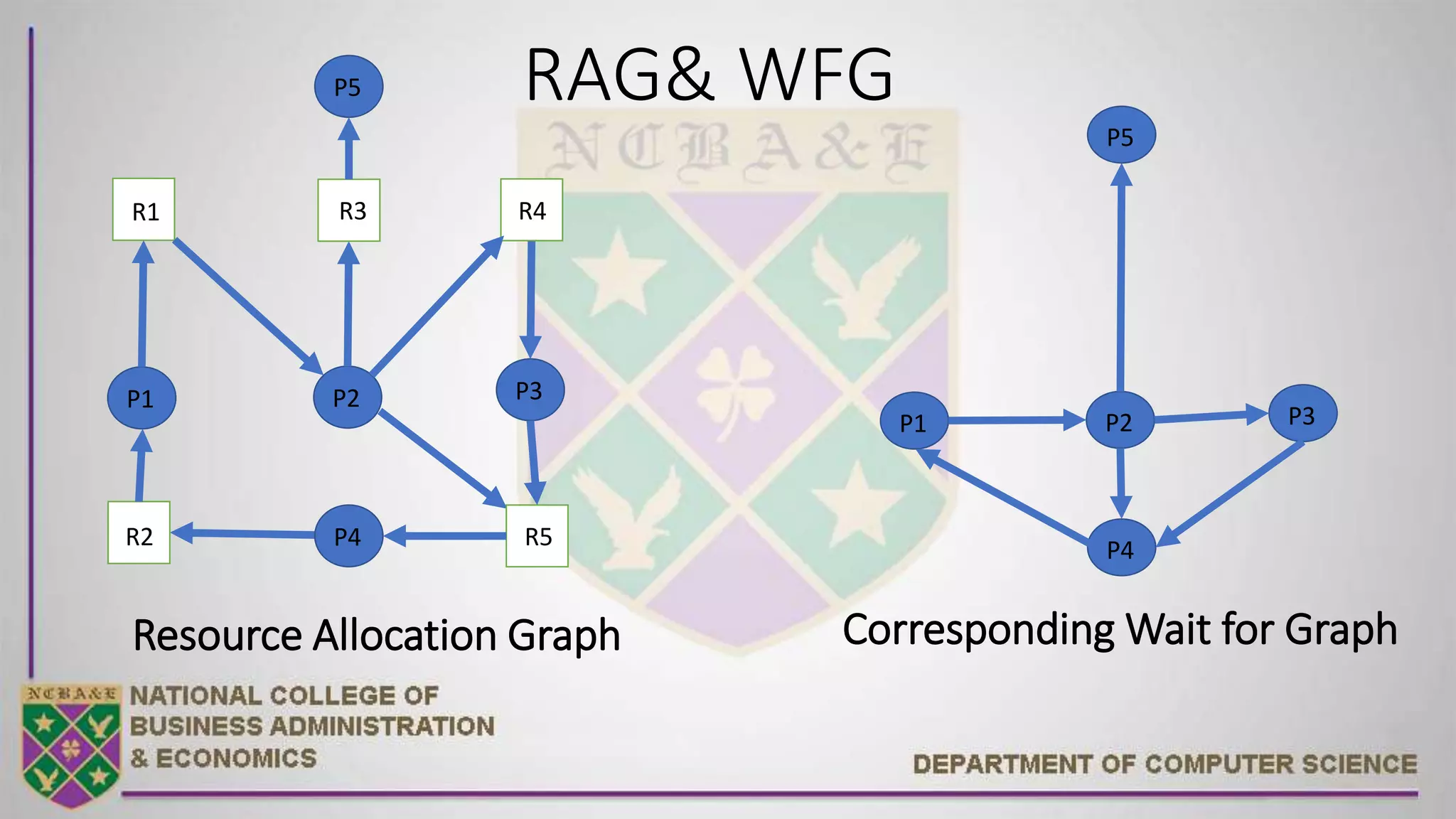
Introduction to Resource Allocation Graph (RAG) representing processes and resources, using request and assignment edges.
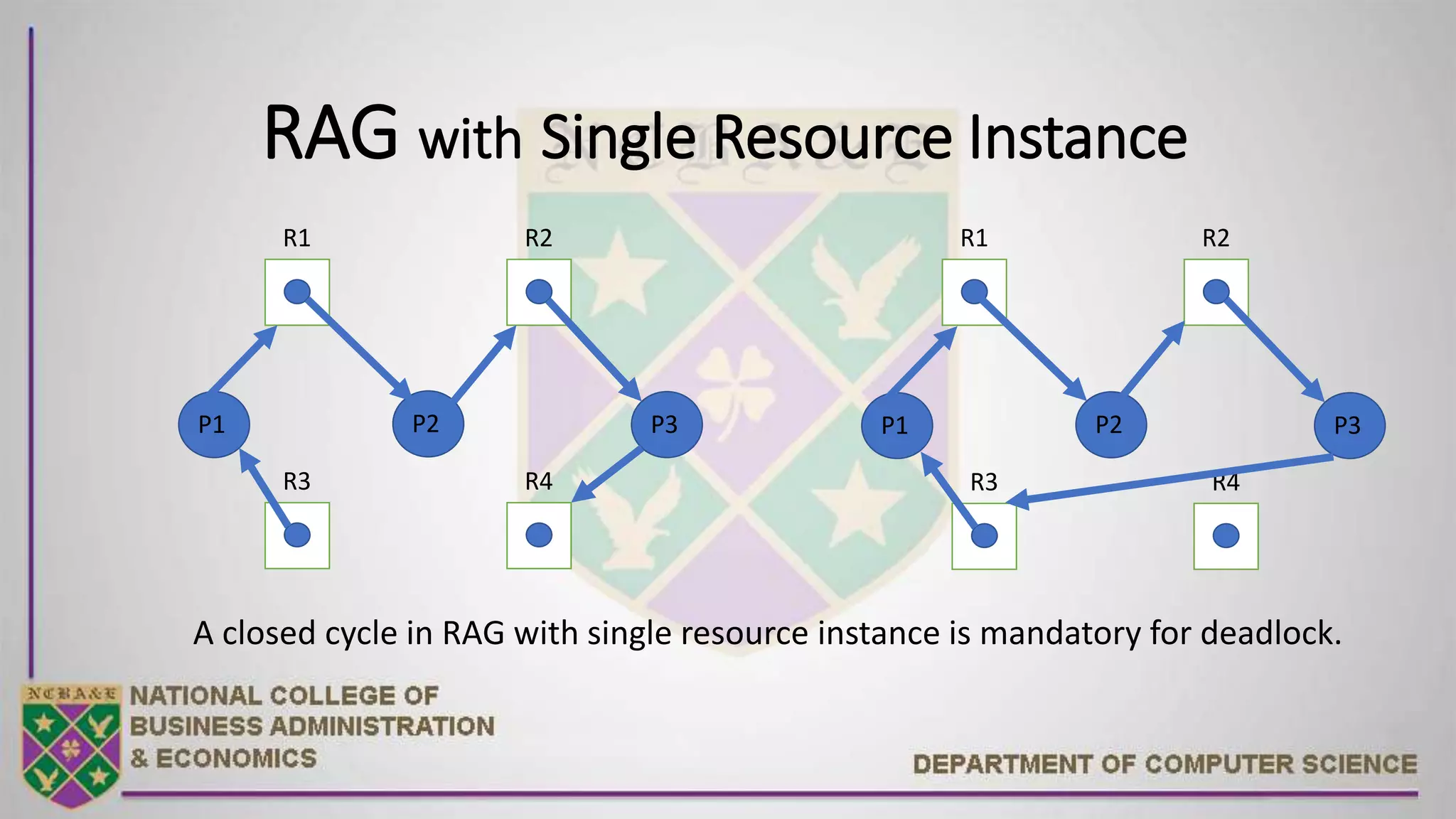
Single resource instance in RAG; closed cycles are mandatory for a deadlock condition.
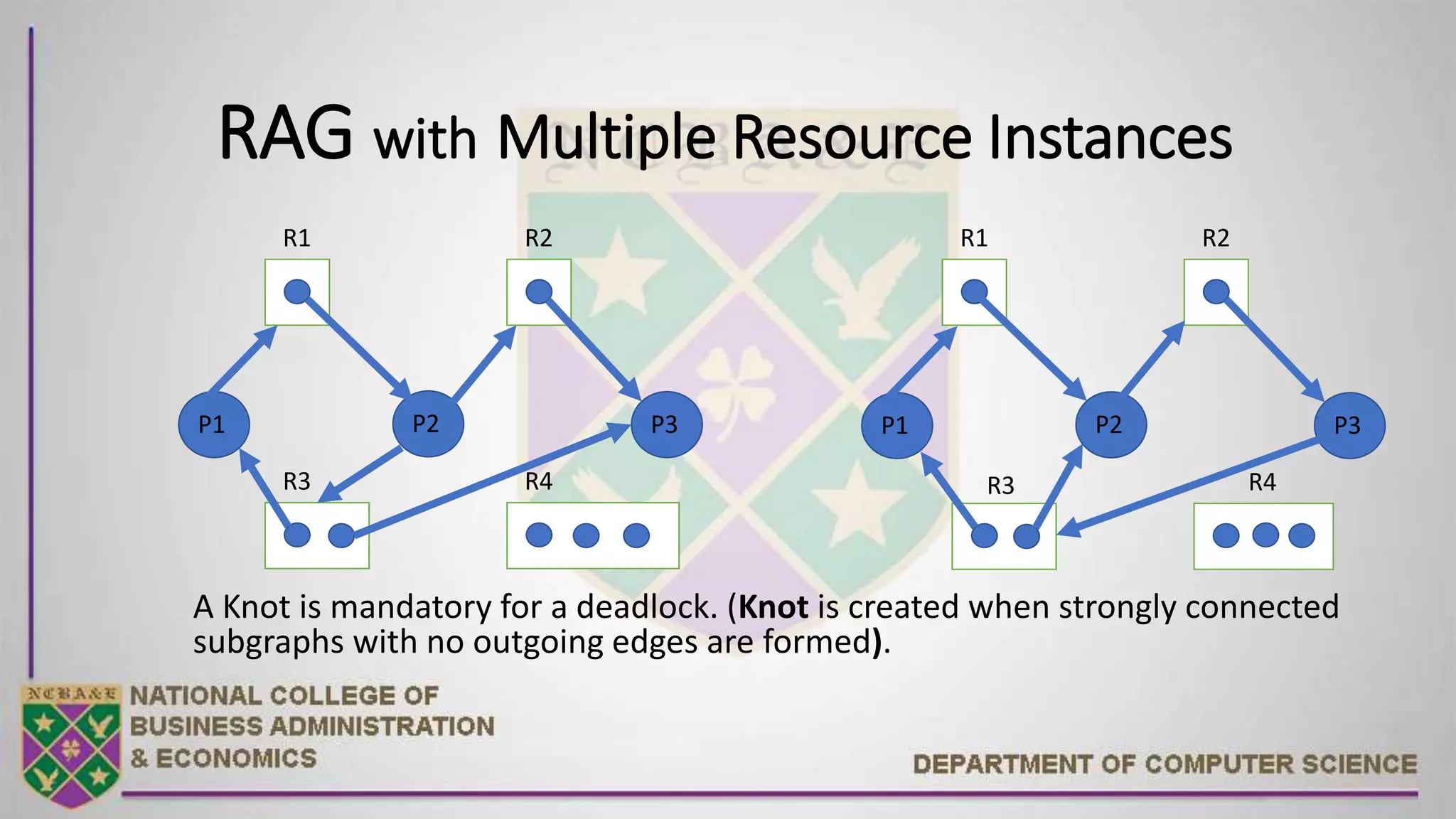
Deadlocks with multiple resource instances; formation of knots indicates deadlocks through strong connections.
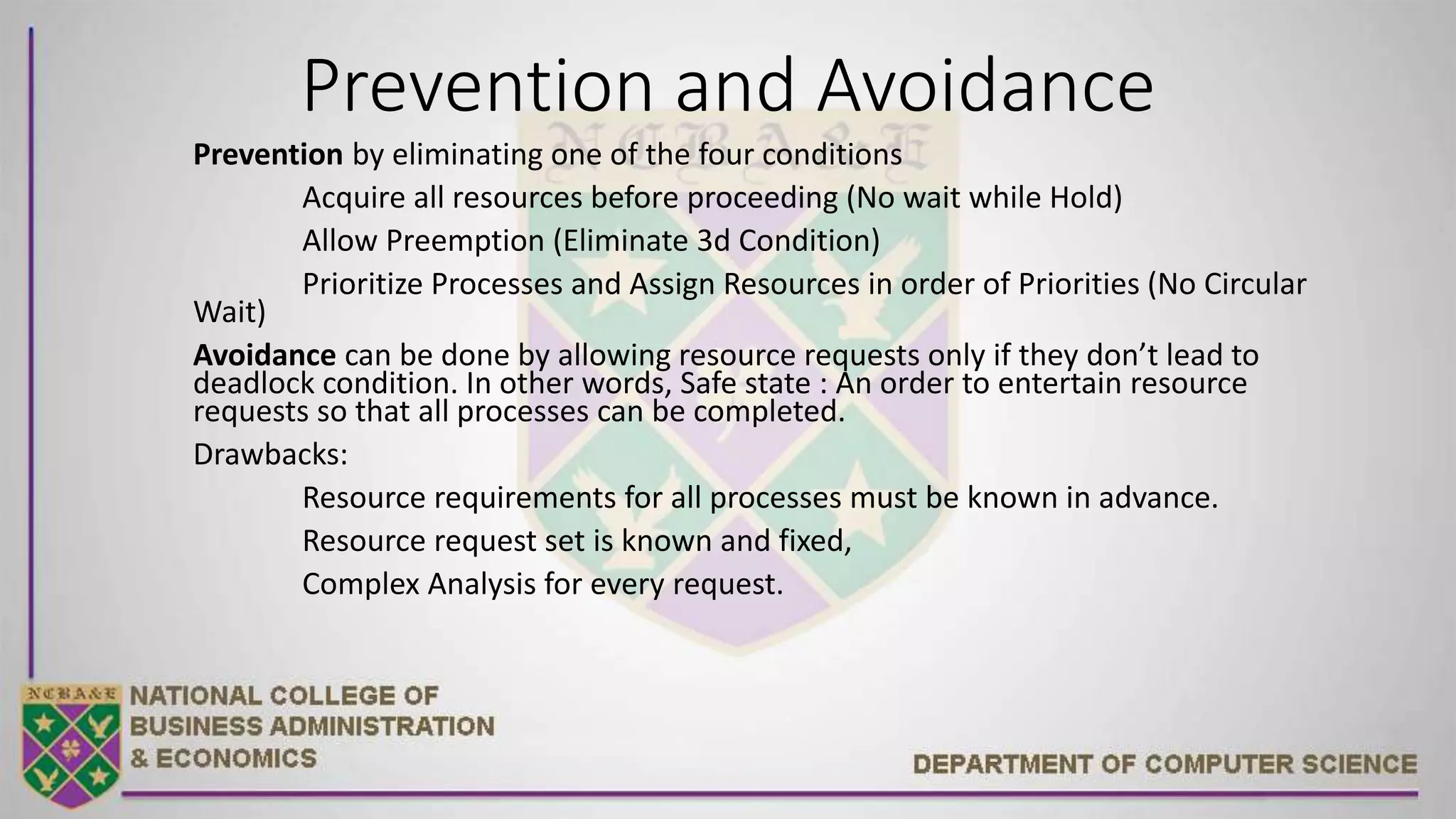
Methods to prevent and avoid deadlocks by eliminating conditions; achieving safe states and their drawbacks.
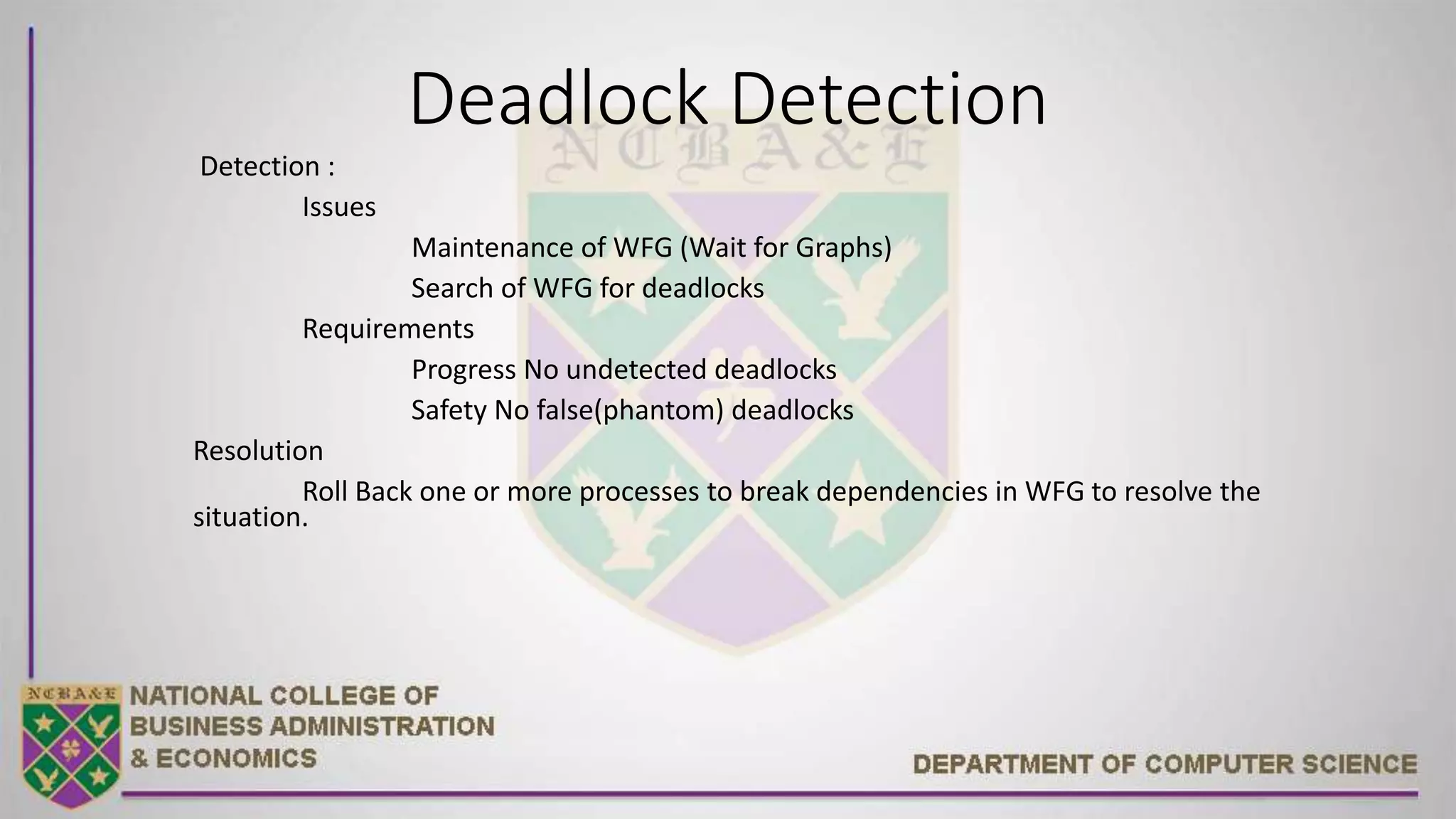
Detection of deadlocks through Wait for Graphs (WFG); requirements for progress and safety in detection.
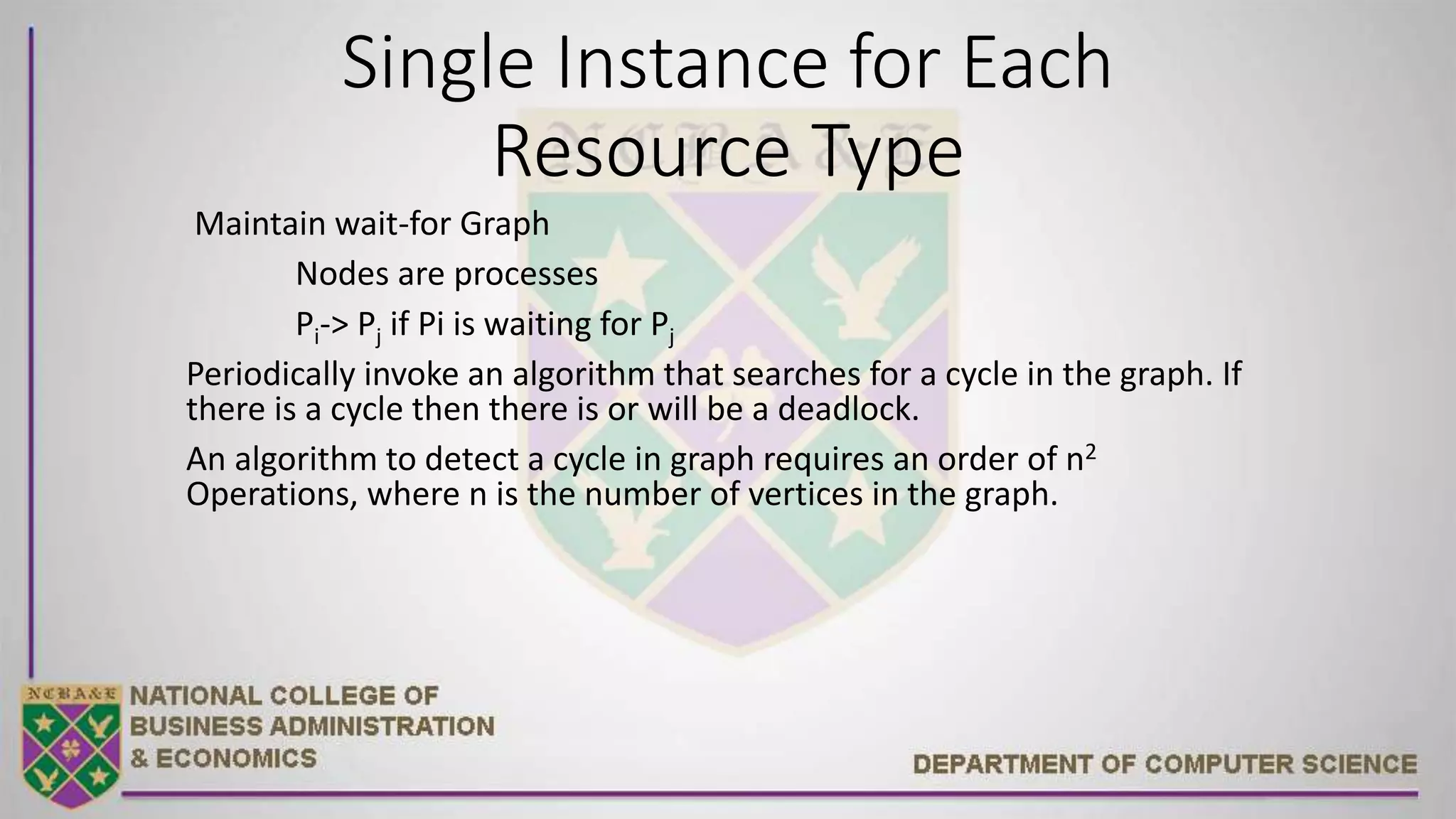
Searching for cycles using wait-for graphs to determine deadlocks; algorithm efficiency based on vertices.
Illustration of Resource Allocation Graph and its corresponding Wait for Graph depicting resource relationships.
Resource management with multiple instances using allocation, request, and available resource matrices.
Step-by-step approach for deadlock detection algorithm; includes initialization and conditions for detecting deadlocks.
Application of the detection algorithm with five processes and three resource types, analyzing system state.
System state assessment upon resource request leading to deadlock among multiple processes.
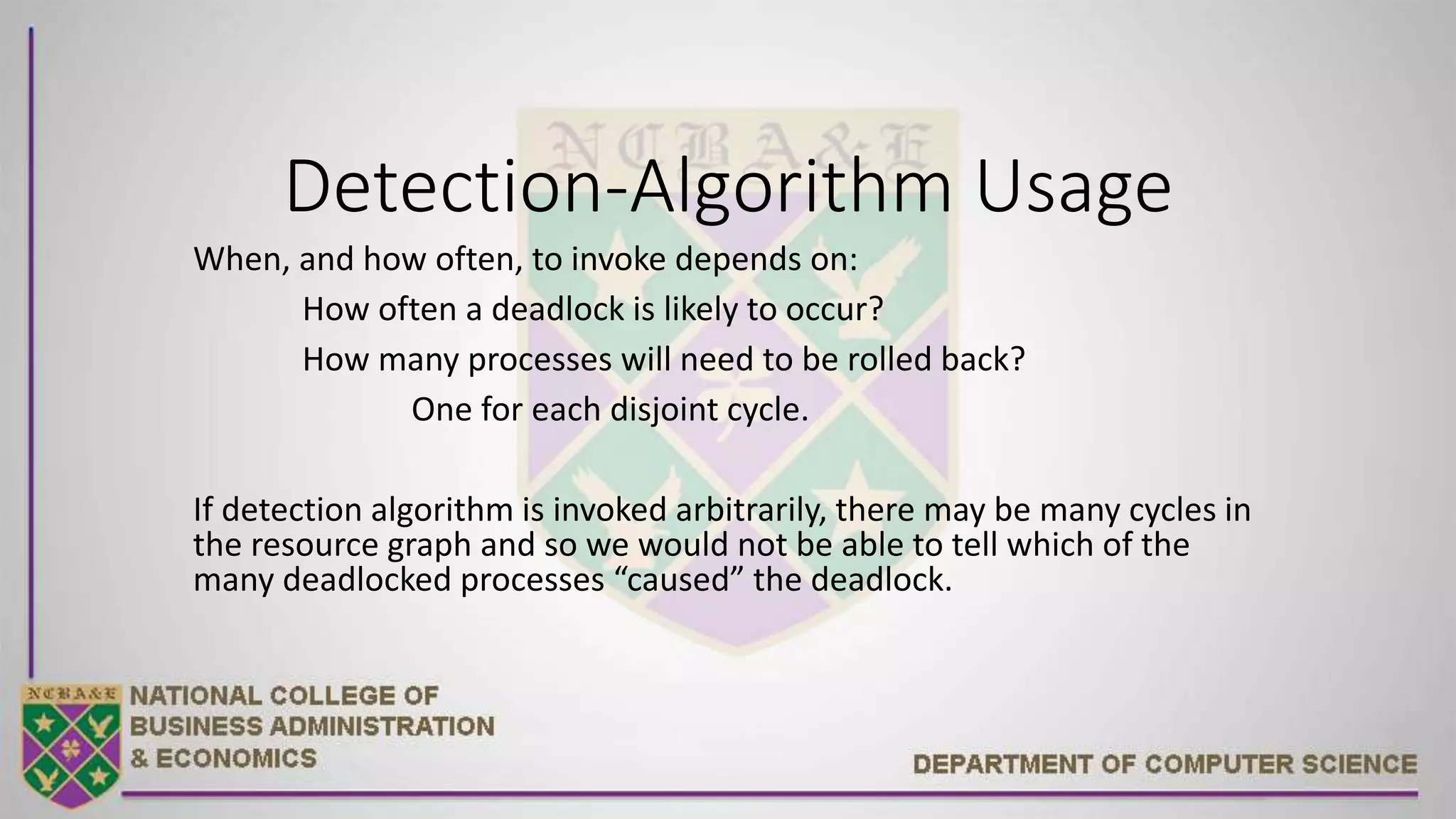
Criteria for invoking detection algorithms; considerations for identifying the cause of deadlocks.
Acknowledgment of the audience.