Deep Postgres Extensions in Rust: postgres-extension.rs Jeff Davis <jdavis@postgresql.org> Citus Data / Microsoft <Jeffrey.Davis@microsoft.com>
2 Motivation ● Postgres relies on an ecosystem of extensions ● This is a good thing! ● Extensions allow domain-specific or experimental development ● We need to encourage new developers to get involved and new types of extension development ● Rust offers a different language and environment ● And brings new ideas!
3 Why Rust? ● More memory safety features than C ● Minimal runtime like C: ● No garbage collector or refcounting ● No “extra” code ● No “extra” data held in structs ● Not even a vtable pointer! ● Modern features ● Growing developer community ● Awesome ecosystem
4 The Postgres World is C ● Real extensions used to require C: ● Foreign Data Wrappers ● Custom Data Types ● Index and Sort Support Functions ● Background Workers ● UDFs calling internal functions
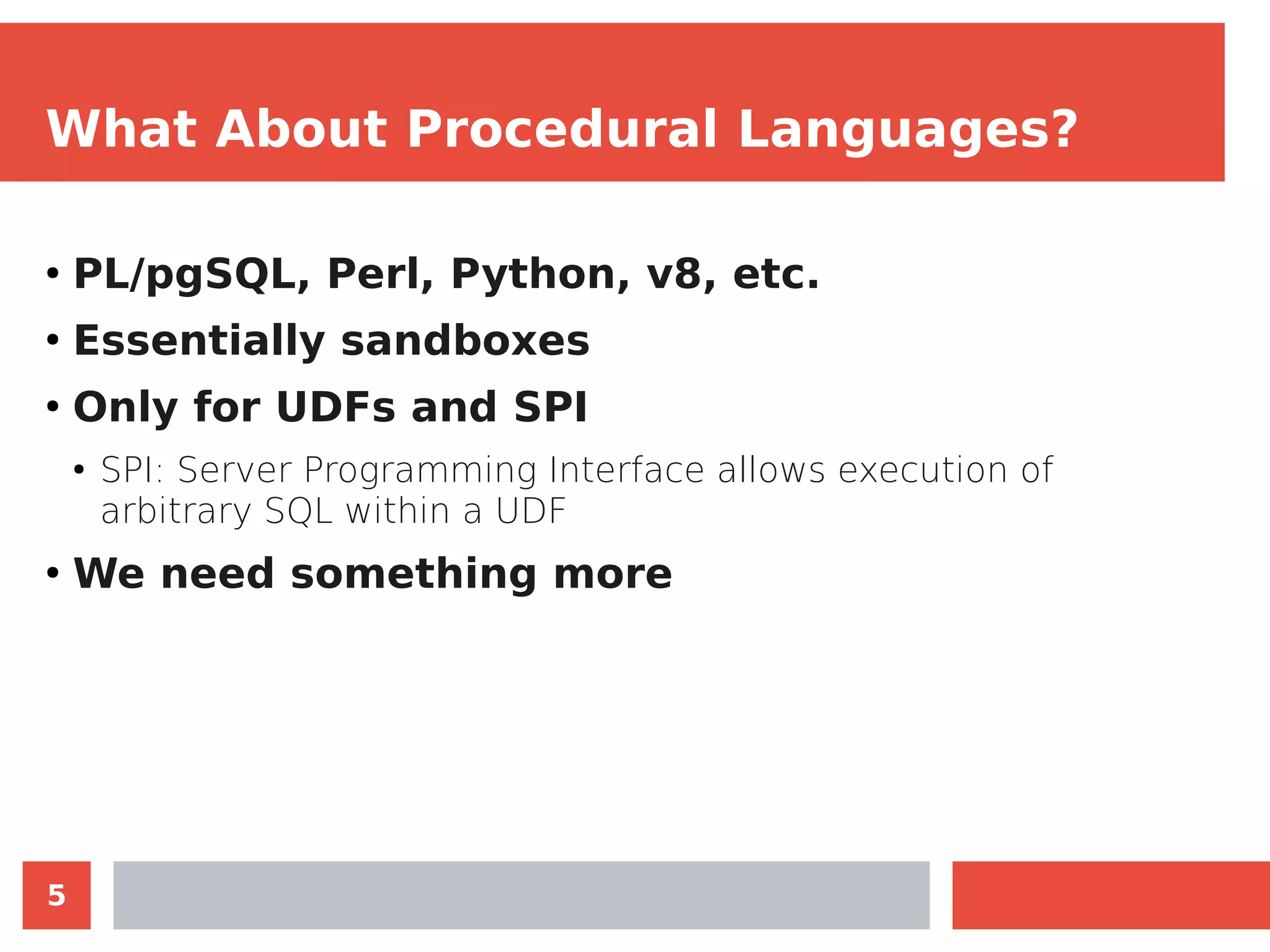
5 What About Procedural Languages? ● PL/pgSQL, Perl, Python, v8, etc. ● Essentially sandboxes ● Only for UDFs and SPI ● SPI: Server Programming Interface allows execution of arbitrary SQL within a UDF ● We need something more
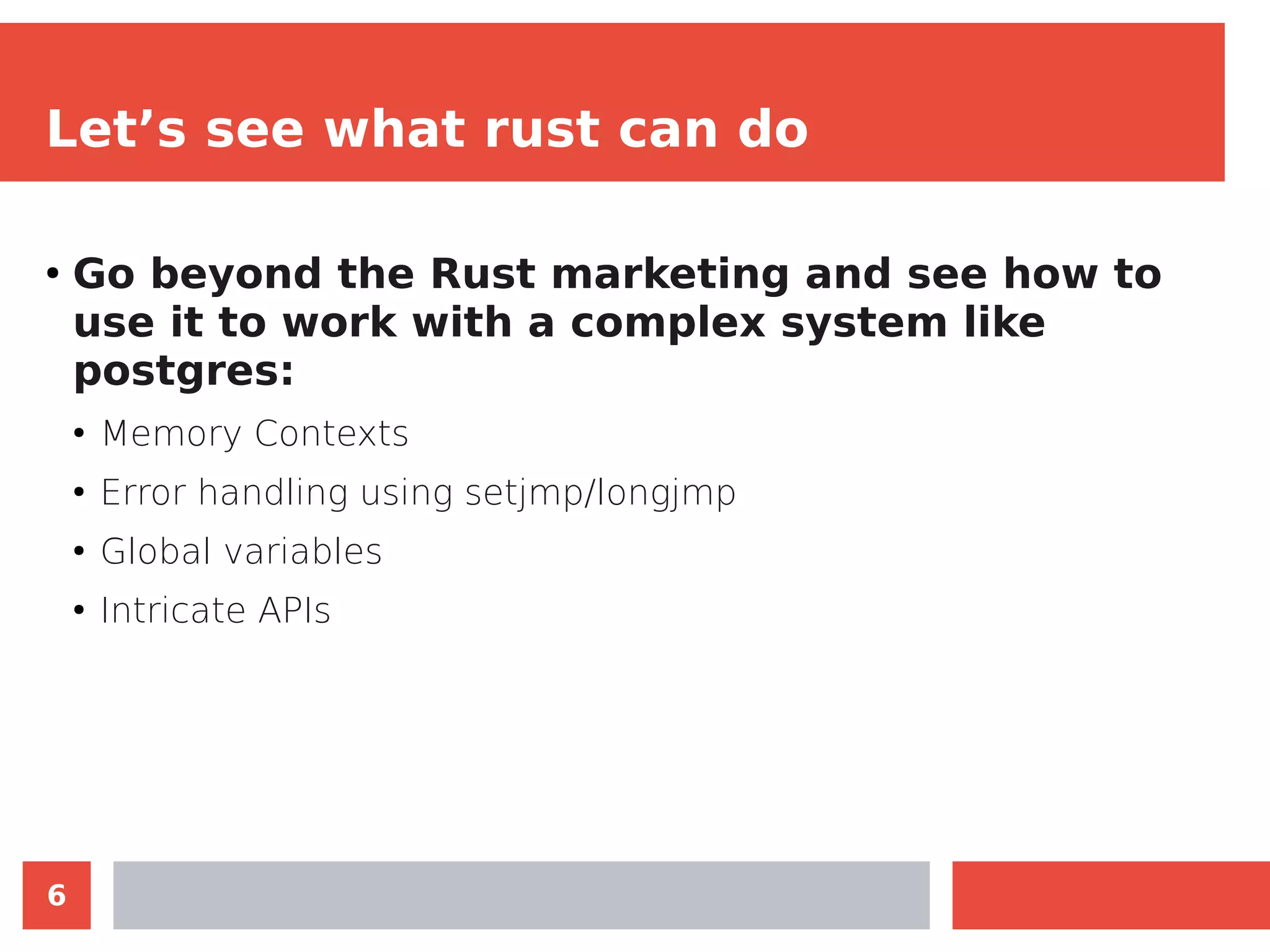
6 Let’s see what rust can do ● Go beyond the Rust marketing and see how to use it to work with a complex system like postgres: ● Memory Contexts ● Error handling using setjmp/longjmp ● Global variables ● Intricate APIs
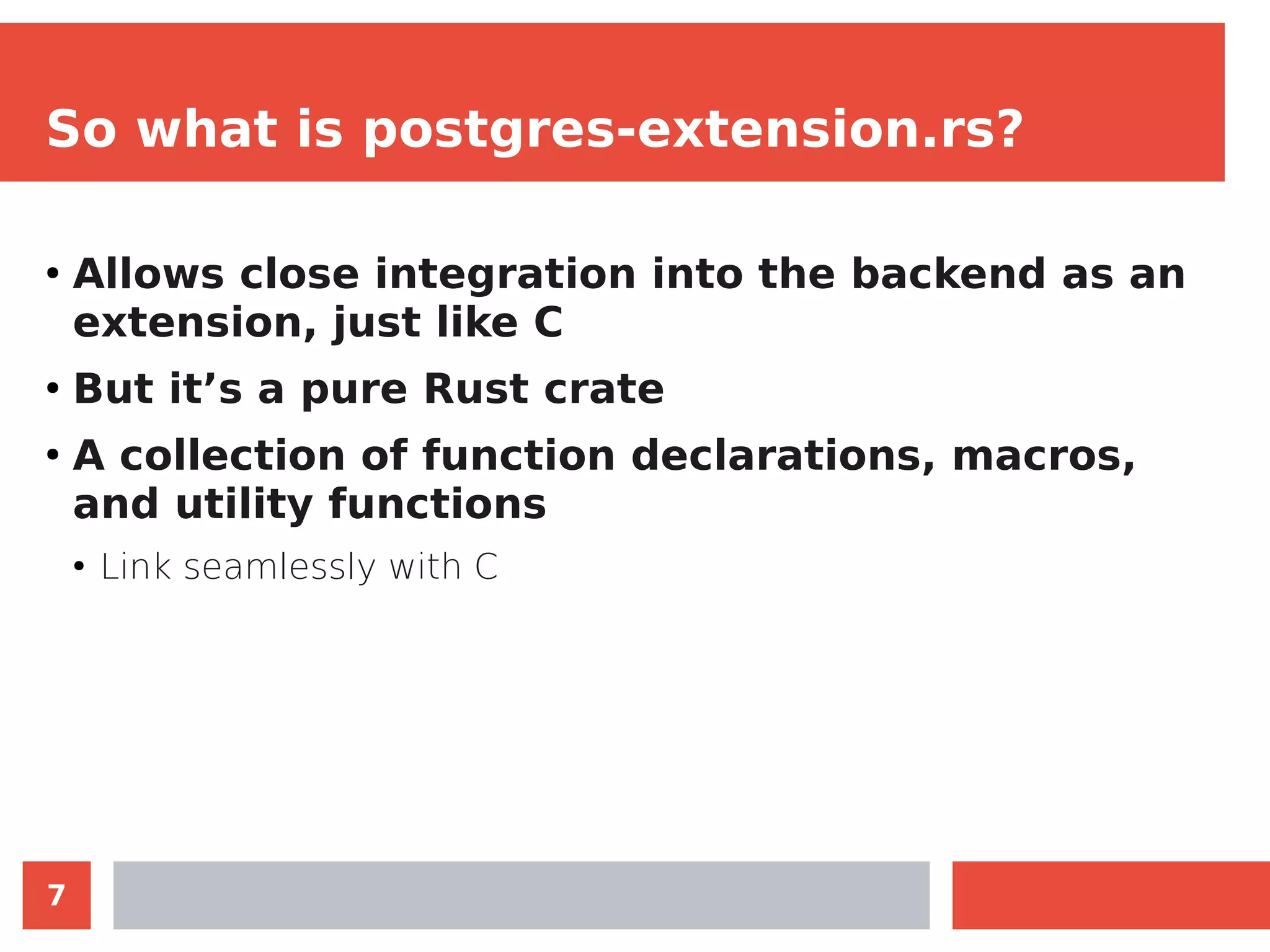
7 So what is postgres-extension.rs? ● Allows close integration into the backend as an extension, just like C ● But it’s a pure Rust crate ● A collection of function declarations, macros, and utility functions ● Link seamlessly with C
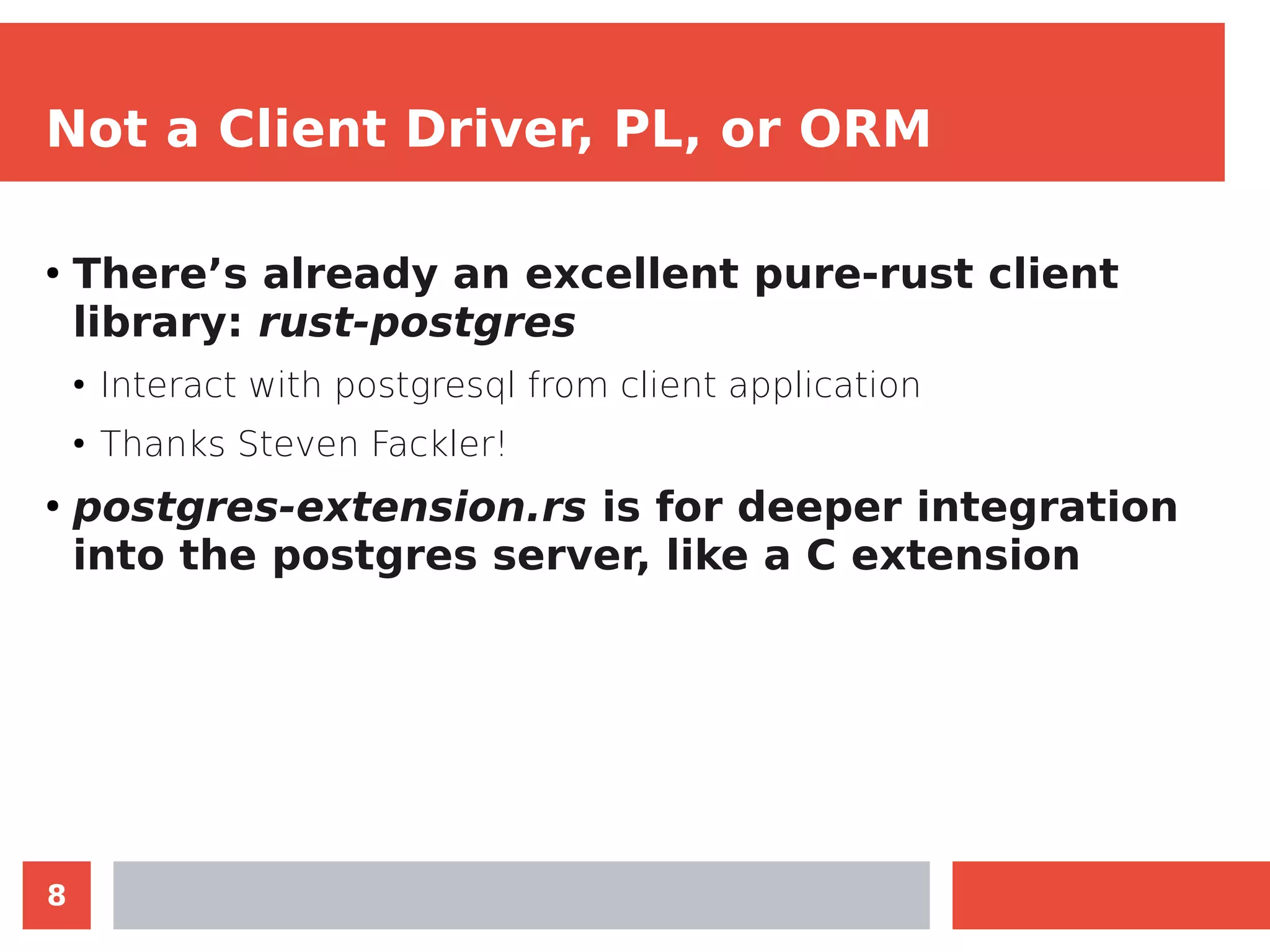
8 Not a Client Driver, PL, or ORM ● There’s already an excellent pure-rust client library: rust-postgres ● Interact with postgresql from client application ● Thanks Steven Fackler! ● postgres-extension.rs is for deeper integration into the postgres server, like a C extension
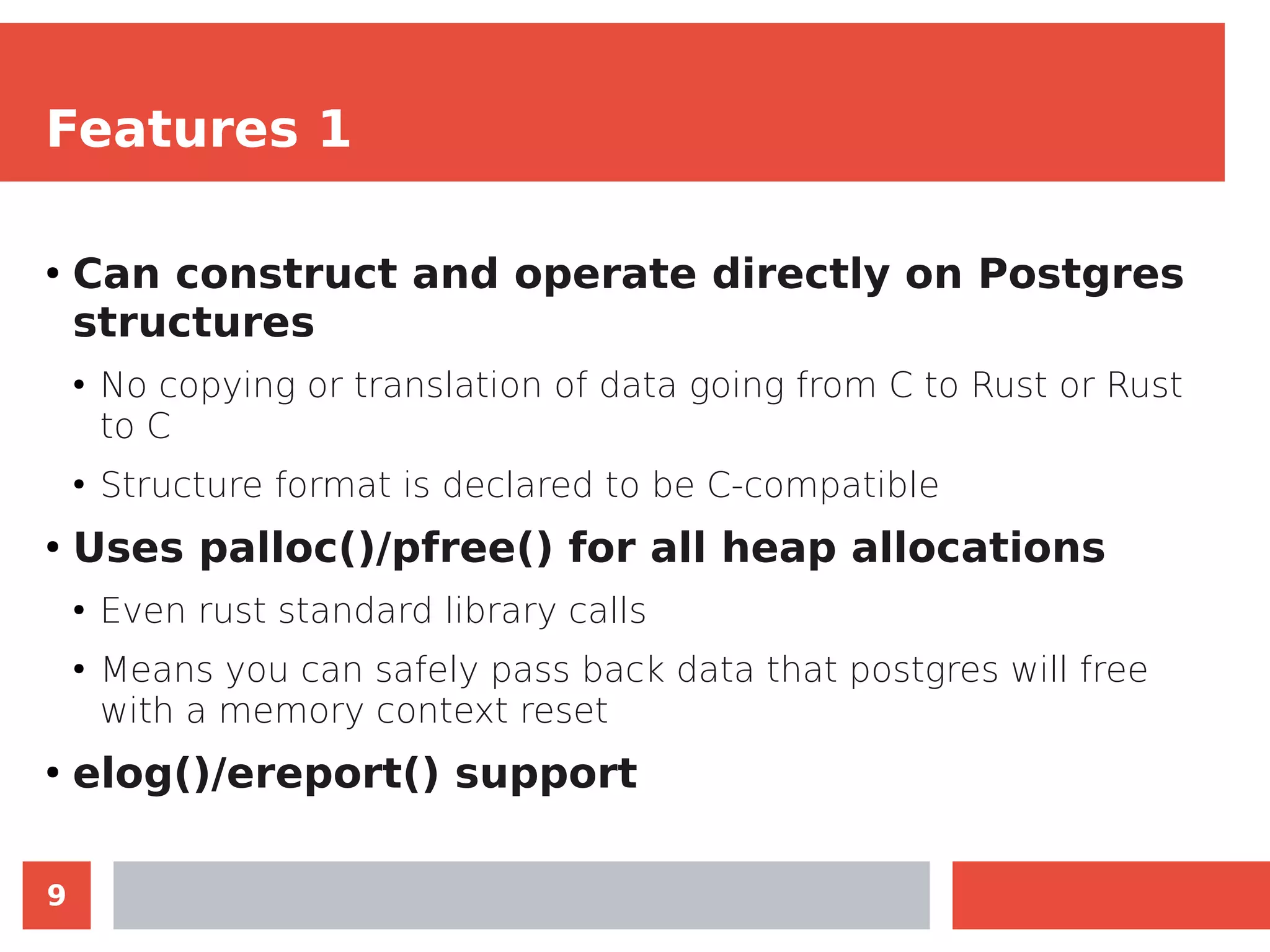
9 Features 1 ● Can construct and operate directly on Postgres structures ● No copying or translation of data going from C to Rust or Rust to C ● Structure format is declared to be C-compatible ● Uses palloc()/pfree() for all heap allocations ● Even rust standard library calls ● Means you can safely pass back data that postgres will free with a memory context reset ● elog()/ereport() support
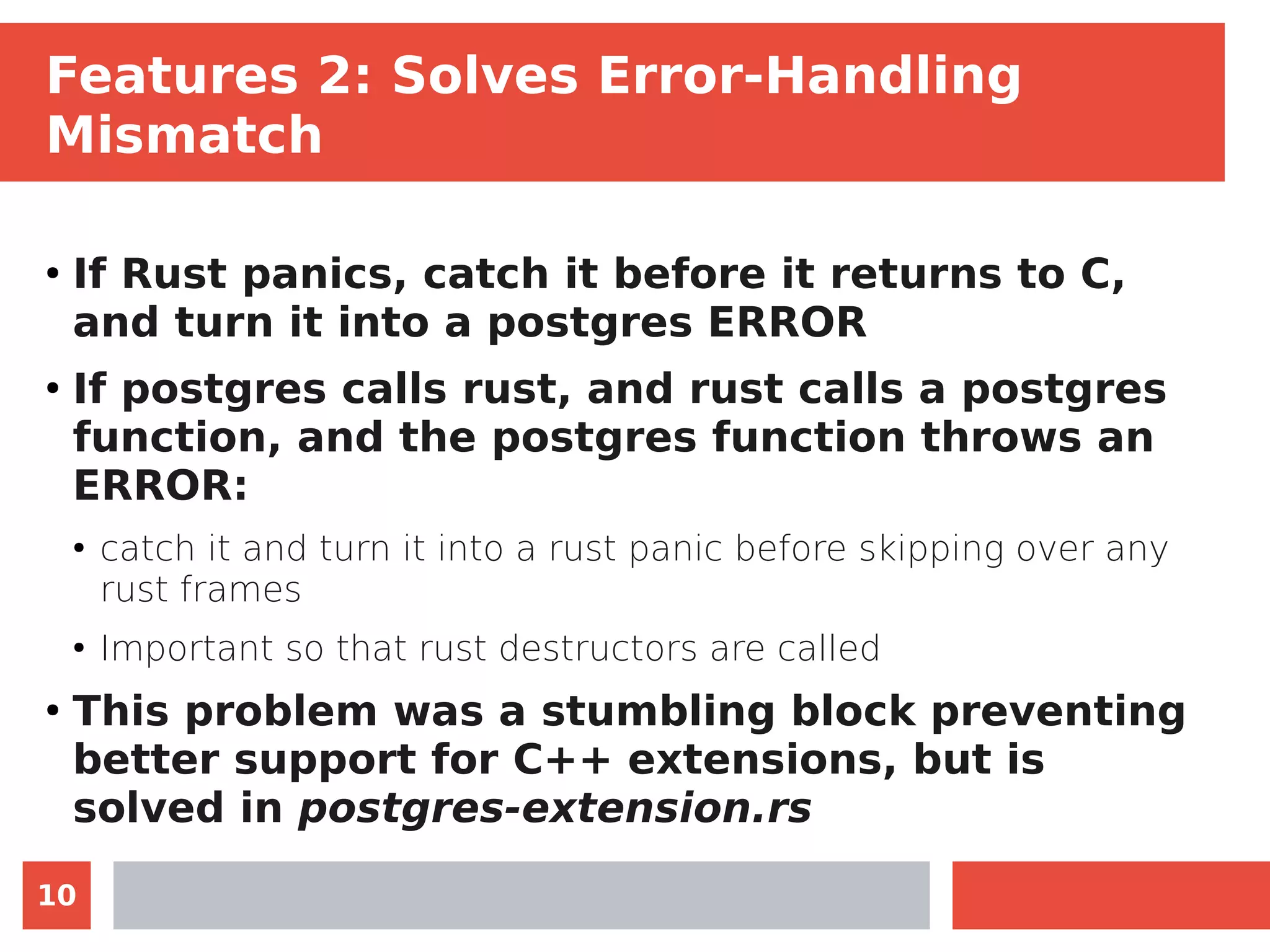
10 Features 2: Solves Error-Handling Mismatch ● If Rust panics, catch it before it returns to C, and turn it into a postgres ERROR ● If postgres calls rust, and rust calls a postgres function, and the postgres function throws an ERROR: ● catch it and turn it into a rust panic before skipping over any rust frames ● Important so that rust destructors are called ● This problem was a stumbling block preventing better support for C++ extensions, but is solved in postgres-extension.rs
11 Demo 1: UDFs and error handling ● DEMO
12 Demo 2: UDF with SPI ● DEMO
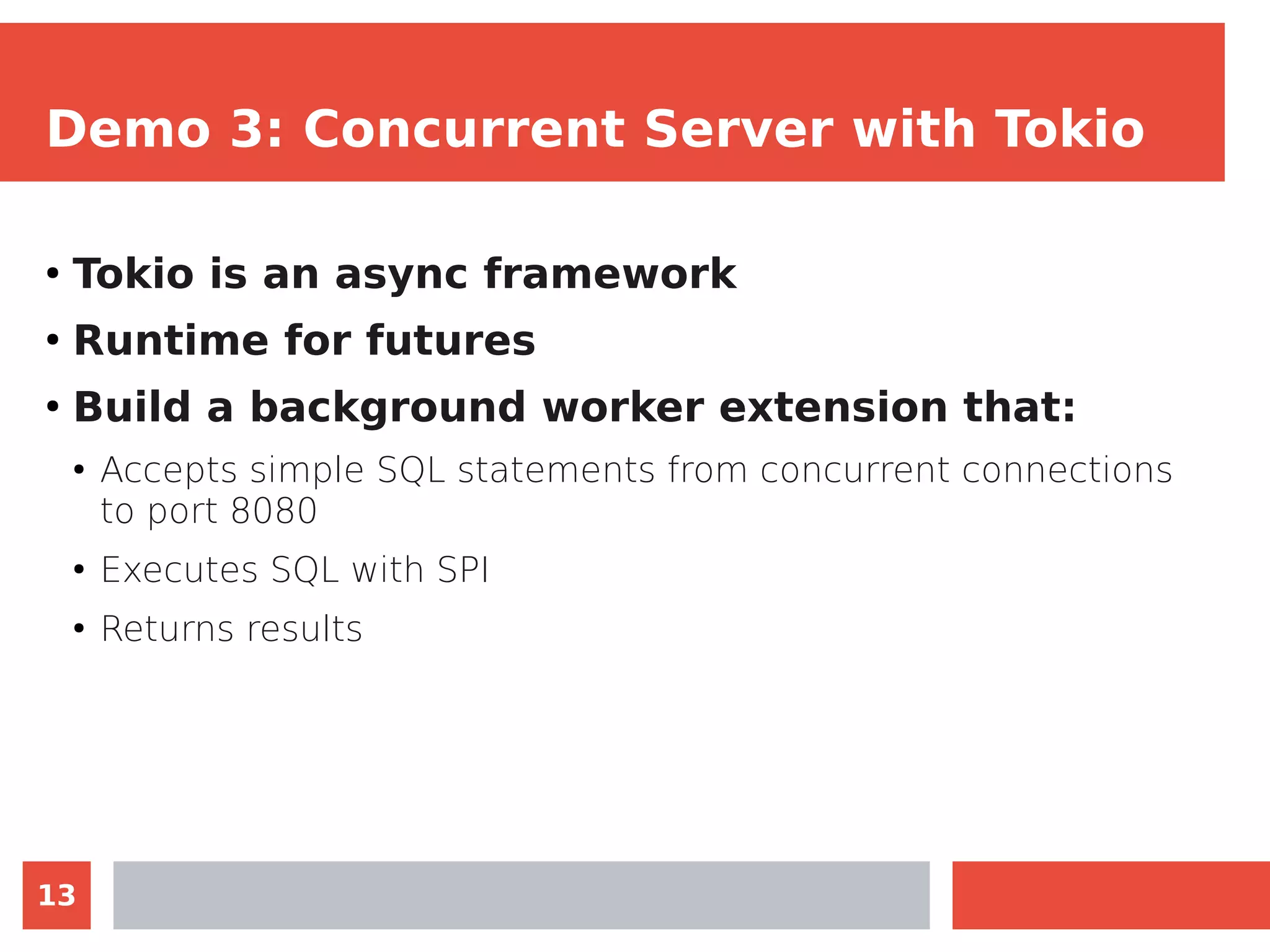
13 Demo 3: Concurrent Server with Tokio ● Tokio is an async framework ● Runtime for futures ● Build a background worker extension that: ● Accepts simple SQL statements from concurrent connections to port 8080 ● Executes SQL with SPI ● Returns results
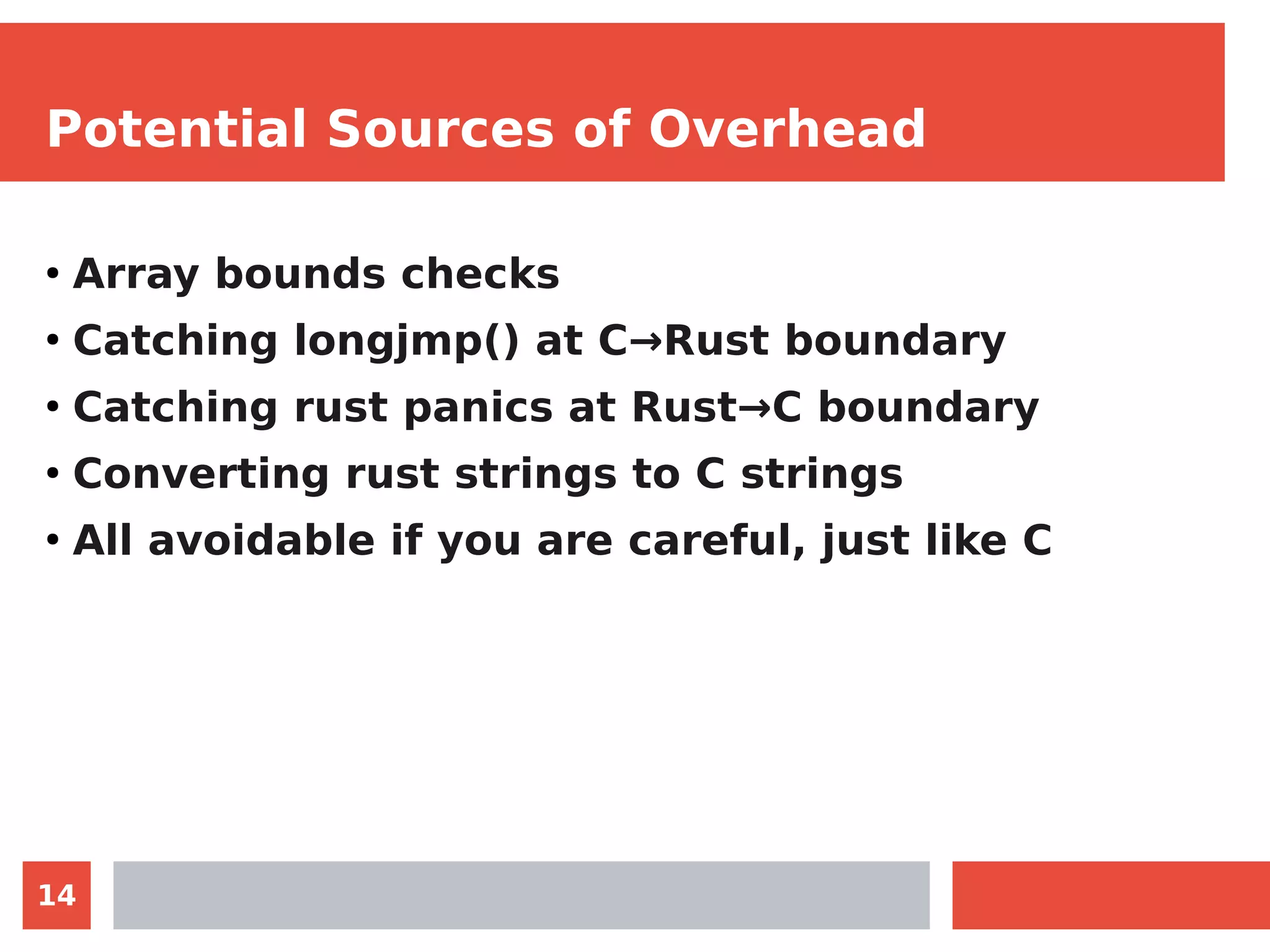
14 Potential Sources of Overhead ● Array bounds checks ● Catching longjmp() at C→Rust boundary ● Catching rust panics at Rust→C boundary ● Converting rust strings to C strings ● All avoidable if you are careful, just like C
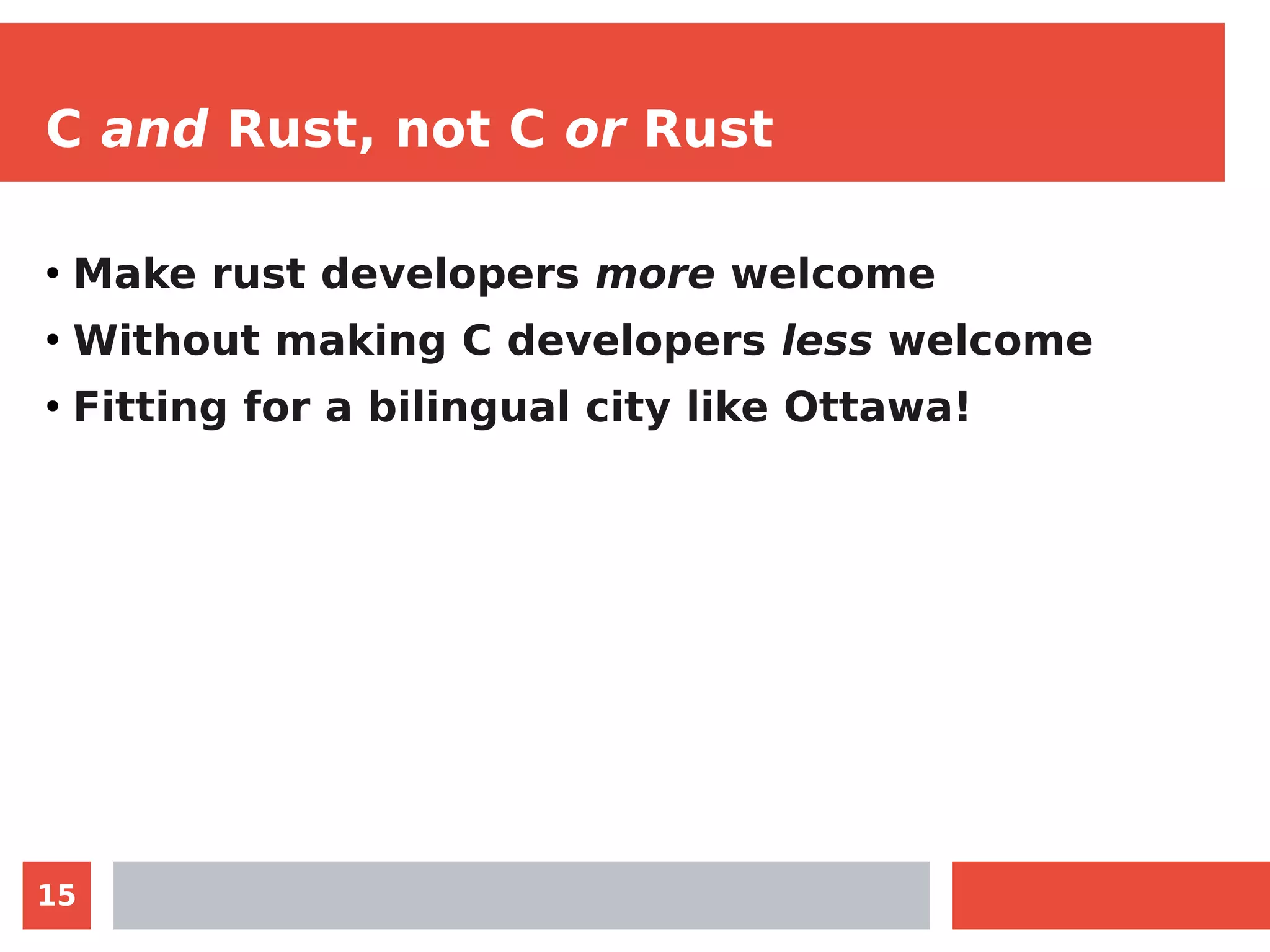
15 C and Rust, not C or Rust ● Make rust developers more welcome ● Without making C developers less welcome ● Fitting for a bilingual city like Ottawa!
16 Conclusion ● http://github.com/jeff-davis/postgres-extension. rs ● Try out writing extensions in a new language ● Only some internal postgres interfaces are supported for now ● Rust seems to have passed the test for real database internals ● Rust and Postgres have great potential together

Deep Postgres Extensions in Rust | PGCon 2019 | Jeff Davis

  • 1.
    Deep Postgres Extensionsin Rust: postgres-extension.rs Jeff Davis <jdavis@postgresql.org> Citus Data / Microsoft <Jeffrey.Davis@microsoft.com>
  • 2.
    2 Motivation ● Postgres relies onan ecosystem of extensions ● This is a good thing! ● Extensions allow domain-specific or experimental development ● We need to encourage new developers to get involved and new types of extension development ● Rust offers a different language and environment ● And brings new ideas!
  • 3.
    3 Why Rust? ● More memorysafety features than C ● Minimal runtime like C: ● No garbage collector or refcounting ● No “extra” code ● No “extra” data held in structs ● Not even a vtable pointer! ● Modern features ● Growing developer community ● Awesome ecosystem
  • 4.
    4 The Postgres Worldis C ● Real extensions used to require C: ● Foreign Data Wrappers ● Custom Data Types ● Index and Sort Support Functions ● Background Workers ● UDFs calling internal functions
  • 5.
    5 What About ProceduralLanguages? ● PL/pgSQL, Perl, Python, v8, etc. ● Essentially sandboxes ● Only for UDFs and SPI ● SPI: Server Programming Interface allows execution of arbitrary SQL within a UDF ● We need something more
  • 6.
    6 Let’s see whatrust can do ● Go beyond the Rust marketing and see how to use it to work with a complex system like postgres: ● Memory Contexts ● Error handling using setjmp/longjmp ● Global variables ● Intricate APIs
  • 7.
    7 So what ispostgres-extension.rs? ● Allows close integration into the backend as an extension, just like C ● But it’s a pure Rust crate ● A collection of function declarations, macros, and utility functions ● Link seamlessly with C
  • 8.
    8 Not a ClientDriver, PL, or ORM ● There’s already an excellent pure-rust client library: rust-postgres ● Interact with postgresql from client application ● Thanks Steven Fackler! ● postgres-extension.rs is for deeper integration into the postgres server, like a C extension
  • 9.
    9 Features 1 ● Can constructand operate directly on Postgres structures ● No copying or translation of data going from C to Rust or Rust to C ● Structure format is declared to be C-compatible ● Uses palloc()/pfree() for all heap allocations ● Even rust standard library calls ● Means you can safely pass back data that postgres will free with a memory context reset ● elog()/ereport() support
  • 10.
    10 Features 2: SolvesError-Handling Mismatch ● If Rust panics, catch it before it returns to C, and turn it into a postgres ERROR ● If postgres calls rust, and rust calls a postgres function, and the postgres function throws an ERROR: ● catch it and turn it into a rust panic before skipping over any rust frames ● Important so that rust destructors are called ● This problem was a stumbling block preventing better support for C++ extensions, but is solved in postgres-extension.rs
  • 11.
    11 Demo 1: UDFsand error handling ● DEMO
  • 12.
    12 Demo 2: UDFwith SPI ● DEMO
  • 13.
    13 Demo 3: ConcurrentServer with Tokio ● Tokio is an async framework ● Runtime for futures ● Build a background worker extension that: ● Accepts simple SQL statements from concurrent connections to port 8080 ● Executes SQL with SPI ● Returns results
  • 14.
    14 Potential Sources ofOverhead ● Array bounds checks ● Catching longjmp() at C→Rust boundary ● Catching rust panics at Rust→C boundary ● Converting rust strings to C strings ● All avoidable if you are careful, just like C
  • 15.
    15 C and Rust,not C or Rust ● Make rust developers more welcome ● Without making C developers less welcome ● Fitting for a bilingual city like Ottawa!
  • 16.
    16 Conclusion ● http://github.com/jeff-davis/postgres-extension. rs ● Try out writingextensions in a new language ● Only some internal postgres interfaces are supported for now ● Rust seems to have passed the test for real database internals ● Rust and Postgres have great potential together