ISSN 2350-1022 International Journal of Recent Research in Mathematics Computer Science and Information Technology Vol. 2, Issue 2, pp: (1-4), Month: October 2015 – March 2016, Available at: www.paperpublications.org Page | 1 Paper Publications Edge Detection Using Fuzzy Logic with Varied Inputs Pragya Tiwari Amity School of Engineering & Technology, Amity University, Jaipur, India Abstract: Image processing refers to a type of signal processing where the input is an image and output is an image or some of the characteristics of the image such as objects in image, contrast and many more. Edge Detection is considered as one of the most important process in the field of image processing. The existing edge detection algorithms like sobel, prewitt, canny, etc have various limitations. These limitations are overcome using a technique like fuzzy logic. This paper discusses about use of fuzzy logic for edge detection along with some other edge detection techniques incorporated as input the fuzzy system and provides an algorithm for the same.. The paper provides a comparison of the algorithm with varied inputs for real image. Keywords: Edge Detection, Fuzzy logic, Image Processing, Laplacian edge detector, Prewitt edge detector, Sobel edge detector. I. INTRODUCTION Fuzzy image processing has emerged as an optimal solution for edge detection technique in the past few years. This technique which is used for understanding, representing and processing the images, their segments and features as fuzzy sets [6]. A) Edge Detection: Edge detection plays a very significant role in the field of image processing. A lot of research work has been done in this field in the past few years and various edge detection algorithms have been developed. Some of them are sobel, prewitt, Laplacian, canny algorithm. The algorithms stated above have limitations such as selecting a threshold value, sensitivity to noise and judging edges over crisp boundaries. B) Fuzzy Image Processing: The fuzzy logic[3] approach overcomes the limitation of the above stated algorithms and provides a better performance. The fuzzy logic uses a truth value that ranges between 0 to 1. Fuzzy image processing has three main stages: image fuzzification, modification of membership values, and if required, image defuzzification. The coding of image data (fuzzification) and decoding of the results (defuzzification) are steps that make possible to process images with fuzzy techniques. The main power of fuzzy image processing is in the middle step (modification of membership values).[4] This paper discusses an algorithm for fuzzy logic based edge detection in which various inputs are provided to the fuzzy system. The comparison of algorithm with various inputs is done for real images. The algorithm stated in the paper takes the output of various edge detection algorithms as input and applies fuzzy logic on the image to obtain a better image with edges. Some of the operators used in algorithm to provide input are Sobel Operator, Prewitt Operator[1], Laplacian of Gaussian Operator[2] and Canny algorithm[5]. Section 2 of the paper describes the proposed algorithm. Section 3 provides the result of the proposed algorithm in the form of comparison for real images. Section 4 provides the conclusion.
ISSN 2350-1022 International Journal of Recent Research in Mathematics Computer Science and Information Technology Vol. 2, Issue 2, pp: (1-4), Month: October 2015 – March 2016, Available at: www.paperpublications.org Page | 2 Paper Publications Start Convert Perform operations on the image and derive the output Give the values of two parameters to the Fuzzy Integral System Define M inputs a Define Fu Image Ed Defuzzification(If required) Output Image II. PROPOSED ALGORITHM The steps included in carrying out the execution of the edge detection technique are stated in this section. Fig 1- Flow Chart for Applying Edge Detection through Fuzzy Logic Using varied Input Algorithm:- Step 1- Input the desired image for which edge detection is to be done. Step 2- Convert the RGB image to grayscale image. Step 3- Perform the required operation to vary the input parameter to the fuzzy system. a) To apply direct image to the system, calculate the gradients of image and provide to system. b) To apply image after applying sobel edge detector, first apply sobel edge detection algorithm to the image, then provide the gradients of output image as input to the system. c) Repeat step (b) with respective algorithm for applying prewitt, canny and Laplacian operated image as input. Step 4- Provide the output of the above step to the fuzzy system. Step 5- Define the input and output membership function of the fuzzy system. Step 6- State the fuzzy rules for obtaining the image edges in „if-then‟ statement. Step 7- Compare the results obtained after applying various inputs to the system. Fig 2- Input Membership Function
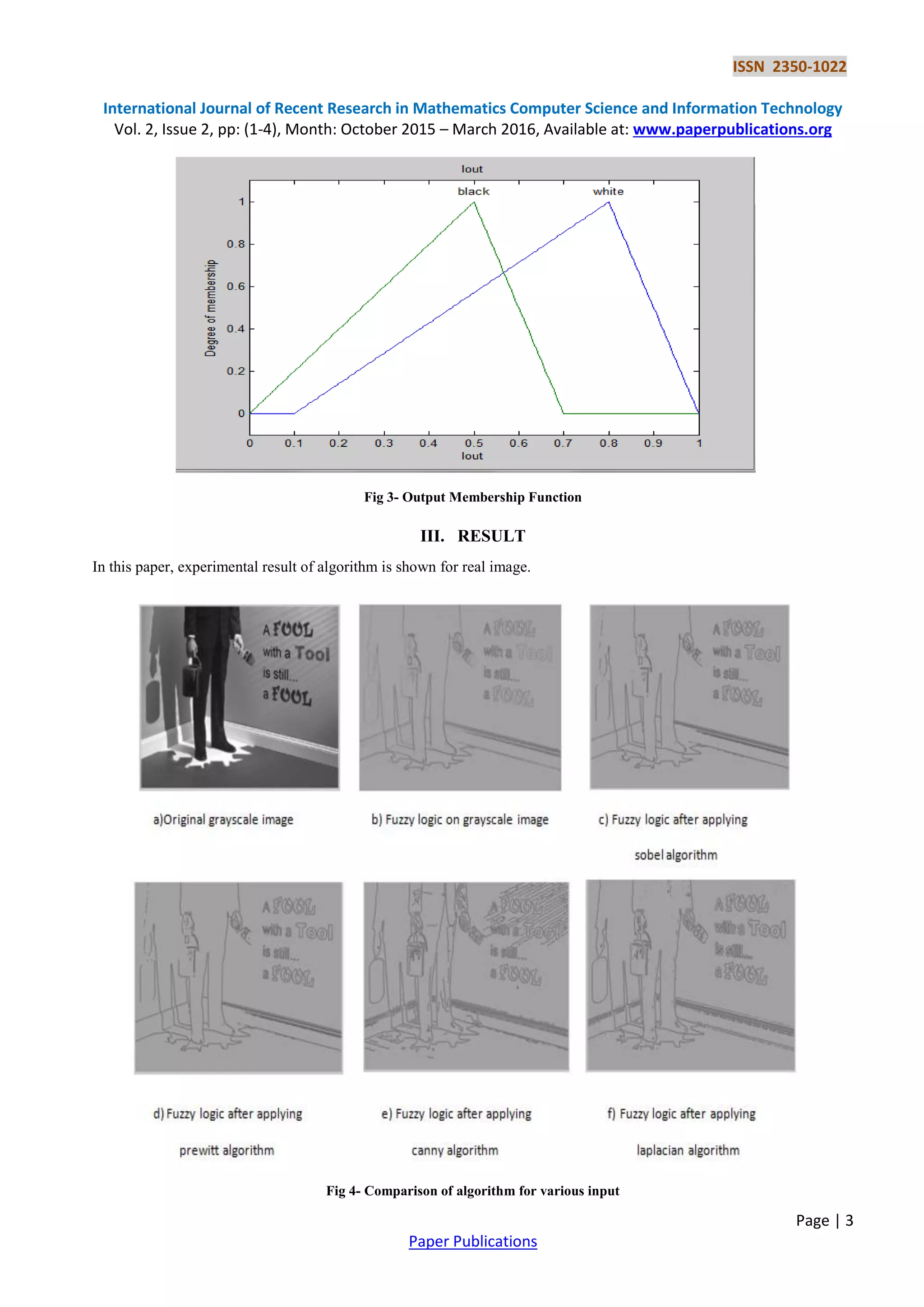
ISSN 2350-1022 International Journal of Recent Research in Mathematics Computer Science and Information Technology Vol. 2, Issue 2, pp: (1-4), Month: October 2015 – March 2016, Available at: www.paperpublications.org Page | 3 Paper Publications Fig 3- Output Membership Function III. RESULT In this paper, experimental result of algorithm is shown for real image. Fig 4- Comparison of algorithm for various input
ISSN 2350-1022 International Journal of Recent Research in Mathematics Computer Science and Information Technology Vol. 2, Issue 2, pp: (1-4), Month: October 2015 – March 2016, Available at: www.paperpublications.org Page | 4 Paper Publications IV. CONCLUSION Edge Detection plays a significant role in the field of image processing. Hence, it is very important to choose the best algorithm to enhance the performance. In this paper we have discussed one of the famous edge detection algorithm prevalent now-a-days i.e. edge detection using fuzzy logic. The algorithm is tested for various inputs and the output is compared for real image. Output of various edge detection algorithms have been used as an input to the algorithm. The paper can be used for the study of algorithm and understanding the technique in a descriptive manner. On visual perception, we can see that the algorithm with sobel operated image as input and algorithm with prewitt operated image as input derive similar output. The algorithm with Laplacian operated image as input provides the best result. REFERENCES [1] Mamta Juneja and Parvinder Singh Sandhu, Performance Evaluation of Edge Detection Techniques for Images in Spatial Domain, International Journal of Computer Theory and Engineering, Vol. 1, No. 5, December, 2009 1793- 820 [2] Raman Maini & Dr. Himanshu Aggarwal, Study and Comparison of Various Image Edge Detection Techniques , International Journal of Image Processing (IJIP), Volume (3) : Issue (1) [3] Richa Garg and Beant Kaur, Detection of Edges using Fuzzy Logic, International Journal of Emerging Technology and Advanced Engineering (ISSN 2250-2459, ISO 9001:2008 Certified Journal, Volume 4, Issue 9, September 2014) [4] Abdallah A. Alshennawy and Ayman A. Aly, Edge Detection in Digital Images Using Fuzzy Logic Technique. International Journal of Information Technology 5:4 2009 [5] E. Nadernejad, S. Sharifzadeh and H. Hassanpour, Edge Detection Techniques: Evaluations and Comparisons. Applied Mathematical Sciences, Vol. 2, 2008, no. 31, 1507 – 1520 [6] Iqbal, J.; mehmood, A.K.; Saadia, T.; Sabahat, z.; “IMPLEMENTING BALL BALANCING BEAM USING DIGITAL IMAGE PROCESSING AND FUZZY LOGIC”, 2005 IEEE, may 2005 canadian conference on electrical and computer engineering, pp. 2241 - 2244.

Edge Detection Using Fuzzy Logic with Varied Inputs

  • 1.
    ISSN 2350-1022 International Journalof Recent Research in Mathematics Computer Science and Information Technology Vol. 2, Issue 2, pp: (1-4), Month: October 2015 – March 2016, Available at: www.paperpublications.org Page | 1 Paper Publications Edge Detection Using Fuzzy Logic with Varied Inputs Pragya Tiwari Amity School of Engineering & Technology, Amity University, Jaipur, India Abstract: Image processing refers to a type of signal processing where the input is an image and output is an image or some of the characteristics of the image such as objects in image, contrast and many more. Edge Detection is considered as one of the most important process in the field of image processing. The existing edge detection algorithms like sobel, prewitt, canny, etc have various limitations. These limitations are overcome using a technique like fuzzy logic. This paper discusses about use of fuzzy logic for edge detection along with some other edge detection techniques incorporated as input the fuzzy system and provides an algorithm for the same.. The paper provides a comparison of the algorithm with varied inputs for real image. Keywords: Edge Detection, Fuzzy logic, Image Processing, Laplacian edge detector, Prewitt edge detector, Sobel edge detector. I. INTRODUCTION Fuzzy image processing has emerged as an optimal solution for edge detection technique in the past few years. This technique which is used for understanding, representing and processing the images, their segments and features as fuzzy sets [6]. A) Edge Detection: Edge detection plays a very significant role in the field of image processing. A lot of research work has been done in this field in the past few years and various edge detection algorithms have been developed. Some of them are sobel, prewitt, Laplacian, canny algorithm. The algorithms stated above have limitations such as selecting a threshold value, sensitivity to noise and judging edges over crisp boundaries. B) Fuzzy Image Processing: The fuzzy logic[3] approach overcomes the limitation of the above stated algorithms and provides a better performance. The fuzzy logic uses a truth value that ranges between 0 to 1. Fuzzy image processing has three main stages: image fuzzification, modification of membership values, and if required, image defuzzification. The coding of image data (fuzzification) and decoding of the results (defuzzification) are steps that make possible to process images with fuzzy techniques. The main power of fuzzy image processing is in the middle step (modification of membership values).[4] This paper discusses an algorithm for fuzzy logic based edge detection in which various inputs are provided to the fuzzy system. The comparison of algorithm with various inputs is done for real images. The algorithm stated in the paper takes the output of various edge detection algorithms as input and applies fuzzy logic on the image to obtain a better image with edges. Some of the operators used in algorithm to provide input are Sobel Operator, Prewitt Operator[1], Laplacian of Gaussian Operator[2] and Canny algorithm[5]. Section 2 of the paper describes the proposed algorithm. Section 3 provides the result of the proposed algorithm in the form of comparison for real images. Section 4 provides the conclusion.
  • 2.
    ISSN 2350-1022 International Journalof Recent Research in Mathematics Computer Science and Information Technology Vol. 2, Issue 2, pp: (1-4), Month: October 2015 – March 2016, Available at: www.paperpublications.org Page | 2 Paper Publications Start Convert Perform operations on the image and derive the output Give the values of two parameters to the Fuzzy Integral System Define M inputs a Define Fu Image Ed Defuzzification(If required) Output Image II. PROPOSED ALGORITHM The steps included in carrying out the execution of the edge detection technique are stated in this section. Fig 1- Flow Chart for Applying Edge Detection through Fuzzy Logic Using varied Input Algorithm:- Step 1- Input the desired image for which edge detection is to be done. Step 2- Convert the RGB image to grayscale image. Step 3- Perform the required operation to vary the input parameter to the fuzzy system. a) To apply direct image to the system, calculate the gradients of image and provide to system. b) To apply image after applying sobel edge detector, first apply sobel edge detection algorithm to the image, then provide the gradients of output image as input to the system. c) Repeat step (b) with respective algorithm for applying prewitt, canny and Laplacian operated image as input. Step 4- Provide the output of the above step to the fuzzy system. Step 5- Define the input and output membership function of the fuzzy system. Step 6- State the fuzzy rules for obtaining the image edges in „if-then‟ statement. Step 7- Compare the results obtained after applying various inputs to the system. Fig 2- Input Membership Function
  • 3.
    ISSN 2350-1022 International Journalof Recent Research in Mathematics Computer Science and Information Technology Vol. 2, Issue 2, pp: (1-4), Month: October 2015 – March 2016, Available at: www.paperpublications.org Page | 3 Paper Publications Fig 3- Output Membership Function III. RESULT In this paper, experimental result of algorithm is shown for real image. Fig 4- Comparison of algorithm for various input
  • 4.
    ISSN 2350-1022 International Journalof Recent Research in Mathematics Computer Science and Information Technology Vol. 2, Issue 2, pp: (1-4), Month: October 2015 – March 2016, Available at: www.paperpublications.org Page | 4 Paper Publications IV. CONCLUSION Edge Detection plays a significant role in the field of image processing. Hence, it is very important to choose the best algorithm to enhance the performance. In this paper we have discussed one of the famous edge detection algorithm prevalent now-a-days i.e. edge detection using fuzzy logic. The algorithm is tested for various inputs and the output is compared for real image. Output of various edge detection algorithms have been used as an input to the algorithm. The paper can be used for the study of algorithm and understanding the technique in a descriptive manner. On visual perception, we can see that the algorithm with sobel operated image as input and algorithm with prewitt operated image as input derive similar output. The algorithm with Laplacian operated image as input provides the best result. REFERENCES [1] Mamta Juneja and Parvinder Singh Sandhu, Performance Evaluation of Edge Detection Techniques for Images in Spatial Domain, International Journal of Computer Theory and Engineering, Vol. 1, No. 5, December, 2009 1793- 820 [2] Raman Maini & Dr. Himanshu Aggarwal, Study and Comparison of Various Image Edge Detection Techniques , International Journal of Image Processing (IJIP), Volume (3) : Issue (1) [3] Richa Garg and Beant Kaur, Detection of Edges using Fuzzy Logic, International Journal of Emerging Technology and Advanced Engineering (ISSN 2250-2459, ISO 9001:2008 Certified Journal, Volume 4, Issue 9, September 2014) [4] Abdallah A. Alshennawy and Ayman A. Aly, Edge Detection in Digital Images Using Fuzzy Logic Technique. International Journal of Information Technology 5:4 2009 [5] E. Nadernejad, S. Sharifzadeh and H. Hassanpour, Edge Detection Techniques: Evaluations and Comparisons. Applied Mathematical Sciences, Vol. 2, 2008, no. 31, 1507 – 1520 [6] Iqbal, J.; mehmood, A.K.; Saadia, T.; Sabahat, z.; “IMPLEMENTING BALL BALANCING BEAM USING DIGITAL IMAGE PROCESSING AND FUZZY LOGIC”, 2005 IEEE, may 2005 canadian conference on electrical and computer engineering, pp. 2241 - 2244.