Asian Journal of Applied Science and Technology (AJAST) Volume 1, Issue 1, Pages 24-29, February 2017 2017 AJAST All rights reserved. www.ajast.net Page | 24 Highly Scalable Energy Efficient Distributed Clustering Mechanism in Wireless Sensor Networks Based on Hierarchical Approach J.K.Deepak Keynes# and Dr.D.Shalini Punithavathani* #Research Scholar, Department of Computer Science and Engineering, Manonmaniam Sundaranar University, Tamil Nadu, India. *Principal, Government College of Engineering, Tirunelveli, Tamil Nadu, India. Article Received: 02 February 2017 Article Accepted: 13 February 2017 Article Published: 16 February 2017 1. INTRODUCTION A wireless sensor node consists of low power processor, tiny memory, radio frequency module, various types of sensing devices and limited powered batteries. More amount of energy consumption in a WSN happens during wireless communications. The energy consumption when transmitting a single bit of data corresponds to thousands of cycles of CPU operations. These wireless sensor nodes assemble data from a sensing area which is possibly inaccessible for humans. Data gathered from the sensing field are usually reported to a remotely located base station (BS). This high redundancy of sensing power can greatly improve the sensing resolution and make sensor networks robust to swiftly changing environment. Some budding applications of wireless sensor networks are wildlife habit study, environmental observation and health care monitoring. Since wireless sensor nodes are power-constrained devices, long-haul transmissions should be kept to minimum in order to expand the network lifetime [3-6]. Thus, direct communications between nodes and the base station are not intensely encouraged. An effective methodology to perk up efficiency is to arrange the network into several clusters (figure 1), with each cluster electing one node as its leader or cluster head (CH). A cluster head collects data from other sensor nodes in its cluster, directly or hopping through other nearby nodes. The data collected from nodes of the same cluster are extremely correlated. Data can be amalgamated during the data aggregation process. The fused data will then be transmitted to the base station directly or by multi-hop fashion. In such an arrangement, only cluster heads are required to transmit data over larger distances. This paper gives a profound description about energy efficient hierarchical distributed clustering algorithm. The remaining nodes will need to do only short-distance transmission. To distribute the workload of the cluster heads amidst the wireless sensor nodes, cluster heads will be reelected from time to time. Clustering follows some projected advantages like localizing route setup within a particular cluster radius, efficient topology maintenance, energy efficiency, utilization of communication bandwidth efficiently and makes best use of network lifetime. Since clustering makes use of the mechanism of data aggregation, unnecessary communication between the sensor nodes, CH and BS is avoided [7-12]. Energy consumption of wireless sensor nodes is greatly trimmed down and the overall network lifetime can thus be prolonged [13-18]. The rest of the paper is organized as follows. A literature review of existing distributed clustering algorithms is given in Section 2. The hierarchical distributed clustering algorithm giving inspiration to this work is described in Section 3. Section 4 elaborates the details of the simulation results. Finally the last section gives the conclusion. Fig.1. Clustering mechanism in a wireless sensor network 2. REVIEW OF CLUSTERING ALGORITHMS Extensive research efforts have been made to minimize the energy consumption and to prolong the lifetime of WSNs. The algorithms described in this section are completely ABSTRACT Extending the longevity, is a significant job to be accomplished by these sensor networks. The traditional routing protocols could not be applied here, due to its nodes powered by batteries. Nodes are often clustered in to non-overlapping clusters, so as to provide energy efficiency. A concise overview on clustering processes, within wireless sensor networks is given in this paper. But it is difficult to replace the deceased batteries of the sensor nodes. A distinctive sensor node consumes much of its energy during wireless communication. This research work suggests the development of a hierarchical distributed clustering mechanism, which gives improved performance over the existing clustering algorithm LEACH. The two hiding concepts behind the proposed scheme are the hierarchical distributed clustering mechanism and the concept of threshold. Energy utilization is significantly reduced, thereby greatly prolonging the lifetime of the sensor nodes. Keywords: Wireless sensor network, sensor node, cluster head, base station, residual energy, energy utilization and network lifetime.
Asian Journal of Applied Science and Technology (AJAST) Volume 1, Issue 1, Pages 24-29, February 2017 2017 AJAST All rights reserved. www.ajast.net Page | 25 distributed and CH changes from node to node based on some parameters. They tend to vary mainly in the methodology by which the CH is elected. Bandyopadhyay and Coyle anticipated EEHC, which is a randomized clustering algorithm which organizes the sensor nodes into hierarchy of clusters with an objective of minimizing the total energy spent in the system to communicate the information gathered by the sensors to the information processing center. It has variable cluster count, the immobile CH aggregates and relays the data to the BS. It is applicable for extensive large scale networks. The peculiar drawback of this algorithm is that, few nodes stay un-clustered throughout the entire clustering process. Barker, Ephremides and Flynn proposed LCA [19], which is mainly developed to avoid the communication collisions among the nodes by using a TDMA time-slot. It makes use of single-hop scheme, attains better degree of connectivity when CH is selected randomly. The updated version of LCA, the LCA2 was implemented to decrease the number of nodes compared to the original LCA algorithm. The main weakness of this algorithm is, the single-hop clustering results in the creation of numerous clusters and much energy is washed out. Nagpal and Coore proposed CLUBS [20], which is implemented with an idea to form overlapping clusters with maximum cluster diameter of two hops. The clusters are formed by local broadcasting and its convergence depends on the local density of the wireless sensor nodes. This algorithm can be implemented in asynchronous environment without reducing efficiency. The main problem is the overlapping of clusters, clusters having their CHs within one hop range of each other, both clusters will collapse and CH election process will restart. Demirbas, Arora and Mittal brought out FLOC [21], which exhibits double-band nature of wireless radio-model for communication. The nodes can commune reliably with the nodes in the inner-band range and unreliably with the nodes that are in the outer-band range. It is scalable and thus exhibits self-healing capabilities. It achieves re-clustering in constant time and in a local manner, thereby finds valid in large scale networks. The key drawback of the algorithm is, the nodes in the outer band exercise unreliable communication and the messages have the utmost probability of getting vanished during communication. Ye, Li, Chen and Wu proposed EECS [22], which is based on the guessing that all CHs can communicate directly with BS. The clusters have variable size, such that those closer to the CH are larger in size and those farther from CH are smaller in size. It is greatly energy efficient in intra-cluster communication and excellent improvement network lifetime. EEUC [23] is proposed for uniform energy consumption within the network. It forms dissimilar clusters, with an assumption that each cluster can have variable sizes. Probabilistic selection of CH is the focal drawback of this algorithm. Few nodes may be gone without being part of any cluster, thereby no guarantee that every node takes part in clustering mechanism. Yu, Li and Levy proposed DECA [25], which selects CH based on residual energy, connectivity and node identifier. It is greatly energy efficient, as it uses fewer messages for CH selection. The main trouble with this algorithm is that high possibility of wrong CH selection which leads to discarding of all the packets sent by the sensor node. Ding, Holliday and Celik proposed DWEHC [24], which elects CH based on weight, a combination of residual energy and its distance to neighboring nodes. It generates well balanced clusters, independent on network topology. A node possessing largest weight in a cluster is nominated as CH. The algorithm constructs multilevel clusters and nodes in every cluster reach CH by relaying through other intermediate nodes. It shows an enormous improvement in intra-cluster and inter-cluster energy consumption. The major problem occurs due to much energy utilization by several iterations until the nodes settle in most energy efficient topology. HEED [2] is a well distributed clustering algorithm in which CH selection is done by taking into account the residual energy of the nodes and the intra-cluster communication cost leading to prolonged network lifetime. It is clear that it can have variable cluster count and supports heterogeneous sensor nodes. The CH is stationary which carries out data aggregation and relaying of the fused data to the BS. The problems with HEED are its application limited only to static networks, the assumption of complex probabilistic methods and multiple clustering messages per node for cluster head selection even though it prevents random selection of cluster head. LEACH [1] is one of the most popular clustering mechanisms for WSNs and it is considered as a representative energy efficient protocol. In this protocol, sensor nodes are grouped together to form a cluster. In every clusters, one sensor node is chosen arbitrarily to act as a cluster head (CH), which collects data from its member nodes, aggregates them and then forwards to the base station. It separates the operation unit into several rounds and each round consists of two phases, namely set-up phase and the steady state phase. During the set-up phase, clusters are created and cluster heads are selected. Fig.2. Evaluation of LEACH algorithm
Asian Journal of Applied Science and Technology (AJAST) Volume 1, Issue 1, Pages 24-29, February 2017 2017 AJAST All rights reserved. www.ajast.net Page | 26 Gone selecting itself as a CH, the node generally broadcasts an advertisement message which contains its own ID. The non-cluster head nodes can make a decision, which cluster to join according to the strength of the received advertisement signal. After the decision is made, every non-cluster head node must transmit a join- request message to the chosen cluster head to specify that it will be a member of the cluster. The cluster head produces and broadcasts the time division multiple-access (TDMA) schedule to swap the data with non-cluster sensor nodes without any collision after it receives all the join-request messages. The steady phase begins after the clusters are fashioned and the TDMA schedules are broadcasted. All the sensor nodes throw their data to the cluster head once per round during their allocated transmission slot based on the TDMA schedule and in other time, they turn off the radio in order to reduce energy consumption. However, the cluster heads must remain awake all the time. Therefore, it can receive every data from the nodes within their own clusters. On receiving all the data from the cluster, the cluster head perform data aggregation and onwards it to the base station directly. This is the complete process of steady phase. After a certain predefined time duration, the network will step into the next round. LEACH is the simplest clustering protocol which processes cluster approach and it can prolong the network lifetime when compared with multi-hop routing and static routing. However, there are still some hiding drawbacks that should be considered. LEACH does not take into account the residual energy to select cluster heads and to construct clusters. As a result, nodes with lesser energy may be selected as cluster heads and then die much earlier. Moreover, since a node selects itself as a cluster head only according to the value of probability, it is tough to guarantee the number of cluster heads and their distribution. To overcome the inadequacy in LEACH, a hierarchical distributed clustering mechanism is proposed, where clusters are arranged in to hierarchical layers. Instead of cluster heads directly sending the aggregated data to the base station, sends them to their next layer cluster heads. These cluster heads send their data along with those received from lower level cluster heads to the next layer cluster heads. The cumulative process gets repeated and finally the data from all the layers reach the base station. 3. FEATURES OF THE PROPOSED SYSTEM The initial step in the creation of LEACH (Low Energy Adaptive clustering of Hierarchy), is the creation of clusters. More specifically, each sensor nodes decides whether or not to turn into the cluster head for the current round. The decision is based on the priority and on the number to time the node has been a cluster head so for. The cluster nodes brings together the data and send them to the cluster head. The radio to each cluster nodes can be turned off when there is no sensing happens. When all the data have been received, the cluster head aggregates the data in to single composite signal. The composite signal is then sent to the base station directly. Fig.3. Evaluation of the proposed algorithm LEACH protocol has the weakness, when periodic transmissions are unnecessary, thus causing pointless power consumption. The election of cluster head is based on priority, hence there is a possibility for weaker nodes to be drained because they are elected to be cluster heads as frequently as the stronger nodes. Moreover, the protocol is based on the assumptions that all nodes commence with the same amount of energy capacity in each election round and all the nodes can transmit with enough power to reach the base station if needed. Nevertheless, in many cases these assumptions are impractical. Also the base station should keep track on the sensor nodes in order to choose which node has the highest residual energy. Hence needless transmissions occur between the base station and cluster nodes, thereby causing increased power consumption. The proposed work suggests a new idea over the existing techniques. In case of existing technique (figure 2), the aggregated data is sent to the base election directly by the CH, which leads to more energy usage. In the proposed algorithm the aggregated data is forwarded only to the next layer cluster head (figure 3), cutting down the communication distance between cluster head and the base station. Two thresholds are employed namely hard threshold and soft threshold. Hard threshold is the bare minimum possible value, of an attribute to trigger a wireless sensor node to switch on its transmitter and transmit to the cluster head. Soft threshold is a little change in the value of the sensed attribute that triggers the node to switch on its transmitter and transmit data. The hard threshold tries to trim down the number of transmission by allowing their nodes to transmit only when the sensed attribute is beyond a critical value. In a similar way, the soft threshold further lessens the number of transmissions that might have otherwise occurred when there is little or no change in the sensed attribute. At each cluster change, the values of both the thresholds can be changed and thus enabling the user to control the tradeoff between energy efficiency and data accuracy. This method reduces unwanted transmissions, trimming down the energy utilization. The main actions in the set-up phase are election of candidate nodes, selection of cluster heads, scheduling at each cluster
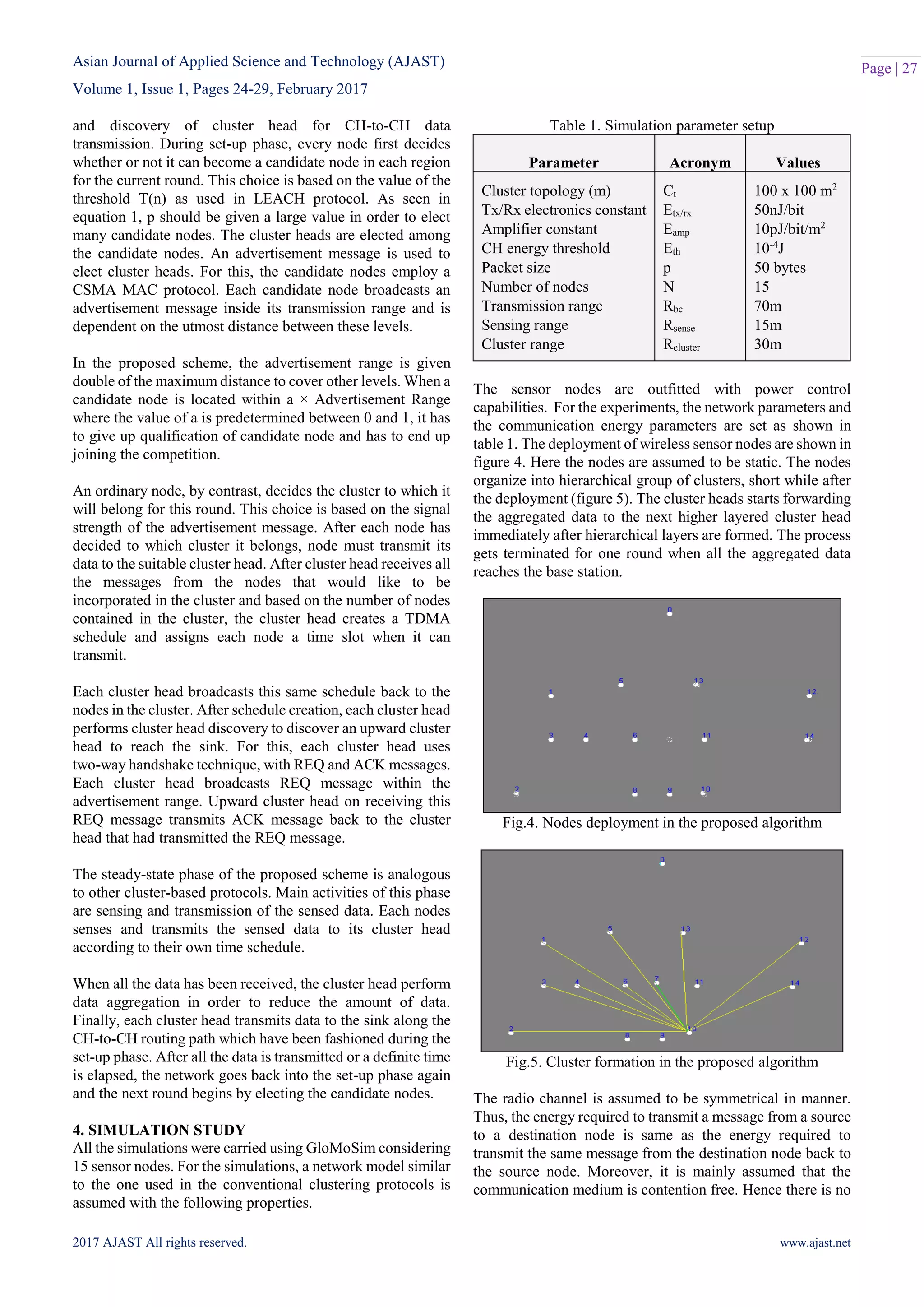
Asian Journal of Applied Science and Technology (AJAST) Volume 1, Issue 1, Pages 24-29, February 2017 2017 AJAST All rights reserved. www.ajast.net Page | 27 and discovery of cluster head for CH-to-CH data transmission. During set-up phase, every node first decides whether or not it can become a candidate node in each region for the current round. This choice is based on the value of the threshold T(n) as used in LEACH protocol. As seen in equation 1, p should be given a large value in order to elect many candidate nodes. The cluster heads are elected among the candidate nodes. An advertisement message is used to elect cluster heads. For this, the candidate nodes employ a CSMA MAC protocol. Each candidate node broadcasts an advertisement message inside its transmission range and is dependent on the utmost distance between these levels. In the proposed scheme, the advertisement range is given double of the maximum distance to cover other levels. When a candidate node is located within a × Advertisement Range where the value of a is predetermined between 0 and 1, it has to give up qualification of candidate node and has to end up joining the competition. An ordinary node, by contrast, decides the cluster to which it will belong for this round. This choice is based on the signal strength of the advertisement message. After each node has decided to which cluster it belongs, node must transmit its data to the suitable cluster head. After cluster head receives all the messages from the nodes that would like to be incorporated in the cluster and based on the number of nodes contained in the cluster, the cluster head creates a TDMA schedule and assigns each node a time slot when it can transmit. Each cluster head broadcasts this same schedule back to the nodes in the cluster. After schedule creation, each cluster head performs cluster head discovery to discover an upward cluster head to reach the sink. For this, each cluster head uses two-way handshake technique, with REQ and ACK messages. Each cluster head broadcasts REQ message within the advertisement range. Upward cluster head on receiving this REQ message transmits ACK message back to the cluster head that had transmitted the REQ message. The steady-state phase of the proposed scheme is analogous to other cluster-based protocols. Main activities of this phase are sensing and transmission of the sensed data. Each nodes senses and transmits the sensed data to its cluster head according to their own time schedule. When all the data has been received, the cluster head perform data aggregation in order to reduce the amount of data. Finally, each cluster head transmits data to the sink along the CH-to-CH routing path which have been fashioned during the set-up phase. After all the data is transmitted or a definite time is elapsed, the network goes back into the set-up phase again and the next round begins by electing the candidate nodes. 4. SIMULATION STUDY All the simulations were carried using GloMoSim considering 15 sensor nodes. For the simulations, a network model similar to the one used in the conventional clustering protocols is assumed with the following properties. Table 1. Simulation parameter setup Parameter Acronym Values Cluster topology (m) Tx/Rx electronics constant Amplifier constant CH energy threshold Packet size Number of nodes Transmission range Sensing range Cluster range Ct Etx/rx Eamp Eth p N Rbc Rsense Rcluster 100 x 100 m2 50nJ/bit 10pJ/bit/m2 10-4 J 50 bytes 15 70m 15m 30m The sensor nodes are outfitted with power control capabilities. For the experiments, the network parameters and the communication energy parameters are set as shown in table 1. The deployment of wireless sensor nodes are shown in figure 4. Here the nodes are assumed to be static. The nodes organize into hierarchical group of clusters, short while after the deployment (figure 5). The cluster heads starts forwarding the aggregated data to the next higher layered cluster head immediately after hierarchical layers are formed. The process gets terminated for one round when all the aggregated data reaches the base station. Fig.4. Nodes deployment in the proposed algorithm Fig.5. Cluster formation in the proposed algorithm The radio channel is assumed to be symmetrical in manner. Thus, the energy required to transmit a message from a source to a destination node is same as the energy required to transmit the same message from the destination node back to the source node. Moreover, it is mainly assumed that the communication medium is contention free. Hence there is no
Asian Journal of Applied Science and Technology (AJAST) Volume 1, Issue 1, Pages 24-29, February 2017 2017 AJAST All rights reserved. www.ajast.net Page | 28 need for retransmission of data. The initial energy of each node is assumed to be the identical. The total system energy usage is the sum total of energy consumed during communication, processing, etc., which is the overall energy consumed for the complete clustering mechanism by the whole sensor network. As discussed in the previous section, LEACH algorithm uses more energy for communication between nodes and the cluster heads. It distributes the loading of cluster heads to all the nodes in the network by switch the cluster heads from time to time. Due to two-hop arrangement of the network, a node far from CH will have to consume more energy than a node nearer to the cluster head. This introduces a rough distribution of energy among the cluster members, affecting the total system energy. The uneven distribution of energy among the cluster members is avoided in the proposed algorithm by the usage of hierarchical clustering mechanism. In the proposed algorithm, fewer communication energy is required which could be understood from the simulations. It uses the concept of threshold to further reduce the communication energy. From the simulation, it is also clear that the slope of LEACH algorithms is maximum, hence consuming the available energy easily compared to the proposed algorithm. Also in the proposed algorithm, parting among the layers is optimized to use optimum power for each layer. From figure 6, the system energy usage of the proposed algorithm is optimum for discrete number of rounds. But in case of LEACH, the energy usage is in a gradual manner. This positive performance of the proposed algorithm is mainly by the reduction in long-haul communications between the cluster head and base station. Fig.6. System energy usage versus number of rounds The node death rate is the measure of the number of nodes die over a particular number of rounds, from the beginning of the process. When the data rate enlarges, the node death rate also increases equivalently. The networks formed by LEACH show periodical variations in data collection time. This is due to the selection function reliant on the number of data collection process. As the CH selection of LEACH is a function of the number of completed data collection processes, the number of cluster changes periodically. This raises up the node death rate. The proposed algorithm uses a restricted data collection process, as the concept of hierarchical clustering is employed. Also the proposed algorithm has an excellent control over the number of connections between the cluster nodes, cluster heads and base station. In LEACH, there is no control over the number of connections, which increases the data collection time, thereby increasing the data rate and node death rate. From figure 7, all the nodes die early in 3000 rounds for LEACH algorithm. The proposed algorithm shows prolonged performance, as all the nodes die only in 4500 rounds. Hence, the proposed algorithm shows excellent reduction in the node death rate compared to LEACH. This is mainly by the usage of soft threshold and hard threshold concept to reduce the redundant aggregated data transmission from cluster head to the base station. Fig.7. Node death rate versus number of rounds 5. Conclusion This paper is concerned with the introduction of hierarchical clustering mechanism in wireless sensor networks with the inclusion of threshold concept within the cluster head. The main feature of this proposed algorithm compared to the existing clustering mechanism (LEACH), is that the entire aggregated data is transmitted by the cluster head to the base station by forwarding through next higher layer cluster heads. Also soft threshold and hard threshold concepts are employed to further reduce the number of transmission from cluster head to the base station. Hence energy wastage by long distance transmission is avoided, thereby reducing energy utilization to much extent. The node death rate is reduced to a greater extent compared to the existing LEACH algorithm. REFERENCES [1] W.B.Heinzelman, A.P.Chandrakasan, H.Balakrishnan, (2002), “An application specific protocol architecture for wireless microsensor networks”, IEEE Transactions on Wireless Communication, Volume 1, Number 4, Pages 660-670. [2] O.Younis, S.Fahmy, (2004), “HEED: A hybrid energy-efficient distributed clustering approach for adhoc sensor networks”, IEEE Transactions on Mobile Computing, Volume 3, Number 4, Pages 366-379. [3] S.Zairi, B.Zouari, E.Niel, E.Dumitrescu, (2012), “Nodes self-scheduling approach for maximizing wireless sensor network lifetime based on remaining energy” IET Wireless Sensor Systems, Volume 2, Number 1, Pages 52-62. [4] I.Akyildiz, W.Su, Y.Sankarasubramaniam, E.Cayirci, (2002), “A Survey on sensor networks”, IEEE Communications Magazine, Pages 102-114. [5] G.J.Pottie, W.J.Kaiser, (2000), “Embedding the internet: wireless integrated network sensors”, Communications of the ACM, Volume 43, Number 5, Pages 51-58.
Asian Journal of Applied Science and Technology (AJAST) Volume 1, Issue 1, Pages 24-29, February 2017 2017 AJAST All rights reserved. www.ajast.net Page | 29 [6] J.H.Chang, L.Tassiulas, (2004), “Maximum lifetime routing in wireless sensor networks”, IEEE/ACM Transactions on Networking, Volume 12, Number 4, Pages 609-619. [7] S.R.Boselin Prabhu, S.Sophia, (2011), “A survey of adaptive distributed clustering algorithms for wireless sensor networks”, International Journal of Computer Science and Engineering Survey, Volume 2, Number 4, Pages 165-176. [8] S.R.Boselin Prabhu, S.Sophia, (2012), “A Research on decentralized clustering algorithms for dense wireless sensor networks”, International Journal of Computer Applications, Volume 57, Number 20, Pages 0975-0987. [9] S.R.Boselin Prabhu, S.Sophia, (2013), “Mobility assisted dynamic routing for mobile wireless sensor networks”, International Journal of Advanced Information Technology, Volume 3, Number 1, Pages 09-19. [10] S.R.Boselin Prabhu, S.Sophia, (2013), “A review of energy efficient clustering algorithm for connecting wireless sensor network fields”, International Journal of Engineering Research & Technology, Volume 1, Number 4, Pages 477– 481. [11] S.R.Boselin Prabhu, S.Sophia, (2013), “Capacity based clustering model for dense wireless sensor networks”, International Journal of Computer Science and Business Informatics, Volume 5, Number 1. [12] J.Deng, Y.S.Han, W.B.Heinzelman, P.K.Varshney, (2005), “Balanced-energy sleep scheduling scheme for high density cluster-based sensor networks”, Elsevier Computer Communications Journal, Special Issue on ASWN04, Pages 1631-1642. [13] C.Y.Wen, W.A.Sethares, (2005), “Automatic decentralized clustering for wireless sensor networks”, EURASIP Journal of Wireless Communication Networks, Volume 5, Number 5, Pages 686-697. [14] S.D.Murugananthan, D.C.F.Ma, R.I.Bhasin, A.O.Fapojuwo, (2005) “A centralized energy-efficient routing protocol for wireless sensor networks”, IEEE Transactions on Communication Magazine, Volume 43, Number 3, Pages S8-13. [15] F.Bajaber, I.Awan, (2009), “Centralized dynamic clustering for wireless sensor networks”, Proceedings of the International Conference on Advanced Information Networking and Applications. [16] Pedro A. Forero, Alfonso Cano, Georgios B.Giannakis, (2011), “Distributed clustering using wireless sensor networks”, IEEE Journal of Selected Topics in Signal Processing, Volume 5, Pages 707-724. [17] Lianshan Yan, Wei Pan, Bin Luo, Xiaoyin Li, Jiangtao Liu, (2011), “Modified energy-efficient protocol for wireless sensor networks in the presence of distributed optical fiber sensor link, IEEE Sensors Journal, Volume 11, Number 9, Pages 1815-1819. [18] S.Bandyopadhay, E.Coyle, (2003), “An energy-efficient hierarchical clustering algorithm for wireless sensor networks”, Proceedings of the 22nd Annual Joint Conference of the IEEE Computer and Communications Societies (INFOCOM 2003), San Francisco, California. [19] D.J.Barker, A.Ephremides, J.A.Flynn, (1984), “The design and simulation of a mobile radio network with distributed control”, IEEE Journal on Selected Areas in Communications, Pages 226-237. [20] R.Nagpal, D.Coore, (2002), “An algorithm for group formation in an amorphous computer”, Proceedings of IEEE Military Communications Conference (MILCOM 2002), Anaheim, CA. [21] M.Demirbas, A.Arora, V.Mittal, (2004), “FLOC: A fast local clustering service for wireless sensor networks”, Proceedings of Workshop on Dependability Issues in Wireless Ad Hoc Networks and Sensor Networks (DIWANS’04), Italy. [22] M.Ye, C.F.Li, G.H.Chen, J.Wu, (2005), “EECS: An energy efficient clustering scheme in wireless sensor networks”, Proceedings of the Second IEEE International Performance Computing and Communications Conference (IPCCC), Pages 535-540. [23] C.F.Li, M.Ye, G.H.Chen, J.Wu, (2005), “An energy efficient unequal clustering mechanism for wireless sensor networks”, Proceedings of the Second IEEE International Conference on Mobile Ad Hoc and Sensor Systems (MASS), Washington. [24] M.Yu, J.H.Li, R.Levy, (2006), “Mobility resistant clustering in multihop wireless networks”, Journal of Networks, Volume 1, Number 1, Pages 12-19. [25] P.Ding, J.Holliday, A.Celik, (2005), “Distributed energy efficient hierarchical clustering for wireless sensor networks”, Proceedings of the IEEE International Conference on Distributed Computing in Sensor Systems (DCOSS’05), Marina Del Rey, CA.

Highly Scalable Energy Efficient Distributed Clustering Mechanism in Wireless Sensor Networks Based on Hierarchical Approach

  • 1.
    Asian Journal ofApplied Science and Technology (AJAST) Volume 1, Issue 1, Pages 24-29, February 2017 2017 AJAST All rights reserved. www.ajast.net Page | 24 Highly Scalable Energy Efficient Distributed Clustering Mechanism in Wireless Sensor Networks Based on Hierarchical Approach J.K.Deepak Keynes# and Dr.D.Shalini Punithavathani* #Research Scholar, Department of Computer Science and Engineering, Manonmaniam Sundaranar University, Tamil Nadu, India. *Principal, Government College of Engineering, Tirunelveli, Tamil Nadu, India. Article Received: 02 February 2017 Article Accepted: 13 February 2017 Article Published: 16 February 2017 1. INTRODUCTION A wireless sensor node consists of low power processor, tiny memory, radio frequency module, various types of sensing devices and limited powered batteries. More amount of energy consumption in a WSN happens during wireless communications. The energy consumption when transmitting a single bit of data corresponds to thousands of cycles of CPU operations. These wireless sensor nodes assemble data from a sensing area which is possibly inaccessible for humans. Data gathered from the sensing field are usually reported to a remotely located base station (BS). This high redundancy of sensing power can greatly improve the sensing resolution and make sensor networks robust to swiftly changing environment. Some budding applications of wireless sensor networks are wildlife habit study, environmental observation and health care monitoring. Since wireless sensor nodes are power-constrained devices, long-haul transmissions should be kept to minimum in order to expand the network lifetime [3-6]. Thus, direct communications between nodes and the base station are not intensely encouraged. An effective methodology to perk up efficiency is to arrange the network into several clusters (figure 1), with each cluster electing one node as its leader or cluster head (CH). A cluster head collects data from other sensor nodes in its cluster, directly or hopping through other nearby nodes. The data collected from nodes of the same cluster are extremely correlated. Data can be amalgamated during the data aggregation process. The fused data will then be transmitted to the base station directly or by multi-hop fashion. In such an arrangement, only cluster heads are required to transmit data over larger distances. This paper gives a profound description about energy efficient hierarchical distributed clustering algorithm. The remaining nodes will need to do only short-distance transmission. To distribute the workload of the cluster heads amidst the wireless sensor nodes, cluster heads will be reelected from time to time. Clustering follows some projected advantages like localizing route setup within a particular cluster radius, efficient topology maintenance, energy efficiency, utilization of communication bandwidth efficiently and makes best use of network lifetime. Since clustering makes use of the mechanism of data aggregation, unnecessary communication between the sensor nodes, CH and BS is avoided [7-12]. Energy consumption of wireless sensor nodes is greatly trimmed down and the overall network lifetime can thus be prolonged [13-18]. The rest of the paper is organized as follows. A literature review of existing distributed clustering algorithms is given in Section 2. The hierarchical distributed clustering algorithm giving inspiration to this work is described in Section 3. Section 4 elaborates the details of the simulation results. Finally the last section gives the conclusion. Fig.1. Clustering mechanism in a wireless sensor network 2. REVIEW OF CLUSTERING ALGORITHMS Extensive research efforts have been made to minimize the energy consumption and to prolong the lifetime of WSNs. The algorithms described in this section are completely ABSTRACT Extending the longevity, is a significant job to be accomplished by these sensor networks. The traditional routing protocols could not be applied here, due to its nodes powered by batteries. Nodes are often clustered in to non-overlapping clusters, so as to provide energy efficiency. A concise overview on clustering processes, within wireless sensor networks is given in this paper. But it is difficult to replace the deceased batteries of the sensor nodes. A distinctive sensor node consumes much of its energy during wireless communication. This research work suggests the development of a hierarchical distributed clustering mechanism, which gives improved performance over the existing clustering algorithm LEACH. The two hiding concepts behind the proposed scheme are the hierarchical distributed clustering mechanism and the concept of threshold. Energy utilization is significantly reduced, thereby greatly prolonging the lifetime of the sensor nodes. Keywords: Wireless sensor network, sensor node, cluster head, base station, residual energy, energy utilization and network lifetime.
  • 2.
    Asian Journal ofApplied Science and Technology (AJAST) Volume 1, Issue 1, Pages 24-29, February 2017 2017 AJAST All rights reserved. www.ajast.net Page | 25 distributed and CH changes from node to node based on some parameters. They tend to vary mainly in the methodology by which the CH is elected. Bandyopadhyay and Coyle anticipated EEHC, which is a randomized clustering algorithm which organizes the sensor nodes into hierarchy of clusters with an objective of minimizing the total energy spent in the system to communicate the information gathered by the sensors to the information processing center. It has variable cluster count, the immobile CH aggregates and relays the data to the BS. It is applicable for extensive large scale networks. The peculiar drawback of this algorithm is that, few nodes stay un-clustered throughout the entire clustering process. Barker, Ephremides and Flynn proposed LCA [19], which is mainly developed to avoid the communication collisions among the nodes by using a TDMA time-slot. It makes use of single-hop scheme, attains better degree of connectivity when CH is selected randomly. The updated version of LCA, the LCA2 was implemented to decrease the number of nodes compared to the original LCA algorithm. The main weakness of this algorithm is, the single-hop clustering results in the creation of numerous clusters and much energy is washed out. Nagpal and Coore proposed CLUBS [20], which is implemented with an idea to form overlapping clusters with maximum cluster diameter of two hops. The clusters are formed by local broadcasting and its convergence depends on the local density of the wireless sensor nodes. This algorithm can be implemented in asynchronous environment without reducing efficiency. The main problem is the overlapping of clusters, clusters having their CHs within one hop range of each other, both clusters will collapse and CH election process will restart. Demirbas, Arora and Mittal brought out FLOC [21], which exhibits double-band nature of wireless radio-model for communication. The nodes can commune reliably with the nodes in the inner-band range and unreliably with the nodes that are in the outer-band range. It is scalable and thus exhibits self-healing capabilities. It achieves re-clustering in constant time and in a local manner, thereby finds valid in large scale networks. The key drawback of the algorithm is, the nodes in the outer band exercise unreliable communication and the messages have the utmost probability of getting vanished during communication. Ye, Li, Chen and Wu proposed EECS [22], which is based on the guessing that all CHs can communicate directly with BS. The clusters have variable size, such that those closer to the CH are larger in size and those farther from CH are smaller in size. It is greatly energy efficient in intra-cluster communication and excellent improvement network lifetime. EEUC [23] is proposed for uniform energy consumption within the network. It forms dissimilar clusters, with an assumption that each cluster can have variable sizes. Probabilistic selection of CH is the focal drawback of this algorithm. Few nodes may be gone without being part of any cluster, thereby no guarantee that every node takes part in clustering mechanism. Yu, Li and Levy proposed DECA [25], which selects CH based on residual energy, connectivity and node identifier. It is greatly energy efficient, as it uses fewer messages for CH selection. The main trouble with this algorithm is that high possibility of wrong CH selection which leads to discarding of all the packets sent by the sensor node. Ding, Holliday and Celik proposed DWEHC [24], which elects CH based on weight, a combination of residual energy and its distance to neighboring nodes. It generates well balanced clusters, independent on network topology. A node possessing largest weight in a cluster is nominated as CH. The algorithm constructs multilevel clusters and nodes in every cluster reach CH by relaying through other intermediate nodes. It shows an enormous improvement in intra-cluster and inter-cluster energy consumption. The major problem occurs due to much energy utilization by several iterations until the nodes settle in most energy efficient topology. HEED [2] is a well distributed clustering algorithm in which CH selection is done by taking into account the residual energy of the nodes and the intra-cluster communication cost leading to prolonged network lifetime. It is clear that it can have variable cluster count and supports heterogeneous sensor nodes. The CH is stationary which carries out data aggregation and relaying of the fused data to the BS. The problems with HEED are its application limited only to static networks, the assumption of complex probabilistic methods and multiple clustering messages per node for cluster head selection even though it prevents random selection of cluster head. LEACH [1] is one of the most popular clustering mechanisms for WSNs and it is considered as a representative energy efficient protocol. In this protocol, sensor nodes are grouped together to form a cluster. In every clusters, one sensor node is chosen arbitrarily to act as a cluster head (CH), which collects data from its member nodes, aggregates them and then forwards to the base station. It separates the operation unit into several rounds and each round consists of two phases, namely set-up phase and the steady state phase. During the set-up phase, clusters are created and cluster heads are selected. Fig.2. Evaluation of LEACH algorithm
  • 3.
    Asian Journal ofApplied Science and Technology (AJAST) Volume 1, Issue 1, Pages 24-29, February 2017 2017 AJAST All rights reserved. www.ajast.net Page | 26 Gone selecting itself as a CH, the node generally broadcasts an advertisement message which contains its own ID. The non-cluster head nodes can make a decision, which cluster to join according to the strength of the received advertisement signal. After the decision is made, every non-cluster head node must transmit a join- request message to the chosen cluster head to specify that it will be a member of the cluster. The cluster head produces and broadcasts the time division multiple-access (TDMA) schedule to swap the data with non-cluster sensor nodes without any collision after it receives all the join-request messages. The steady phase begins after the clusters are fashioned and the TDMA schedules are broadcasted. All the sensor nodes throw their data to the cluster head once per round during their allocated transmission slot based on the TDMA schedule and in other time, they turn off the radio in order to reduce energy consumption. However, the cluster heads must remain awake all the time. Therefore, it can receive every data from the nodes within their own clusters. On receiving all the data from the cluster, the cluster head perform data aggregation and onwards it to the base station directly. This is the complete process of steady phase. After a certain predefined time duration, the network will step into the next round. LEACH is the simplest clustering protocol which processes cluster approach and it can prolong the network lifetime when compared with multi-hop routing and static routing. However, there are still some hiding drawbacks that should be considered. LEACH does not take into account the residual energy to select cluster heads and to construct clusters. As a result, nodes with lesser energy may be selected as cluster heads and then die much earlier. Moreover, since a node selects itself as a cluster head only according to the value of probability, it is tough to guarantee the number of cluster heads and their distribution. To overcome the inadequacy in LEACH, a hierarchical distributed clustering mechanism is proposed, where clusters are arranged in to hierarchical layers. Instead of cluster heads directly sending the aggregated data to the base station, sends them to their next layer cluster heads. These cluster heads send their data along with those received from lower level cluster heads to the next layer cluster heads. The cumulative process gets repeated and finally the data from all the layers reach the base station. 3. FEATURES OF THE PROPOSED SYSTEM The initial step in the creation of LEACH (Low Energy Adaptive clustering of Hierarchy), is the creation of clusters. More specifically, each sensor nodes decides whether or not to turn into the cluster head for the current round. The decision is based on the priority and on the number to time the node has been a cluster head so for. The cluster nodes brings together the data and send them to the cluster head. The radio to each cluster nodes can be turned off when there is no sensing happens. When all the data have been received, the cluster head aggregates the data in to single composite signal. The composite signal is then sent to the base station directly. Fig.3. Evaluation of the proposed algorithm LEACH protocol has the weakness, when periodic transmissions are unnecessary, thus causing pointless power consumption. The election of cluster head is based on priority, hence there is a possibility for weaker nodes to be drained because they are elected to be cluster heads as frequently as the stronger nodes. Moreover, the protocol is based on the assumptions that all nodes commence with the same amount of energy capacity in each election round and all the nodes can transmit with enough power to reach the base station if needed. Nevertheless, in many cases these assumptions are impractical. Also the base station should keep track on the sensor nodes in order to choose which node has the highest residual energy. Hence needless transmissions occur between the base station and cluster nodes, thereby causing increased power consumption. The proposed work suggests a new idea over the existing techniques. In case of existing technique (figure 2), the aggregated data is sent to the base election directly by the CH, which leads to more energy usage. In the proposed algorithm the aggregated data is forwarded only to the next layer cluster head (figure 3), cutting down the communication distance between cluster head and the base station. Two thresholds are employed namely hard threshold and soft threshold. Hard threshold is the bare minimum possible value, of an attribute to trigger a wireless sensor node to switch on its transmitter and transmit to the cluster head. Soft threshold is a little change in the value of the sensed attribute that triggers the node to switch on its transmitter and transmit data. The hard threshold tries to trim down the number of transmission by allowing their nodes to transmit only when the sensed attribute is beyond a critical value. In a similar way, the soft threshold further lessens the number of transmissions that might have otherwise occurred when there is little or no change in the sensed attribute. At each cluster change, the values of both the thresholds can be changed and thus enabling the user to control the tradeoff between energy efficiency and data accuracy. This method reduces unwanted transmissions, trimming down the energy utilization. The main actions in the set-up phase are election of candidate nodes, selection of cluster heads, scheduling at each cluster
  • 4.
    Asian Journal ofApplied Science and Technology (AJAST) Volume 1, Issue 1, Pages 24-29, February 2017 2017 AJAST All rights reserved. www.ajast.net Page | 27 and discovery of cluster head for CH-to-CH data transmission. During set-up phase, every node first decides whether or not it can become a candidate node in each region for the current round. This choice is based on the value of the threshold T(n) as used in LEACH protocol. As seen in equation 1, p should be given a large value in order to elect many candidate nodes. The cluster heads are elected among the candidate nodes. An advertisement message is used to elect cluster heads. For this, the candidate nodes employ a CSMA MAC protocol. Each candidate node broadcasts an advertisement message inside its transmission range and is dependent on the utmost distance between these levels. In the proposed scheme, the advertisement range is given double of the maximum distance to cover other levels. When a candidate node is located within a × Advertisement Range where the value of a is predetermined between 0 and 1, it has to give up qualification of candidate node and has to end up joining the competition. An ordinary node, by contrast, decides the cluster to which it will belong for this round. This choice is based on the signal strength of the advertisement message. After each node has decided to which cluster it belongs, node must transmit its data to the suitable cluster head. After cluster head receives all the messages from the nodes that would like to be incorporated in the cluster and based on the number of nodes contained in the cluster, the cluster head creates a TDMA schedule and assigns each node a time slot when it can transmit. Each cluster head broadcasts this same schedule back to the nodes in the cluster. After schedule creation, each cluster head performs cluster head discovery to discover an upward cluster head to reach the sink. For this, each cluster head uses two-way handshake technique, with REQ and ACK messages. Each cluster head broadcasts REQ message within the advertisement range. Upward cluster head on receiving this REQ message transmits ACK message back to the cluster head that had transmitted the REQ message. The steady-state phase of the proposed scheme is analogous to other cluster-based protocols. Main activities of this phase are sensing and transmission of the sensed data. Each nodes senses and transmits the sensed data to its cluster head according to their own time schedule. When all the data has been received, the cluster head perform data aggregation in order to reduce the amount of data. Finally, each cluster head transmits data to the sink along the CH-to-CH routing path which have been fashioned during the set-up phase. After all the data is transmitted or a definite time is elapsed, the network goes back into the set-up phase again and the next round begins by electing the candidate nodes. 4. SIMULATION STUDY All the simulations were carried using GloMoSim considering 15 sensor nodes. For the simulations, a network model similar to the one used in the conventional clustering protocols is assumed with the following properties. Table 1. Simulation parameter setup Parameter Acronym Values Cluster topology (m) Tx/Rx electronics constant Amplifier constant CH energy threshold Packet size Number of nodes Transmission range Sensing range Cluster range Ct Etx/rx Eamp Eth p N Rbc Rsense Rcluster 100 x 100 m2 50nJ/bit 10pJ/bit/m2 10-4 J 50 bytes 15 70m 15m 30m The sensor nodes are outfitted with power control capabilities. For the experiments, the network parameters and the communication energy parameters are set as shown in table 1. The deployment of wireless sensor nodes are shown in figure 4. Here the nodes are assumed to be static. The nodes organize into hierarchical group of clusters, short while after the deployment (figure 5). The cluster heads starts forwarding the aggregated data to the next higher layered cluster head immediately after hierarchical layers are formed. The process gets terminated for one round when all the aggregated data reaches the base station. Fig.4. Nodes deployment in the proposed algorithm Fig.5. Cluster formation in the proposed algorithm The radio channel is assumed to be symmetrical in manner. Thus, the energy required to transmit a message from a source to a destination node is same as the energy required to transmit the same message from the destination node back to the source node. Moreover, it is mainly assumed that the communication medium is contention free. Hence there is no
  • 5.
    Asian Journal ofApplied Science and Technology (AJAST) Volume 1, Issue 1, Pages 24-29, February 2017 2017 AJAST All rights reserved. www.ajast.net Page | 28 need for retransmission of data. The initial energy of each node is assumed to be the identical. The total system energy usage is the sum total of energy consumed during communication, processing, etc., which is the overall energy consumed for the complete clustering mechanism by the whole sensor network. As discussed in the previous section, LEACH algorithm uses more energy for communication between nodes and the cluster heads. It distributes the loading of cluster heads to all the nodes in the network by switch the cluster heads from time to time. Due to two-hop arrangement of the network, a node far from CH will have to consume more energy than a node nearer to the cluster head. This introduces a rough distribution of energy among the cluster members, affecting the total system energy. The uneven distribution of energy among the cluster members is avoided in the proposed algorithm by the usage of hierarchical clustering mechanism. In the proposed algorithm, fewer communication energy is required which could be understood from the simulations. It uses the concept of threshold to further reduce the communication energy. From the simulation, it is also clear that the slope of LEACH algorithms is maximum, hence consuming the available energy easily compared to the proposed algorithm. Also in the proposed algorithm, parting among the layers is optimized to use optimum power for each layer. From figure 6, the system energy usage of the proposed algorithm is optimum for discrete number of rounds. But in case of LEACH, the energy usage is in a gradual manner. This positive performance of the proposed algorithm is mainly by the reduction in long-haul communications between the cluster head and base station. Fig.6. System energy usage versus number of rounds The node death rate is the measure of the number of nodes die over a particular number of rounds, from the beginning of the process. When the data rate enlarges, the node death rate also increases equivalently. The networks formed by LEACH show periodical variations in data collection time. This is due to the selection function reliant on the number of data collection process. As the CH selection of LEACH is a function of the number of completed data collection processes, the number of cluster changes periodically. This raises up the node death rate. The proposed algorithm uses a restricted data collection process, as the concept of hierarchical clustering is employed. Also the proposed algorithm has an excellent control over the number of connections between the cluster nodes, cluster heads and base station. In LEACH, there is no control over the number of connections, which increases the data collection time, thereby increasing the data rate and node death rate. From figure 7, all the nodes die early in 3000 rounds for LEACH algorithm. The proposed algorithm shows prolonged performance, as all the nodes die only in 4500 rounds. Hence, the proposed algorithm shows excellent reduction in the node death rate compared to LEACH. This is mainly by the usage of soft threshold and hard threshold concept to reduce the redundant aggregated data transmission from cluster head to the base station. Fig.7. Node death rate versus number of rounds 5. Conclusion This paper is concerned with the introduction of hierarchical clustering mechanism in wireless sensor networks with the inclusion of threshold concept within the cluster head. The main feature of this proposed algorithm compared to the existing clustering mechanism (LEACH), is that the entire aggregated data is transmitted by the cluster head to the base station by forwarding through next higher layer cluster heads. Also soft threshold and hard threshold concepts are employed to further reduce the number of transmission from cluster head to the base station. Hence energy wastage by long distance transmission is avoided, thereby reducing energy utilization to much extent. The node death rate is reduced to a greater extent compared to the existing LEACH algorithm. REFERENCES [1] W.B.Heinzelman, A.P.Chandrakasan, H.Balakrishnan, (2002), “An application specific protocol architecture for wireless microsensor networks”, IEEE Transactions on Wireless Communication, Volume 1, Number 4, Pages 660-670. [2] O.Younis, S.Fahmy, (2004), “HEED: A hybrid energy-efficient distributed clustering approach for adhoc sensor networks”, IEEE Transactions on Mobile Computing, Volume 3, Number 4, Pages 366-379. [3] S.Zairi, B.Zouari, E.Niel, E.Dumitrescu, (2012), “Nodes self-scheduling approach for maximizing wireless sensor network lifetime based on remaining energy” IET Wireless Sensor Systems, Volume 2, Number 1, Pages 52-62. [4] I.Akyildiz, W.Su, Y.Sankarasubramaniam, E.Cayirci, (2002), “A Survey on sensor networks”, IEEE Communications Magazine, Pages 102-114. [5] G.J.Pottie, W.J.Kaiser, (2000), “Embedding the internet: wireless integrated network sensors”, Communications of the ACM, Volume 43, Number 5, Pages 51-58.
  • 6.
    Asian Journal ofApplied Science and Technology (AJAST) Volume 1, Issue 1, Pages 24-29, February 2017 2017 AJAST All rights reserved. www.ajast.net Page | 29 [6] J.H.Chang, L.Tassiulas, (2004), “Maximum lifetime routing in wireless sensor networks”, IEEE/ACM Transactions on Networking, Volume 12, Number 4, Pages 609-619. [7] S.R.Boselin Prabhu, S.Sophia, (2011), “A survey of adaptive distributed clustering algorithms for wireless sensor networks”, International Journal of Computer Science and Engineering Survey, Volume 2, Number 4, Pages 165-176. [8] S.R.Boselin Prabhu, S.Sophia, (2012), “A Research on decentralized clustering algorithms for dense wireless sensor networks”, International Journal of Computer Applications, Volume 57, Number 20, Pages 0975-0987. [9] S.R.Boselin Prabhu, S.Sophia, (2013), “Mobility assisted dynamic routing for mobile wireless sensor networks”, International Journal of Advanced Information Technology, Volume 3, Number 1, Pages 09-19. [10] S.R.Boselin Prabhu, S.Sophia, (2013), “A review of energy efficient clustering algorithm for connecting wireless sensor network fields”, International Journal of Engineering Research & Technology, Volume 1, Number 4, Pages 477– 481. [11] S.R.Boselin Prabhu, S.Sophia, (2013), “Capacity based clustering model for dense wireless sensor networks”, International Journal of Computer Science and Business Informatics, Volume 5, Number 1. [12] J.Deng, Y.S.Han, W.B.Heinzelman, P.K.Varshney, (2005), “Balanced-energy sleep scheduling scheme for high density cluster-based sensor networks”, Elsevier Computer Communications Journal, Special Issue on ASWN04, Pages 1631-1642. [13] C.Y.Wen, W.A.Sethares, (2005), “Automatic decentralized clustering for wireless sensor networks”, EURASIP Journal of Wireless Communication Networks, Volume 5, Number 5, Pages 686-697. [14] S.D.Murugananthan, D.C.F.Ma, R.I.Bhasin, A.O.Fapojuwo, (2005) “A centralized energy-efficient routing protocol for wireless sensor networks”, IEEE Transactions on Communication Magazine, Volume 43, Number 3, Pages S8-13. [15] F.Bajaber, I.Awan, (2009), “Centralized dynamic clustering for wireless sensor networks”, Proceedings of the International Conference on Advanced Information Networking and Applications. [16] Pedro A. Forero, Alfonso Cano, Georgios B.Giannakis, (2011), “Distributed clustering using wireless sensor networks”, IEEE Journal of Selected Topics in Signal Processing, Volume 5, Pages 707-724. [17] Lianshan Yan, Wei Pan, Bin Luo, Xiaoyin Li, Jiangtao Liu, (2011), “Modified energy-efficient protocol for wireless sensor networks in the presence of distributed optical fiber sensor link, IEEE Sensors Journal, Volume 11, Number 9, Pages 1815-1819. [18] S.Bandyopadhay, E.Coyle, (2003), “An energy-efficient hierarchical clustering algorithm for wireless sensor networks”, Proceedings of the 22nd Annual Joint Conference of the IEEE Computer and Communications Societies (INFOCOM 2003), San Francisco, California. [19] D.J.Barker, A.Ephremides, J.A.Flynn, (1984), “The design and simulation of a mobile radio network with distributed control”, IEEE Journal on Selected Areas in Communications, Pages 226-237. [20] R.Nagpal, D.Coore, (2002), “An algorithm for group formation in an amorphous computer”, Proceedings of IEEE Military Communications Conference (MILCOM 2002), Anaheim, CA. [21] M.Demirbas, A.Arora, V.Mittal, (2004), “FLOC: A fast local clustering service for wireless sensor networks”, Proceedings of Workshop on Dependability Issues in Wireless Ad Hoc Networks and Sensor Networks (DIWANS’04), Italy. [22] M.Ye, C.F.Li, G.H.Chen, J.Wu, (2005), “EECS: An energy efficient clustering scheme in wireless sensor networks”, Proceedings of the Second IEEE International Performance Computing and Communications Conference (IPCCC), Pages 535-540. [23] C.F.Li, M.Ye, G.H.Chen, J.Wu, (2005), “An energy efficient unequal clustering mechanism for wireless sensor networks”, Proceedings of the Second IEEE International Conference on Mobile Ad Hoc and Sensor Systems (MASS), Washington. [24] M.Yu, J.H.Li, R.Levy, (2006), “Mobility resistant clustering in multihop wireless networks”, Journal of Networks, Volume 1, Number 1, Pages 12-19. [25] P.Ding, J.Holliday, A.Celik, (2005), “Distributed energy efficient hierarchical clustering for wireless sensor networks”, Proceedings of the IEEE International Conference on Distributed Computing in Sensor Systems (DCOSS’05), Marina Del Rey, CA.